
This Free Massachusetts Sculpture Garden Is A Delight For Anyone Who Grew Up Reading Dr. Seuss
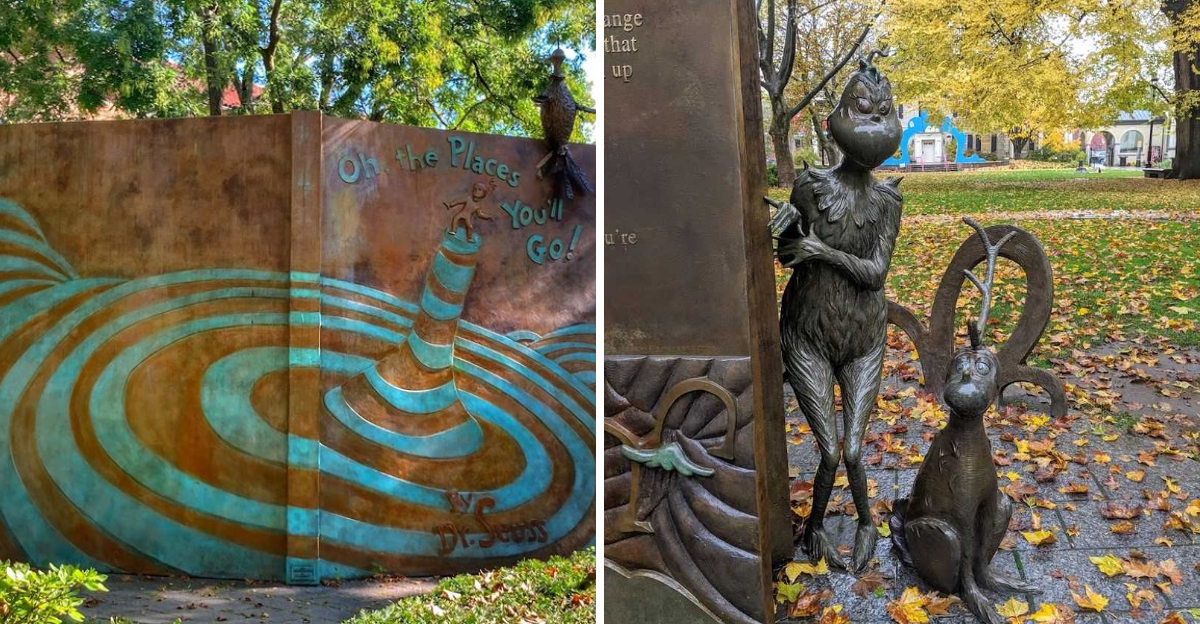
A childhood favorite can feel surprisingly real when the characters suddenly stand taller than you do.
Massachusetts has a playful outdoor spot where familiar faces, storybook shapes, and whimsical sculptures bring a beloved author’s imagination into the open air.
It is free to visit, easy to enjoy, and full of little details that make adults smile just as much as children. One minute you are walking through a regular city setting, and the next you are standing beside figures that feel pulled straight from the pages you remember.
How often does a quiet stroll turn into a trip back to your bookshelf?
For anyone who grew up with rhymes, mischief, and wildly creative characters, this Massachusetts stop feels cheerful, nostalgic, and wonderfully unexpected.
A Free Outdoor Experience Anyone Can Enjoy
Not every great attraction costs money, and this one proves the point with quiet confidence. This garden is completely free to visit, with no ticket required and no reservation needed.
You simply walk in and start exploring.
The garden sits within the Springfield Museums complex, a campus-style setting with shaded walking paths, benches, and open spaces that invite you to slow down.
Families with young children will find the layout easy to navigate, while adults can wander at their own pace without feeling rushed.
Hours run from 9 AM to 8 PM between May and September, and 9 AM to 5 PM from October through April. That extended summer schedule gives evening visitors a chance to see the sculptures in softer light.
Parking is straightforward, and the grounds are well-kept throughout the year.
For anyone planning a day trip through western Massachusetts, this stop requires almost no planning and delivers a surprisingly full experience.
The accessibility alone makes it worth including on any Springfield itinerary.
The Story Behind The Garden And Its Creator
Every great memorial has a personal story behind it, and this one carries an especially meaningful connection.
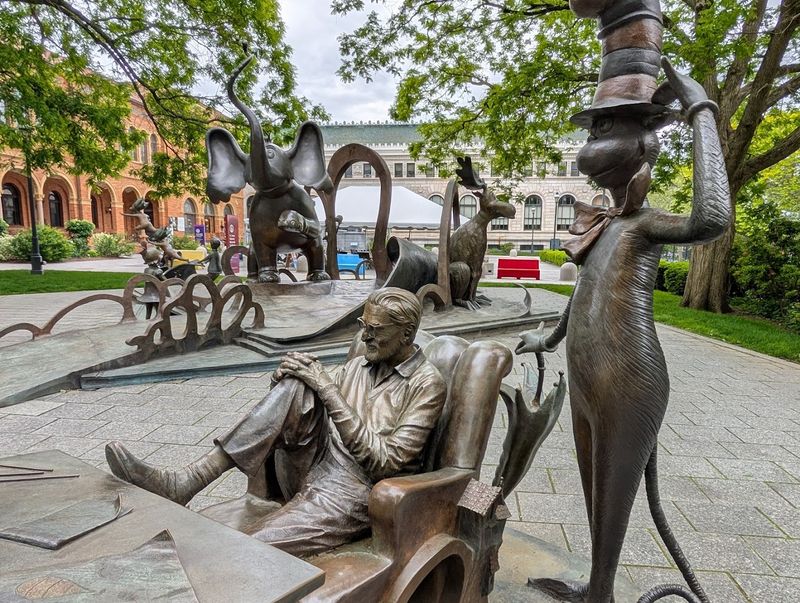
The Dr. Seuss National Memorial Sculpture Garden was designed by Lark Grey Dimond-Cates, the stepdaughter of Theodor Seuss Geisel, the man the world knows as Dr. Seuss.
Her involvement gave the project an emotional depth that goes beyond typical public art.
The garden opened on June 1, 2002, and has welcomed visitors ever since.
Dimond-Cates sculpted each bronze figure with attention to the spirit of the original illustrations, capturing the loose, expressive quality that made Geisel’s drawings so recognizable.
Standing near the sculptures, you can feel how much care went into each one.
Theodor Geisel was born in Springfield in 1904, and his childhood years in the city directly shaped the stories he would later create. His very first children’s book drew inspiration from Mulberry Street, an actual road in Springfield.
The garden honors that local legacy in a way that feels both personal and celebratory. Knowing this history adds a layer of meaning to every sculpture you encounter during your visit.
Over Thirty Bronze Sculptures Fill The Courtyard
Thirty-plus bronze sculptures spread across the garden, and each one brings a different character to life with remarkable detail.
The collection includes some of the most beloved figures from Dr. Seuss’s long career, arranged throughout the courtyard in a way that feels organic rather than museum-rigid.
You turn a corner and there is the Lorax. You look up and spot a tower of turtles.
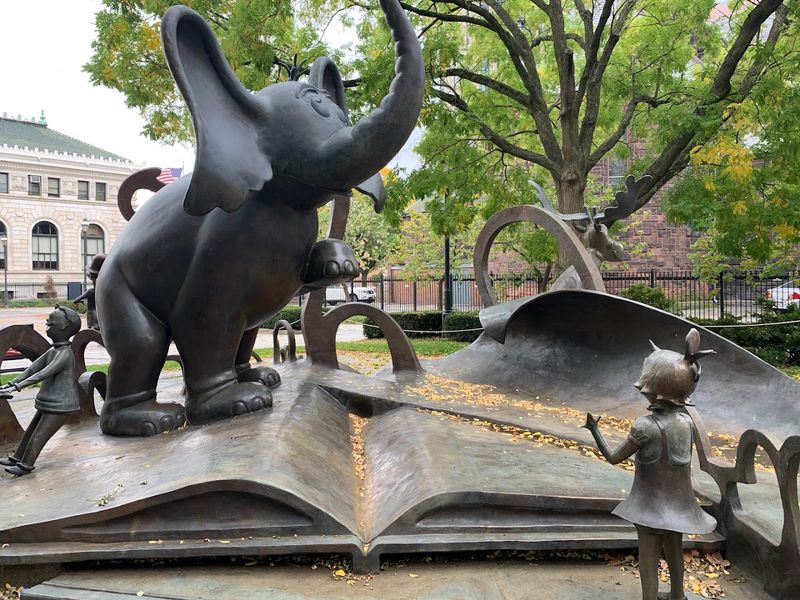
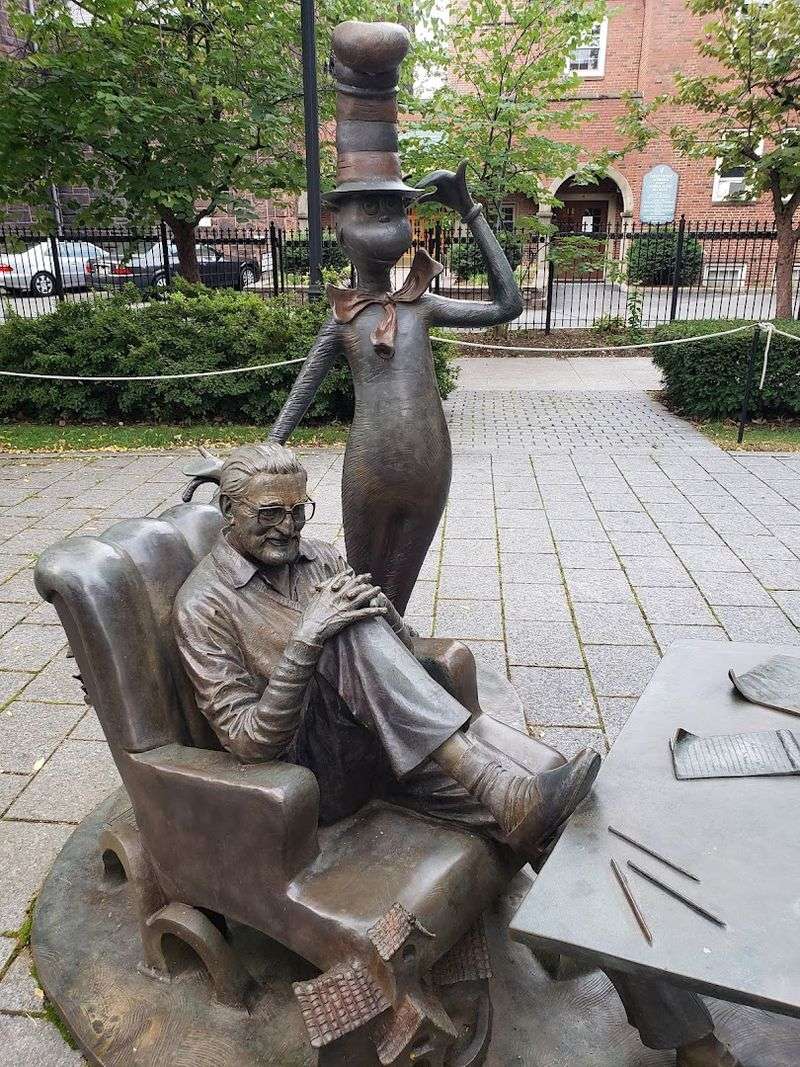
The Cat in the Hat appears alongside Dr. Seuss himself, captured at his desk in a pose that feels both studious and playful. Horton the Elephant steps out from an open book, surrounded by Thing One, Thing Two, Sam-I-Am, Sally, her brother, and Thidwick the Big-Hearted Moose.
Each grouping tells a small story on its own. Children tend to react with immediate excitement when they recognize familiar faces.
Adults, meanwhile, often find themselves reading character names aloud and tracing the details of each figure with genuine appreciation.
The bronze finish gives the sculptures a timeless quality, and the scale of several pieces adds a sense of real presence. A visit here rarely feels like a quick stop.
Most people linger far longer than they originally planned.
The Storyteller Chair And Its Towering Book
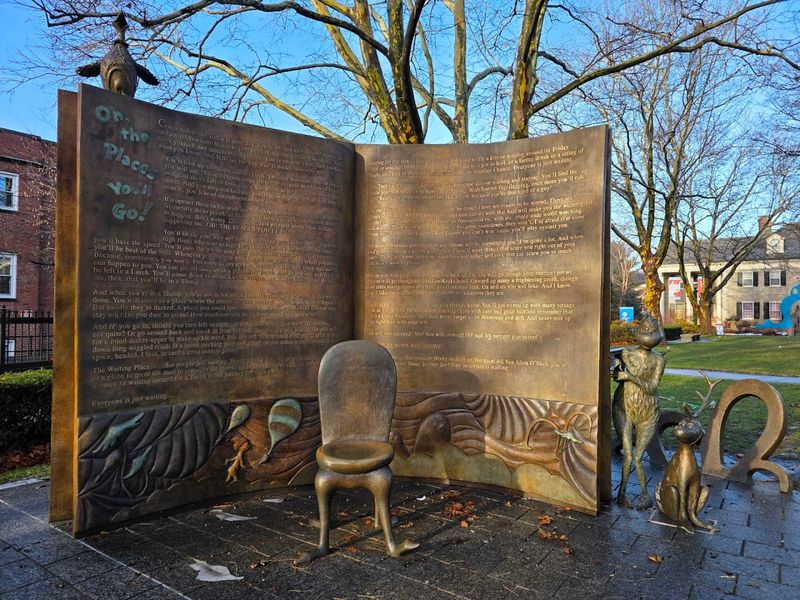
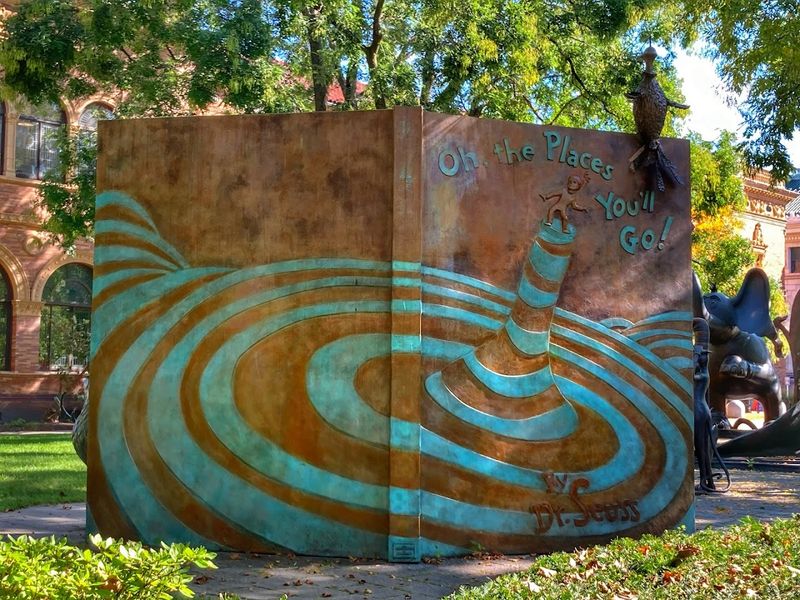
One of the most striking features in the garden is a sculpture called The Storyteller, built around a Seussian chair positioned in front of a 10-foot-tall open book.
The book displays text from “Oh, the Places You’ll Go!”, one of Dr. Seuss’s most quoted works and a perennial favorite at graduation ceremonies around the country.
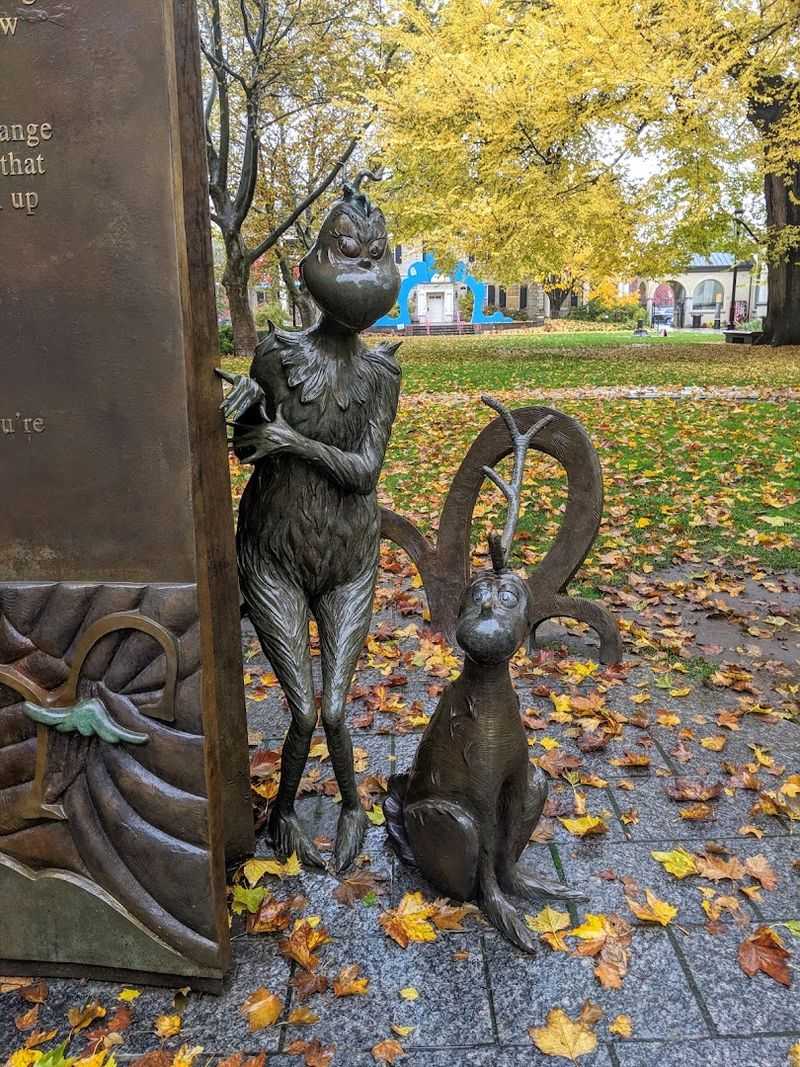
Look closely and you will find Gertrude McFuzz perched at the very top of the book, her single tail feather a small but perfect detail. On the side, the Grinch peers around the edge with his dog Max, adding a touch of mischief to an otherwise uplifting composition.
The whole arrangement rewards patient observation.
Visitors regularly stop here for photographs, and it is easy to understand why.
The chair is large enough to sit beside for a picture, and the surrounding figures create a frame that feels straight out of an illustrated page.
The choice of text from “Oh, the Places You’ll Go!” feels intentional and resonant, especially for anyone who received the book as a gift at a milestone moment in life. It is one of those spots in the garden that lingers in memory well after you leave.
Yertle The Turtle And A Tower Worth Finding
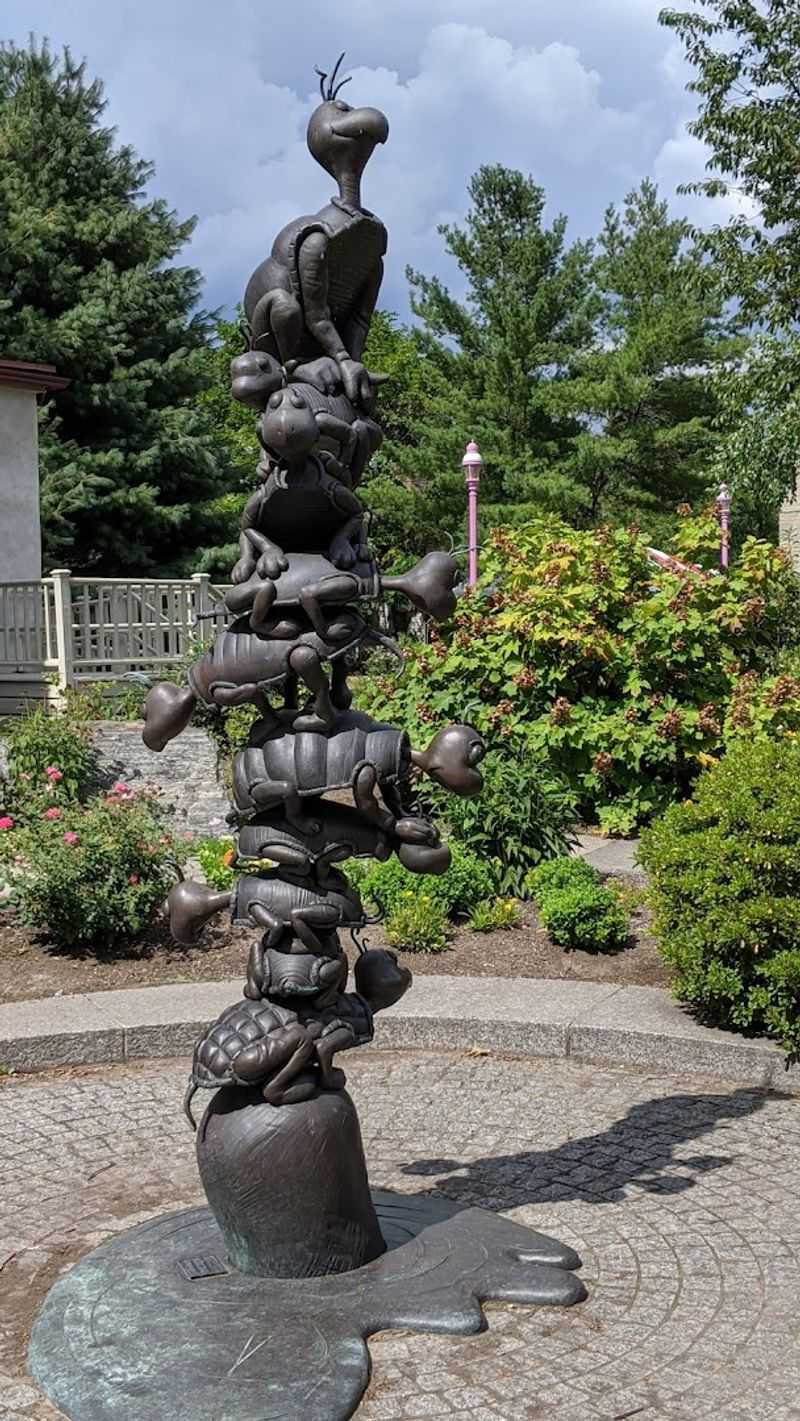
Among the many sculptures scattered through the garden, the Yertle the Turtle tower stands out for its sheer vertical ambition. At 10 feet tall, the stacked bronze turtles rise in a column that captures the absurd logic of the original story perfectly.
Yertle sits at the top, looking out with the self-satisfied expression of a ruler who has not yet learned his lesson.
The story of Yertle the Turtle, published in 1958, is widely read as a commentary on power and arrogance, though Dr. Seuss always let children find their own meaning in the text. The sculpture does the same.
Some kids just see a funny pile of turtles. Others, especially older visitors, read the composition with a knowing smile.
Finding this particular sculpture has become a small tradition among garden visitors, as reviews frequently mention the Yertle tower as a highlight worth seeking out. One visitor wrote about the fun of discovering it as a bonus during a casual walk through the grounds.
The sculpture sits at a scale that makes it impossible to miss once you are nearby, but the garden layout still gives it a sense of surprise. That balance between the obvious and the unexpected runs throughout the entire space.
Horton The Elephant Steps Off The Page
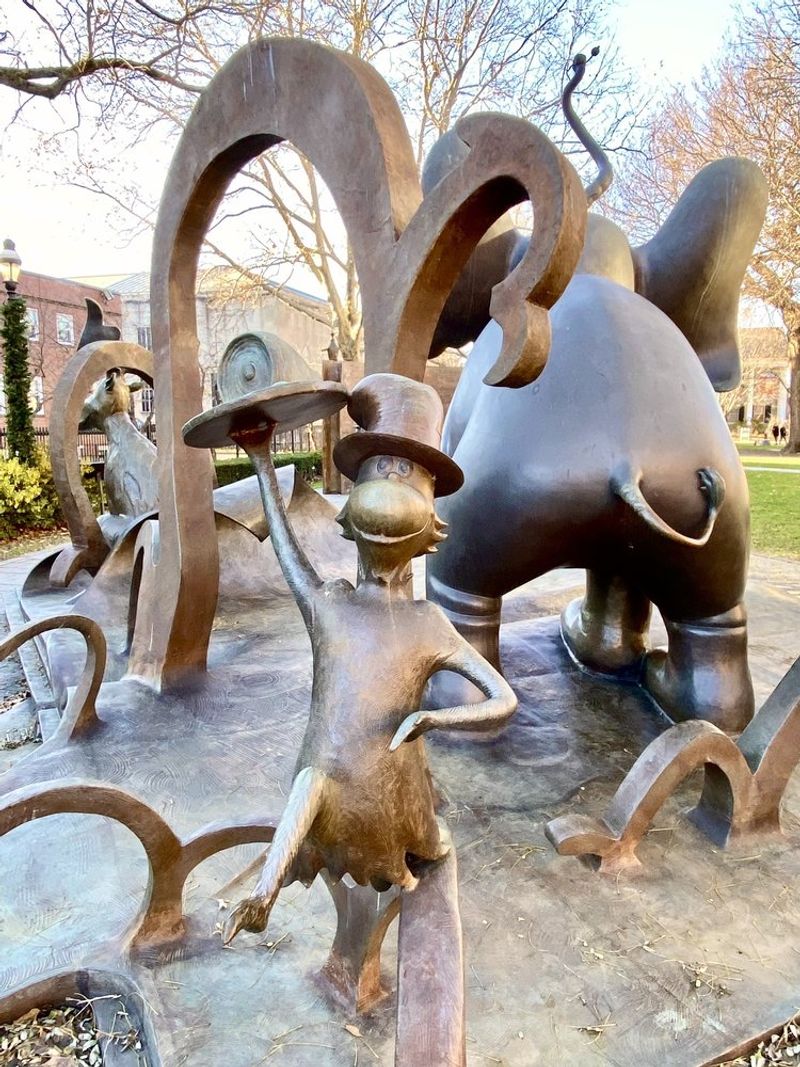
Horton the Elephant has always been one of the most emotionally resonant characters in Dr. Seuss’s catalog, and the sculpture dedicated to him captures that warmth in solid bronze.
He appears to be stepping directly out of an open book, a visual choice that speaks to the power of reading itself.
Around him stand some of the most recognizable figures in children’s literature.
Thing One and Thing Two flank the scene with their characteristic energy, while Sam-I-Am holds his signature plate. Sally and her brother stand nearby, and Thidwick the Big-Hearted Moose adds his considerable presence to the group.
The composition is busy in the best possible way, full of movement and personality without feeling cluttered.
Children who visit with parents who read these books aloud will likely feel an immediate jolt of recognition. The characters are rendered at a scale that feels approachable rather than overwhelming, which encourages kids to walk right up and interact with the sculptures.
Adults tend to spend extra time here, pointing out details and sharing memories of specific stories. The Horton grouping may be the single most photographed section of the entire garden, and it earns that status with every detail Dimond-Cates built into it.
The Lorax Stands Guard On His Stump
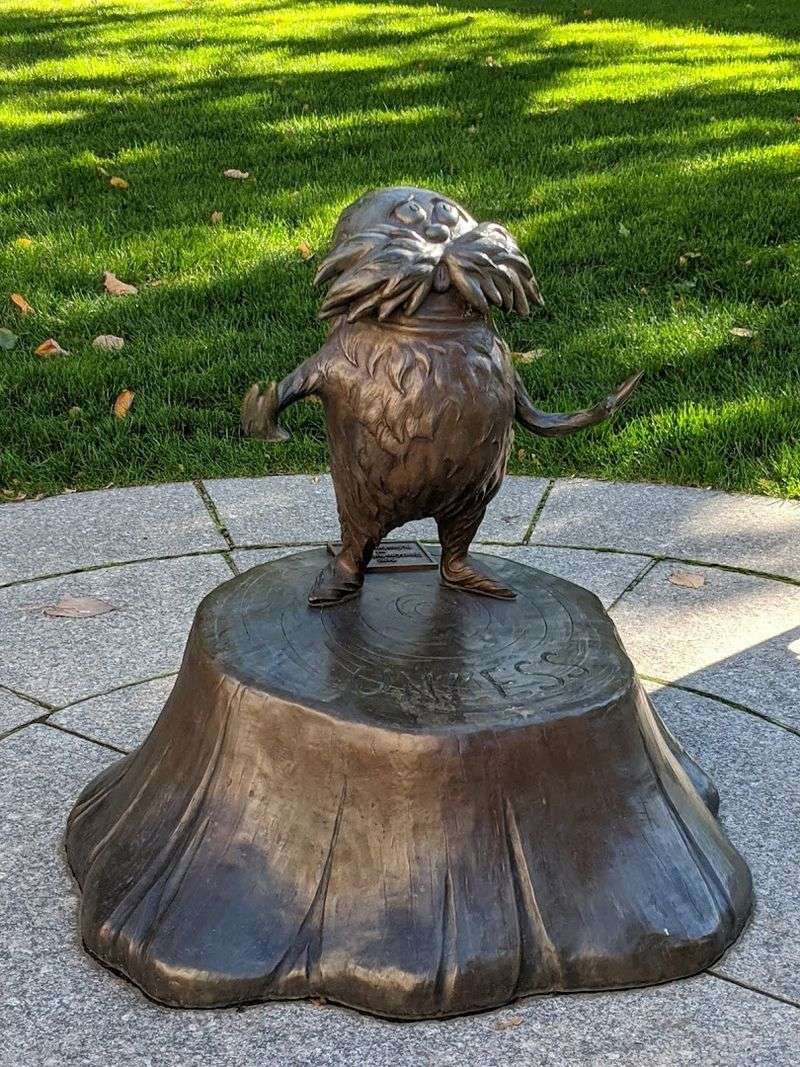
Short in stature but enormous in attitude, the Lorax has always been one of Dr. Seuss’s most purposeful characters. His bronze figure in the garden stands on a tree stump, a detail that carries the full weight of the original story without needing a single word of explanation.
The choice of setting is deliberate and quiet in its impact.
Published in 1971, “The Lorax” carried an environmental message at a time when such themes were only beginning to reach mainstream children’s literature.
Decades later, the character remains relevant, and seeing him rendered in permanent bronze gives the message a kind of dignity.
He is not just a story figure here. He feels like a statement.
Visitors who make the trip specifically to see the Lorax often mention it as a highlight, including one group who timed their visit to Earth Day as a small personal tribute.
The sculpture rewards close observation, with surface details that bring the familiar orange figure to life in three dimensions.
For anyone who grew up hearing “I speak for the trees,” standing next to this sculpture carries a quiet emotional charge that is hard to fully articulate but very easy to feel.
Springfield As The Birthplace Of Dr. Seuss
Springfield, Massachusetts holds a particular place in American cultural history as the city where Theodor Seuss Geisel spent his formative years. Born here in 1904, Geisel absorbed the streets, people, and rhythms of the city before heading out into the wider world.
That early exposure shaped the imagination that would eventually produce some of the most beloved books ever written for children.
His first children’s book, “And to Think That I Saw It on Mulberry Street,” published in 1937, drew directly from a real Springfield road. That connection between place and creativity runs through much of his work, even when the settings become fantastical.
Springfield gave him a foundation, and the garden honors that origin with genuine civic pride. Visiting the city with this background in mind changes how the garden feels.
It stops being just a tourist attraction and becomes something closer to a homecoming, even for visitors who never lived here.
The Springfield Museums complex, where the garden sits, reflects the city’s broader commitment to arts and education. For anyone curious about where great creative work begins, a walk through this courtyard offers a grounded and meaningful answer.
The address, 21 Edwards St, Springfield, MA 01103, is easy to find and well worth the drive.
What Visitors Say About Their Experience

The garden holds a 4.7-star rating across nearly 2,200 reviews, which says a great deal about the consistency of the experience it delivers.
Visitors return again and again, often bringing new people with them, and the reviews reflect a genuine warmth that goes beyond polite appreciation.
People describe feeling like children again, sharing memories with their own kids, and discovering details they missed on previous visits.
One family drove from Connecticut specifically to see the sculptures and described the trip as entirely worthwhile. Another visitor noted that even with just one free hour available, the garden alone provided a satisfying and complete experience.
Several reviewers mentioned the cleanliness of the grounds and the helpfulness of the staff as consistent positives.
A recurring theme across reviews is the emotional resonance of seeing characters from childhood books rendered at full scale in bronze. Phrases like “brought back memories” and “felt like wonder” appear frequently, and they do not read as exaggeration.
The garden seems to activate something genuine in most visitors, regardless of age.
For families especially, it creates a shared moment that connects generations around a set of stories that have remained in print for decades.
That kind of cultural staying power is rare and worth celebrating.
Planning Your Visit To The Sculpture Garden
A visit to the Dr. Seuss National Memorial Sculpture Garden requires very little advance preparation, which is part of its appeal.
The garden is open daily, running from 9 AM to 5 PM year-round according to current hours, with extended evening hours during the warmer months.
No ticket is required, and the space is open to anyone who walks through.
Parking near the Springfield Museums complex is accessible and manageable, even on busier days.
The campus-style layout means you can combine the sculpture garden with a visit to the adjacent Amazing World of Dr. Seuss Museum, which opened in 2017.
On the first Wednesday of each month, admission to the surrounding museums is also free.
Bringing a lunch and settling on one of the benches inside the courtyard is a genuinely pleasant way to spend an afternoon. The tree-lined paths provide shade, and the overall atmosphere is calm without being dull.
For anyone who carries a fondness for the books that shaped their early reading life, this garden offers something that very few free attractions manage to provide: a reason to stay longer than expected.