
You Don’t Need A Ticket To Have The Time Of Your Life In Seattle, Washington This World Cup Summer
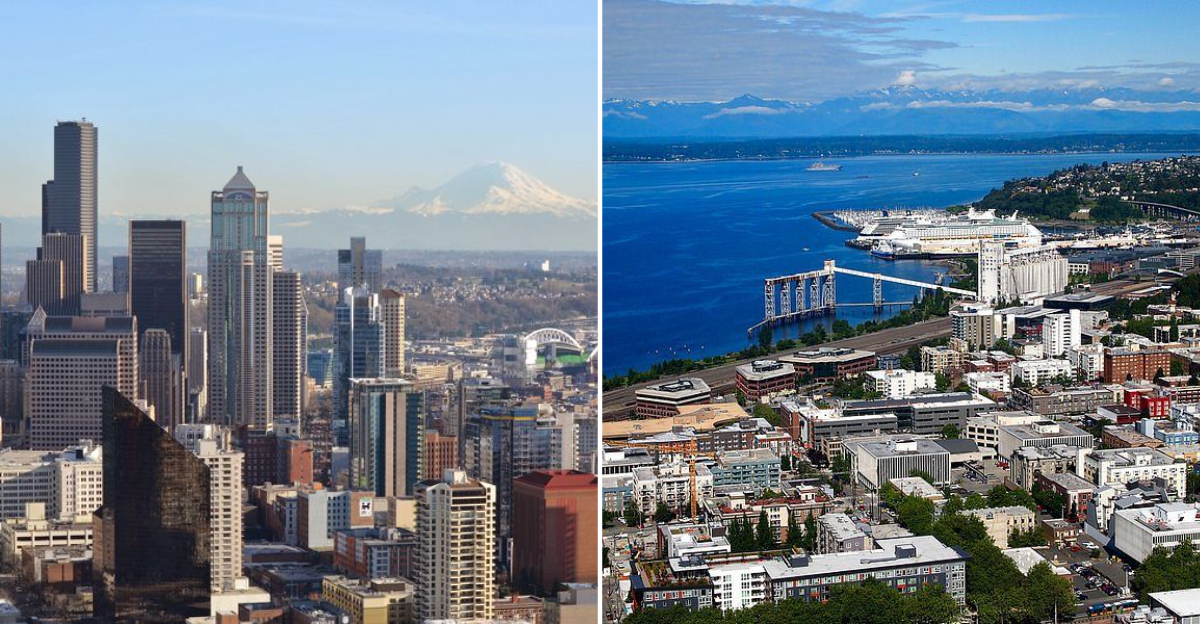
The stadium holds tens of thousands. The city holds everyone else, and it made sure they wouldn’t feel like they missed out.
Seattle built a World Cup summer that runs parallel to the ticketed version and doesn’t apologize for the comparison. Washington state doesn’t host events at this scale without taking the surrounding experience seriously.
Free watch parties fill plazas that don’t usually operate at this volume. Waterfront activations turn familiar stretches of the city into something that feels purpose built for this specific summer.
Neighborhood celebrations run their own program entirely, disconnected from the official schedule and better for it. The fans who couldn’t get tickets made plans anyway.
Those plans are turning out to be worth making, and in some cases worth more than the alternative. A stadium seat delivers the match.
The city delivers everything surrounding it, and that radius turns out to be considerably larger than anyone mapped out in advance. Some of the best World Cup memories this summer won’t involve a seat inside any venue.
Seattle understood that early and built accordingly, and the result is a city that feels like the tournament belongs to everyone who showed up for it.
1. Kerry Park
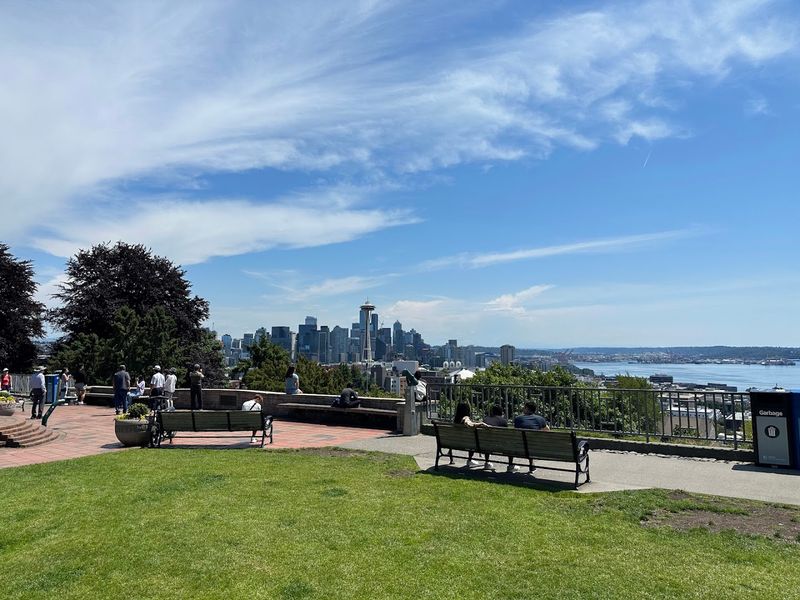
Some viewpoints exist on maps, and some exist in the actual memory of everyone who has stood there. Kerry Park belongs to the second category.
This small hilltop park on Queen Anne Hill delivers what is widely considered the definitive view of Seattle. The skyline, Space Needle, Elliott Bay, and Mount Rainier align in one iconic view that has drawn photographers and visitors for decades.
The view sits at exactly the right elevation on exactly the right slope to make everything visible at once.
The space itself is modest. A narrow strip of grass and paved walkway with a low wall that serves as the natural gathering point for anyone facing south toward the city.
No admission, no ticketing, no infrastructure beyond the basics. The view does all the work.
Morning visits reward early risers with softer light and smaller crowds. Serious photographers arrive before sunrise because the golden hour framing of the skyline produces results that midday light cannot replicate.
Sunset brings a different energy. The western sky behind the Olympic Mountains catches color that reflects off Elliott Bay and frames the Space Needle in a way that stops people mid-sentence.
Mount Rainier changes the calculation entirely when it decides to appear. The volcano dominates the background of the skyline on clear days in a way that reminds everyone exactly where they are standing.
From Kerry Park, the reason Seattle residents track Rainier sightings with such enthusiasm becomes immediately obvious.
The park was donated to the city by Albert Kerry in 1927. Nearly a century later the gift continues paying returns that no municipal budget could have purchased outright.
Find it at 211 W Highland Dr, Seattle, WA 98119.
2. Seattle Center
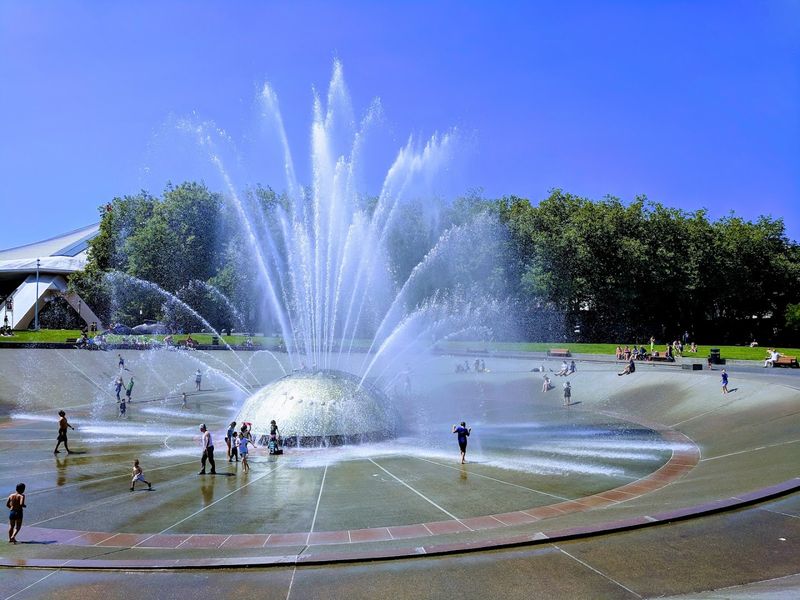
Few urban campuses carry this much variety without losing coherence. Seattle Center manages the balance in a way that makes it worth more than a single visit.
The 74-acre campus sits just north of downtown and houses a range of cultural institutions, performance venues, and public spaces that serve the city across every season.
It was built for the 1962 World’s Fair, and the bones of that original vision are still visible in the layout and several of the remaining structures.
The Space Needle defines the skyline from this address, but it is far from the only reason to spend time here. The Museum of Pop Culture sits on the same grounds, its Frank Gehry-designed exterior announcing itself before anyone reaches the entrance.
Chihuly Garden and Glass occupies another corner with a permanent collection that uses the Space Needle as an unlikely backdrop for Dale Chihuly’s large-scale glass work.
McCaw Hall brings opera and ballet to the campus on a regular performance schedule. The Seattle Repertory Theatre operates nearby.
On any given weekend, the grounds host festivals, outdoor performances, and community events that draw locals rather than exclusively tourists.
The International Fountain at the center of the campus has been a gathering point since the World’s Fair. Families with children treat it as a destination in itself during the summer months.
The surrounding lawn fills up on warm days with the kind of unhurried crowd that public space is designed to accommodate.
Seattle Center functions as a genuine civic resource rather than a tourist overlay. That distinction shows in who uses it and how often they return.
Visit at 305 Harrison St, Seattle, WA 98109.
3. Mural Amphitheatre At Seattle Center
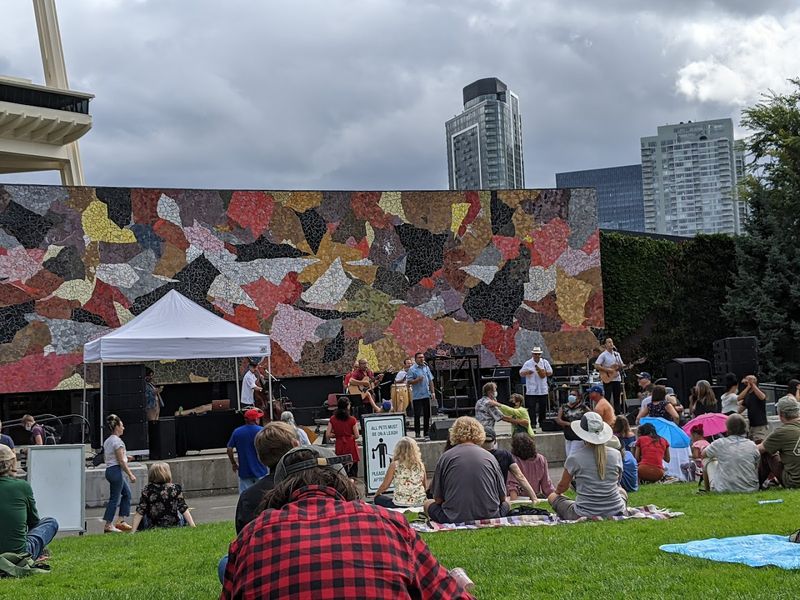
Outdoor performance spaces succeed or fail based on atmosphere more than infrastructure. Mural Amphitheatre succeeds on both counts.
Located within Seattle Center, this open-air venue has been hosting concerts, festivals, and community events since the 1962 World’s Fair grounds were established. The stage faces a generous lawn that fills naturally depending on the size of the event.
No assigned seating, no rigid format. The space adapts to what it is being asked to hold.
Summer is when the amphitheatre operates at full capacity. Concerts run across genres without committing to a single curatorial identity.
Folk, world music, local acts, and larger touring performers have all shared the same stage across different seasons. That range keeps the programming calendar worth following regardless of specific taste.
Bumbershoot, Seattle’s long-running music and arts festival, has historically used this venue as one of its primary stages.
The festival draws large crowds, while the amphitheatre retains its open-air feel.
The surrounding Seattle Center campus adds context to any visit here. Arriving early means access to the broader grounds before the show starts.
The combination of outdoor performance and walkable cultural institutions in the same footprint is genuinely difficult to find in most American cities.
Free events appear on the calendar regularly throughout the summer months. Community programming that does not require a ticket makes the space accessible in a way that reinforces its role as a civic venue rather than purely a commercial one.
Find it at 305 Harrison St, Seattle, WA 98109.
4. Fisher Pavilion
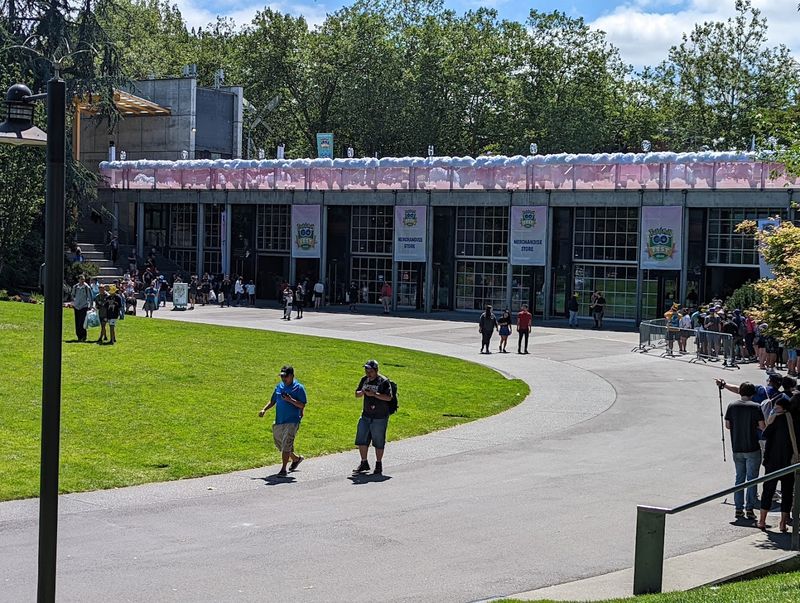
Flexible event spaces are only as good as the programming that fills them. Fisher Pavilion earns its place on the Seattle Center campus by attracting events worth showing up for.
The pavilion sits at the western edge of Seattle Center with a terrace that opens toward the International Fountain and the broader campus grounds.
The indoor and outdoor combination gives event organizers genuine options that a purely enclosed venue cannot offer.
That flexibility shows in the variety of events the space attracts across any given year.
Home shows, cultural festivals, community gatherings, and specialty markets have all run through here. The square footage handles large-scale setups without feeling cavernous when smaller events occupy the same floor.
That range makes it a practical choice for organizers working across different scales and formats.
The terrace becomes its own destination during summer programming. Views across the fountain plaza and toward the Space Needle give the outdoor portion of the pavilion a backdrop that purpose-built event spaces spend considerable money trying to manufacture.
Here it comes with the address.
Seattle Center’s calendar drives consistent foot traffic past Fisher Pavilion regardless of what is scheduled inside on any particular day.
That built-in audience from the broader campus benefits every event that sets up here in a way that standalone venues in other parts of the city cannot replicate.
The pavilion also serves a quieter function between major events. The terrace remains accessible as a public space even when nothing is scheduled inside.
Locals cut through on their way across the campus, sit along the fountain edge, and use the outdoor area in the casual way that good public infrastructure invites without demanding.
Checking the Seattle Center events calendar before visiting is worth the effort. The pavilion’s programming shifts frequently enough that what is running during one visit has no bearing on what fills the space a month later.
Find it at 305 Harrison St, Seattle, WA 98109.
5. Gas Works Park
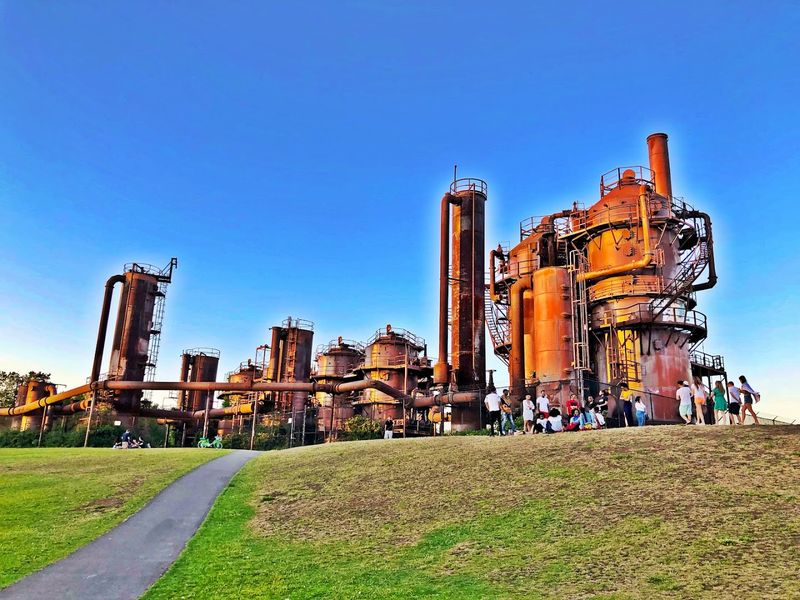
Industrial ruins do not typically become beloved public parks. Gas Works Park in Washington is the exception that makes that assumption worth revisiting.
The site operated as a gasification plant from 1906 until 1956, converting coal into gas for the city’s energy needs.
When the plant shut down, what remained was a contaminated lakefront property covered in rusting machinery that most cities would have demolished without a second thought.
Seattle kept the structures and built a park around them.
Landscape architect Richard Haag’s decision to preserve the industrial remnants rather than erase them produced something genuinely singular.
The towers and processing structures that remain on site are not reconstructions or decorative references. They are the actual equipment, weathered and repurposed into the defining visual feature of the park.
The hill at the center of the park is the highest point on the Lake Union shoreline, and the view from the top earns the climb.
Downtown Seattle, the Space Needle, and the lake itself all sit within a single sightline that photographers and casual visitors have been returning to for decades.
Kite flying has become one of the park’s unofficial traditions. The hilltop catches consistent wind, and the open grass provides enough space that multiple kites can operate simultaneously without conflict.
Weekend afternoons in summer produce a skyline of kites above the hill that has become part of the park’s visual identity.
The lakefront path draws cyclists, joggers, and anyone who wants to move along the water without leaving the city. Kayak and paddleboard rentals operate nearby, making the park a natural starting point for time on Lake Union.
Gas Works Park works because it did not try to become something other than what the site already was. That honesty is exactly what makes it worth the trip.
The address is 2101 N Northlake Way, Seattle, WA 98103.
6. Westlake Park
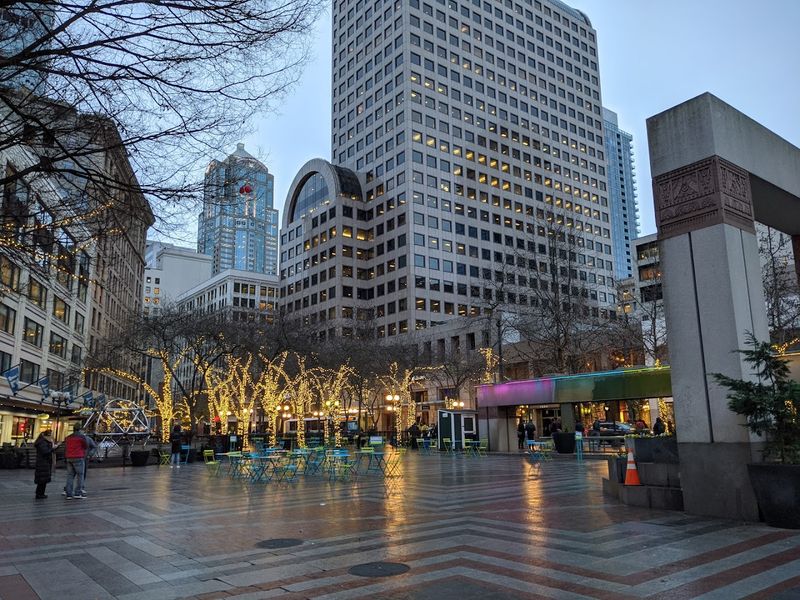
Downtown parks earn their place by serving the people who actually use them daily, not just those passing through. Westlake Park holds its ground in the middle of one of Seattle’s busiest commercial corridors.
The park sits at the intersection of Pine Street and Fourth Avenue, surrounded by retail, transit, and the kind of foot traffic that downtown Seattle generates on any given weekday. That location makes it less a destination and more a civic pressure valve.
A place where the city slows down briefly before continuing at its usual pace.
The brick plaza and tiered seating accommodate the full range of downtown activity without favoring any particular use. Office workers eat lunch on the steps.
Street performers claim the open space when the crowds justify it. Protesters have gathered here for decades because the location and visibility make it a natural assembly point.
The park absorbs all of it without losing function.
Holiday programming transforms the space seasonally. The Christmas tree lighting draws significant crowds each year, and the surrounding retail district amplifies the energy in a way that feels genuinely communal rather than purely commercial.
Winter markets and seasonal installations have made Westlake a recurring destination for visitors during the colder months.
The Monorail station at the northern edge of the park connects directly to Seattle Center, which makes Westlake a practical transit node as much as a public space.
Visitors moving between downtown and the Space Needle pass through here naturally, and the park benefits from that constant circulation.
Public art installations appear throughout the plaza and shift periodically. The rotating presence of commissioned work gives regular visitors reason to look up rather than simply pass through on autopilot.
Point your navigation to 401 Pine St, Seattle, WA 98101.