
This Arizona Town Has An Advanced Healthcare System That Ranks Among The Best In The Country

I once read something at a hospital entrance that stayed with me: health isn’t everything, but without it, everything else is nothing. Waiting rooms have a way of making time feel endless.
Most people spend that time feeling nervous. I spent mine thinking about those words instead.
This Arizona town seems to understand that idea deeply. It’s home to a healthcare system that ranks among the best in the country.
Facilities here invest heavily in both technology and staff training. That combination shows up clearly in patient outcomes.
Residents rarely need to travel elsewhere for specialized care, something smaller towns often struggle to offer locally. Wait times stay shorter than national averages, another detail that sets the system apart.
This town proved that excellent healthcare doesn’t require a major city to achieve national recognition.
A Leader In Arizona’s Healthcare Landscape

Second place in an entire state is nothing to shrug at, especially when the competition is this strong. HonorHealth Scottsdale Shea Medical Center earned that spot in U.S.
News & World Report rankings, and it didn’t happen by accident.
The list of services here is extensive and reads like a full medical encyclopedia. Cardiology, orthopedics, neurology, oncology, plus women’s services and labor and delivery all operate under the same umbrella.
What makes the Shea campus interesting is how much sits on one property. HonorHealth Cancer Care handles treatment plans, the Virginia G.
Piper Surgery Center manages procedures, and the HonorHealth Research Institute works on studies that push treatment forward.
For patients, that layout means fewer scattered appointments across town. A cardiology consult and a follow-up scan can happen without a long drive in between, which matters more than people realize when they are not feeling well.
Doctors here handle everything from routine deliveries to complicated brain and spine cases. The range is wide enough that families often end up using the same campus across decades and generations.
Anyone researching hospitals in the Phoenix area will run into this name fast. It has become a reference point for what strong regional care looks like in the Sonoran Desert.
You can find HonorHealth Scottsdale Shea Medical Center at 9003 E. Shea Blvd., Scottsdale, AZ 85260.
Mayo Clinic’s Desert Oasis Of Excellence
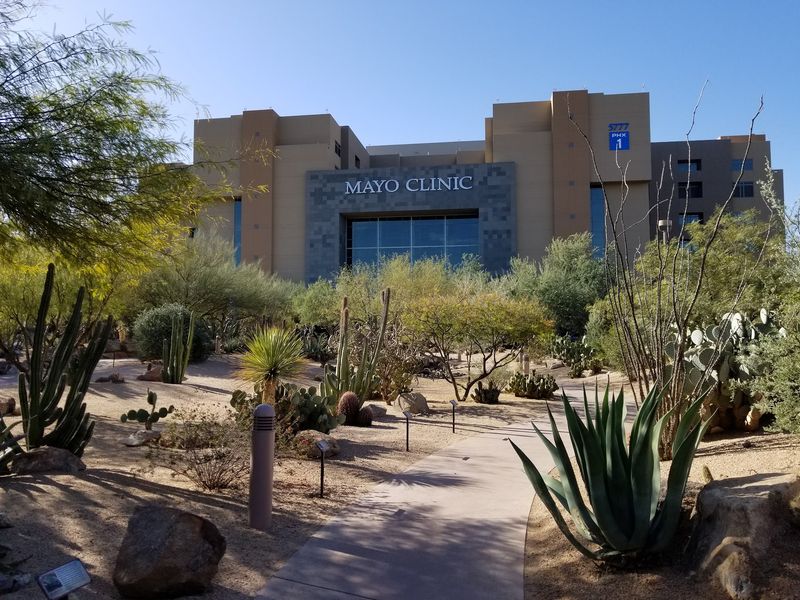
Fourteen years in a row at number one. That is the streak Mayo Clinic in Arizona holds as the top hospital in both the state and the Phoenix metro area, and streaks like that tell you something about consistency.
More than 65 medical and surgical specialties operate across the Scottsdale and Phoenix campuses. Organ transplantation, cancer treatment, neurology, and cardiology are among the programs that draw patients from far outside Arizona.
Here is the part that catches people off guard. The campus includes quiet walking paths and meditation gardens, which is an unusual feature for a place doing transplant surgery.
That design choice is not decoration for its own sake. Recovery involves more than medication, and having somewhere calm to sit while waiting on news makes a genuinely hard day slightly easier.
Care at Mayo is built around teams rather than single doctors working alone. A patient with a complex diagnosis might have specialists from three departments comparing notes in the same conversation.
That integrated approach is a big reason the reputation traveled well beyond the Southwest. People book flights specifically to be seen here, then discover they landed in a city surrounded by cactus-covered hills.
Sunshine and world-class medicine make an odd pairing on paper. In Scottsdale, it somehow works out perfectly.
Pioneering Medical Innovation Behind The Scenes

Great hospitals treat patients. The really ambitious ones also spend their time inventing what comes next, and that second job is alive and well in Scottsdale.
Mayo Clinic teamed up with Arizona State University to create dual degree programs through its Alix School of Medicine. Students dig into healthcare delivery, health informatics, and biomedical diagnosis alongside traditional medical training.
Translation for the rest of us: future doctors here learn how to fix systems, not just people. That skill set changes how a whole hospital runs down the road.
Then there is the Center for Procedural Innovation, a 4,000-square-foot bioskills training facility on the Scottsdale campus. Surgeons practice new techniques there using advanced surgical technology before those methods ever reach a real operating room.
Think of it as a flight simulator, except for scalpels and scopes. Mistakes made in that room cost nothing but time, which is exactly the point.
Research, teaching, and hands-on practice all share the same address, so ideas move quickly from concept to bedside. A technique refined on a Tuesday morning might help someone months later.
Cities do not usually become innovation hubs by accident. Scottsdale got there by giving smart people space, equipment, and permission to experiment with better ways of doing difficult things.
Specialized Cancer Care Through A Powerful Partnership

Getting a cancer diagnosis is hard enough without adding a plane ticket to the process. That is the problem Banner Health is working to solve in Scottsdale.
One of the largest nonprofit health systems in the country, Banner is expanding its Scottsdale medical campus to include a comprehensive cancer center. The project is happening in collaboration with MD Anderson Cancer Center.
MD Anderson lands near the top of national cancer care rankings almost every year. Having that name attached to a local facility changes the math for families in the area.
Instead of traveling out of state for advanced treatment, patients can access specialized therapies and clinical research much closer to their own kitchen table. Recovery goes better when you sleep in your own bed.
Cancer treatment often stretches across months of appointments, scans, and infusions. Cutting the travel out of that schedule saves energy that patients need for other things.
The partnership also brings research opportunities along with it. Trials and newer treatment approaches tend to follow institutions with this kind of track record.
For a desert city already loaded with medical talent, adding a heavyweight cancer program is a serious upgrade. It is the sort of investment residents may not think about until the day they truly need it.
Comprehensive Rehabilitation And Recovery Suites

Leaving the hospital is a milestone. Going straight home, however, is not always realistic, and that gap is where Advanced Health Care of Scottsdale steps in.
The facility focuses on short-term nursing and rehabilitation, with private suites and nursing staff available around the clock. Every recovery plan is built for the individual rather than pulled off a shelf.
Physical, occupational, and speech therapy are all offered on site. Wound care plus cardiac and orthopedic recovery programs round out the services.
Someone recovering from a knee replacement needs different work than a stroke patient relearning speech. Having both handled in one building keeps the process organized and far less stressful for families.
Comfort is treated as part of the treatment, not a bonus. The atmosphere leans upscale, which helps when the work of rehab feels frustrating on day nine.
The goal throughout is independence. Therapists aim to get patients strong enough to handle stairs, showers, groceries, and everything else normal life requires.
Recovery rarely follows a straight line, and a rushed discharge can undo weeks of progress. Bridging that middle stage properly is one of the most underrated pieces of good healthcare.
Scottsdale figured that out early, and patients benefit from the extra attention.
Network Of Coordinated Care Across The Valley
Ever had one doctor ask a question your other doctor already answered? Innovation Care Partners exists largely to stop that from happening.
ICP began as a joint venture between Scottsdale Healthcare Hospitals, now known as HonorHealth, and the Scottsdale Physician Organization. The idea was straightforward: connect physicians so patient information actually travels with the patient.
Today the network includes more than 2,400 physician members working across nine hospitals in the Phoenix area. That is a lot of people sharing the same playbook.
Coordinated care sounds like industry jargon until you live it. It means fewer repeated tests, faster referrals, and specialists who already know your history before you sit down.
Reducing unnecessary healthcare spending is part of the mission too. Duplicate imaging and avoidable hospital stays add up fast for everyone involved.
Primary care doctors, surgeons, and specialists inside the network can flag concerns early instead of waiting for a small problem to become an emergency room visit. Prevention is cheaper and considerably less scary.
What makes ICP notable is that competing interests chose cooperation instead. Hospitals and independent physicians decided the patient experience mattered more than turf.
For Scottsdale residents, the payoff is a system that feels connected rather than scattered across a dozen unrelated offices.
Focus On Research And Development

Behind the exam rooms and waiting areas, a quieter operation runs on grant money and stubborn curiosity. Greater Phoenix, Scottsdale very much included, has become a real player in healthcare research and development.
Public officials and private companies in the region have made advancing medical innovation a shared priority. That coordination is unusual, and it shows up in results.
The area has attracted multiple healthcare-related grants, which fund the unglamorous early work that eventually turns into treatments. Discoveries do not appear out of nowhere.
Major employers here dedicate resources to developing new therapies and better diagnostic methods. Catching disease earlier often matters more than treating it aggressively later.
Research money also brings people. Scientists, lab technicians, engineers, and clinical trial coordinators all move in, and their expertise raises the ceiling for everyone.
Patients gain access to clinical trials they might otherwise never hear about. For someone with a rare condition, a nearby trial can be the difference between waiting and acting.
Fun detail worth knowing: a big share of medical breakthroughs come from regions where hospitals and universities sit close enough to argue over lunch. Scottsdale and its neighbors have exactly that setup.
Sunshine, cacti, and serious laboratory work. Not the combination most people expect.
Community-Oriented Health Initiatives Close To Home

The best healthcare system in the world is useless if getting an appointment takes three months. Scottsdale’s providers seem to understand that basic truth.
Banner Health puts real emphasis on giving people choices, from walk-in urgent care to fully integrated medical services. Different problems call for different doors.
A sprained ankle on a Saturday hike does not require a major hospital. Having urgent care nearby keeps emergency departments free for actual emergencies.
Because so many top-tier facilities operate in the same city, residents can find primary care, specialists, imaging, therapy, and follow-up support without leaving town. Convenience adds up over a lifetime.
Retirees, young families, and weekend athletes all live here, and their needs barely overlap. The variety of options reflects that mixed population.
Health systems in Scottsdale also work to stay woven into daily community life rather than sitting apart from it. Outreach, education, and accessible services are treated as part of the job.
Put it all together, and a pattern emerges. This is a city that decided well-being deserved the same attention as its golf courses and art galleries.
Which explains why people keep showing up for the sunshine and quietly stay for the doctors.