
Pull Over For 6 Oversized Ohio Landmarks, Including A 7-Story Picnic Basket
Some of the best stops in Ohio are the ones nobody plans for. You’re halfway through a long drive, half-thinking about lunch, and then something enormous appears on the shoulder of the road that makes zero sense at highway speed.
A giant stamp. A field of concrete corn.
A building shaped like a picnic basket big enough to hold a small neighborhood. Here are six of the state’s most gloriously supersized landmarks, all of them worth tapping the brakes for.
1. Longaberger Basket, Newark, OH
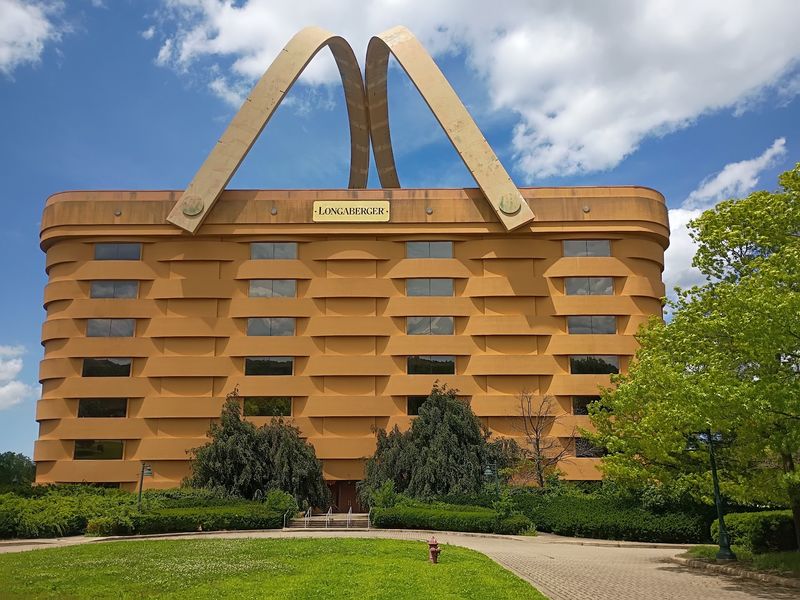
Seven stories of woven-looking concrete and stucco, two handles arching 150 tons over a glass roof, and a footprint of 180,000 square feet. The Longaberger Basket in Newark isn’t a sculpture or a sign.
It’s an actual office building shaped like the company’s best-selling Medium Market Basket, scaled up roughly 160 times.
Longaberger built it in 1997 as corporate headquarters for a business that handcrafted maple wood baskets and hit a billion dollars in sales by 2000. Inside were glass elevators, cherry-wood finishes, and a 30,000-square-foot atrium.
Fun detail: the handles contain heating elements so ice can’t form and drop onto the glass below.
Employees moved out in 2016, and the property has changed hands since. Visitors today do exactly one thing here, and it’s enough: park along East Main Street and walk the perimeter with a camera.
There’s no restaurant and no restroom on site, so plan accordingly.
If you grew up around Longaberger baskets, the scale hits differently. If you didn’t, it’s still one of the most photographed buildings in the state, and you’ll understand why in about four seconds.
2. World’s Largest Cuckoo Clock, Sugarcreek, OH
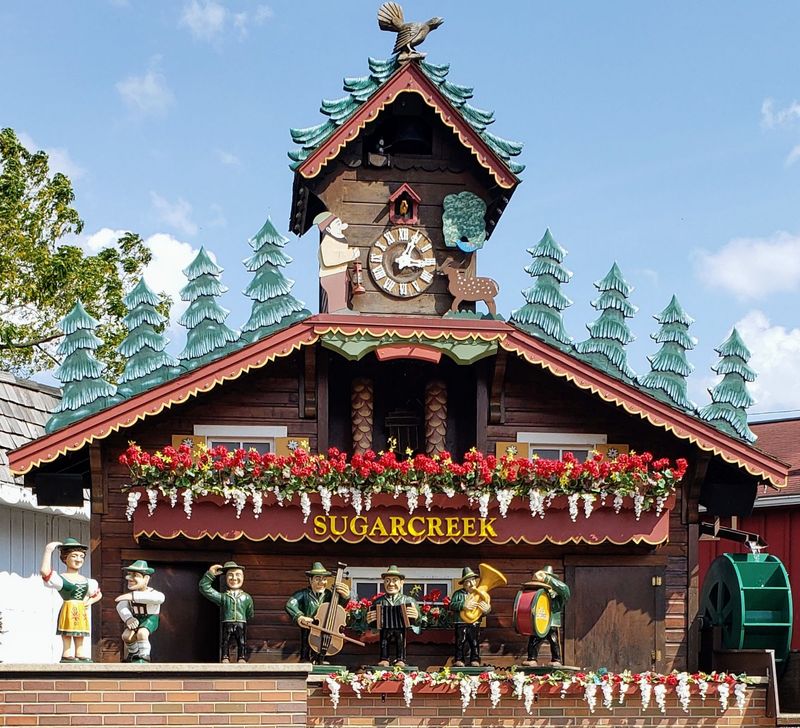
Every hour and half hour in downtown Sugarcreek, a little door swings open and a band of carved dancers rolls out to play polka music. Then they tuck themselves back inside.
The clock they live in stands 23 feet tall and 24 feet wide, which makes it the largest cuckoo clock on the planet.
Sugarcreek sits in the heart of Ohio’s Amish country, and the clock fits the town’s Swiss heritage perfectly. A small garden with benches wraps around the base, so you can settle in and wait for the show instead of hovering awkwardly on the sidewalk.
Timing matters here. Arrive on the :00 or the :30, or you’ll be looking at a very large closed door.
Hours run 9 AM to 9 PM daily, and the clock takes a winter break, so check ahead in cold months.
Practically speaking, it’s an easy stop: free parking lot, free street parking, restrooms and a restaurant nearby, and plenty for kids to watch. Saturday afternoons draw the biggest crowds, while Sundays stay noticeably calmer.
3. Free Stamp, Cleveland, OH
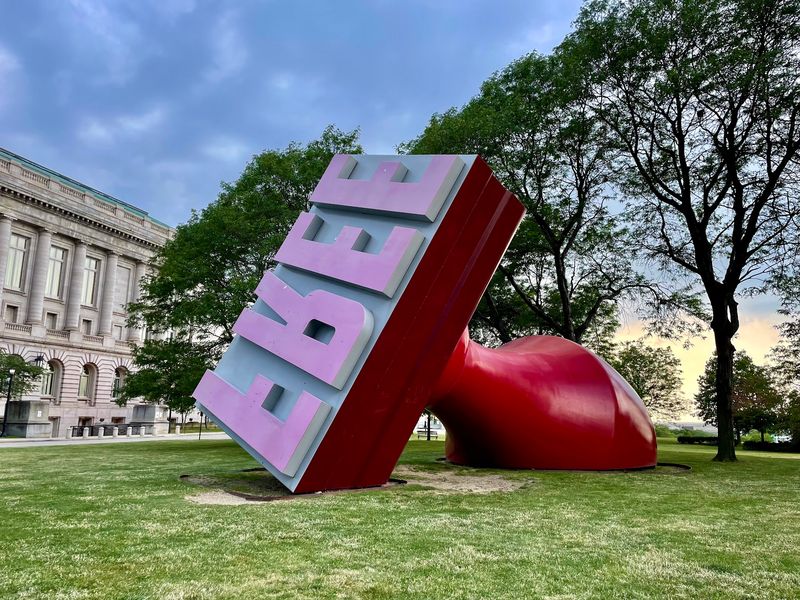
Tipped on its side in Willard Park, a rubber hand stamp the size of a small house presses the word FREE into the grass. Claes Oldenburg and Coosje van Bruggen made it, and it’s arguably the most argued-about piece of public art in Cleveland.
The location puts it within an easy walk of the Rock and Roll Hall of Fame and right beside City Hall, which gives the whole thing a nice bit of civic mischief. Because the sculpture lies on its side, the raised letters face outward instead of down, so the word is legible from across the lawn.
What makes the stop work is how frictionless it is. The park is open 24 hours, admission costs nothing, and the sculpture is huge enough to photograph from just about any angle without waiting your turn.
Saturday afternoons see the most foot traffic; early Sunday mornings are practically empty.
Give it five minutes or twenty, depending on how much you enjoy debating what an eight-ton stamp is supposed to mean. Either way, downtown Cleveland is right there when you’re done.
4. Field of Corn, Dublin, OH
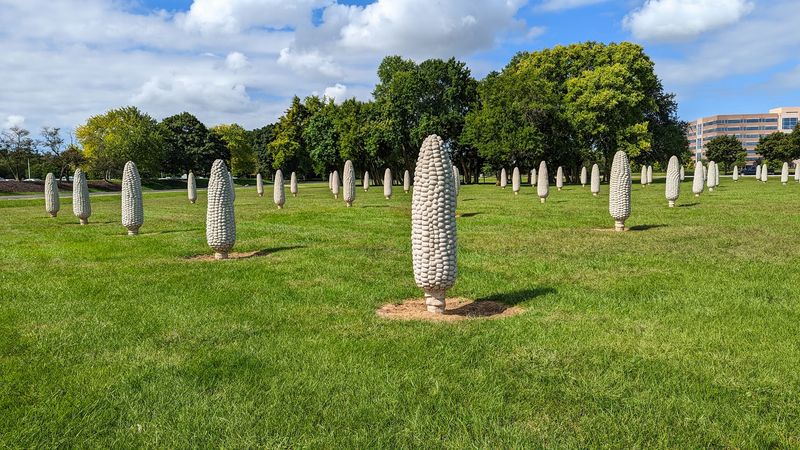
Locals call it Cornhenge, and the nickname sticks for good reason. Standing in neat agricultural rows across a green field in Dublin are 109 ears of corn cast in white architectural concrete, each about six feet tall and weighing 1,500 pounds apiece.
Artist Malcolm Cochran, a sculpture professor at Ohio State, dedicated the installation in 1994 on land that had genuinely been farmland. It honors Sam Frantz, a local farmer who helped pioneer hybrid corn seed development, and it nods to the broader agricultural history of central Ohio, from Wyandot cultivation through generations of area farmers.
Placards on site fill in that story.
Osage orange trees line the edges, benches sit along the paths, and the grounds stay tidy and open 24 hours. Free street parking on Rings Road means you can be out of the car and among the corn in under a minute.
Photographers love it because the rows create long, strange sightlines, especially in low afternoon light. Weekday and Saturday afternoons bring the most visitors; Monday nights are about as quiet as a field of concrete corn can get.
5. Gavel Sculpture, Columbus, OH
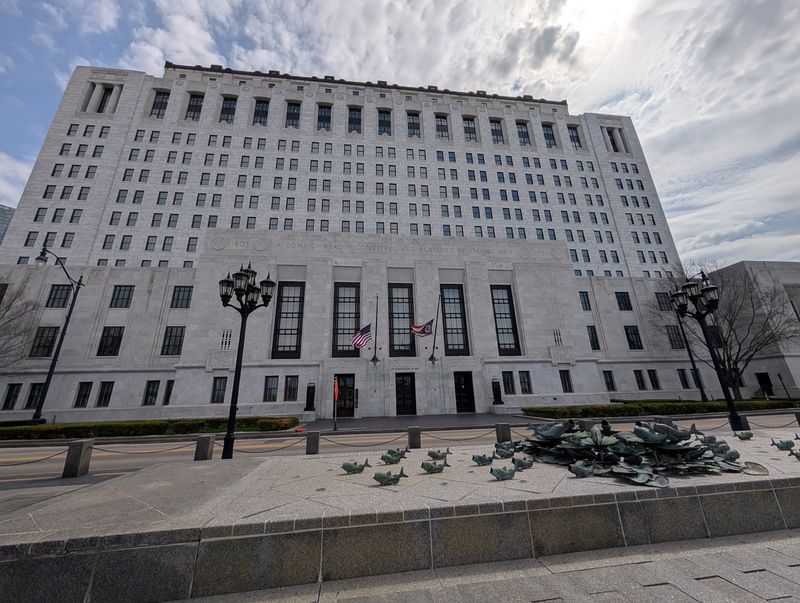
Thirty-one feet of polished stainless steel, standing upright in a reflecting pool outside the Supreme Court of Ohio. Weighing 17,000 pounds, the Gavel Sculpture is exactly as subtle as it sounds, and that’s the whole point.
Artist Andrew F. Scott created it in 2008 on commission from the Ohio State Bar Association, pairing the gavel with its sound block to represent the authority of the judiciary.
Seen from the sidewalk on South Front Street, the mirrored surface throws back the sky, the water, and the courthouse behind it.
It also happens to be the largest gavel in the world, which makes it a natural entry on any world’s-largest checklist. There’s a slight comedy to the scale, though the reflecting pool keeps things dignified.
Access is straightforward: the site is outdoors, open around the clock, and costs nothing to see. Parking downtown is paid, whether lot or street, so factor that in.
Midday on weekdays and Saturday evenings tend to be busiest, while Tuesday evenings stay quiet.
Pair it with a walk along the Scioto riverfront and you’ve got a solid Columbus detour.
6. Big Muskie Bucket, McConnelsville, OH
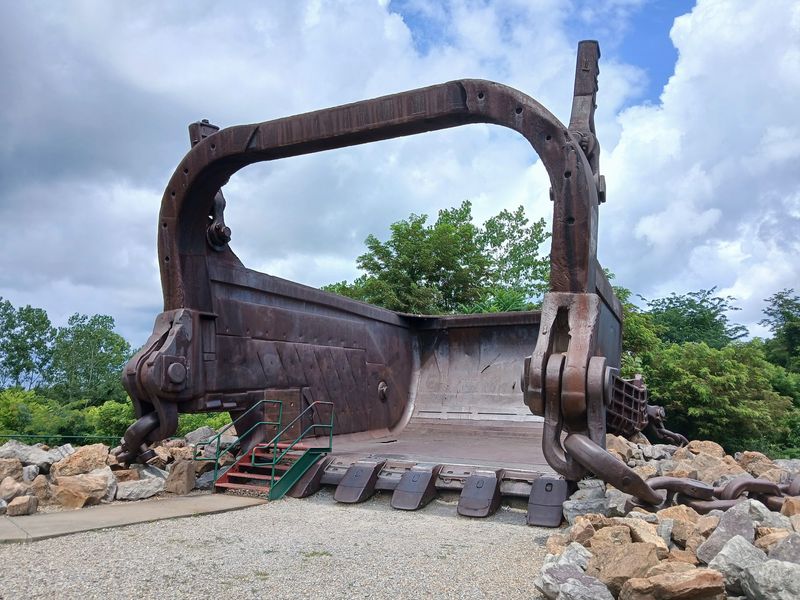
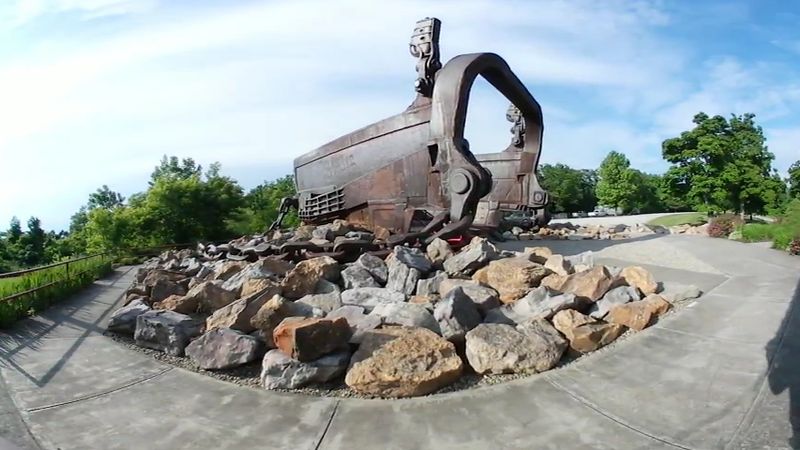
Picture a steel scoop with a 220-cubic-yard capacity, big enough to swallow a couple of buses, and you’ve got Big Muskie’s bucket. The bucket alone weighs 240 tons and could lift 325 tons of earth in a single bite.
The machine it belonged to was the largest dragline excavator ever built, towering 240 feet and working southeastern Ohio coal country from 1969 to 1991. Too big to ship assembled, it was constructed on site over two years using hundreds of railcars and trucks of parts.
It moved more than 483 million cubic yards of earth and rock before being taken apart and recycled in 1999.
The bucket survived, and now anchors Miners Memorial Park inside Jesse Owens State Park along OH-78. Interpretive signage covers the region’s mining history, restrooms are available, and there’s no restaurant, so bring snacks.
Heads up for anyone on two wheels: the approach includes a long stretch of loose gravel, so take it slow. Parking includes both free and paid lots.
For anyone even mildly interested in heavy machinery, standing next to this thing rearranges your sense of scale.