
This Must-Try New York Hike Has A Wildly Good Payoff For The Shortest Miles

Not every great hike needs to be long and exhausting. This New York trail proves it the fun way.
The walk starts off easy, the path winds through beautiful scenery, and just when you think you’re still warming up… the view suddenly explodes into something amazing. Wide open landscapes, dramatic cliffs, and that “wow” moment hikers love.
Honestly, this might be one of the most satisfying short hikes in New York.
The best part? You don’t have to trek for hours to earn the reward.
A short climb, a little effort, and suddenly you’re standing at a viewpoint that feels far bigger than the miles it took to reach it. Just make sure your camera is ready.
You’ll need it.
The Hike That Punches Way Above Its Weight Class
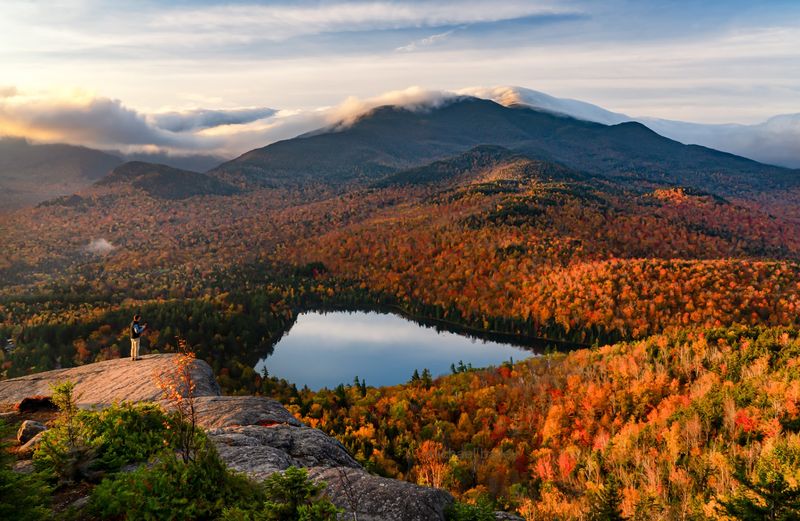
Imagine getting a text from a friend at 8 a.m. saying there’s a nearby hike that takes less than an hour and leads to a view that looks straight out of a glossy travel magazine. You think they are exaggerating.
They are absolutely not. Mount Jo is that hike, and it has been quietly blowing people’s minds for years without making a big fuss about it.
Sitting at 2,876 feet, this mountain in North Elba, NY 12946, rewards hikers with one of the most satisfying summit views in all of New York State. The contrast between the short distance and the quality of the scenery is almost comical in the best possible way.
Heart Lake shimmers directly below, framed by ridgelines that stretch far into the distance.
Hikers consistently rate this trail at 4.8 out of 5 stars, and it is easy to understand why. The experience feels disproportionately grand for the effort involved, which is precisely what makes it so popular among first-timers and seasoned walkers alike.
Come prepared, because once you see it, you will want to return every season.
Two Trails, One Summit, Zero Regrets

One of the more thoughtful features of Mount Jo is that it offers two distinct routes to the same spectacular finish line. The Short Trail climbs steeply and directly, covering just under a mile with rock scrambles and wooden stairs near the upper section.
The Long Trail takes a more gradual approach, winding through the forest with a gentler grade that feels considerably more forgiving on the knees.
Most hikers tend to ascend via the Short Trail and descend using the Long Trail, which creates a satisfying loop experience and ensures you see two different sides of the mountain. Each path has its own personality.
The Short Trail is energetic and a little scrappy, while the Long Trail feels more contemplative and steady, with roots and rocks underfoot but far fewer dramatic elevation jumps.
Both trails are well-marked and maintained, so navigation is straightforward even for those who are relatively new to hiking. Families with younger children are generally better served by the Long Trail, while those looking for a more vigorous workout tend to favor the Short Trail going up.
Either way, the summit waiting at the top makes the choice feel almost irrelevant.
What The Summit Actually Looks Like Up Close

Arriving at the summit of Mount Jo feels less like finishing a hike and more like stepping into a room with a very good view. The top opens onto a broad, flat rock ledge that gives hikers plenty of space to sit, rest, eat a snack, and simply absorb what is in front of them.
There is no crowding at the edge, no scrambling for position, just open sky and a generous stretch of exposed rock.
Heart Lake sits directly below, its dark water contrasting beautifully against the surrounding forest. On clear days, the silhouettes of Algonquin Peak, Mount Marcy, and Mount Colden are unmistakable along the horizon, forming a ridgeline that reminds you exactly where you are and how fortunate you are to be standing there.
The sense of scale is genuinely impressive for a mountain of this modest height.
One useful tip worth knowing: a short path veering to the right before the main summit leads to a secondary viewpoint that many hikers consider even better than the official top. It offers an unobstructed look down at Heart Lake that is quieter and less trafficked.
Finding it feels like discovering a small secret that the mountain kept just for you.
Getting There Without Losing Your Parking Spot Or Your Mind

Parking at the Adirondack Loj base area, which serves as the trailhead for Mount Jo, fills up with surprising speed on weekends and warm-weather mornings. The lot charges a fee of around eighteen dollars, and once it reaches capacity, latecomers find themselves parking along the road and adding a twenty-minute walk to their approach.
Arriving early is not just a suggestion here but a genuine strategy for a smoother experience.
Weekday visits tend to be considerably calmer, offering easier parking and a quieter trail overall. If your schedule allows flexibility, a Tuesday or Wednesday morning in late spring or early fall rewards you with the full experience minus the weekend energy.
The trailhead itself is well-organized, with a registry box near the start and restroom facilities available at the Loj, including both flushing toilets and portable options.
After 5 or 6 p.m., parking at the Adirondack Loj reportedly becomes free, which makes an evening ascent an appealing option for those chasing a quieter summit and the possibility of a sunset over the High Peaks. The light at that hour settles across the ridgelines in a way that is genuinely worth the slightly cooler temperatures.
Plan accordingly and the logistics become entirely manageable.
Why First-Time Hikers Keep Choosing This Mountain

Mount Jo has built a quiet reputation as the ideal introduction to Adirondack hiking, and that reputation is well-earned. The trail is challenging enough to feel like a real accomplishment without being so demanding that it discourages people who are new to the outdoors.
Rock scrambles near the upper section of the Short Trail add a touch of adventure, but nothing about the route requires technical skill or specialized gear.
First-timers consistently describe the summit moment as unlike anything they expected from a two-mile hike. That kind of response is not unusual for Mount Jo, where the gap between expectation and reality almost always tilts in the hiker’s favor.
Children who are reasonably fit and comfortable on uneven terrain handle the Long Trail well, and the hike is manageable for older adults who take their time. Dogs are welcome on the trail too, though steep sections of the Short Trail can be tough on older or less agile animals.
The Long Trail remains the more accommodating option for anyone who prefers a steadier, less vertical approach to the summit.
Fall Foliage, Sunsets, And The Best Seasons To Visit

Autumn transforms Mount Jo into something almost unreasonably beautiful. The Adirondack forest shifts through a full range of amber, copper, and deep red during peak foliage season, typically in early to mid-October, and the summit views take on an entirely different character when the valleys below are blanketed in color.
Hikers who time their visit for this window often describe it as the definitive version of the experience.
Spring brings its own appeal, with snowmelt feeding the streams along the trail and the forest floor beginning to green up after a long winter. Summer mornings offer clear skies and the best visibility toward the High Peaks, though trail traffic peaks during July and August.
Visiting just after sunrise on a summer day combines good light, manageable temperatures, and a noticeably quieter trail than midday conditions allow.
Winter hiking on Mount Jo is possible for those with the right equipment and experience, but the trail becomes significantly more demanding with ice and packed snow on the steeper sections. Microspikes or crampons are strongly recommended from late November through March.
Each season presents a genuinely distinct version of the same mountain, which is one reason why so many people find themselves returning to Mount Jo more than once.
What To Bring And How To Make The Most Of Your Visit

A hike as short as Mount Jo can tempt people into underestimating what to carry, but a few practical items make the difference between a comfortable outing and an avoidable struggle. Water is the obvious priority, with at least one liter per person being a sensible baseline for the round trip.
Trail snacks are worth packing too, partly for energy and partly because eating on that summit ledge with that view is an experience that deserves to be savored slowly.
Footwear matters more than distance alone might suggest. The rocky terrain on both trails, particularly the Short Trail, benefits from sturdy hiking shoes or boots with decent grip.
Sneakers can work for fit and sure-footed adults, but anything with a smooth sole becomes a liability on wet or mossy rock sections. Trekking poles are helpful for the descent, especially on the Long Trail where root-covered sections demand a bit of extra balance.
Layers are worth including even in summer, since the summit can be noticeably cooler and windier than the trailhead. A light jacket takes up almost no space and earns its place on the way down as temperatures drop.
Arriving with a small amount of preparation and a relaxed pace turns Mount Jo from a good hike into a genuinely memorable one.