
In Cambodia: floating village, acrobats, golden girls, monkeys, temple-destroying trees, and Angkor Wat
By Eileen Ogintz
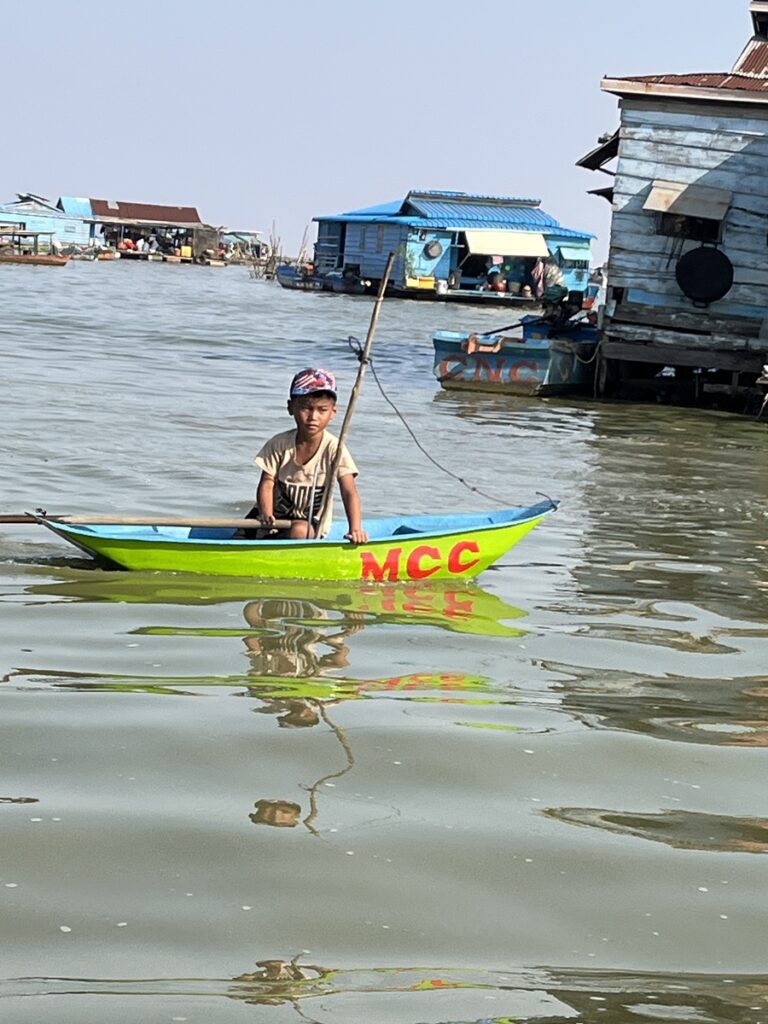
Talk about a moveable feast. In this case, an entire moveable village on stilts in Tunle Sab Lake, Southeast Asia’s largest freshwater lake in Cambodia, where scores of fisherman families live and work.
We’re southwest of Siem Reap, famous for being the home of Angkor Wat, the largest Buddhist temple complex in the world as well as many other temples. We are here touring for a few days on a CroisiEurope pre tour before we board one of their small boats (just 14 cabins) to cruise on the Mekong River.
Tunle Sab Lake, our guide Nhoem Sidet explains, is a huge natural lake that empties into the Mekong River, acting as a reservoir for the river that crosses five countries. This lake rises and falls about 20 feet each year between the dry and rainy seasons (May-November generally being the wet months).
This village of Chong Knees, home to more than 100 families, is complete with shops, restaurants, a school, church and even Buddhist Monastery. When the water is high during the rainy season, the entire village moves to the canal that flows into the lake.
Living here is primitive and modern. There is solar power but no bathrooms or sanitation. A few of the dwellings seem to have satellite internet dishes. They use large jugs of bottled water for bathing and cooking. Clothes are washed by hand; locals either go to the market in town or buy from the people who travel through the village on a small boat.
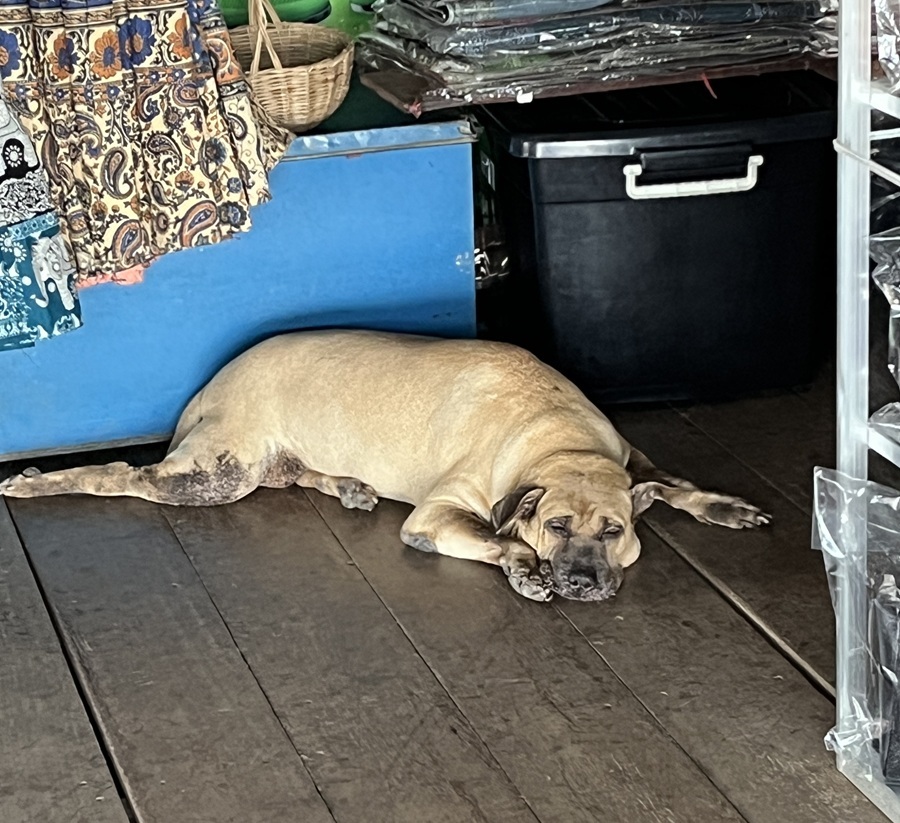
At one of the floating markets, there is a very sad looking dog. We wonder if she ever gets to run or play.
Like other tourists, we travel through the village on a small boat. Tourism, our guide explains, has become as big a business as fishing, We see people casting their nets on the lake (there are thousands of species here) and also see boats getting ready for sunset cruises complete with white tablecloths and wine glasses. Sunsets over the lake are said to be spectacular.
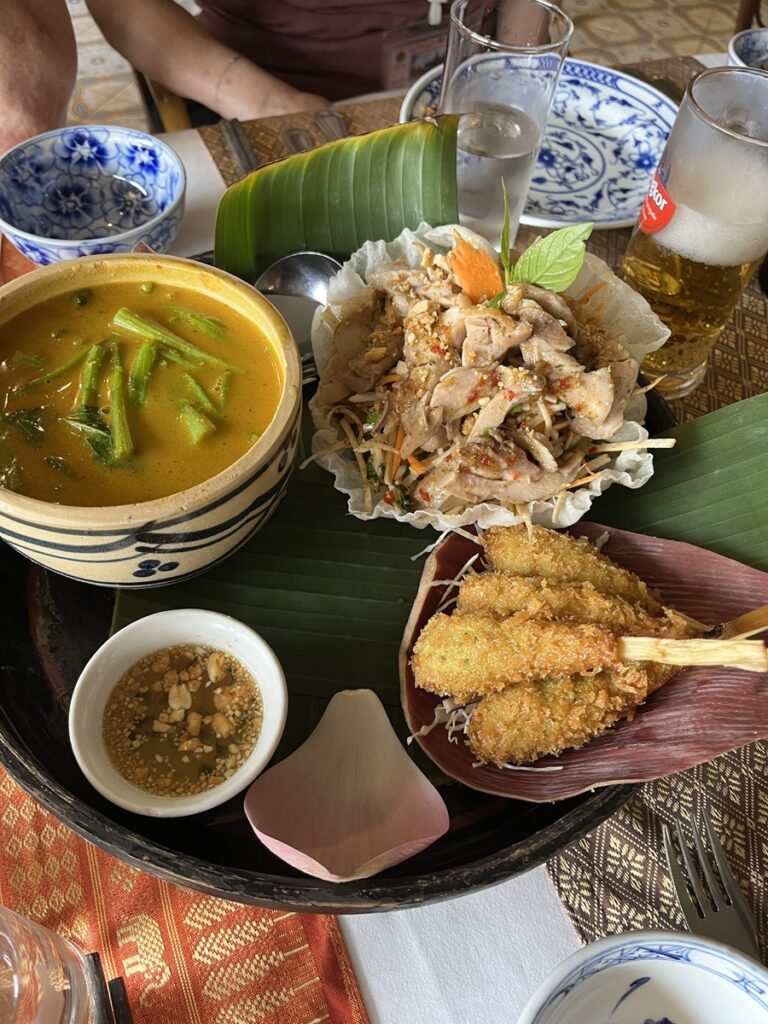
Siem Reap is one of Cambodia’s largest cities with over a million people in the province and almost 250,000 in the city center which is a tourist hub complete with every kind of food you could want- Indian, fast food, French, Italian, Mexican Chinese, and plenty of Khmer options in refined restaurants and street food stalls along the river front—grilled pork stickers, sticky rice, noodles. Here is your chance to try cow’s brain, a local delicacy, or fried insects, grilled snakes.
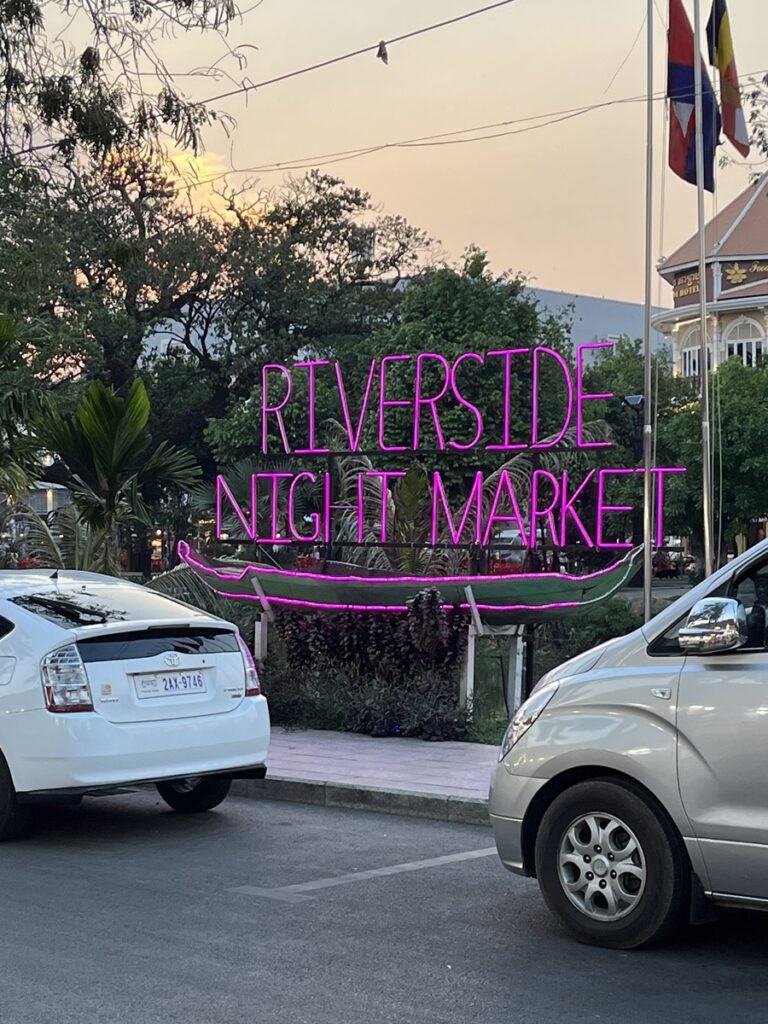
We perused the adjacent Night Markets open from 5 pm to midnight with hundreds of stalls selling everything from silk scarves to baby clothes to linen shirts and pants to every variety of souvenir (key chain or magnet perhaps? A Carved Buddha? Chopsticks (10 pairs for $3).
We discovered we didn’t need to change our money into local currency as US dollars are accepted everywhere—and even preferred. It is so hot here the first week in April (well over 90 degrees and high humidity) that we shopped for loose linen pants ($5) and couldn’t resist a shirt with elephants ($6) and an adorable dress for a baby ($3). Bargaining is expected but also expect the vendors to be aggressive, not taking the first no for an answer.
It is very nice to be on this pre-cruise trip with CroisiEurope as we have such a knowledgeable guide and driver. We don’t have to worry about where to go, how to get there or what it is safe to eat and drink.
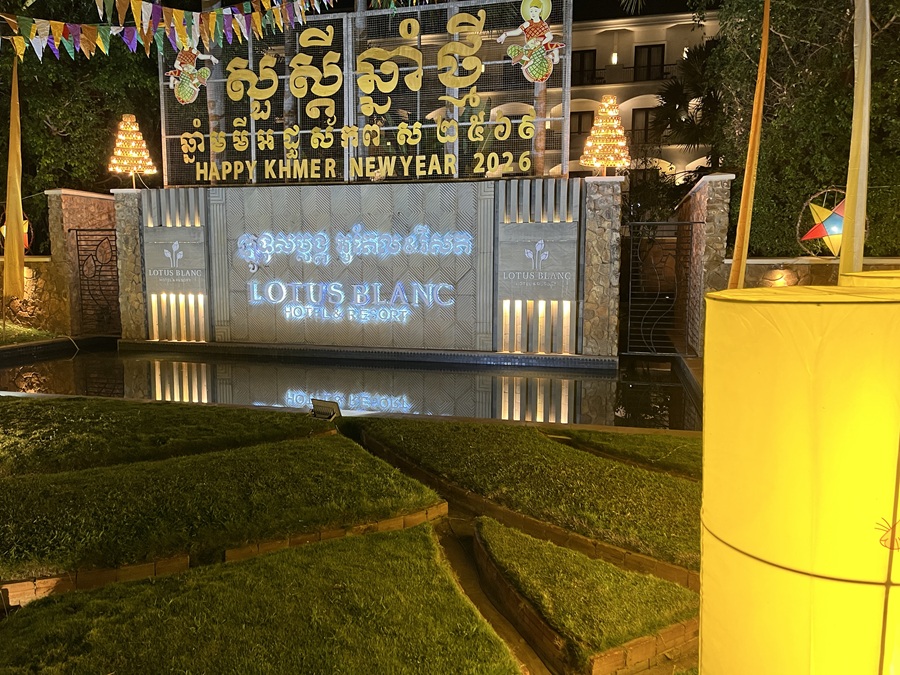
We stayed at the Lotus Blanc Hotel where the staff couldn’t be nicer and the breakfast is bountiful with everything from adding your own fixings to Pho, made to order omelets, waffles, pancakes, and Nutella crepes, fresh fruit, pastries and much, much more. (We joked that the Lotus Blanc had much less drama than it’s HBO cousins).
We started early, 7:30 am, to begin our Temples visit because it gets too hot and humid mid-day (98 degrees F yesterday). First we headed to Angkor Archeological Park, a UNESCO World Heritage Site with the remains of more than 150 temples that were built from the 9th to the 15th Centuries.
Angkor Wat is the largest religious monument in the world; we visit Angkor Thom and the Bayon Temple famous for its stone faces and Ta Prohm, known as the “Tomb Raider” famous for the massive tree roots growing through the ruins. The temples are different styles as the kings built them to suit themselves. When the capitol of Cambodia was moved from here to Phnom Penh in 1432, the temples were left and were buried, the jungle growing over them, for more than 500 years until French archeologists began to clear the jungle in 1911.
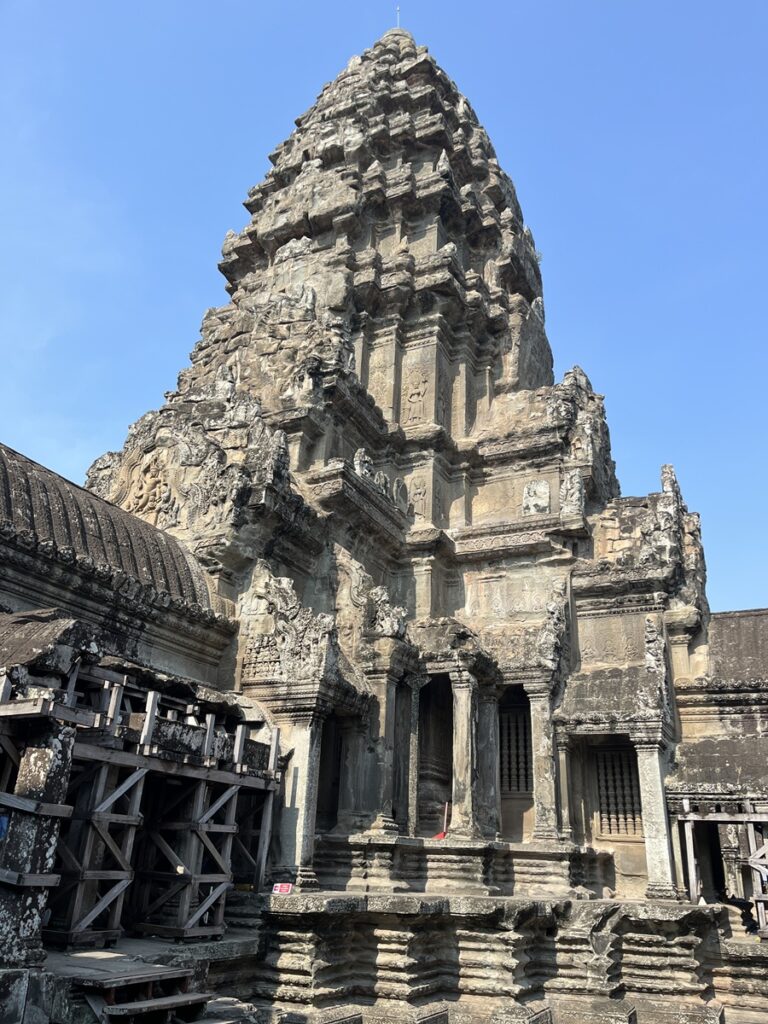
The next morning, just as early, we visited Angkor Wat, the largest religious building in the world that is a symbol of pride for all Cambodians (its image is on the flag). It’s surrounded by a huge moat and was built in the 12th Century. The carvings—some 1100 of dancing celestial girls around the central temple is astounding as are other carvings of heaven and hell. It is one of the most important archeological sites in Cambodia and for several centuries, was the center of the Khmer kingdom. First, this was a Hindu temple and then transformed for Buddhist worship.
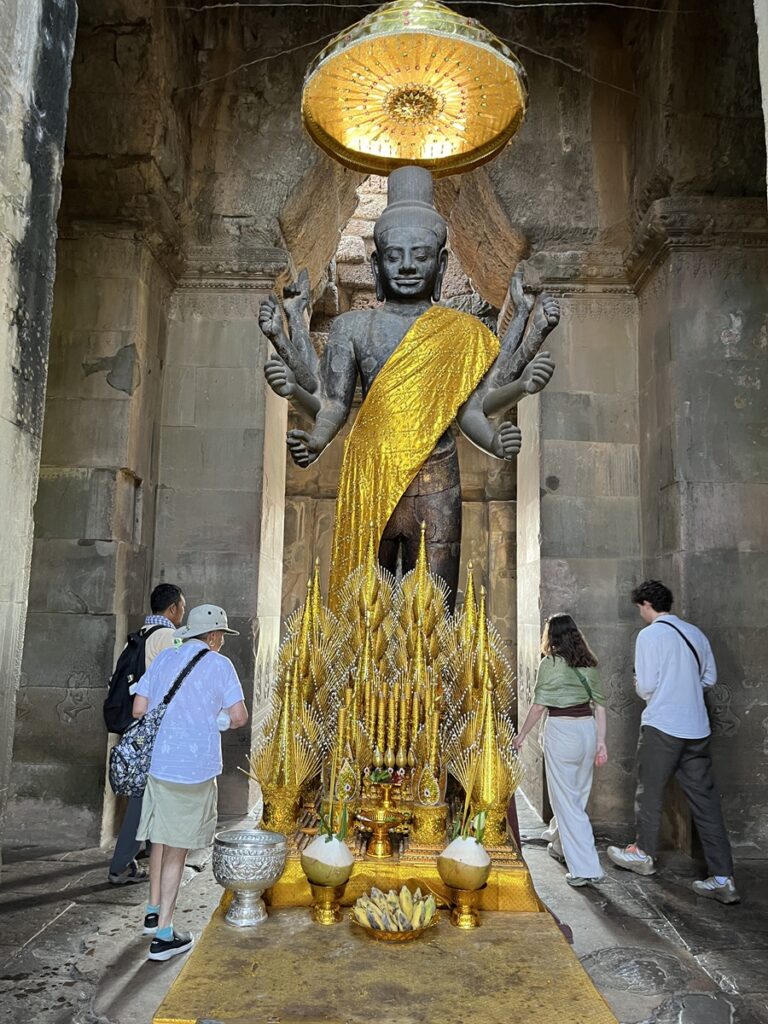
Today we see worshippers praying with a Buddhist monk. Angkor Wat is a top tourist attraction in Cambodia and Siem Reap has grown as a tourist center as a result with major international hotels and attracting nearly three million tourists in the first half of last year, a 50 per cent increase from the same period the year before, with an increase in in international tourists.
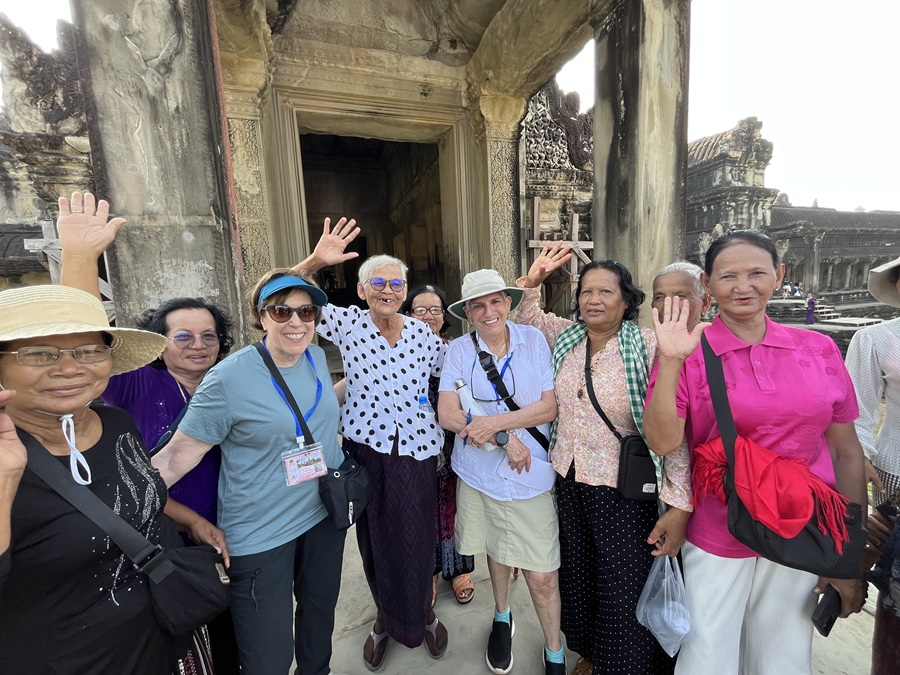
A smiling group of senior Cambodian women – girls trip from Phnom Penh — insisted on taking photos with them, reminding us to “be happy” while hugging and kissing us.
These temples still are ruins with statues looted—especially the heads and arms if they held valuable amulets. A wealthy British man, Douglas Latchford, was among the looters during the Cambodian Civil War and Khmer Rouge regime when locals were made to steal the treasures and take n to Thailand for sale.
Today there is a major repatriation effort underway with researchers and authorities using 3D imaging to trace broken statues and having looted treasures returned from major museums around the world. After Latchford’s death, his daughter returned his ill-gotten treasures. You can see these returned treasures at the National Museum of Cambodia in Phnom Penh. A documentary film “Loot” about Latchford was released in 2025.
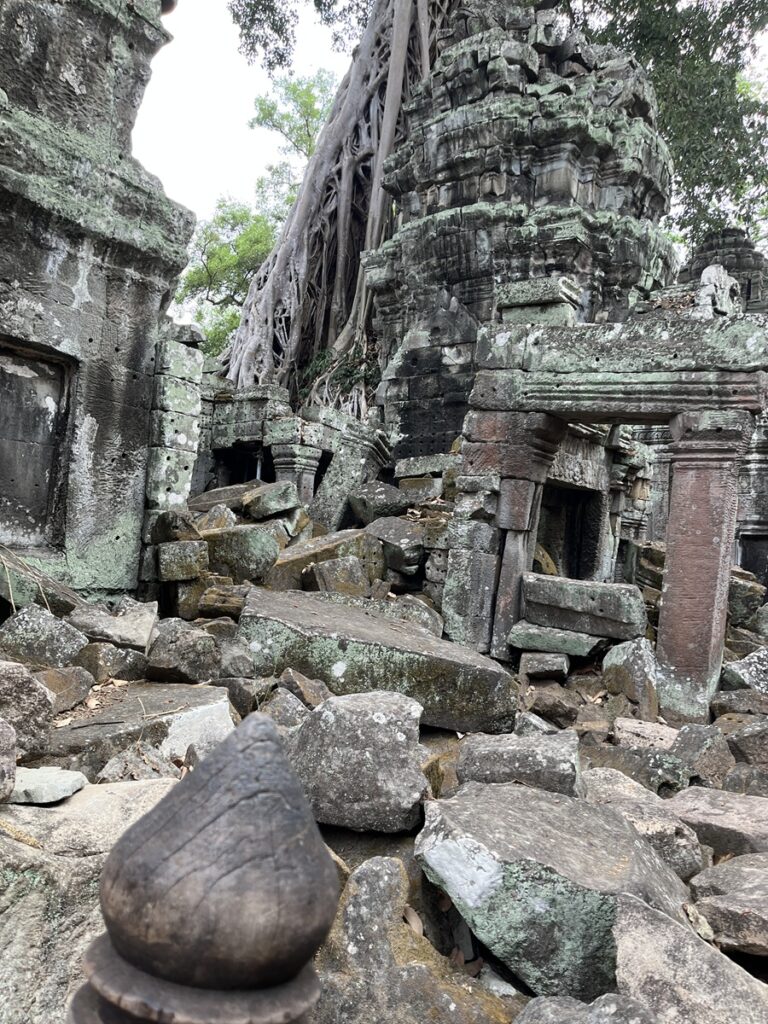
We climbed over broken stones to admire what is left of what must have been extraordinary structures at the Bayon Buddhist Temple built in the late 12th or early 13th Century by King Jayavarman VII. The Temple is best known for its smiling stone faces carved on all sides that are said to symbolize compassion and royal authority. There are carvings of everyday life depicting events, religious themes, musicians, merchants, military officers on elephants, making it an important source for the study of ancient Angkor society. The Bayon Temple has been destroyed slowly and methodically for centuries by tree roots but parts of it are being restored today.
Particularly striking is the South Gate entrance to the ancient Khmer city famous for its four-faced stone tower and an entry way lined with 54 giant stone figures—gods on one side and devils on the other who are constantly engaging in a tug of war with a dragon head as a rope. Each face has a different expression. The entrance is narrow, built to accommodate those arriving on elephants.
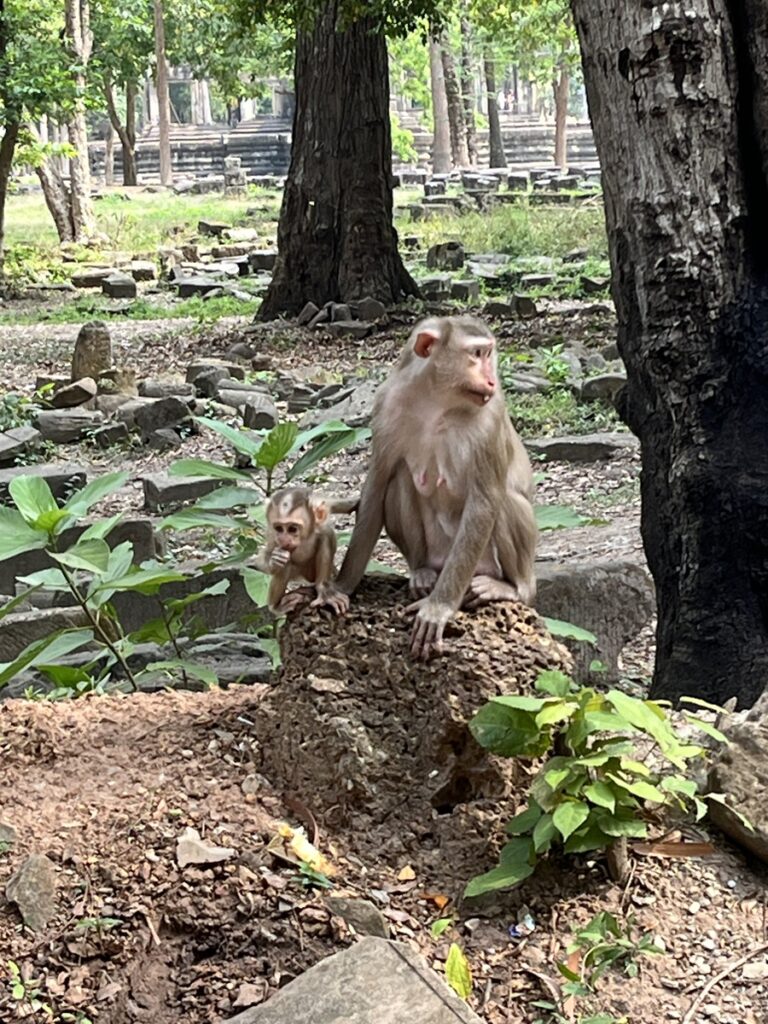
As popular as the statues are the monkeys who try their hardest to snare treats from visitors. They obviously don’t have any trouble climbing amid the ruins or the tall trees. Signs warned visitors not to feed or tease them.
A happy surprise of our visit was Phare the Cambodian Circus which showcases young people doing astounding feats of acrobatics as a back story is told about the conflict between greed and good, the desire to win a young woman’s affections, and the importance of rice, “white gold” accompanied by original music with original paintings created during the performance.
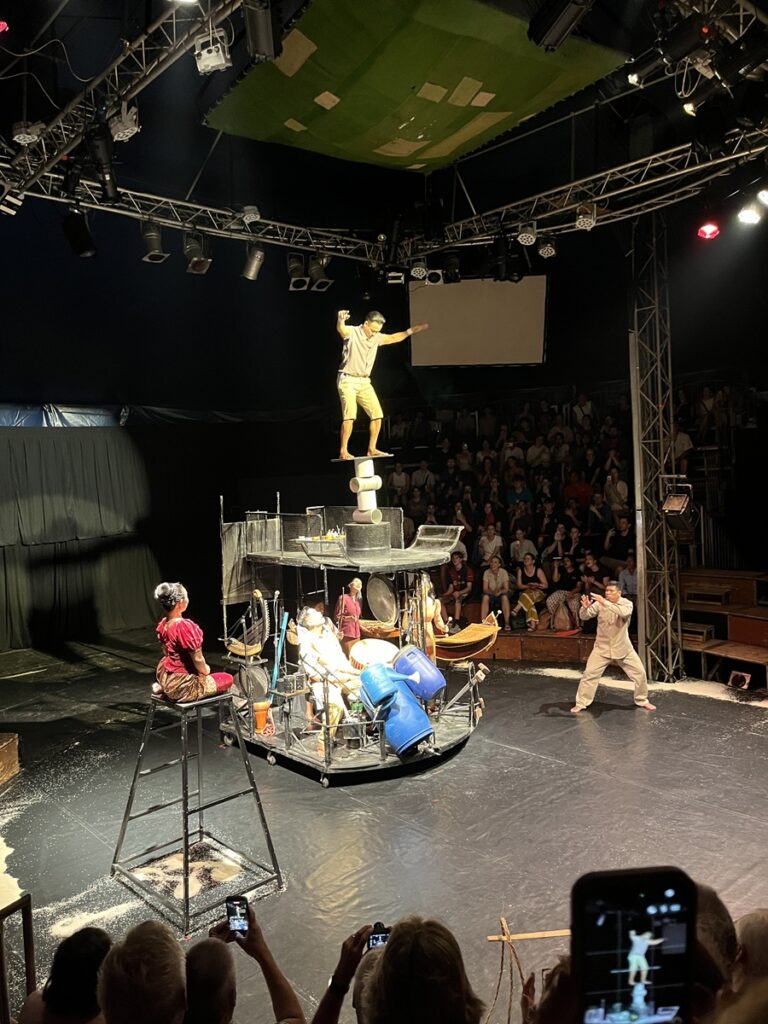
There are different shows based on the artists’ experiences. They all come from underprivileged backgrounds and have been trained at the nonprofit Phare Ponleu Sepak school. The hour long show both entertained and astounded the audience as they tumbled, balanced high off the ground, juggled and more. The boutique showcases arts and crafts made by locals to support livelihoods for Khmer artists.
The young artists are excellent. It isn’t surprising that some have gone on to international careers and universities.
Bravo!