
10 Massachusetts Waterfalls Where The Rock Formations Are Just As Stunning As The Water
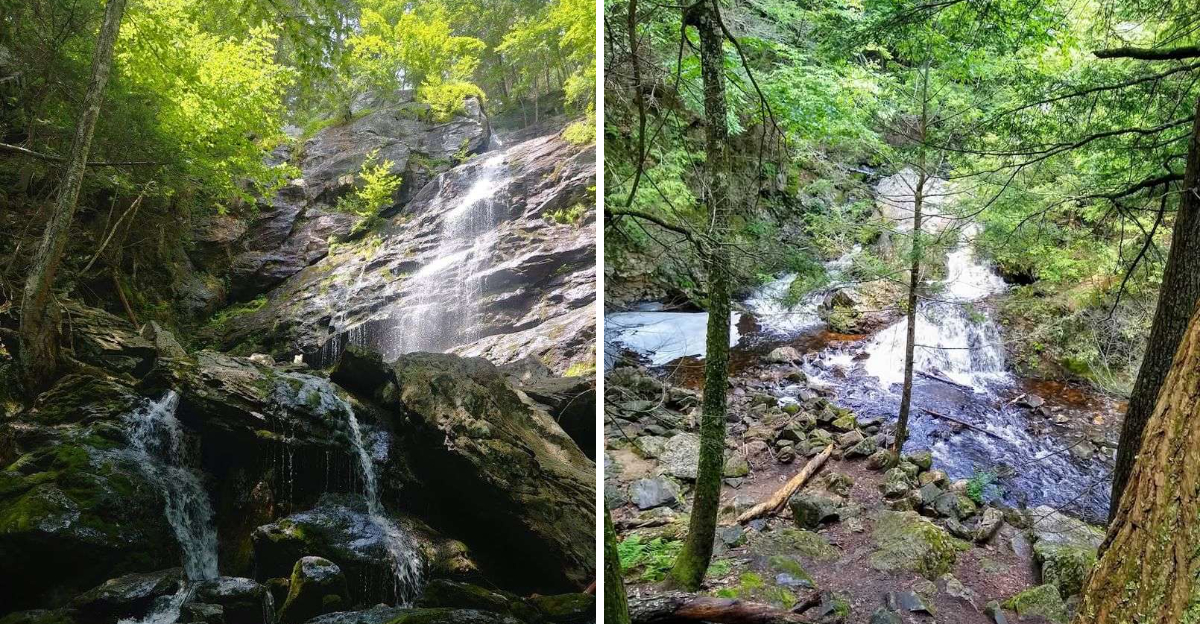
Water gets most of the attention at a waterfall, but the rocks often steal the show. Massachusetts is home to cascades framed by towering ledges, deep gorges, broad stone shelves, and boulders shaped by centuries of rushing water.
Some falls tumble through narrow channels, while others slide across smooth rock before dropping into quiet pools below.
These natural formations add drama to every view. They also make each stop feel completely different.
You might find layered cliffs that resemble giant steps, mossy walls glowing after rain, or rounded stones scattered along a woodland stream.
Take your time at each stop. The best view may appear beside the trail, near the base, or farther back where the full landscape comes into focus.
These waterfalls prove that rushing water is only part of the attraction. The remarkable stone surrounding each cascade can be just as memorable.
1. Bash Bish Falls, Mount Washington
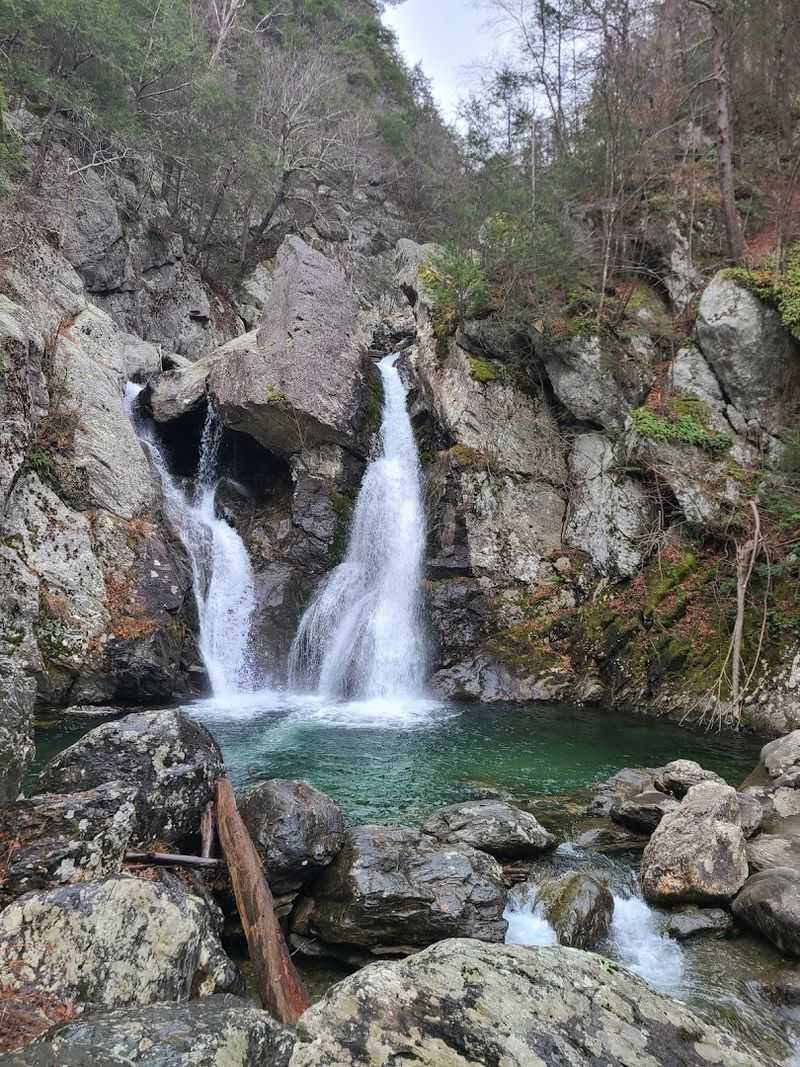
Standing at the base of Bash Bish Falls and looking up, you quickly understand why people keep coming back to this remote corner of Mount Washington.
The waterfall splits around a massive central boulder, sending two ribbons of water plunging roughly 60 feet before they reunite in a glassy emerald pool below.
That boulder is no accident. It was shaped by glacial forces during the last ice age, and the steep gorge walls flanking it are equally ancient, carved from bedrock over countless centuries.
The cliffs rise dramatically on both sides of the falls, framing the scene like a natural amphitheater built from stone rather than wood and concrete.
Bash Bish Brook flows from a spring on Mount Washington and continues westward into New York State, making this one of the few Massachusetts waterfalls that literally crosses a state border.
Spring brings the most powerful flow, when snowmelt pushes the water into a roaring display that bounces off every rock surface in the gorge.
Viewing is limited to designated areas, which actually helps preserve the raw, untouched quality that makes this place feel so genuinely wild.
Few waterfalls in New England offer this combination of geological drama and pure visual impact all in one spot.
2. Royalston Falls, Royalston
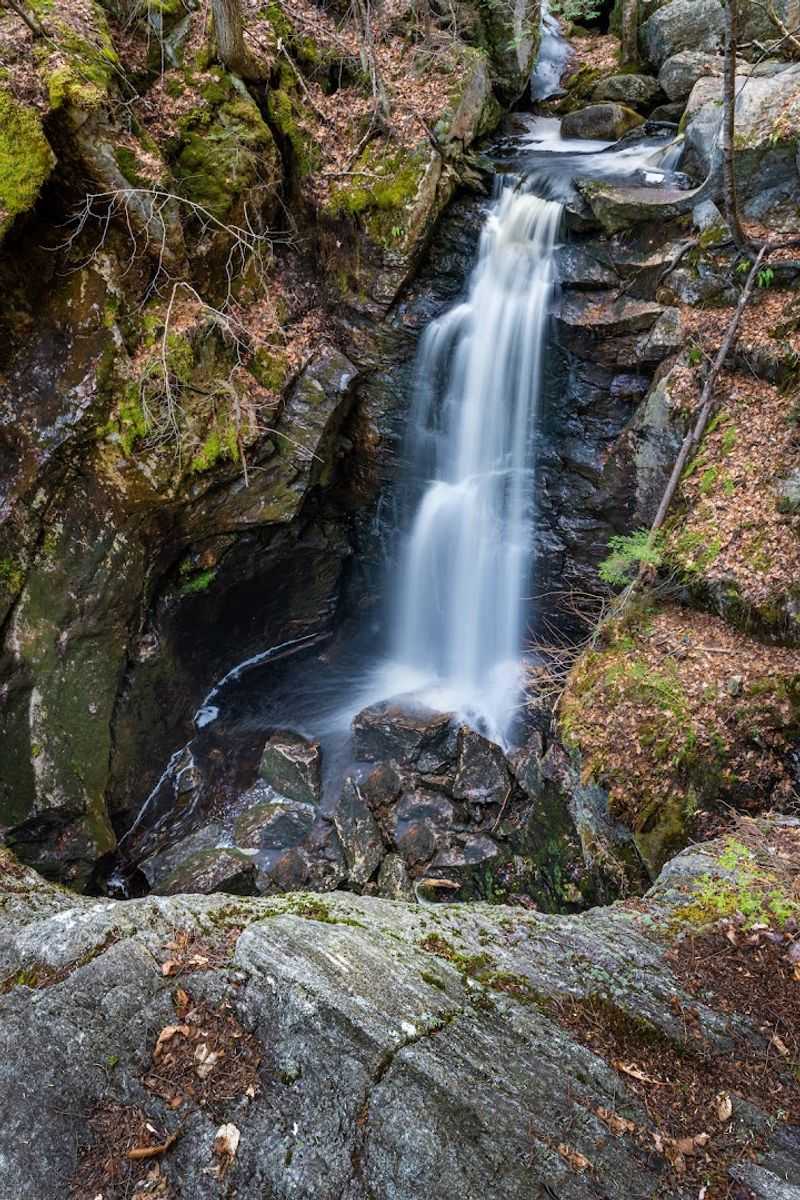
Some waterfalls are wide and showy. Royalston Falls in Royalston goes deep instead, dropping 45 to 50 feet straight into one of the most unusual geological formations in the entire state.
The gorge here is roughly cylinder-shaped, carved by prehistoric glacial meltwater that gouged through solid granite with relentless force over thousands of years.
That cylindrical shape creates an almost chamber-like effect, where the sound of falling water echoes off the moss-covered walls and the cool mist settles in a permanent chill around the pool.
Falls Brook feeds this cascade, and the surrounding 217-acre preserve managed by The Trustees of Reservations keeps the whole area feeling genuinely remote and untouched.
The Tully Trail and the New England National Scenic Trail both pass through the property, so reaching the falls involves a pleasant forest walk through second-growth woodland.
Autumn is a particularly spectacular time to stand at the gorge rim, when the hillside trees surrounding the granite walls ignite in shades of red, orange, and gold.
Spring runoff sends the waterfall into full thunder mode, with the enclosed gorge amplifying every crash and splash into something almost symphonic.
The rock walls here are the real storytellers, and Royalston Falls gives them plenty of dramatic material to work with.
3. Windsor Jambs, Windsor
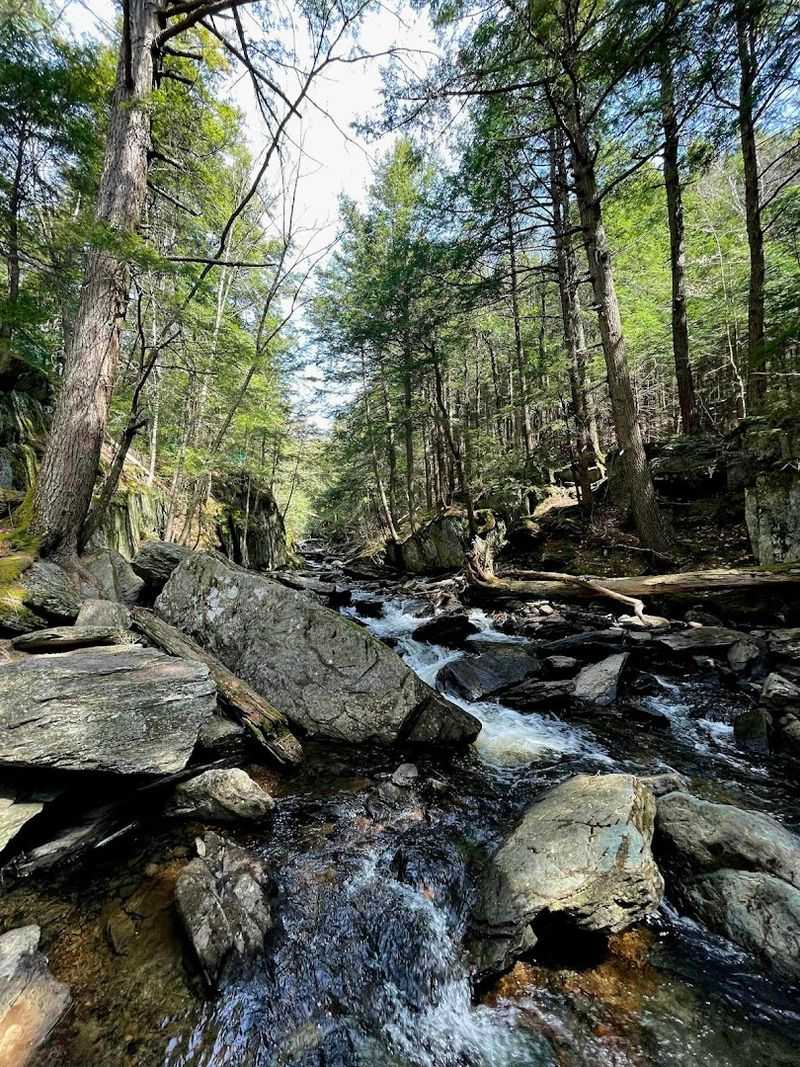
Eighty feet of sheer granite rising on both sides of a stream that is only about 25 feet wide. That is Windsor Jambs in Windsor and the numbers alone barely capture how striking this place actually feels in person.
Windsor Jambs Brook has been cutting through this corridor for millennia, smoothing and sculpting the stone walls into curved, moss-draped surfaces that glow green after a rain.
The word “jambs” refers to the vertical rock walls flanking the water, and once you see them, the name makes perfect sense. They stand like enormous stone gateposts on either side of the rushing current.
Sunlight filters down through the forest canopy above the gorge, casting shifting patterns across the wet stone and the white water below.
Windsor State Forest surrounds the entire area, providing a network of trails that follow the brook and allow for close-up views of the rocky streambed at multiple points.
The gorge was formed over countless centuries by the same geological forces that shaped much of the Berkshire highlands, leaving behind a landscape that feels genuinely ancient.
Cool air flows steadily out of the gorge even on warm summer days, making this one of the most refreshing natural corridors in western Massachusetts.
The stone walls here do not just frame the water. They are the whole conversation.
4. Chapel Falls, Ashfield
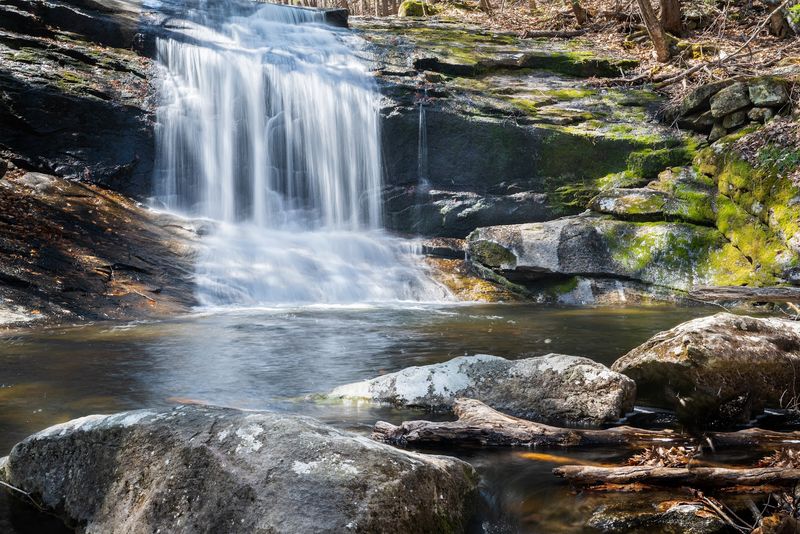
Three broad steps of ancient bedrock, each one worn smooth by Chapel Brook over countless seasons. That is the signature look of Chapel Falls in Ashfield and it is one of the more photogenic waterfall arrangements in the state.
The staircase effect changes noticeably depending on the season. High water in spring sends sheets of white foam rushing across every ledge simultaneously, while lower summer flows reveal the full texture and color of the exposed stone beneath.
Each ledge drops between 10 and 20 feet, giving Chapel Brook a layered, theatrical descent that feels more like a natural performance than a simple stream crossing a hillside.
The surrounding forest is dense and lush, with a canopy that softens the light and adds a quiet, almost cathedral-like atmosphere to the whole scene. That comparison to a chapel is not accidental.
Just beyond the falls, Pony Mountain, also called Chapel Ledge, adds another layer of geological interest. A 100-foot open granite cliff face rises above the forest, offering a completely different perspective on the rugged bedrock that defines this landscape.
The combination of cascading water, layered stone, and open cliff face makes Ashfield a destination that rewards anyone willing to explore beyond the main waterfall viewpoint.
Chapel Falls proves that sometimes the most compelling geology comes in layers.
5. Glendale Falls, Middlefield
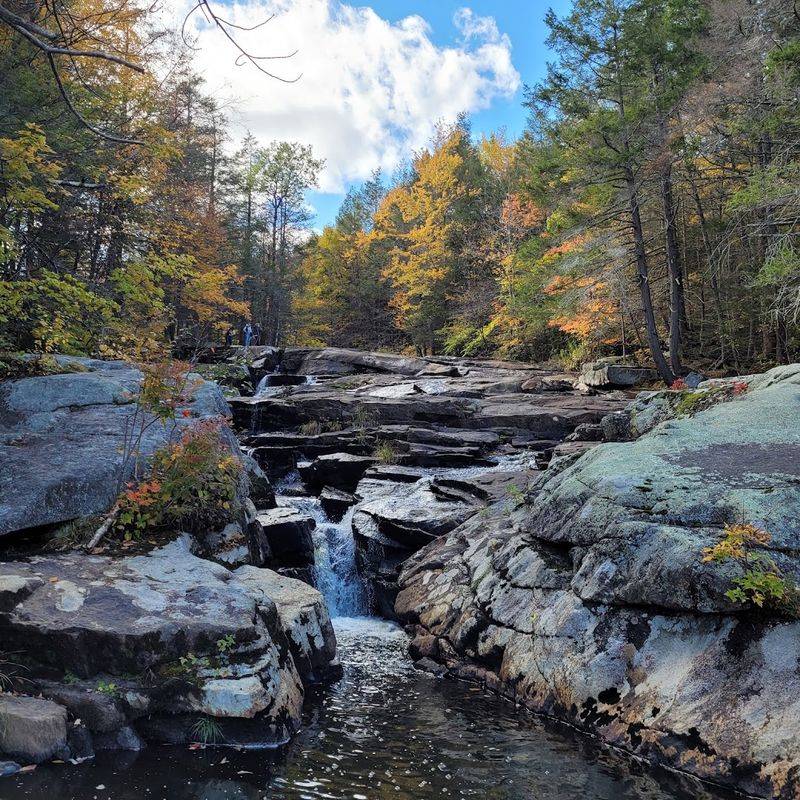
Raw power is the first thing you notice at Glendale Falls in Middlefield, Massachusetts.
Glendale Brook drops somewhere between 150 and 160 feet over a long chain of steep rock ledges, making this one of the longest continuous waterfall runs anywhere in the state.
The watershed feeding this cascade spans more than five square miles, which means even after moderate rainfall the ledges are covered in a churning, roaring sheet of white water that demands attention.
What sets Glendale apart from other Massachusetts waterfalls is how much exposed stone remains visible even at peak flow. The ledges are wide and angular, jutting out at sharp angles that redirect the water in unexpected directions as it tumbles downward.
The Trustees of Reservations manages the 60-acre preserve, and a quarter-mile trail leads from the parking area to the base of the falls, where the full scale of the cascade becomes clear.
Spring runoff is the undisputed highlight here. The volume of water crashing over those ledges and boulders creates a thunderous display that you feel in your chest before you even see the falls around the final bend in the trail.
Eventually the brook joins the Middle Branch of the Westfield River below, but the real drama happens on those long, relentless ledges.
Glendale Falls does not whisper. It roars.
6. Bear’s Den Falls, New Salem
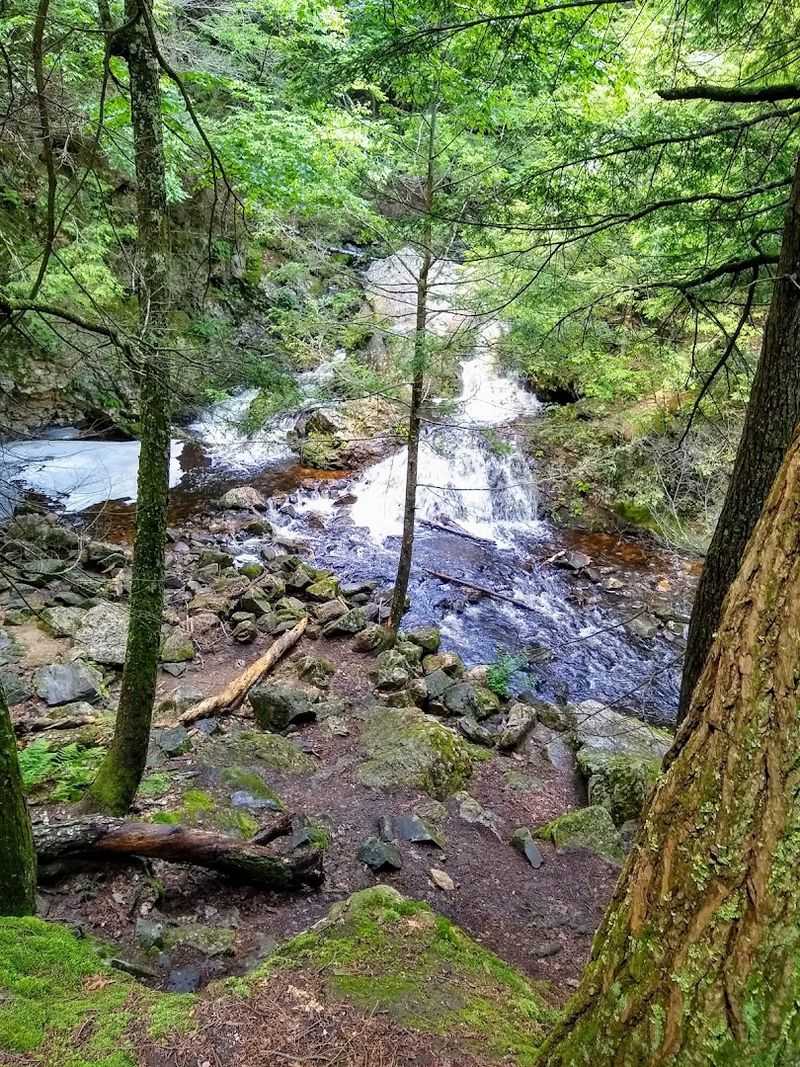
On its own, the waterfall at Bear’s Den in New Salem would be pleasant. Inside a 70-foot-deep gorge flanked by granite cliffs and towering hemlock trees, it becomes something else entirely.
The Middle Branch of the Swift River carves through this landscape with quiet authority, splitting around large boulders that divide the current into multiple channels before it reunites in the gorge below.
Those boulders are not random. They are part of a geological story that includes glacial deposits, ancient granite bedrock, and centuries of erosion working together to create one of the most layered natural environments in central Massachusetts.
The Trustees of Reservations owns this six-acre reserve, and a short quarter-mile trail leads from the road to the gorge rim and then down toward the water.
Along the way, small caves tucked into the granite cliffs hint at the wild, rugged history of the area. The combination of caves, cliffs, boulders, and falling water gives Bear’s Den a quality that feels almost mythological.
The hemlock canopy above the gorge filters the light into something cool and green, adding to the sense of entering a completely separate world just a short walk from the trailhead.
Bear’s Den rewards the curious. The more you look, the more geological detail reveals itself in every crack, curve, and shadow of that granite gorge.
7. Doane’s Falls, Royalston
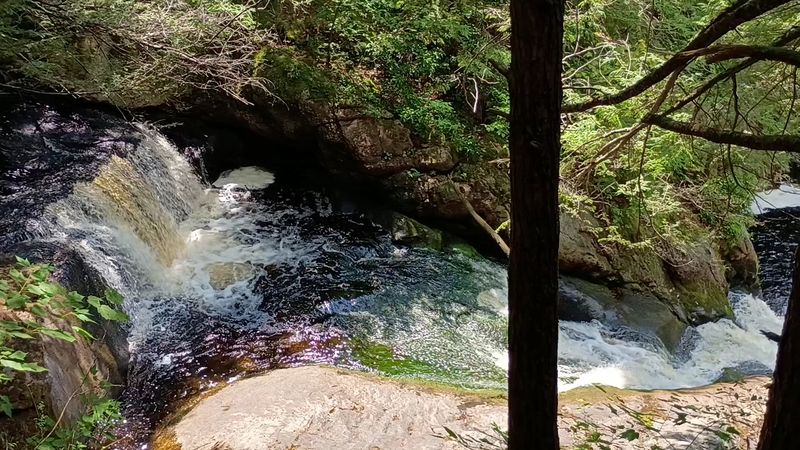
A stone bridge arching over rushing water is already a great image. Add a chain of cascades stretching 175 to 200 feet down a rocky streambed below it, and you have Doane’s Falls in Royalston.
Lawrence Brook is the force behind this display, tumbling over rugged ledges, mid-stream boulders, flat granite slabs, and small rocky islands as it works its way toward Tully Lake.
The variety of rock formations along this stretch is genuinely impressive. Every few steps along the half-mile trail that follows the west bank reveals a new configuration of stone and water, from wide plunging drops to tight curving chutes.
History adds another layer to the experience. Mills once operated along Lawrence Brook, and stone remnants from those structures are still visible on the banks.
After modest rainfall, the falls become noticeably more ferocious, with the water level rising enough to submerge many of the smaller rocks and transform the gentle upper cascades into something considerably more powerful.
The stone bridge near the upper falls provides a natural focal point and one of the best vantage points for photographing the cascade sequence from above.
Two great things about Doane’s Falls: the rocks are always interesting, and the water never seems to run out of new ways to move across them.
8. Tannery Falls, Savoy
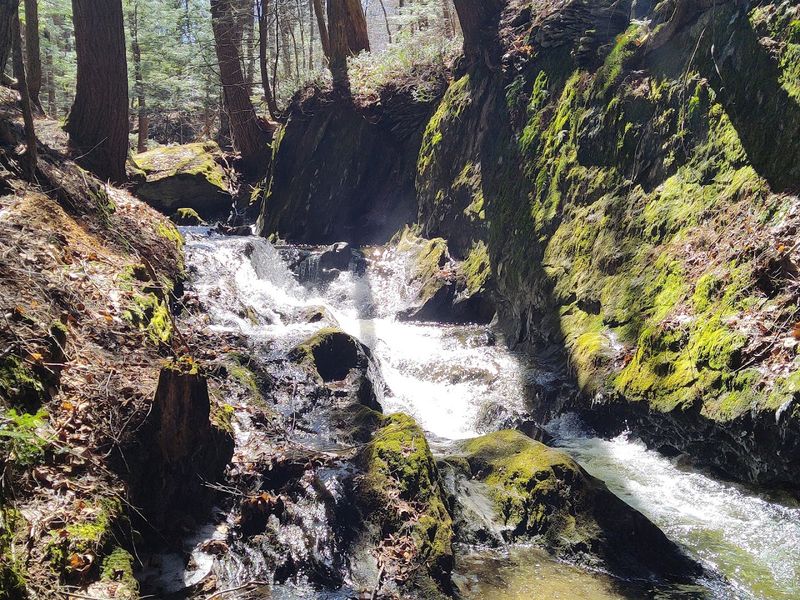
Tall, slender, and closely wrapped in stone on both sides. Tannery Falls in Savoy Mountain State Forest has a distinct personality that sets it apart from the wider, more open falls found elsewhere in the state.
The narrow stream follows a long rock formation through the ravine, creating a waterfall that hugs the stone rather than spilling freely away from it.
The result is something intimate and precise, like the rock and water worked out an agreement about exactly how this descent should go.
At 75 to 100 feet tall, the main falls are part of a larger series that includes curving horsetail cascades and a thundering upper section that shows its full force during periods of heavy rainfall.
The approach involves wooden steps built into the ravine slope, which make the descent manageable while also framing the waterfall nicely.
The surrounding forest has a lush, layered quality that some describe as reminiscent of the Pacific Northwest, with mossy rocks and dense green undergrowth softening the hard edges of the stone formation.
Swimming and rock climbing are prohibited here, which helps preserve the natural integrity of the ravine and keeps the environment in the condition that makes it worth the hike in the first place.
Tannery Falls is proof that sometimes the narrowest paths lead to the most memorable views.
9. Race Brook Falls, Sheffield
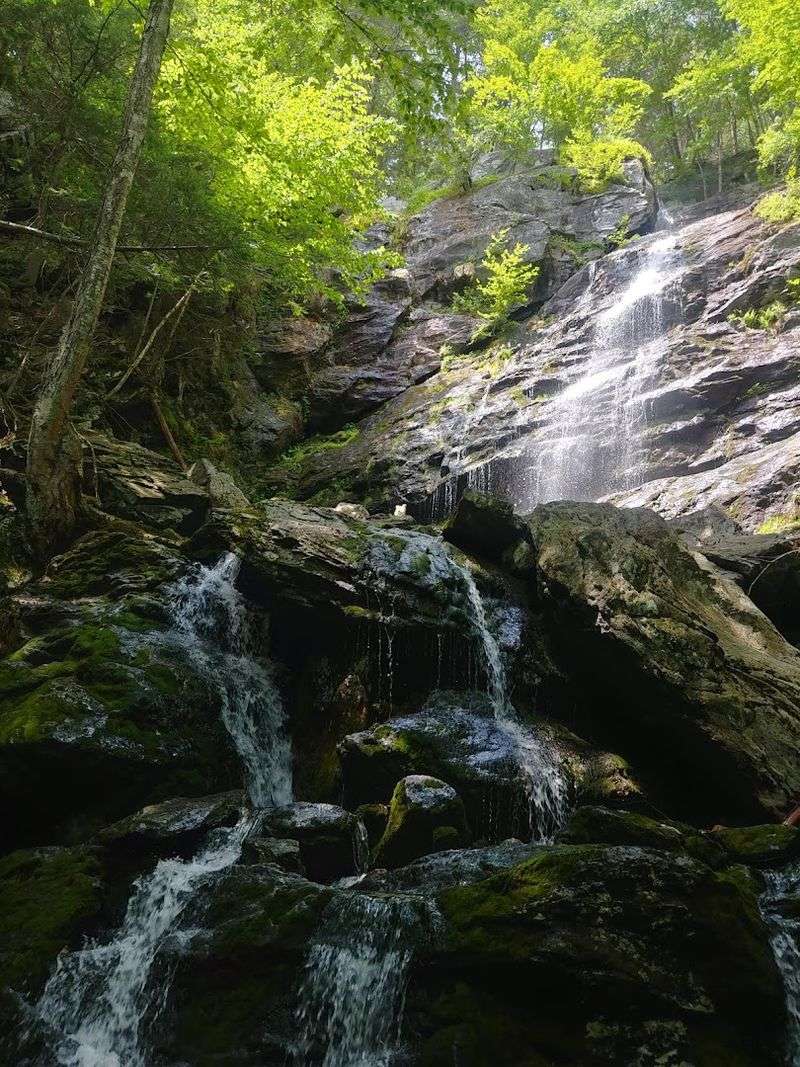
Five separate cascades on a single trail. Race Brook Falls on Mount Race in Sheffield offers a waterfall experience that keeps delivering long after you think it must have peaked.
The lowermost cascade is the showstopper, spilling dramatically over a broad, steep rock face into a shallow pool and reaching close to 100 feet in height.
That wide rock face is streaked with brown and green moss, giving the stone a richly textured appearance that contrasts sharply with the white water rushing over it.
Further upstream, the character of the falls shifts. A 30-foot inclined drop gives way to smaller cascades where the water slides rather than plunges, moving across angled slabs of stone at a more conversational pace before the next dramatic drop begins.
The trail along Race Brook provides multiple vantage points, each one offering a slightly different relationship between the water and the surrounding geology.
During heavy rainfall, the entire sequence accelerates. The water roars down the rock faces, and cool mist rises from every pool and ledge along the brook.
The thick pine forest and deciduous canopy overhead create a shaded corridor that enhances the overall atmosphere, keeping temperatures cool and the light soft even on bright summer days.
Race Brook Falls is the kind of place where you plan to spend an hour and somehow end up staying for three.
10. Wahconah Falls, Dalton
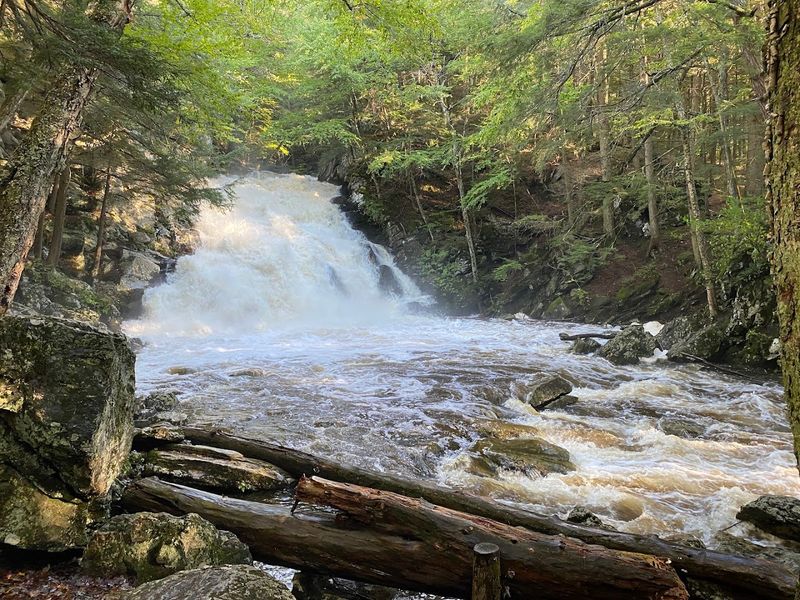
Geology gets a starring role at Wahconah Falls in Dalton, where the brook tumbles over an outcrop of Becket Gneiss, a specific rock formation that gives the ledges here a distinctive layered, almost architectural appearance.
The brook moves across several smaller ledges before reaching the main 40-foot cascade, building anticipation with each smaller drop before the full finale comes into view.
That layered quality is worth paying attention to.
The Becket Gneiss formation creates horizontal banding in the rock that the water follows and cuts across in equal measure.
Spring runoff is when Wahconah Falls truly earns its reputation. High water fills every ledge to capacity and sends the final cascade over the edge with a force that makes the whole scene vibrate with energy.
A half-mile loop trail circles the upper falls area, offering multiple angles on the cascade sequence without requiring a strenuous climb.
The surrounding northern hardwood and conifer forest adds seasonal color and a pleasant woodland atmosphere to the experience.
Swimming is not permitted, but standing close enough to feel the spray from the main cascade while studying the Gneiss layers beneath the water is its own kind of reward.
Wahconah Falls is where ancient rock and moving water hold an ongoing conversation, and both sides make compelling points.