
Nevada Has A Colorful Art Installation In The Middle Of The Desert And It’s Completely Free
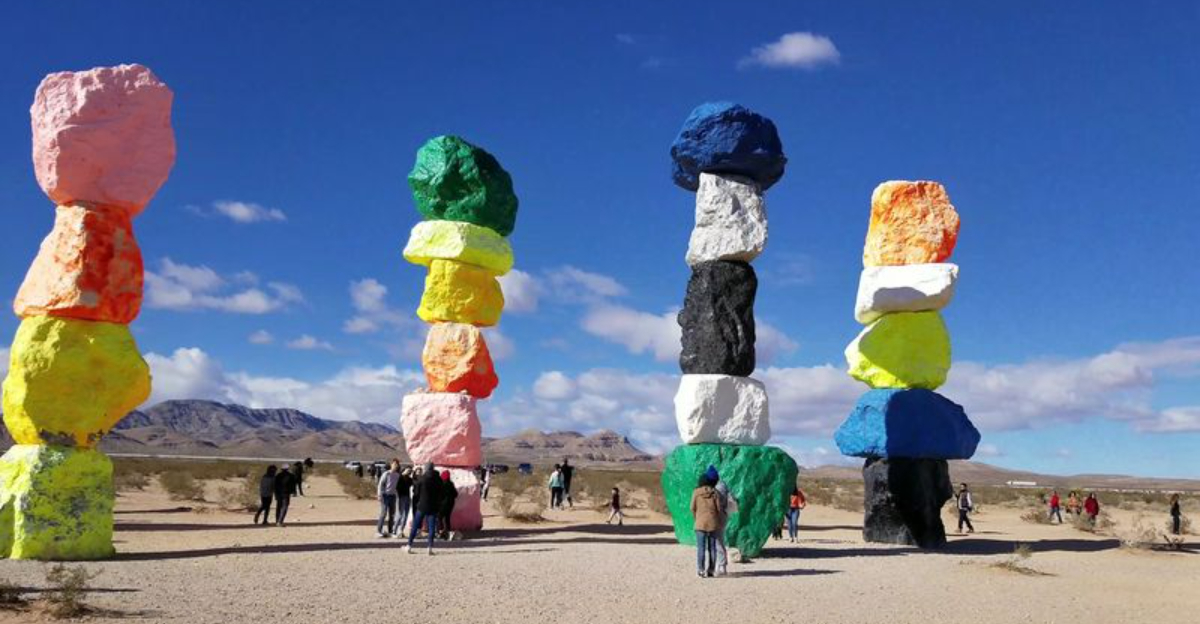
Picture this: you’re cruising south on Interstate 15. Desert beige stretches endlessly in every direction. Then seven towers of stacked boulders erupt from the Nevada floor in shades of electric pink, blazing orange, and cartoon blue.
Nobody warned you. There’s no buildup. Just suddenly, color stacked impossibly high, like a giant knocked over a bag of crayons and walked away.
It’s the kind of roadside sight that makes you yank the wheel without thinking. The best part? Zero dollars to get in. No ticket booth, no reservation, no catch. Just you, the desert heat, and what might be the most photographed stretch of open land in the entire state. Pull over. It’s worth it.
The Installation Was Created By Swiss Artist Ugo Rondinone
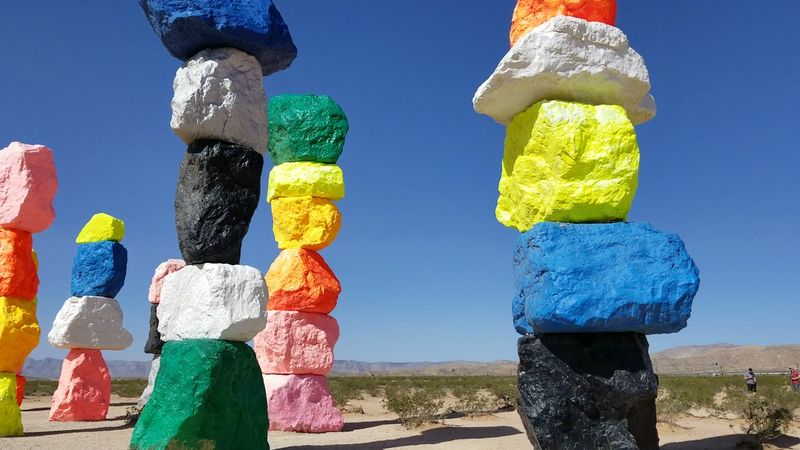
Ugo Rondinone conceived Seven Magic Mountains as a meditation on the relationship between natural landscapes and human intervention. The Swiss artist, known for his explorations of time, nature, and emotion, designed the installation to exist somewhere between land art and pop art.
His vision was to create something that felt simultaneously ancient and contemporary, as though the towers had always belonged in this particular stretch of desert.
Rondinone chose Nevada specifically for its stark beauty and proximity to Las Vegas, creating a deliberate contrast between the manufactured spectacle of the city and the raw authenticity of the desert. The project took years to realize, requiring environmental studies, permits, and collaboration with the Nevada Museum of Art and the Art Production Fund.
His choice of fluorescent colors was intentional, meant to amplify rather than blend with the surrounding landscape.
The artist has described the work as a symbol of human creativity persisting in the natural world. Rondinone’s broader body of work often explores similar themes, but Seven Magic Mountains remains his most accessible and publicly celebrated piece.
Seven Towers Rise More Than 30 Feet Above The Desert
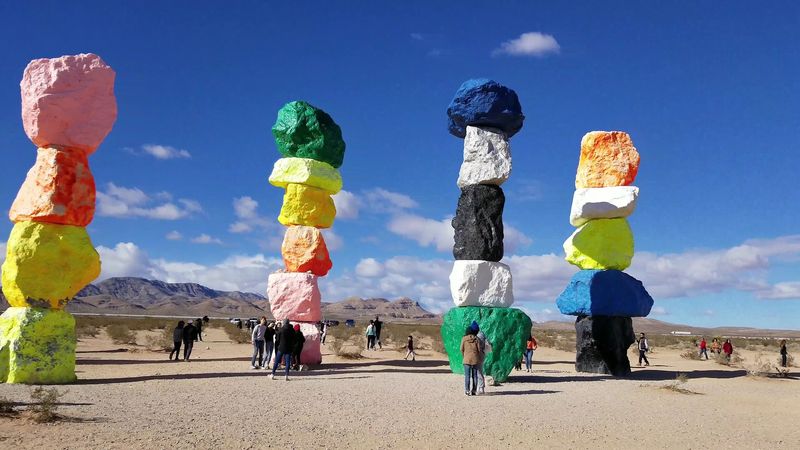
The scale of Seven Magic Mountains surprises most visitors who arrive expecting something modest. These towers loom large against the flat expanse of the Mojave Desert, with the tallest reaching more than 30 feet into the sky.
Each stack consists of locally sourced limestone boulders balanced carefully atop one another, creating vertical sculptures that defy both gravity and expectation.
Standing at the base of any tower offers a humbling perspective on the engineering required to assemble such massive structures. The boulders themselves weigh several tons each, and their careful arrangement required cranes, precision planning, and considerable patience.
Visitors often circle the towers slowly, necks craned upward, trying to understand how something so precarious remains standing in the desert wind.
The height allows the installation to be visible from the highway, serving as a beacon for curious travelers. From a distance, the towers appear almost flat against the horizon, but approaching them reveals their true dimensionality and impressive vertical reach into the cloudless Nevada sky.
It Sits Just Outside Las Vegas Near Jean Dry Lake
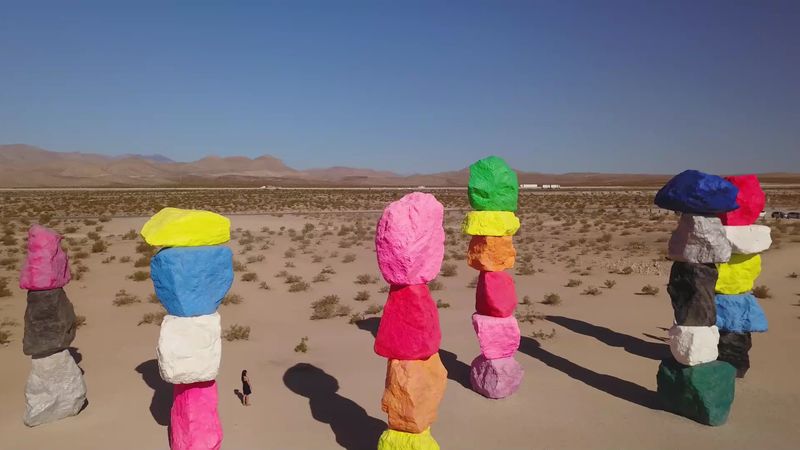
Seven Magic Mountains occupies a stretch of desert approximately 10 miles south of Las Vegas Boulevard, positioned between the city and the small town of Jean. The installation sits near Jean Dry Lake, a flat expanse that occasionally fills with water during rare desert storms but typically remains parched and cracked.
This location was chosen deliberately for its accessibility and its stark visual emptiness, which allows the colorful towers to command full attention.
The site is located along South Las Vegas Boulevard, easily reachable from Interstate 15. Visitors traveling between Las Vegas and Southern California often spot the towers from the highway and exit to investigate.
The proximity to the city makes it an ideal escape for tourists seeking something beyond casinos and neon lights, yet the desert surroundings create a sense of isolation and quiet.
Jean Dry Lake itself has a history as a filming location and occasional venue for events, but the area around Seven Magic Mountains remains undeveloped. The lack of commercial intrusion preserves the installation’s contemplative atmosphere, allowing visitors to experience the art without distraction.
Admission Is Completely Free For Visitors
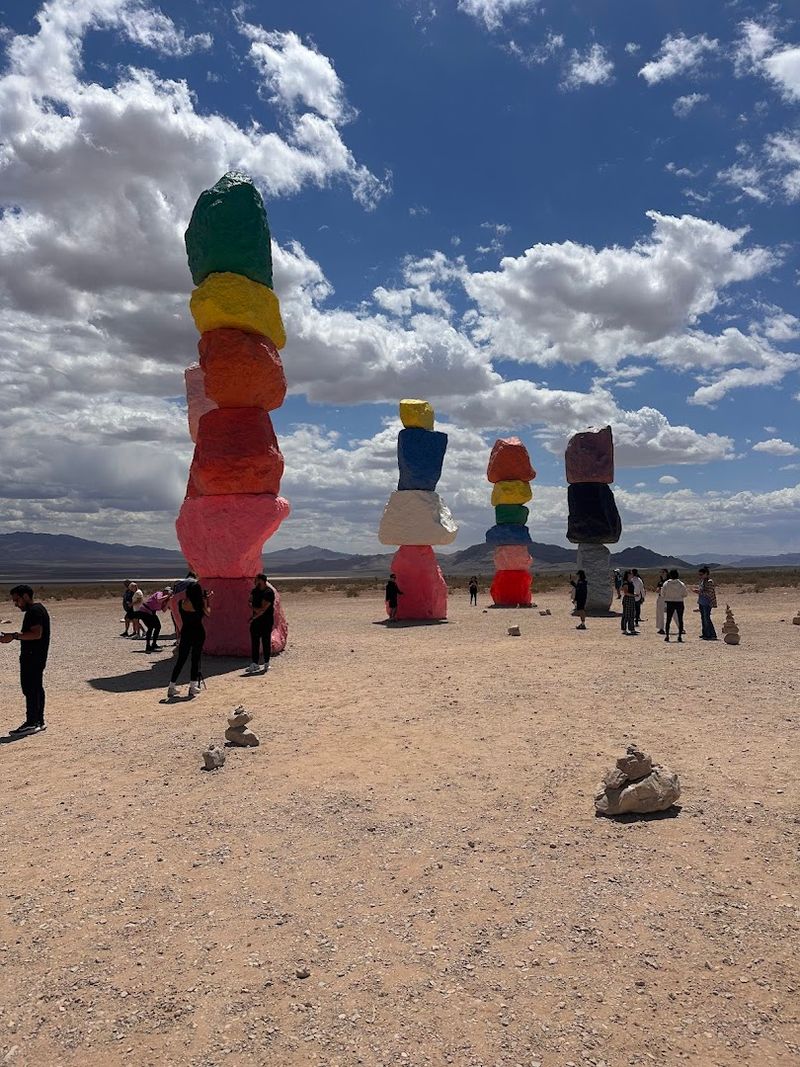
Seven Magic Mountains operates without admission fees, parking charges, or ticketing systems of any kind. Visitors simply pull off the road, park in the designated lot, and walk directly to the installation.
This accessibility was a core principle of the project from its inception, reflecting a belief that public art should remain genuinely public and available to anyone regardless of economic status.
The site remains open 24 hours a day, allowing visitors to experience the towers at sunrise, midday, sunset, or under the stars. Early morning and late afternoon offer the most comfortable temperatures and the best lighting for photography, but the installation never closes.
There are no guards, no gates, and no restrictions on how long visitors can stay or how they interact with the space.
Funding for the project came from private donors and arts organizations rather than public tax dollars, yet the decision to keep it free reflects a commitment to inclusivity. Families, photographers, artists, and curious travelers all mingle at the site, united by the simple act of looking at something unexpected in the middle of the desert.
The Bright Colors Make A Wild Contrast Against The Nevada Desert
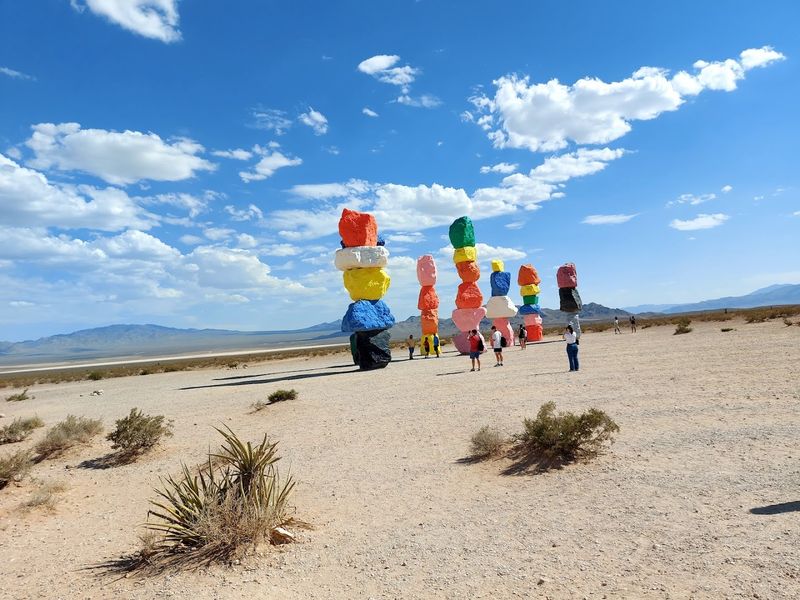
The fluorescent paint coating each boulder creates a visual shock against the muted tones of the Mojave Desert. Shades of hot pink, electric yellow, vivid orange, lime green, and deep blue pop against the beige sand and pale blue sky, creating a contrast so sharp it almost vibrates in the midday sun.
The colors feel borrowed from a different world, as though someone airlifted a piece of Miami Beach or a neon sign factory into the emptiness of Nevada.
This deliberate clash between natural and artificial was central to Rondinone’s vision. The desert provides a neutral canvas that allows the colors to sing without competition, while the colors themselves force viewers to reconsider the landscape around them.
Suddenly, the subtle variations in the desert’s palette become more visible, the shadows more pronounced, the sky more expansive.
Photographers flock to the site because the contrast creates images that require no filters or enhancements. The colors remain vivid even in harsh light, and the surrounding desert prevents visual clutter.
Sunset and sunrise amplify the effect, bathing the towers in golden light that softens the fluorescence without diminishing its impact.
Each Tower Is Made From Stacked Locally Sourced Boulders
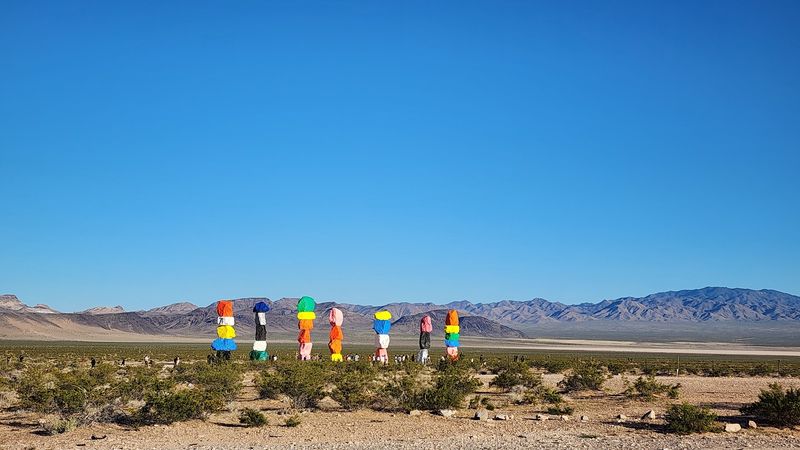
The boulders used in Seven Magic Mountains were quarried from sites within Nevada, honoring a tradition in land art of using materials native to the location. These limestone rocks carry the geological history of the region, formed over millions of years from ancient seabeds and compressed sediment.
Their irregular shapes and rough textures remain visible beneath the paint, grounding the installation in the physical reality of the desert.
Each tower required careful selection of boulders that could balance properly while creating the desired height and visual impact. Engineers worked alongside artists to determine the arrangement, ensuring structural stability against wind, temperature fluctuations, and seismic activity.
The boulders were transported to the site, lifted by crane, and positioned with precision that belied their massive weight.
Using local materials connected the project to Nevada’s landscape in a fundamental way. Rather than importing stones or using manufactured materials, Rondinone chose to work with what the desert provided.
The limestone’s natural color peeks through in places where the paint has weathered, creating unexpected layers of texture and revealing the organic foundation beneath the vivid exterior.
Visitors Should Go Early Or Late To Avoid The Harsh Desert Heat
Summer temperatures in the Nevada desert regularly exceed 110 degrees Fahrenheit, transforming the area around Seven Magic Mountains into an oven by midday. The site offers no shade, no shelter, and no relief from the sun, making timing crucial for a comfortable visit.
Early morning hours, particularly between sunrise and 9 a.m., provide cooler temperatures and softer light that enhances the colors without causing heat exhaustion.
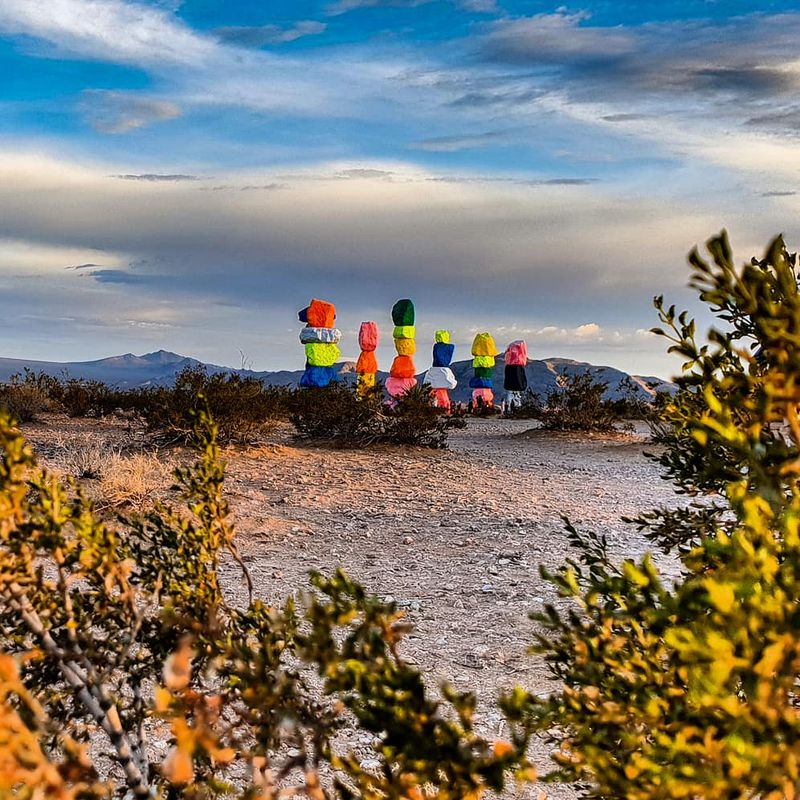
Late afternoon visits, starting around 5 p.m., offer similar advantages as the desert begins to cool and the sun drops toward the horizon. The angled light during these hours creates dramatic shadows around the towers and enriches the fluorescent colors with warm undertones.
These times also tend to be less crowded, allowing for better photographs and a more contemplative experience.
Visitors who arrive during midday heat should bring substantial water, wear protective clothing and sunscreen, and limit their time at the site. The reflective quality of the painted boulders can intensify the sun’s glare, and the open parking area provides no escape.
Checking weather forecasts and planning accordingly transforms the visit from an ordeal into a memorable encounter with art and landscape.