
Step Back In Time At This Presidential Museum In Albany, New York That Feels Like An Entirely Different Era
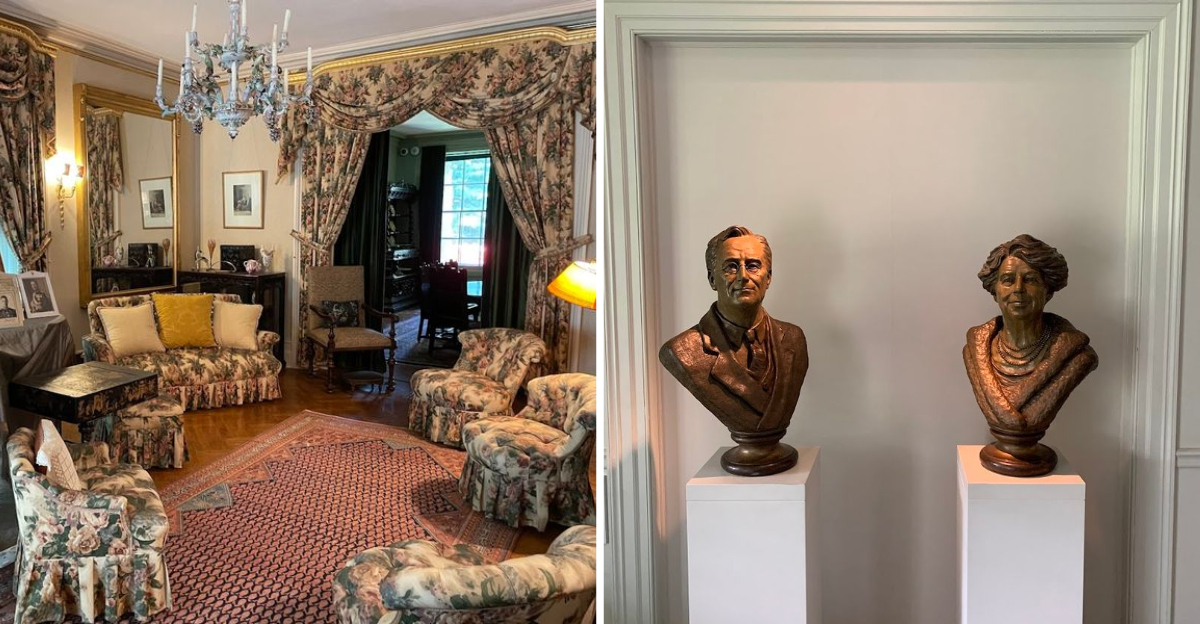
The moment you walk in, the pace shifts. Rooms feel preserved rather than recreated, and the details don’t need explaining to make an impression.
This presidential museum in New York doesn’t rely on screens or modern displays to hold your attention, it lets the setting speak for itself.
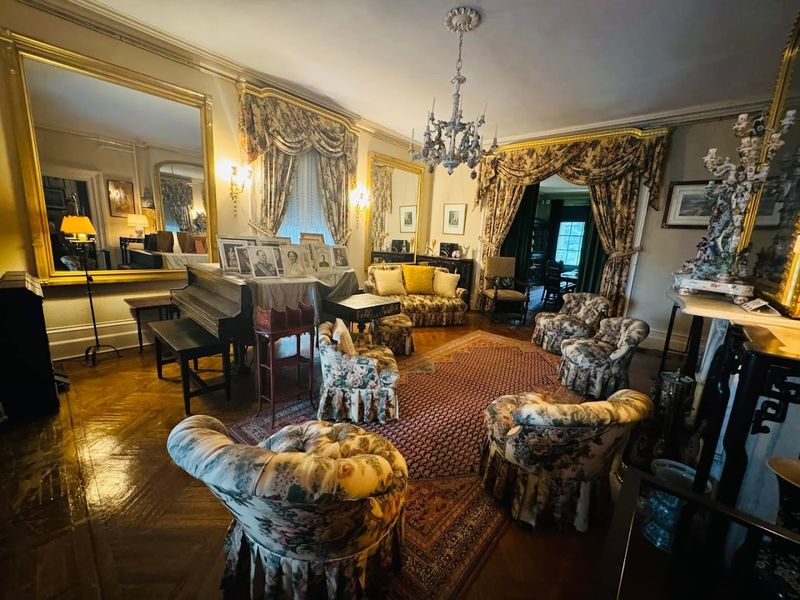
Move through it slowly and the atmosphere starts to settle in. Furniture, documents, and everyday objects bring the era into focus without overcomplicating the experience.
Nothing feels rushed or overdesigned. It’s simple, direct, and surprisingly immersive.
Spend a little time here, and it becomes less about reading history and more about stepping into it, even if just for a while.
A Presidential Library Unlike Any Other
Before most people even knew what a presidential library was, Franklin D. Roosevelt was already building one.
Established under his own direction between 1939 and 1940, the Franklin D. Roosevelt Presidential Library and Museum became the first institution of its kind in the United States.
That distinction alone makes it worth the drive to Hyde Park.
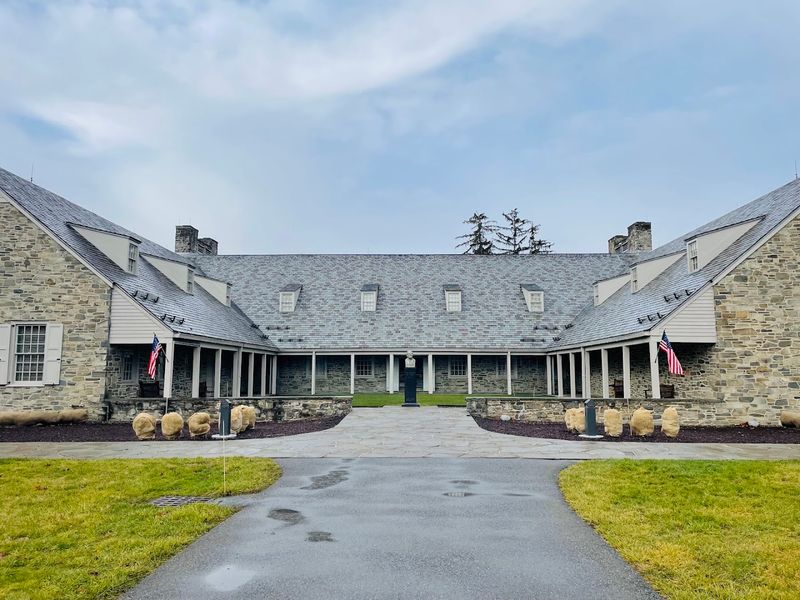
The building carries a quiet confidence that suits its purpose well. Dutch Colonial Revival in style, it blends naturally into the surrounding landscape without demanding attention the way some monuments do.
The grounds are beautifully maintained, with open lawns and mature trees framing the property in every season.
Dedicated on June 30, 1941, the library opened while Roosevelt himself was still in office, a remarkable and almost unheard-of act of transparency. He wanted the public to have access to the record of his presidency, and that spirit of openness still defines the place today.
Few institutions carry that kind of founding intention so visibly. Arriving here feels less like entering a museum and more like being welcomed into a living chapter of American history that has never quite closed.
Getting There And Planning Your Visit
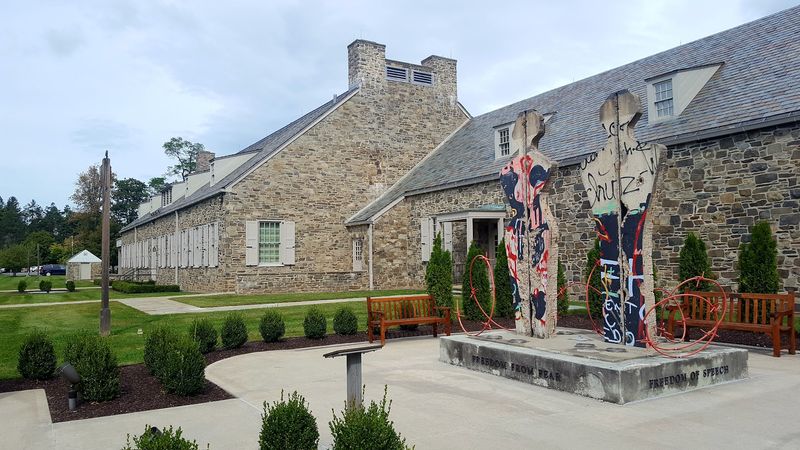
Located at 4079 Albany Post Rd, Hyde Park, NY 12538, the museum sits about four miles north of Poughkeepsie, roughly halfway between New York City and Albany. Getting there is straightforward whether you prefer driving along the scenic Hudson Valley corridor or hopping a Metro-North train to Poughkeepsie and arranging a short ride north.
The museum is open daily from 9:00 a.m. to 5:00 p.m. during the cooler months, extending to 6:00 p.m. from April through October. Adult admission is currently priced at $15, and veterans receive free entry, which is a genuinely appreciated gesture.
Children ages 15 and under also enter free of charge.
Experienced visitors consistently recommend setting aside at least three to four hours to move through the exhibits at a comfortable pace. Rushing through here would be a genuine disservice to the material and to yourself.
The museum holds enough depth to keep a curious mind engaged for an entire afternoon. Call ahead at 845-486-7770 or visit fdrlibrary.org to check current hours, special programs, and any ticketing updates before your trip.
Good planning makes for a much more rewarding day.
The Great Depression And New Deal Exhibits
Few periods in American history carry as much weight as the 1930s, and the exhibits covering the Great Depression and the New Deal bring that era into sharp, human focus. Original documents, photographs, and artifacts line the galleries in a way that makes the scale of the crisis feel real rather than abstract.
You are not reading about hard times from a distance here.
Roosevelt’s response to the economic collapse was ambitious and deeply controversial in its day. The New Deal programs he championed reshaped the relationship between the federal government and ordinary Americans in ways that still echo through public policy today.
Seeing the original paperwork and correspondence behind those decisions adds a dimension that no textbook can fully replicate.
The curators have done an admirable job of presenting this material with clarity and context, making it accessible to visitors of all ages and backgrounds. A teenager on a school trip and a retired economist can stand in the same gallery and each walk away with something meaningful.
That kind of broad accessibility is genuinely difficult to achieve in a history museum, and the FDR Library pulls it off with impressive consistency throughout this section.
Original Artifacts And Historic Personal Items
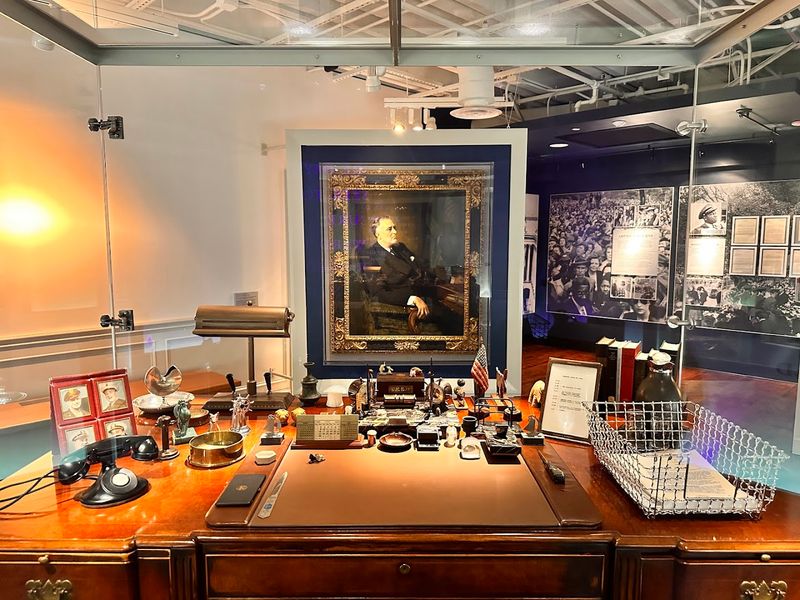
Roosevelt’s personal desk sits inside the museum exactly as history left it, and standing near it produces an unexpectedly quiet moment of reflection. His wheelchair, his correspondence, and other personal effects are displayed with the kind of care that communicates genuine respect for the man and his story.
These are not reproductions.
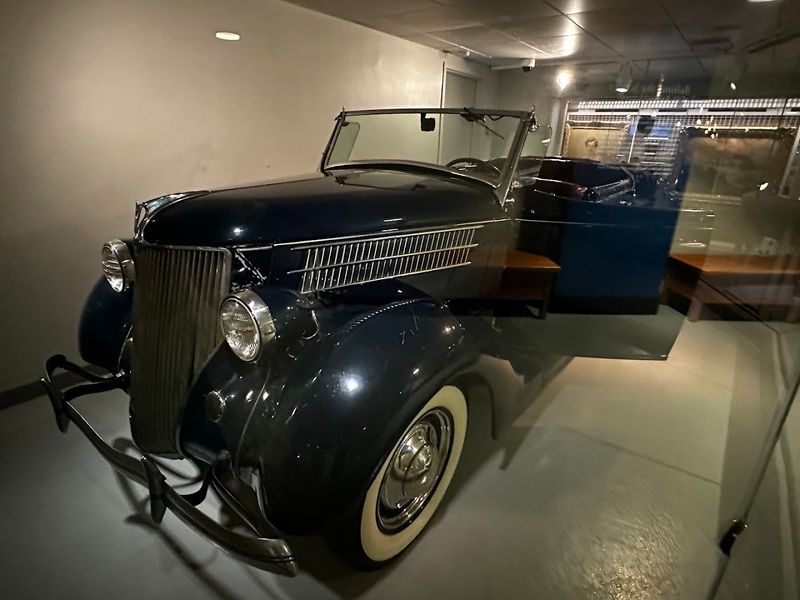
One of the more popular items among visitors is Roosevelt’s presidential automobile, a specially modified 1936 Ford Phaeton that accommodated his limited mobility. Seeing the car in person conveys something about his character that words alone struggle to capture.
He adapted, continued, and led without making his physical condition the defining story of his presidency.
The basement level of the museum houses ship models alongside the automobile, creating an interesting contrast between FDR the naval enthusiast and FDR the wartime commander. He had a lifelong passion for the sea and for naval history, and that personal dimension adds warmth to what might otherwise be a purely political institution.
Personal objects have a way of humanizing historical figures that no amount of written text can fully achieve, and the FDR Library understands this instinctively. Every artifact on display earns its place.
Eleanor Roosevelt’s Remarkable Legacy On Display
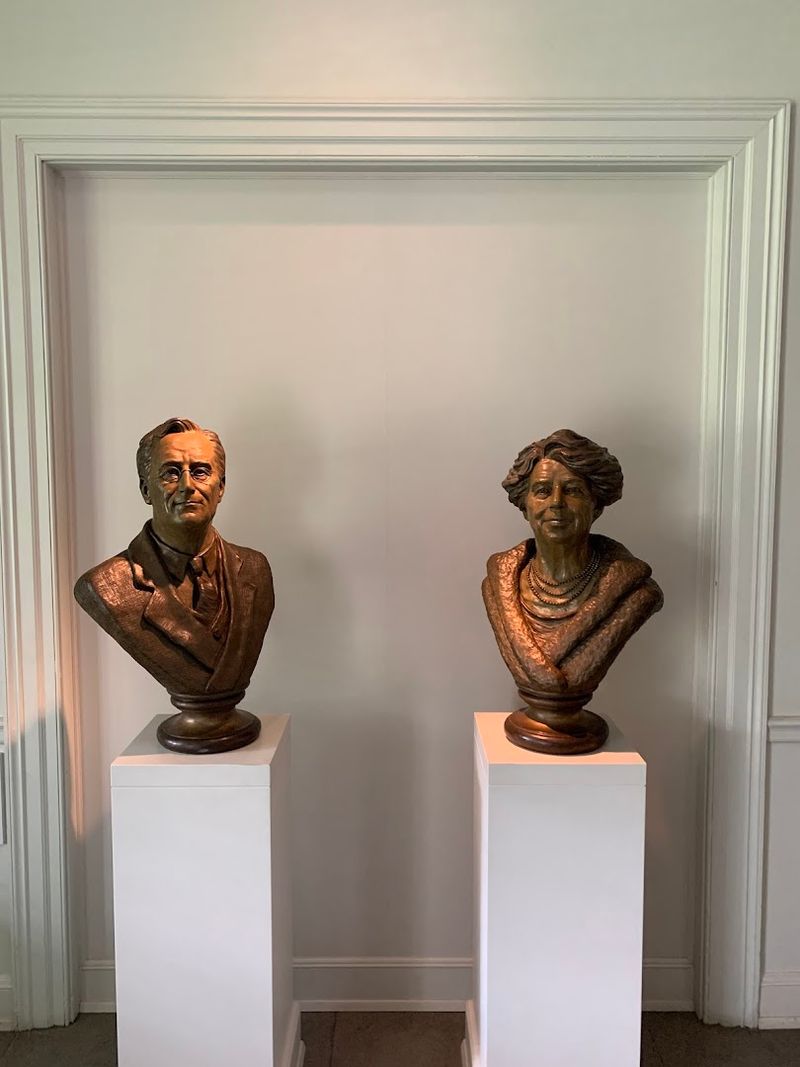
Two full wings of the museum are dedicated to Eleanor Roosevelt, and the space they occupy feels entirely justified.
Her influence on American public life extended far beyond the role of first lady, and the exhibits trace her work as a diplomat, humanitarian, and advocate with the same rigor applied to her husband’s presidency.
She was a force entirely her own.
Eleanor’s correspondence alone fills volumes, and selected letters on display reveal a mind that was sharp, compassionate, and unafraid of controversy. Her post-presidential years, during which she helped draft the United Nations Universal Declaration of Human Rights, are covered with particular depth.
Many visitors leave the Eleanor section feeling that her story deserves even more space than it already receives.
The museum presents both Roosevelts as individuals with distinct voices and convictions rather than as a single unified narrative. That editorial decision gives the institution a maturity and intellectual honesty that elevates it above the average commemorative museum.
For visitors who arrive primarily interested in Franklin and leave equally fascinated by Eleanor, the museum has done exactly what it set out to do. Her legacy is presented with the full weight it deserves, and the result is genuinely moving.
Interactive Displays And Audio-Visual Theaters
History museums that rely solely on static displays can lose a visitor’s attention faster than they might expect. The FDR Library addresses that challenge directly with interactive exhibits and audio-visual theaters that bring the Roosevelt era to life in genuinely engaging ways.
The Milstein Auditorium at the Henry A. Wallace Visitor and Education Center screens an orientation film that provides excellent context before you move through the main galleries.
The interactive elements are designed thoughtfully, inviting visitors to engage with the material rather than simply observe it from behind a velvet rope.
Younger visitors respond especially well to these sections, and families with children will find that the museum holds attention across generations without dumbing down the content for anyone.
That balance is harder to strike than it looks.
Audio components throughout the exhibits include period recordings, speeches, and documentary narration that add texture and atmosphere to the visual displays. Hearing Roosevelt’s actual voice while standing among his personal papers creates a connection to the past that photographs alone cannot provide.
The museum’s investment in high-quality presentation technology reflects a deep commitment to making history accessible and memorable for every type of visitor who walks through the door.
Uncle Sam’s Canteen And The New Deal Museum Store
After several hours of absorbing history, a well-timed stop at Uncle Sam’s Canteen is a genuinely welcome pause. The cafe inside the Henry A.
Wallace Visitor and Education Center offers food and service that visitors consistently describe as better than expected for a museum setting. The staff are friendly, the space is comfortable, and the food is straightforward and satisfying.
The New Deal Museum Store next door has earned its own reputation as an unusually good museum shop. It carries books, educational materials, and thoughtfully selected gifts that reflect the Roosevelt era with more creativity than the average gift shop typically manages.
History enthusiasts tend to linger here longer than planned, which is about the highest compliment a bookstore can receive.
Both the canteen and the store are located within the visitor center, making them easy to access at the start or end of your visit without backtracking across the property. The visitor center also houses restrooms, a water refill station, and the orientation theater, so it serves as a natural anchor point for the day.
Starting your visit here to collect tickets, watch the orientation film, and get your bearings is genuinely the most efficient approach to navigating the entire site.
Why This Museum Belongs On Every History Lover’s List
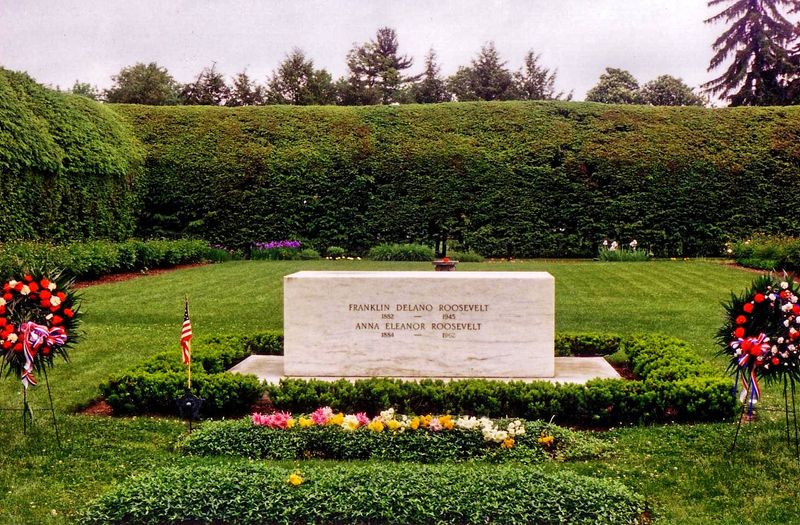
Holding a 4.8-star rating across hundreds of visitor responses, the Franklin D. Roosevelt Presidential Library and Museum has built a reputation that it consistently lives up to.
Visitors who arrive expecting a standard historical institution tend to leave describing the experience in much larger terms. The museum earns that response through the quality and depth of its content rather than through spectacle.
Roosevelt led the United States through twelve years and four terms that included two of the most severe crises the country has ever faced. Understanding that period more fully is not just a matter of historical curiosity.
The decisions made during those years shaped the social, economic, and political structures that Americans still live within today. That relevance gives the museum a weight that many institutions quietly lack.
Veterans enter free, children under 16 enter free, and the $15 adult admission represents exceptional value for the depth of experience on offer. The museum is suitable for solo travelers, couples, families, and school groups alike, with enough material to satisfy the casual visitor and the dedicated history enthusiast in equal measure.
A trip to Hyde Park to spend a full day at this institution is time that will not feel wasted by anyone who makes it.