
There’s A Real-Life UFO House Waiting In The Woods Of Tennessee
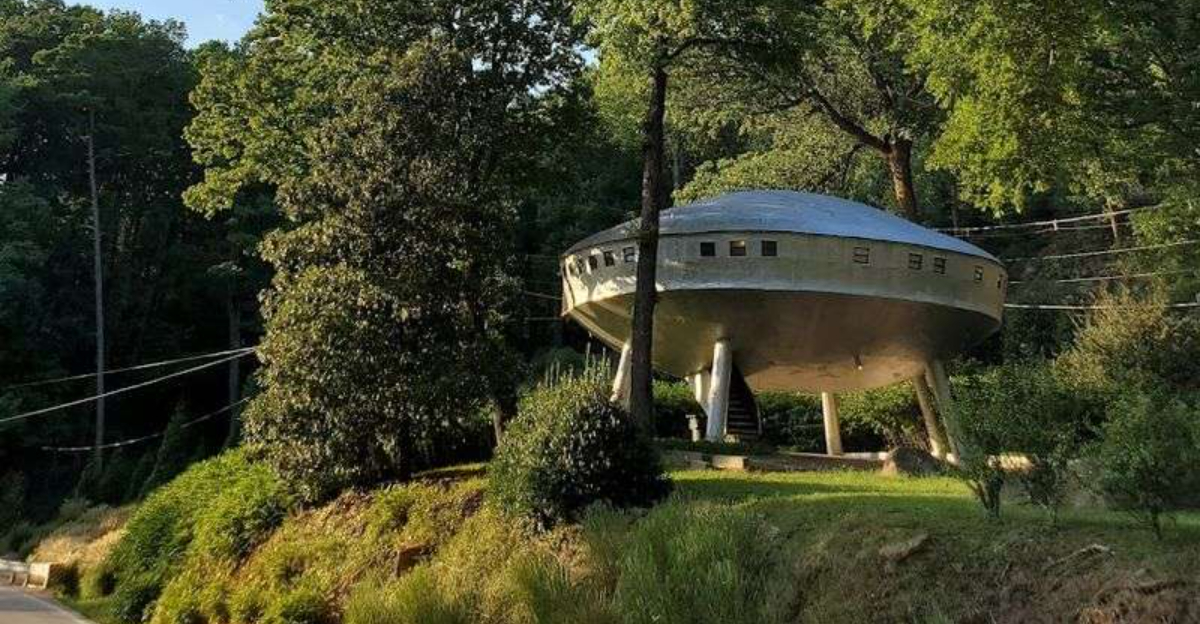
Some houses have porches, shutters, and neat little lawns. This one looks ready for takeoff.
Deep in Tennessee, there’s a real-life UFO-shaped house that feels more like a movie prop than an actual roadside find. Its round frame, raised design, and space-age look make it impossible to ignore, especially if you love odd attractions with a bit of mystery.
It is strange in the best way.
You do not need to believe in aliens to enjoy this stop. You just need a soft spot for unusual architecture, quirky travel stories, and places that make you say, “Wait, is that real?” Tennessee has plenty of scenic views and classic small-town stops, but this one adds something much weirder to the mix.
The Builder Behind The Vision
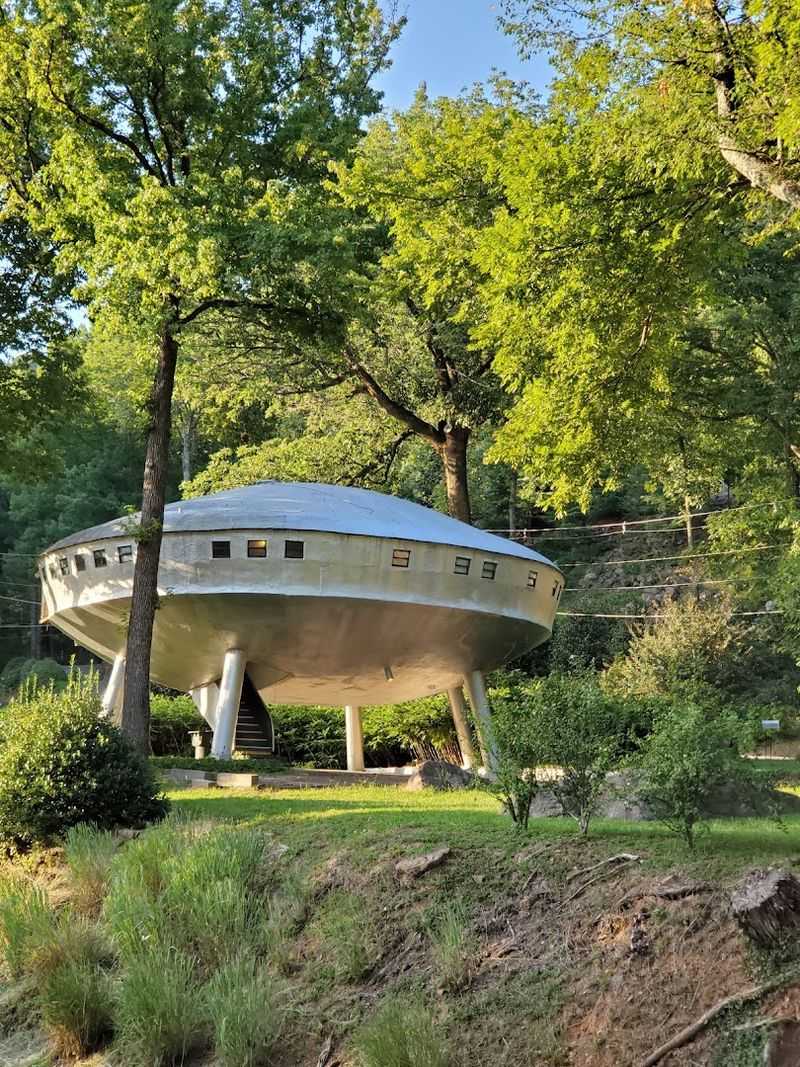
Curtis W. King was not the kind of builder who played it safe.
The Chattanooga-based contractor designed and constructed this place between 1970 and 1973, originally envisioning it as a bachelor pad for his sons and a bold demonstration of what residential architecture could become. He was, by most accounts, a man who genuinely believed the future deserved a physical address.
King estimated the construction cost at $250,000 at the time of completion – a figure that translates to roughly $1.34 million in 2024 dollars. That kind of financial commitment tells you something about how seriously he took the project.
This was not a weekend experiment or a novelty stunt.
The structural ambition alone was remarkable. King used a steel frame wrapped in concrete and finished with fiberglass – materials chosen for durability rather than mere showmanship.
The result was a home that has outlasted countless conventional houses built in the same era. King’s vision, however unconventional, was built to endure, and Signal Mountain has been living with his legacy ever since.
What The Structure Actually Looks Like Up Close
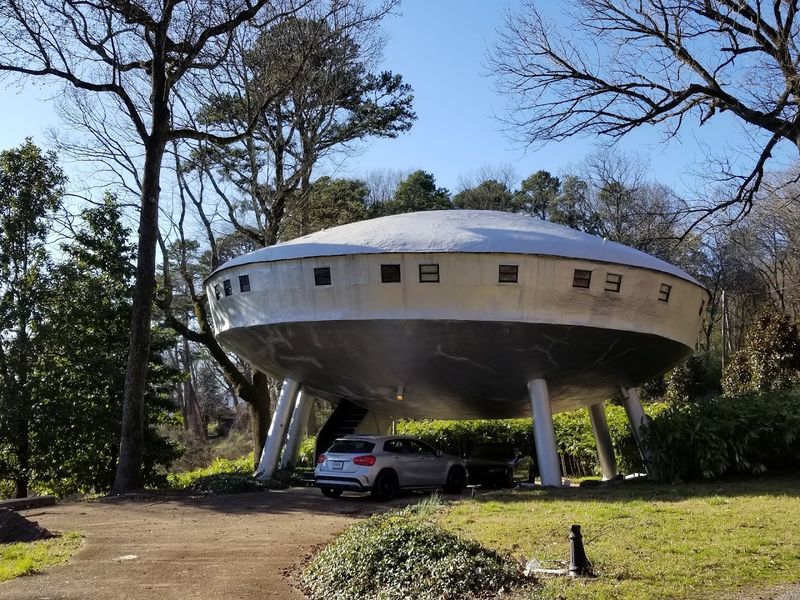
From a distance, the house reads as a visual joke your brain refuses to accept. Get closer, and the scale of the thing becomes genuinely impressive.
The disc measures 52 feet in diameter and sits elevated above the ground on six slanted columnar legs that angle outward like a landing craft preparing to touch down.
The exterior was painted silver around 2018, replacing the white finish it wore for many years prior. That color change did the house a considerable favor.
Silver suits the spacecraft aesthetic far better, and on overcast Tennessee mornings, the structure practically glows against the dark tree line behind it.
All plumbing and electrical lines run through those six supporting legs, which is both an engineering curiosity and a reminder that King thought through the practical details with real care. The house offers between 1,960 and 2,000 square feet of interior living space – not a cramped novelty capsule, but a fully functional home.
Visitors who pull over consistently report that photographs do not prepare you for the actual experience of standing in front of it. The location is 1408 S Palisades Dr, Signal Mountain, TN 37377.
Rooms That Orbit A Central Core
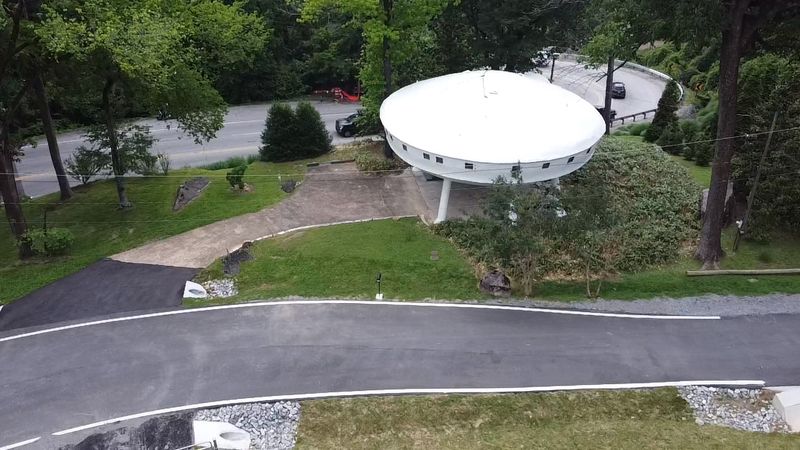
Every room inside the Flying Saucer House points back toward the center. That single design decision gives the interior a spatial quality unlike anything found in conventional rectangular homes.
Three bedrooms and two or three bathrooms arrange themselves around a central axis, and moving through the space feels less like walking through a house and more like navigating a vessel.
When the house was first completed, King outfitted it with amenities that were genuinely ahead of their time. A microwave oven, a trash compactor, and a closed-circuit television system for screening visitors at the door were all part of the original installation.
In the early 1970s, those features belonged to science fiction more than to everyday domestic life.
One of the most talked-about original features was an electrically retractable staircase – the kind of entrance mechanism you might expect on a private aircraft. Visitors had to be granted access before the stairs would descend.
That staircase is now permanently fixed in the lowered position after a mechanical failure, but its existence alone speaks volumes about the theatrical ambition King brought to every design choice inside this remarkable home.
The Setting That Makes It All Stranger
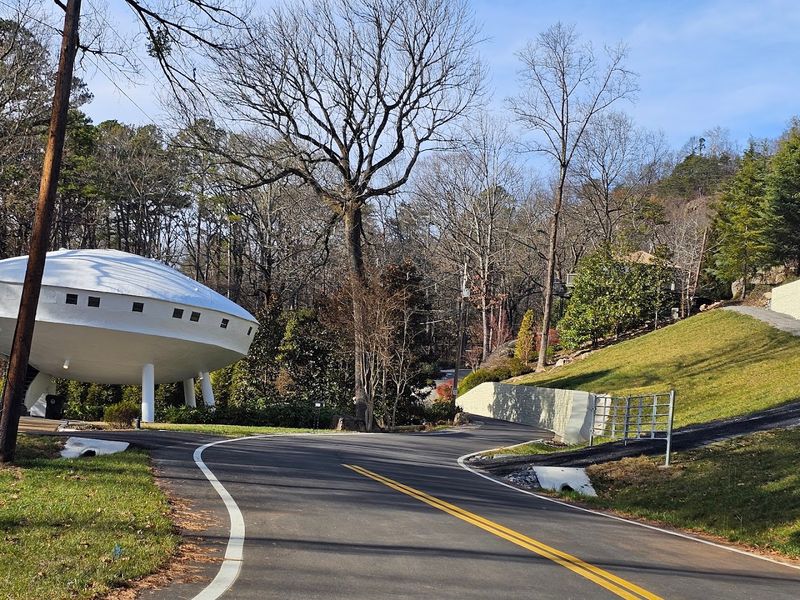
Signal Mountain sits above Chattanooga and is a community of winding roads, tall trees, and sudden valley views that most visitors only discover by accident. The mountain rises steeply from the Tennessee River valley.
The drive up South Palisades Drive involves the kind of curves that demand full attention and reward patience with genuinely spectacular scenery.
The curves are sharp, the grade is steep, and the drop-offs are not forgiving. Slowing down is not optional here.
It is the only reasonable approach, especially for first-time visitors who may also be craning their necks toward the treeline looking for a silver disc.
The Great Valley stretches out below, with Chattanooga visible at the bottom on clear days. That backdrop transforms the Flying Saucer House from a roadside oddity into something almost theatrical – a futuristic structure perched above an ancient landscape.
The setting earns its own credit in making this landmark feel genuinely otherworldly rather than merely eccentric.
A Landmark With A Surprisingly Practical Price History
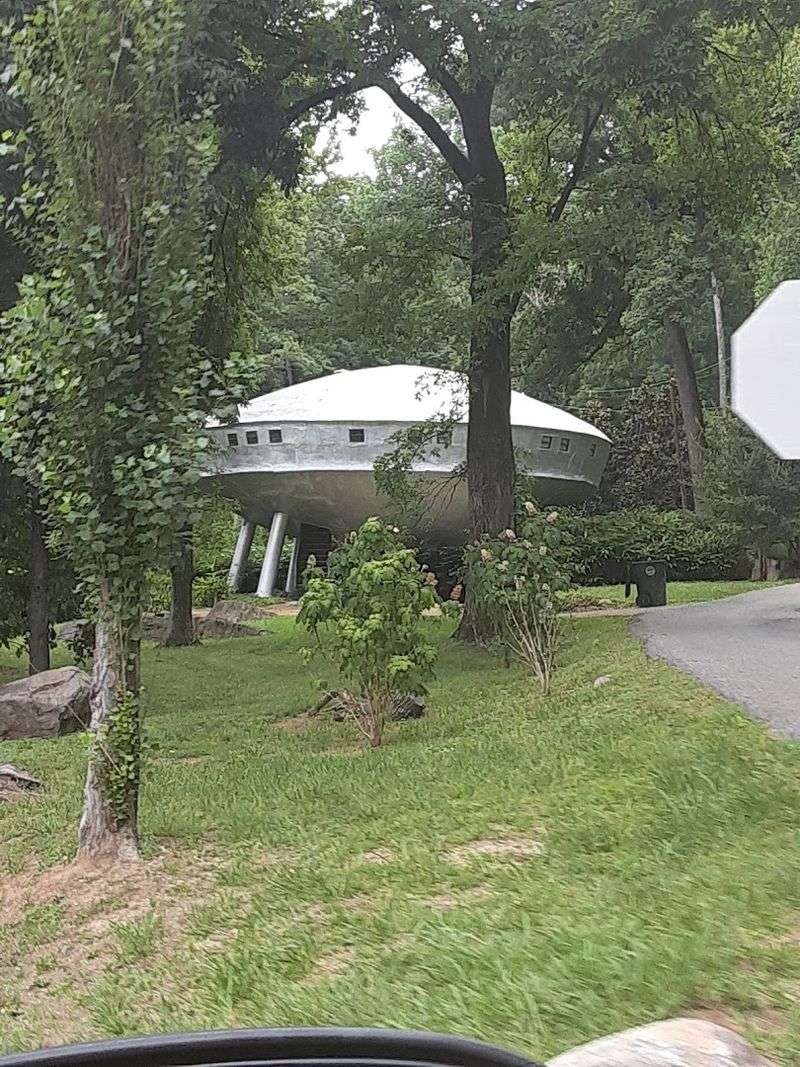
For a structure that cost the equivalent of $1.34 million to build in today’s dollars, the Flying Saucer House has changed hands at prices that would surprise most real estate observers. The property sold for $165,000 in 2007, and then again at auction for somewhere between $119,000 and $120,000 in 2008 or 2009.
By 2013, the property had transitioned into vacation rental use. This gave curious visitors the rare opportunity to actually sleep inside the saucer rather than simply photograph it from the road.
Rental rates around 2020 were reported at approximately $1,750 per month, which is a reasonable figure for a property of such singular character on a Tennessee mountainside.
As of 2022 and into 2024, the rental status has become less clear. Some Signal Mountain residents noted they had not observed regular activity at the property for some time.
The house remains privately owned and is not open for public tours or walk-throughs. Whatever its current occupancy, the structure itself shows no signs of fading from local consciousness or from the curiosity of passing travelers.
How Visitors Actually Experience The House Today
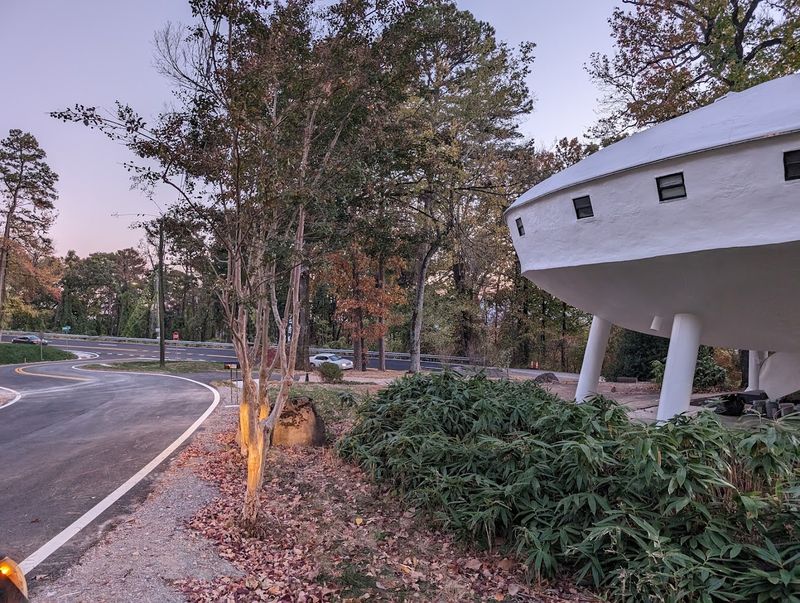
Most people encounter the Flying Saucer House exactly the way it deserves to be encountered by surprise. You are driving through Signal Mountain on your way to somewhere else, the trees part for a moment, and there it is.
The experience tends to produce an involuntary verbal reaction regardless of age or architectural sophistication.
There is a small turnout on the side of South Palisades Drive that accommodates visitors who want to stop, look, and photograph without blocking traffic. That detail matters on a road this narrow and curved.
The house appears on Roadside America, a well-regarded guide to unusual American landmarks. It is the kind of stop that takes five minutes and stays with you for considerably longer.
No ticket, no tour guide, no gift shop. Just a silver disc on a hillside, doing what it has always done, which is making perfectly rational people stop and stare.
The Multi-Generational Pull Of A Mountain Oddity
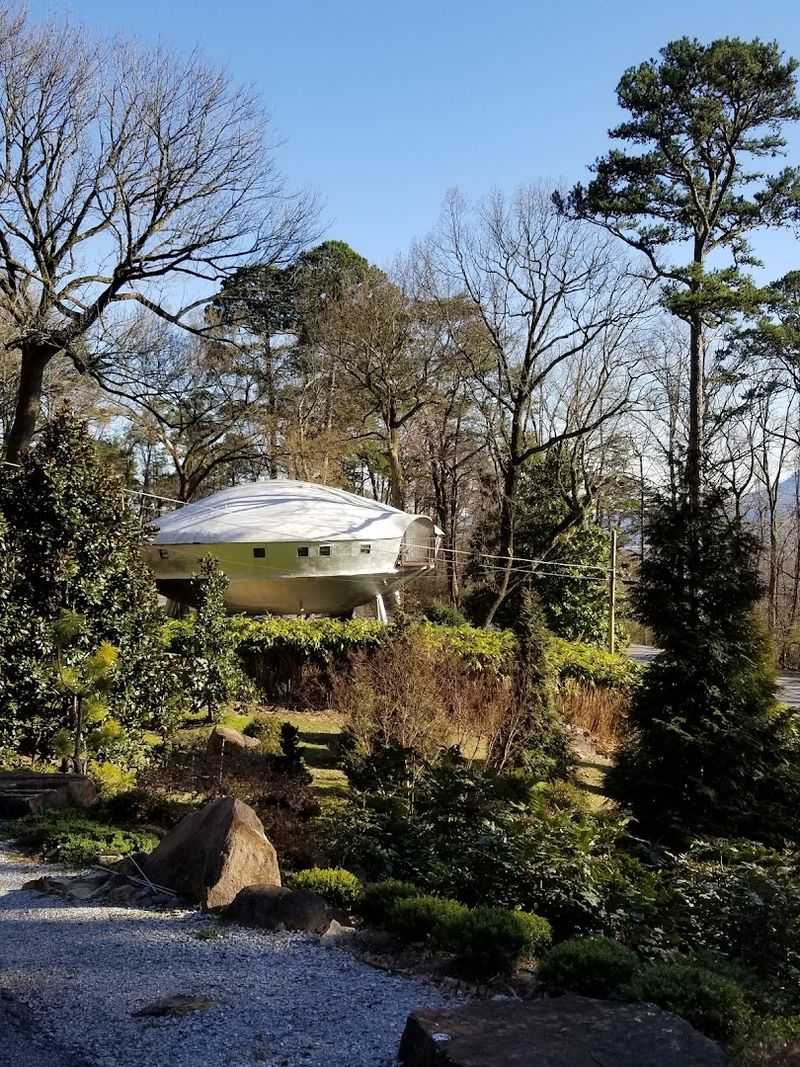
Few roadside landmarks manage to hold their appeal across generations, but this one has done exactly that for more than fifty years. One reviewer described seeing the house as a teenager on the way to Signal Mountain Youth Camp, then decades later pointing it out to their own daughter making the same trip.
Another reviewer mentioned that their daughter once attended a birthday sleepover inside the house at age twelve. That detail carries a particular quality – the idea that this landmark has also served as the backdrop for ordinary childhood memories.
It is a reminder that the house is, at its core, someone’s home rather than a performance.
The appeal crosses age groups with unusual consistency. Children respond to the spacecraft shape with immediate delight.
Adults respond to the engineering curiosity and the historical context. Older visitors tend to bring a layer of nostalgia, having watched the house age alongside their own lives.
That layered appeal explains why the Flying Saucer House remains a genuine landmark rather than a faded novelty.
The Architectural Style That Time Could Not Categorize
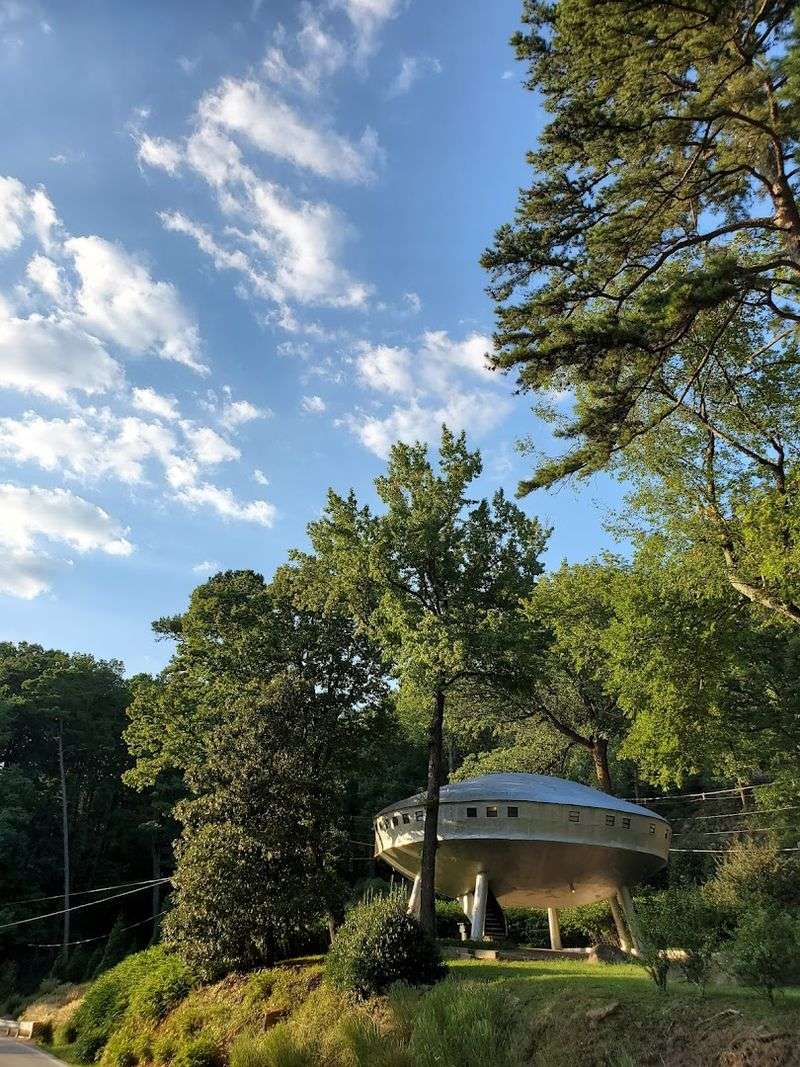
Architectural historians tend to approach the Flying Saucer House with a mixture of genuine admiration and mild bewilderment. It does not fit cleanly into any recognized movement.
It borrows from mid-century modernism, flirts with Googie architecture, and then takes a hard left turn into something that defies tidy classification. That resistance to categorization is part of what makes it architecturally interesting rather than merely visually odd.
The construction method itself reflects serious engineering intent. A structural steel frame provides the skeleton, concrete fills and shapes the body, and fiberglass provides the outer skin.
Decades later, the house remains structurally sound, which validates King’s material choices even if his aesthetic choices continue to provoke debate.
The circular floor plan, with all rooms radiating from a central point, reflects a genuine design philosophy rather than a gimmick. Circular homes have appeared across architectural history in various cultures, valued for their structural efficiency and their resistance to wind loads.
King was drawing on real principles, even if the flying saucer silhouette made those principles easy to overlook. The result is a home that works both as architecture and as spectacle.
What The Reviews Reveal About The Experience
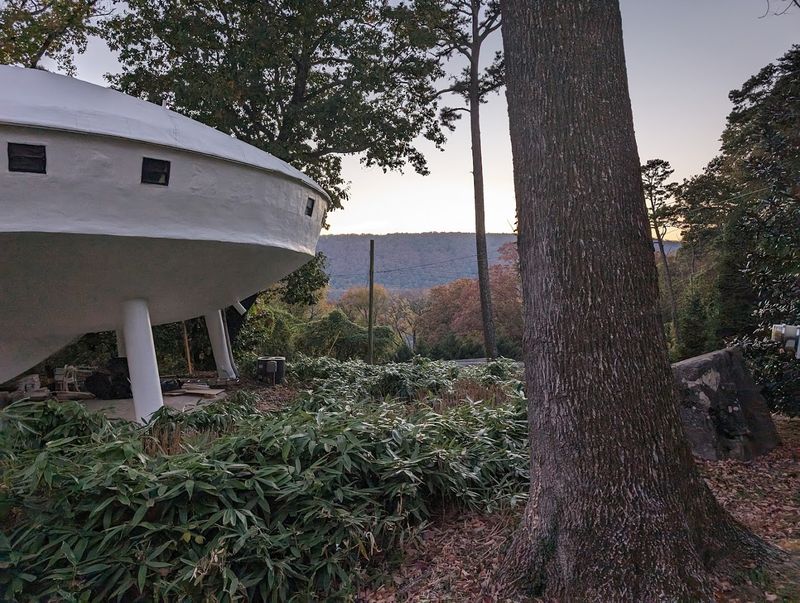
The Google Maps reviews for the Flying Saucer House read like a small anthology of American road-trip culture. Visitors from Arizona arrived wearing foil hats.
Others stumbled across the house mid-route to an unrelated destination and found themselves writing five-star reviews. The response pattern is remarkably consistent: surprise, delight, and an immediate desire to tell someone about it.
At least one visitor rated the experience two stars, arguing that the house looks better in photographs than in person and that the road itself carries more visual interest than the structure.
What the reviews collectively confirm is that the place delivers something increasingly rare on the American road: genuine surprise. Most landmarks are pre-digested through photographs and travel guides before you ever reach them.
This one retains its capacity to produce an authentic double-take, even for visitors who knew exactly what they were driving toward. That quality alone earns it a place on any serious road-trip itinerary through the Tennessee mountains.
Planning A Visit To 1408 S Palisades Drive
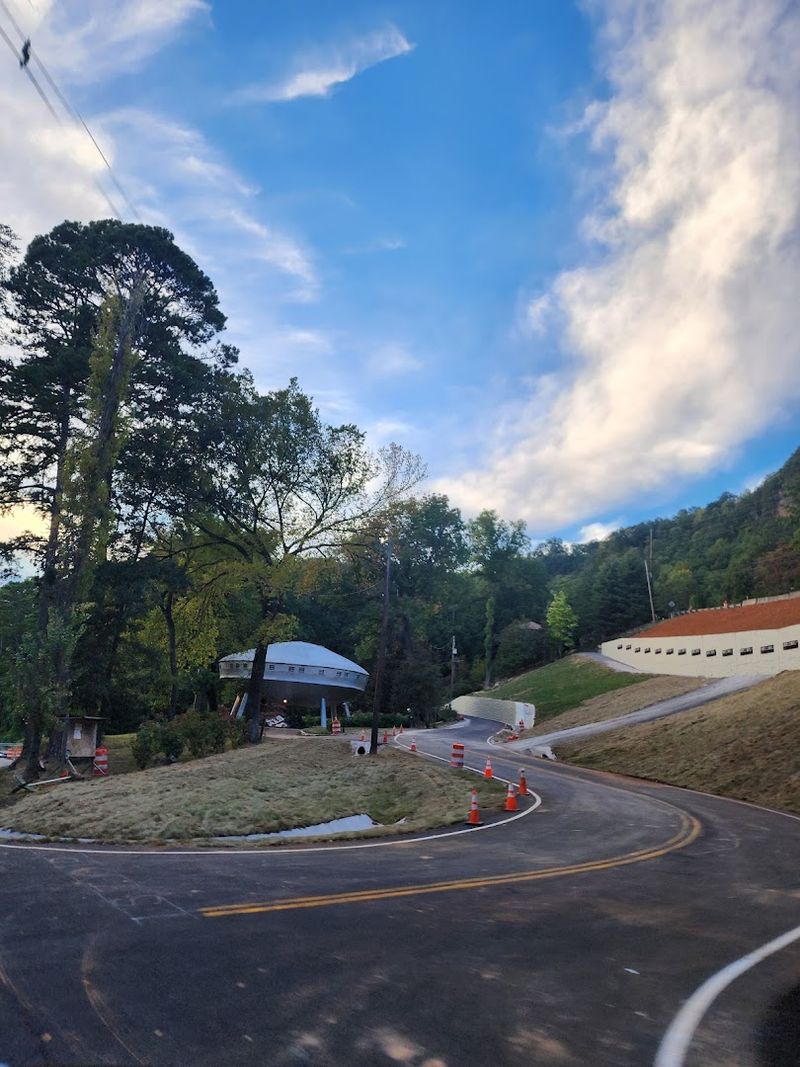
The drive itself is worth the effort independent of the destination. Signal Mountain sits above Chattanooga, and the approach via South Palisades Drive winds through mature forest with periodic views across the valley.
Allow more time than the map suggests – the curves demand a slower pace than most drivers initially expect.
The house is privately owned and not open for tours or visits. Approaching the property, knocking on doors, or attempting to enter the grounds is not appropriate and will not be well received.
The roadside pull-off provides a perfectly adequate vantage point for photographs and observation.
Google Maps lists operating hours for the landmark as a viewable roadside site. The house carries a 4.5-star rating across 93 reviews – a strong consensus for a structure you can only look at from a distance.
Pair the stop with a drive through the broader Signal Mountain area, and you have the foundation of a genuinely satisfying afternoon in the Chattanooga region.