
This Historic Tennessee Church Has Painted Ceilings And Stained Glass Most Locals Have Never Seen
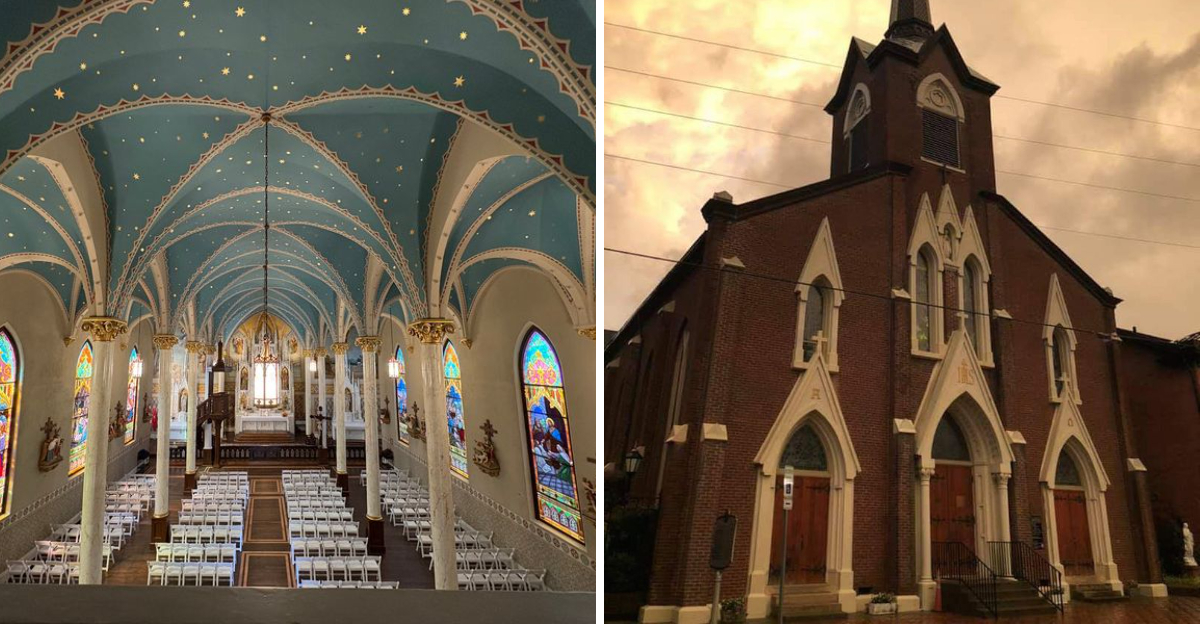
How many times can you pass a historic church without realizing what is waiting inside?
One Tennessee landmark gives that question a pretty surprising answer. Behind its brick exterior, painted ceilings, stained glass, murals, and carefully restored details turn the interior into something far more striking than most people expect.
The colors pull your eyes upward, and the artwork makes the room feel almost like a small gallery wrapped inside a place of worship.
What makes it even more interesting is how easy it is to overlook. Plenty of people know the neighborhood, but far fewer have taken the time to see what the church holds beyond its doors.
That contrast gives the visit its charm. The outside feels quiet and familiar.
Inside, every glance reveals another detail worth noticing, especially overhead, where the painted ceiling becomes one of the most memorable parts of the entire space.
A Ceiling Crowded With Over 2,000 Gold Stars
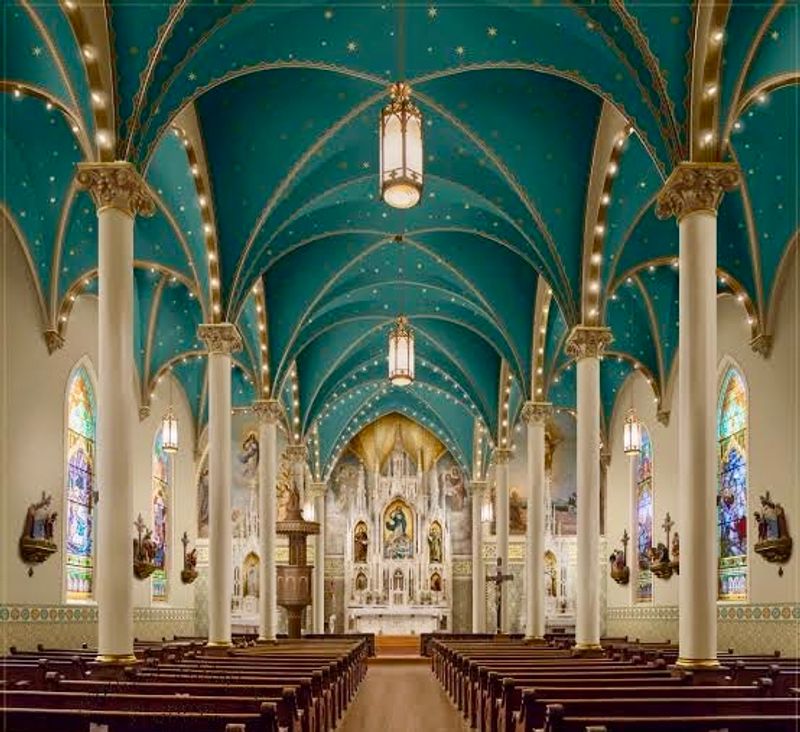
Look up first. That is the honest advice anyone would give you here.
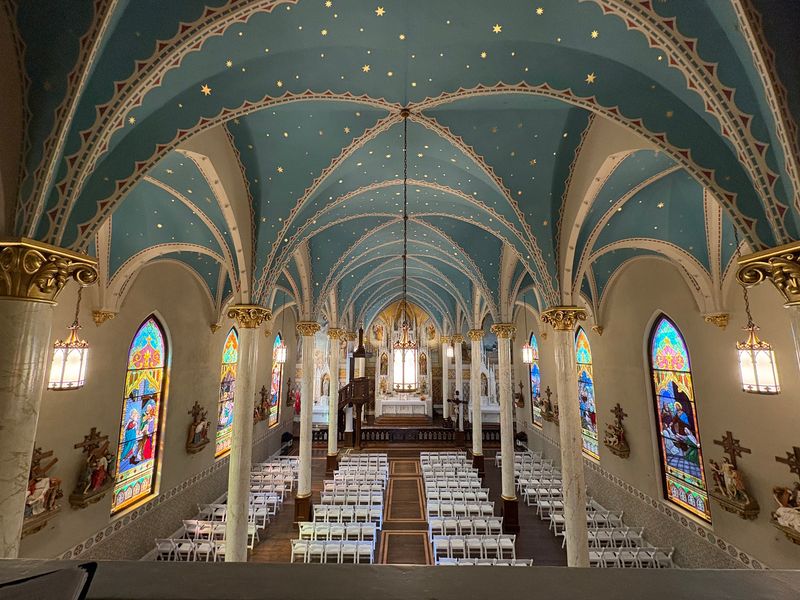
The vaulted ceiling glows a deep, saturated blue, and scattered across it are more than 2,000 gold-gilded stars.
The stars are not all the same. Artisans painted them in five-pointed, six-pointed, and eight-pointed versions, which keeps the whole surface from feeling mechanical.
The design nods to Psalm 147:4, a verse about God counting the stars and naming each one.
Here is the charming part. Parishioners could sponsor individual stars during a fundraising campaign, meaning the heavens above the nave were paid for one small point of light at a time.
A painted crescent moon joins the constellation, marked with Latin text drawn from Revelation 12:1. The imagery ties directly to Mary, the figure the parish is named for.
The gold used across the interior is 23-karat leaf, applied by hand. In daylight it reads as soft shimmer. Under the interior lighting it warms up considerably.
Most people expect painted ceilings in European cathedrals, not in a Tennessee neighborhood church. That contrast is exactly what makes the moment land so hard.
Give yourself a full minute to just stand still and stare upward before you look at anything else.
Stained Glass Rebuilt From A Single Small Photograph
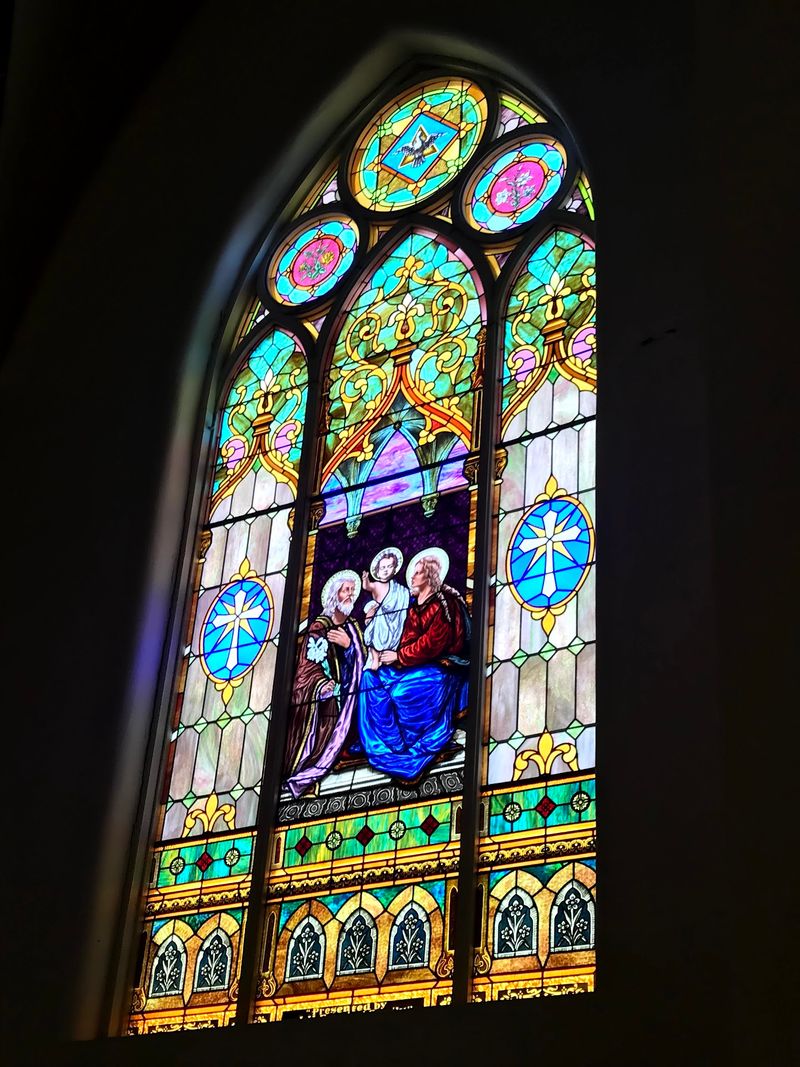
Restoring stained glass is delicate work. Recreating a destroyed window from one small photo is something else entirely.
That is what happened to the Holy Family window on the north wall at Assumption Church. A tornado tore through in March 2020 and left it severely damaged.
Conrad Schmitt Studios rebuilt the design using a small photograph as the only visual reference.
Much of the original glass made it back into the finished window. That detail matters.
It means the light passing through today is filtered through the same material that was set in place generations ago.
The window had already been restored once before, back in the late 1980s, so it has a long history of careful hands looking after it.
Other windows around the sanctuary tell the life of Christ. Those were installed around 1909, roughly fifty years after the building was dedicated, and they carry the rich jewel tones typical of that era.
Timing your arrival makes a real difference. Morning and late afternoon light hit different walls, so the colors you see depend entirely on when you show up.
Bring patience rather than a camera checklist. The panels reward slow looking, and the smaller background details tend to surface only after you have stood there a while.
Bricks Borrowed From Nashville’s First Catholic Church
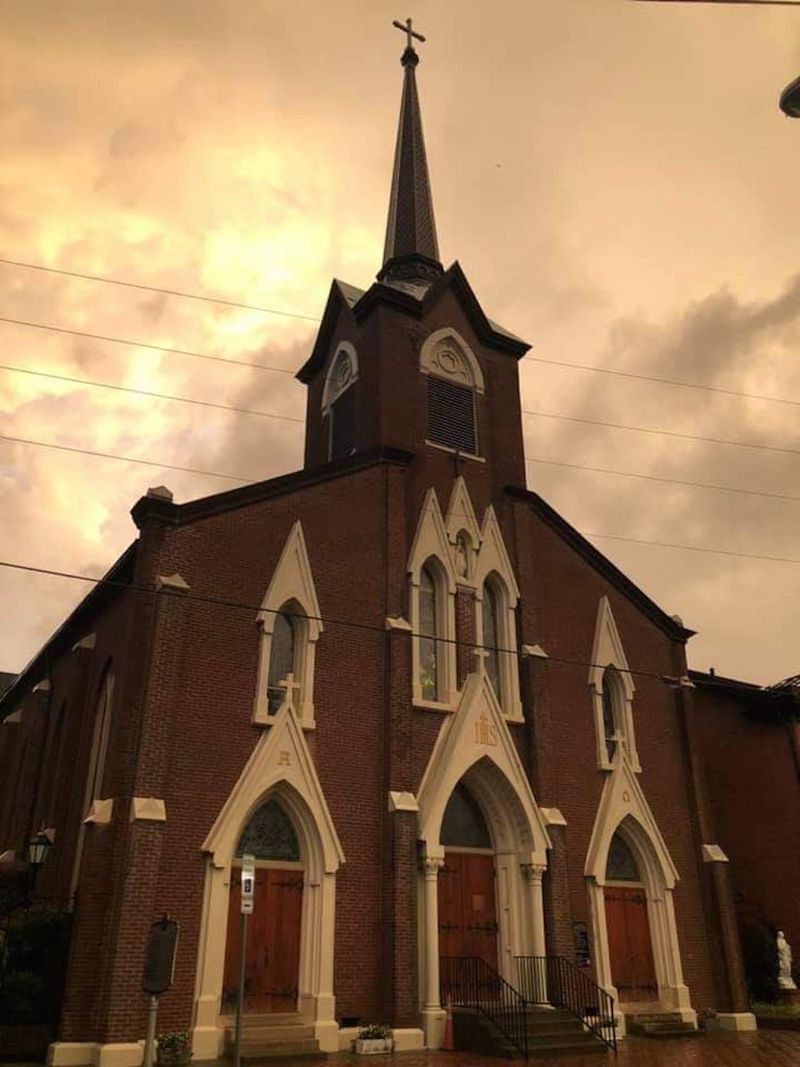
Recycling is not a modern invention. When crews built this church, they used bricks salvaged from Holy Rosary Cathedral, Nashville’s very first Catholic church.
Bishop Richard Pius Miles dedicated the finished building on August 14, 1859. That date makes it the second oldest Catholic church in the city, and the walls literally contain pieces of the oldest.
The reason it exists comes down to language and home. German immigrants had settled in the neighborhood now known as Germantown, and they wanted a place to worship in their own tongue, following their own traditions.
You can find it at 1227 7th Ave N, Nashville, TN 37208, on a corner surrounded by restored 19th-century houses.
The style you see now is not the 1859 original. During the 1880s the building was enlarged and reworked into the Gothic look it wears today, complete with pointed arches and a soaring roofline.
Recognition came later. The National Register of Historic Places added the church in 1977, and Germantown itself became a historic district in 1979.
Walk the exterior before heading inside. The brickwork, the proportions, and the way the steeple cuts against the sky all set up what you are about to find within.
Murals That Spent Decades Under A Coat Of Paint
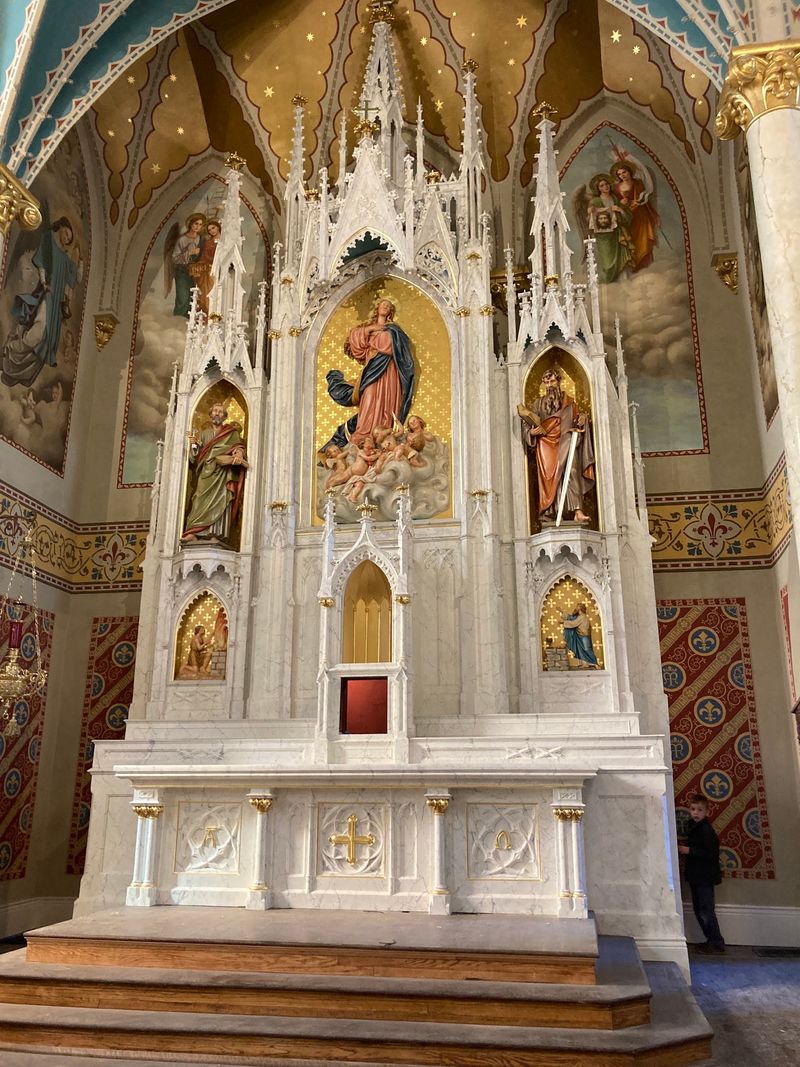
Some art hides in plain sight. Behind the altar here, murals were painted over following a fire in 1942 and stayed buried for roughly eighty years.
The 2020s restoration brought them back. Conservators worked through the layers and returned the artwork to view, giving the sanctuary a depth it had lost decades ago.
Above the side altars sit two important pieces. One shows the Ascension of Jesus, the other the Assumption of Mary, and both were carefully conserved rather than replaced.
Fresh work joined them too. New murals above the main altar and reredos portray angels along with elements of the Passion of Jesus, designed using historical examples from the 20th century as a guide.
That approach keeps everything speaking the same visual language. Nothing feels bolted on or out of period, which is harder to pull off than it sounds.
The high altar centers on an image of Our Lady of the Assumption, the church’s namesake and the anchor of the whole decorative program.
Stand toward the back of the nave for the full composition. Then move forward.
The murals gain detail and expression as you close the distance, and small touches in the angels’ faces only appear up close.
Stenciling Copied, Recolored, And Brought Back To Life
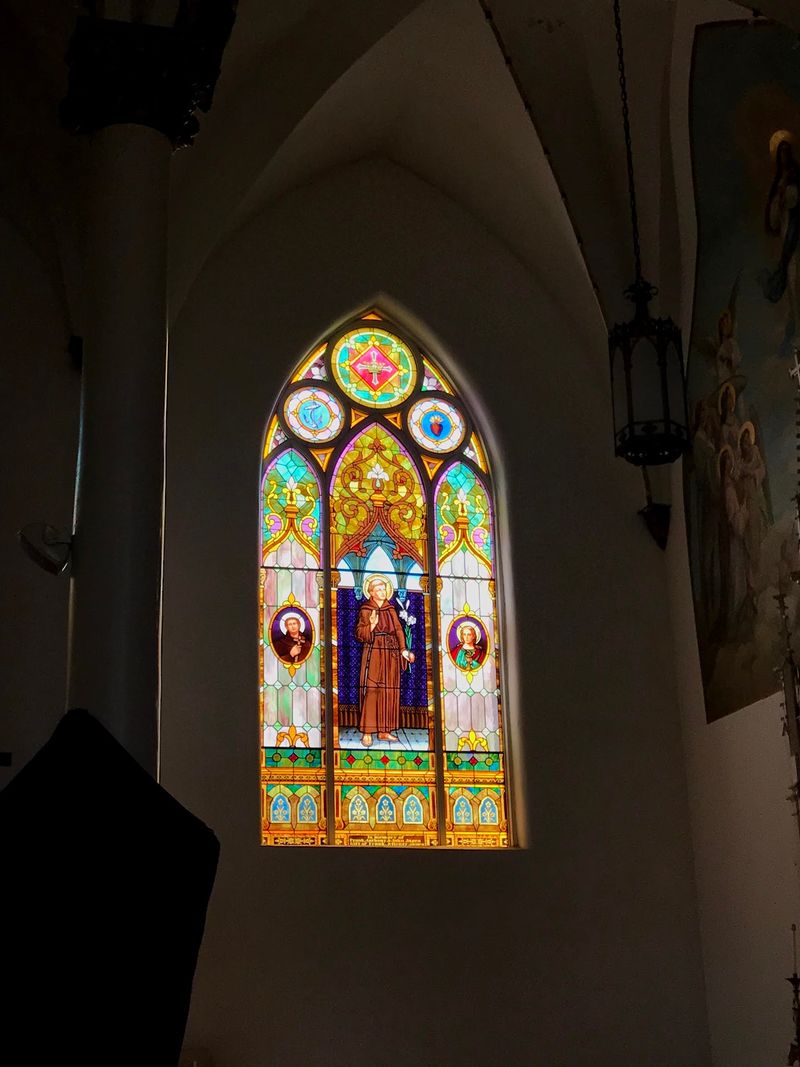
Stencil work is the quiet hero of this interior. It covers walls, arches, and ceiling ribs, and it took real detective work to recover.
Original patterns had been painted over or worn away. Restoration teams uncovered what survived, copied the designs precisely, then reapplied them in a fresh color scheme.
More than twenty paint colors appear throughout the church, plus metallic finishes and that 23-karat gold leaf. The palette is bold without tipping into chaos.
Where original patterns were missing, new ones were invented carefully.
Designers studied late 19th-century German neo-Gothic examples found in historical photographs, then applied the results around the three altars and the new shrines to Saint Roch and Saint Anthony of Padua.
Look for Marian symbols as you scan the surfaces. The Mystic Rose and the fleur-de-lis repeat across the decoration, and their intricacy deliberately increases as you move toward the sanctuary.
That gradient is a clever piece of design. It pulls your eye forward without any signage or arrows telling you where to look.
Plaster repairs, statue restoration, and updated liturgical furnishings rounded out the project. Conrad Schmitt Studios led the effort, which wrapped up in March 2025 after several years of steady work.
A Baptismal Font Carved In Italy From Matching Marble
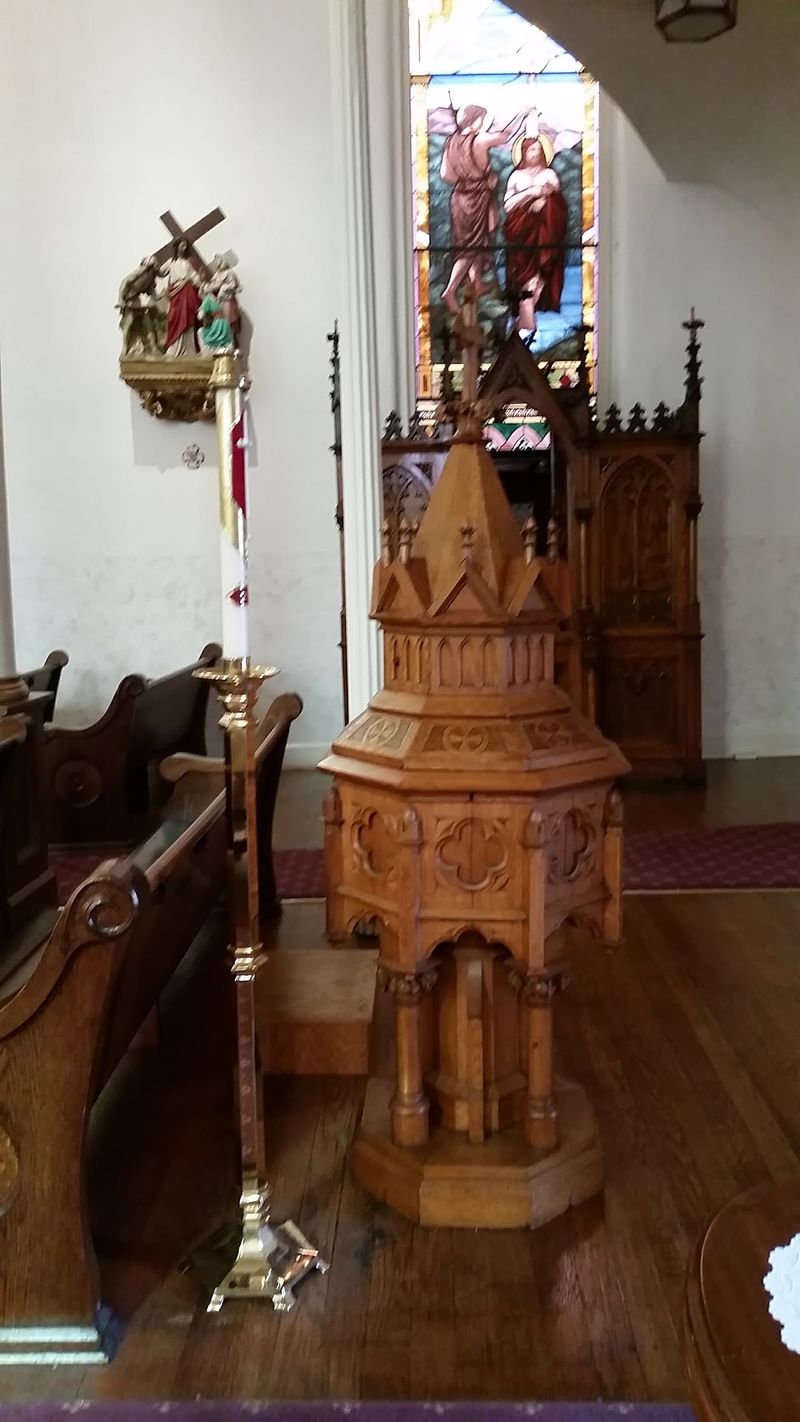
Matching marble across an ocean is a fussy task. The new baptismal font here was crafted in Italy from the same marble used elsewhere in the church, so nothing looks mismatched.
The baptistry received a full redesign during the restoration. So did the pulpit, both getting new treatments rather than simple cleanups.
Above the font, a new vaulted ceiling was built. Its corbels were shaped to mimic the existing ones along the nave and behind the high altar, tying the small chapel into the larger building.
Details like that are easy to miss and easy to appreciate once pointed out. Consistency is what makes a restored interior feel whole instead of patched.
The baptismal chapel sits apart from the main seating area, which gives it a quieter, more intimate feel. Sound behaves differently in there.
Marble picks up ambient color from the painted surfaces nearby, so the font shifts subtly depending on the light.
If you are the sort of person who likes craftsmanship over spectacle, this corner may end up being your favorite. It is small, precise, and clearly made by people who cared about getting the proportions right rather than simply filling a space.
A Steeple Holding A Relic And A Hidden Message
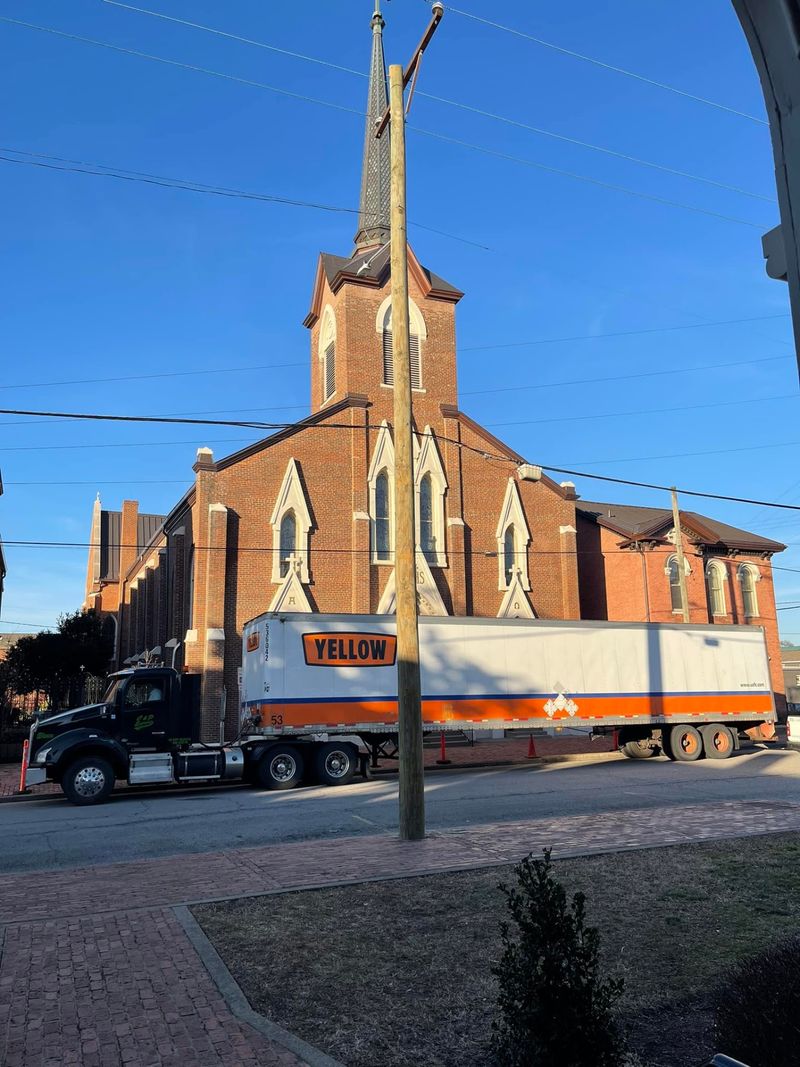
Steeples keep secrets. This one holds a relic of Saint Roch, placed inside during December 2021 and sealed within the base of the original cross when the steeple went back up.
The copper steeple itself dates to 1984. It was raised to mark the church’s 125th anniversary and built to mirror the 1880s design it replaced.
The bells in the tower are historic and were restored as part of the recent project. Hearing them ring over Germantown connects the present-day neighborhood to its immigrant beginnings.
Inside, another hidden note turned up. Workers found a painter’s inscription from 1975 written on a ceiling rib, left behind by whoever repainted the church that year.
Rather than erase it, the current team added 2021 alongside it. Some future crew will find both dates and continue the chain.
Small human gestures like that stick with you longer than the gold leaf does.
The building has taken hits and kept going. Union troops commandeered it in 1864 during the Civil War, which cost it much of its original decoration, and rebuilding followed once the fighting ended.
Fire, storm, and war have all passed through. Assumption Church is still standing, still ringing, still in use.
Planning Your Look Around This Tennessee Landmark
A little planning goes a long way here. The church keeps posted hours, generally 8 AM to 4 PM Monday through Thursday, with shorter Friday and Sunday windows and Saturday closed.
Checking ahead is smart. A look at assumptionnashville.org saves a wasted trip.
The parish is known for traditional worship, including the Latin Mass. If you plan to attend, arriving early is wise because seating fills up, and parking is available across the street.
Germantown makes the outing easy. The neighborhood sits close to downtown Nashville and the farmers market, so you can build a half day around the stop.
The parish has produced notable figures too, counting Cardinal Samuel Stritch and Archbishop John Floersh among those who came from here.
New Stations of the Cross were added around the 50th anniversary in 1909, adding another layer of artwork to trace along the walls.
Dress respectfully and keep your voice low. This is an active place of worship first and a historic landmark second.
Few Tennessee interiors reward curiosity like this one. Assumption Church has been quietly spectacular since 1859, and the recent work only sharpened the effect.