
This Massachusetts Beach Hides A Century-Old Shipwreck You Can Sometimes See At Low Tide
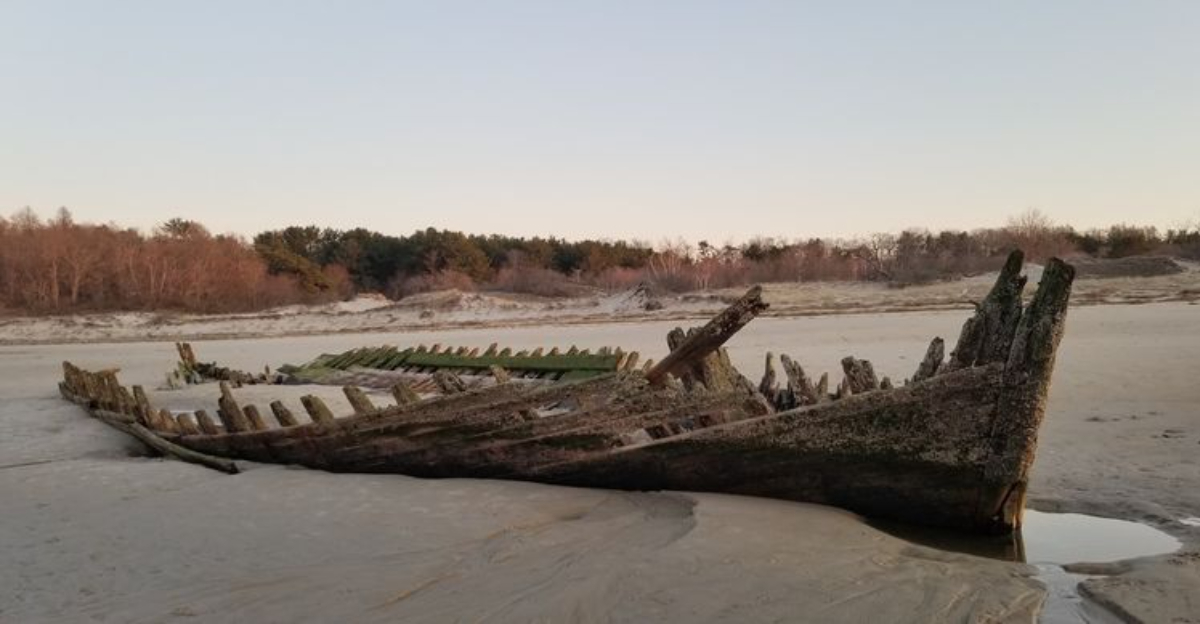
Some beach walks come with shells. This one can come with a shipwreck.
Massachusetts has a coastline full of stories, but few feel as surprising as seeing old wooden remains appear in the sand after the tide pulls away.
It turns an ordinary summer stroll into something that feels part mystery, part history lesson, and part lucky timing.
One day the beach looks calm and familiar. Another day, the ocean reveals a piece of a vessel that met its fate more than a century ago.
How often does a casual walk lead you straight to the past? Bring curiosity, check the tide, and keep your eyes on the sand.
This Massachusetts beach proves that summer scenery can still surprise you, especially when the sea decides to share one of its oldest secrets.
A Memory Etched In Sand
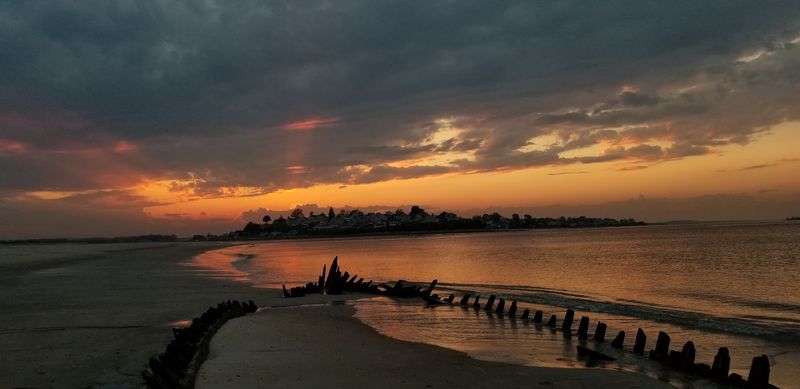
There is something quietly remarkable about a beach that holds a story beneath its surface. The beach located within the Crane Estate in Ipswich, Massachusetts is that kind of place.
The shoreline looks peaceful and wide at first glance, but beneath the shifting sands lies the skeletal frame of a vessel that has been resting there for well over a hundred years.
The wreck belongs to the Ada K. Damon, a two-masted schooner built in 1875 by Ebenezer Burnham in Essex, Massachusetts.
The ship started its life as a fishing vessel before being repurposed in 1909 to haul sand along the New England coast. Its history is short but dramatic, and the beach has preserved that drama in its own quiet way.
What makes this spot so compelling is how ordinary it feels until you know what you are standing near. The sand stretches broadly, the sky opens wide, and the Atlantic moves steadily onward.
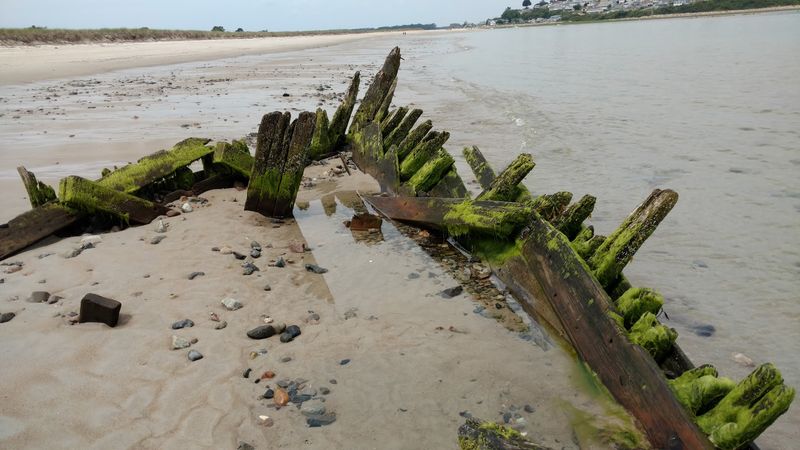
Only when the tide pulls back does the past begin to show itself, dark wooden ribs rising from the seafloor like a memory the ocean cannot fully keep to itself.
The Schooner’s Fateful Voyage
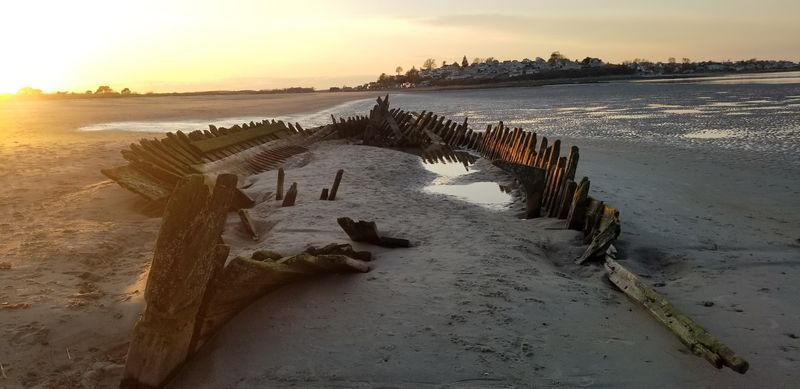
December 26, 1909, was not a gentle day on the New England coast. A powerful storm, later called the Great Christmas Snowstorm, swept through the region with fierce winds and punishing seas.
The Ada K. Damon had just been converted from a fishing vessel into a sand-hauling schooner, and this was meant to be its first voyage in that new role.
The ship was traveling from Plum Island toward Boston when the storm overtook it. Its anchor chain snapped under the pressure of the violent conditions, leaving the crew with no way to hold position.
The schooner was driven toward Steep Hill Beach and ran aground, stranding itself permanently on the shoreline. Fortunately, every member of the crew survived the ordeal.
The timing gives the story an almost ironic quality. The Ada K.
Damon had barely begun its second chapter when that chapter came to an abrupt end. What should have been a routine cargo run became the final voyage of a vessel that had already spent more than three decades at sea.
The wreck has remained on that beach ever since, outlasting the storm that caused it by more than a century.
When The Tides Unveil History
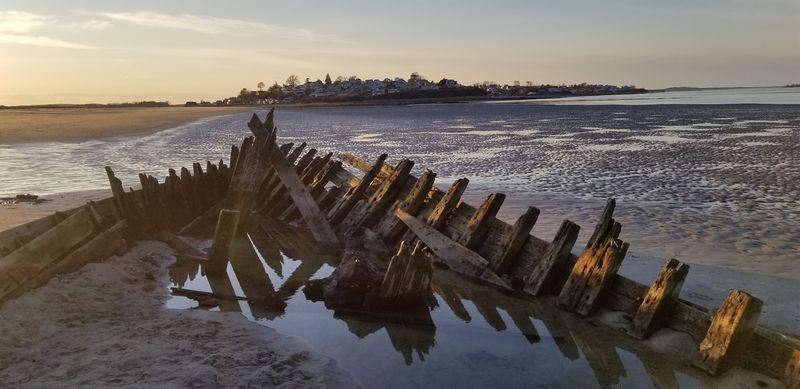
The Ada K. Damon does not reveal itself on a fixed schedule.
Its appearances depend entirely on the behavior of the tides, the force of seasonal storms, and the constant movement of sand along the intertidal zone. That unpredictability is part of what makes finding it feel genuinely special rather than simply touristic.
During periods of unusually high winds and rough seas, larger sections of the hull tend to surface.
In late February and early March of 2024, strong storm activity exposed a 50-foot section of the ship’s hull, drawing visitors who had heard about the wreck but never seen it emerge so dramatically.
Earlier significant appearances were recorded in 2004 and 2016, suggesting these revelations come in cycles tied to larger weather patterns.
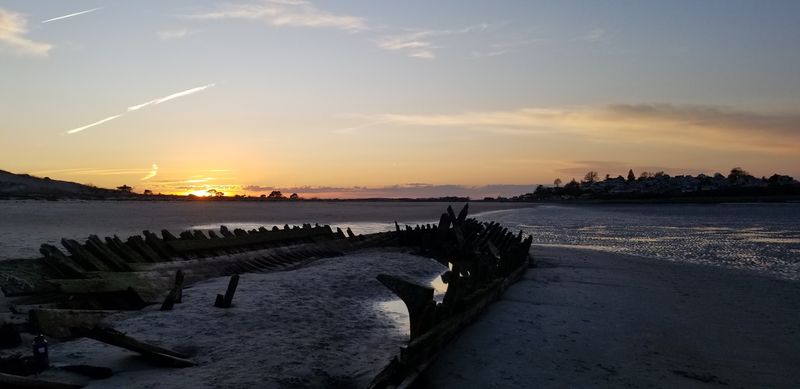
At high tide, the wreck disappears entirely beneath the water. At low tide, the dark wooden ribs appear gradually as the sea retreats, giving the impression that the ship is slowly resurfacing from a long sleep.
Visitors planning a trip specifically to see the wreck should check tide charts in advance and time their arrival accordingly. Low tide is the only window that offers a clear look at the remains.
A Century Of Surfacing And Disappearing
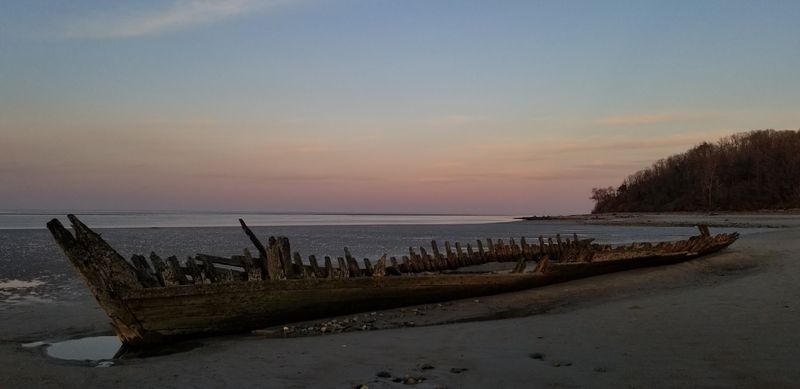
Since 1909, the Ada K. Damon has been playing a slow, patient game with the ocean.
Sand covers it, storms strip that covering away, and then the cycle begins again. The wreck has never fully disappeared, but it has never stayed fully visible for long either.
This rhythm of concealment and exposure has continued for well over a hundred years.
A hurricane in 2020 caused noticeable damage to the structure, breaking apart portions of the hull that had survived intact for decades. Each major storm event leaves its mark, and the wreck today is more fragmented than it was even a generation ago.
Still, enough of the original frame remains to give visitors a clear sense of the vessel’s size and construction.
The Ada K. Damon is now approximately 114 to 115 years old as of early 2024, making it one of the older accessible shipwrecks along the Massachusetts shoreline.
Its age alone commands a certain respect. The fact that it keeps returning to the surface, again and again across different eras and different storms, gives it a kind of persistence that feels almost biographical.
The ship refuses to be entirely forgotten by the sea or by the people who come to see it.
Exploring The Skeletal Remains
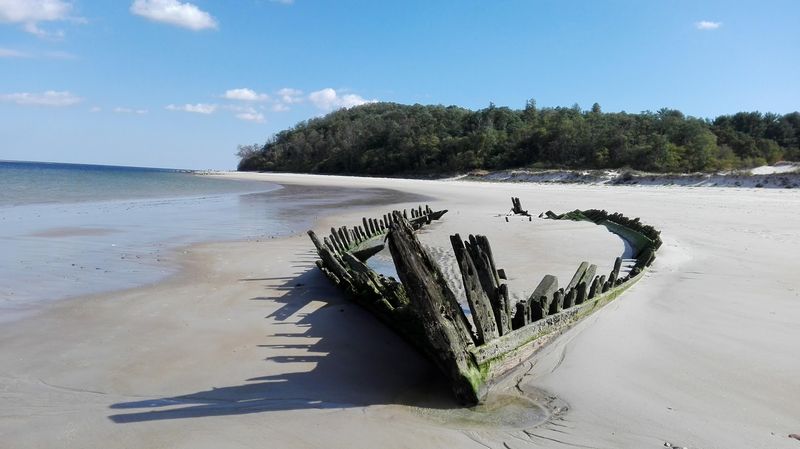
Standing beside the Ada K. Damon at low tide is a surprisingly grounding experience.
The exposed hull timbers are dark, weathered, and heavy-looking, shaped in a way that still communicates the original form of the vessel.
You can see how the ribs curved outward from the keel, giving the ship its characteristic schooner silhouette even in its broken state.
Visitors are welcome to walk up to the wreck and touch the wood, though the Trustees of Reservations, who manage the Crane Estate and Steep Hill Beach, ask that people refrain from standing on the structure.
The timbers are fragile, and the weight of foot traffic would accelerate the deterioration of what remains.
Beyond that practical request, there is a legal dimension as well: all artifacts found on the beach must remain in place.
Massachusetts law, administered through the Board of Underwater Archaeological Resources, requires that any items associated with the wreck stay where they are found. Removing artifacts is not permitted.
This regulation protects the historical integrity of the site and ensures that future visitors have the same opportunity to encounter the wreck as it exists today.
The Trustees have also organized public programs around the wreck, offering guided access during periods when it is exposed.
Steep Hill Beach: A Shoreline Of Stories
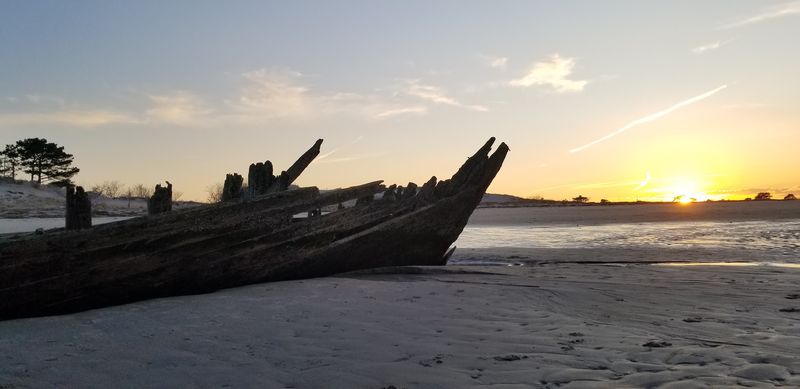
The beach itself deserves attention beyond the shipwreck.
Steep Hill Beach sits on the western edge of Crane Estate at Ipswich, Massachusetts 01938, and it carries the kind of atmosphere that feels genuinely removed from busier coastal destinations.
The sand is wide and clean, the horizon broad, and the sound of the water arrives without competition from crowds or commercial noise.
Access to the beach requires a short hike from the Crane Estate property. Visitors typically follow a path through the woods at the end of the Grand Allee, descending a cleared hillside trail that takes roughly fifteen minutes to walk.
A parking area sits near the trailhead. There is an entry fee at the Crane Estate, generally around ten dollars per person, which covers access to the broader property including the beach.
Swimming and traditional sunbathing are not permitted at Steep Hill Beach, which keeps the crowd profile distinctly different from nearby Crane Beach. The visitors who make the hike tend to be walkers, nature observers, and history-minded travelers.
The result is a shoreline that feels quieter and more contemplative than most beaches of its quality. Individual conversations carry clearly across the sand, which says something meaningful about how peaceful the place genuinely is.
Preserving A Fragile Past
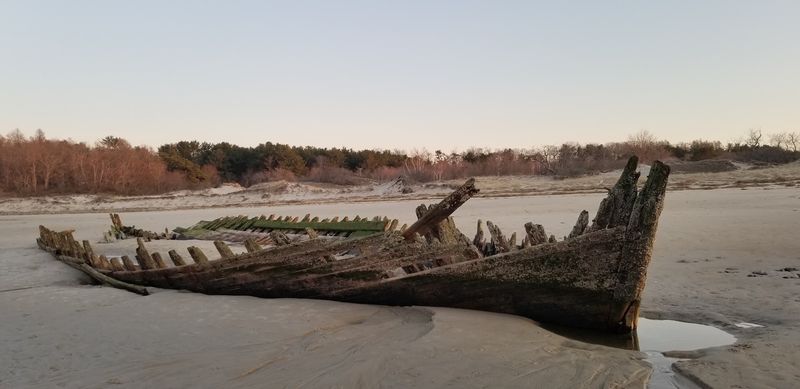
Protecting a shipwreck that sits in the intertidal zone presents real challenges. The Ada K.
Damon is exposed to salt water twice daily, subjected to storm surges during severe weather, and gradually worn down by the same natural forces that have shaped it over more than a century.
No intervention can fully stop that process, but thoughtful stewardship can slow it considerably.
The Massachusetts Board of Underwater Archaeological Resources holds jurisdiction over intertidal and underwater archaeological sites within state waters. Their oversight means the Ada K.
Damon is recognized as a protected historical site, not simply an interesting piece of debris.
This classification matters because it creates a legal framework that discourages disturbance and ensures the wreck is treated with appropriate seriousness.
The Trustees of Reservations have played an active role in public education around the wreck, organizing programs that bring visitors out to the site when conditions allow. These efforts help transform a passive curiosity into a meaningful cultural encounter.
People who learn the story of the Ada K. Damon before seeing it tend to approach the remains with greater care and appreciation.
Preservation, in this context, is as much about cultivating informed visitors as it is about managing the physical condition of the wood itself.
Observations From The Intertidal Zone
The intertidal zone is one of the more dynamic environments on any coastline. Twice a day, it shifts between a submerged underwater habitat and an exposed stretch of sand and rock.
The Ada K. Damon occupies this zone permanently, which means it exists in a state of constant transition between two very different worlds.
At low tide, the area around the wreck becomes surprisingly rich with small life. Tidal pools form in depressions around the hull timbers, and the wet sand holds impressions of the retreating sea.
The wreck itself becomes a kind of artificial reef structure, offering shelter and surface area for organisms that would not otherwise find purchase on a sandy beach. Observing this closely rewards patience and a slow pace.
For visitors with snorkeling gear, high tide offers an entirely different perspective.
The hull disappears beneath the surface, and the wreck becomes an underwater feature that can be explored from above with a mask and snorkel.
Both experiences, the low-tide walk and the high-tide float, offer something genuinely distinct. The intertidal zone at Steep Hill Beach is not simply a backdrop for the shipwreck story.
It is an active, living part of the narrative that changes with every visit and every tide cycle.
Where Time And Tide Converge
There are places where history and landscape align so naturally that the combination feels almost inevitable. Steep Hill Beach is one of them.
The story of the Ada K. Damon is not just a shipwreck story.
It is a story about the relationship between human ambition and natural force, between a vessel built for work and a coastline that ultimately claimed it.
Visiting the beach on a clear day, with the tide pulling back and the wooden ribs of the schooner emerging from the sand, produces a quiet sense of proportion.
The ship was built in 1875, sailed for more than three decades, and has been resting on this beach for over a century.
The Atlantic keeps moving. The sand keeps shifting. The wreck keeps surfacing.
For anyone traveling through northeastern Massachusetts, the detour to Ipswich and the Crane Estate is genuinely worth making.
The hike is manageable, the landscape is open and beautiful, and the experience of standing beside a century-old shipwreck on an otherwise ordinary-looking beach carries a kind of weight that is hard to replicate elsewhere.
Some destinations reward you with scenery. This one rewards you with perspective, and that tends to stay with you considerably longer.