
This Massachusetts Nature Preserve Has Nearly 200-Million-Year-Old Dinosaur Footprints
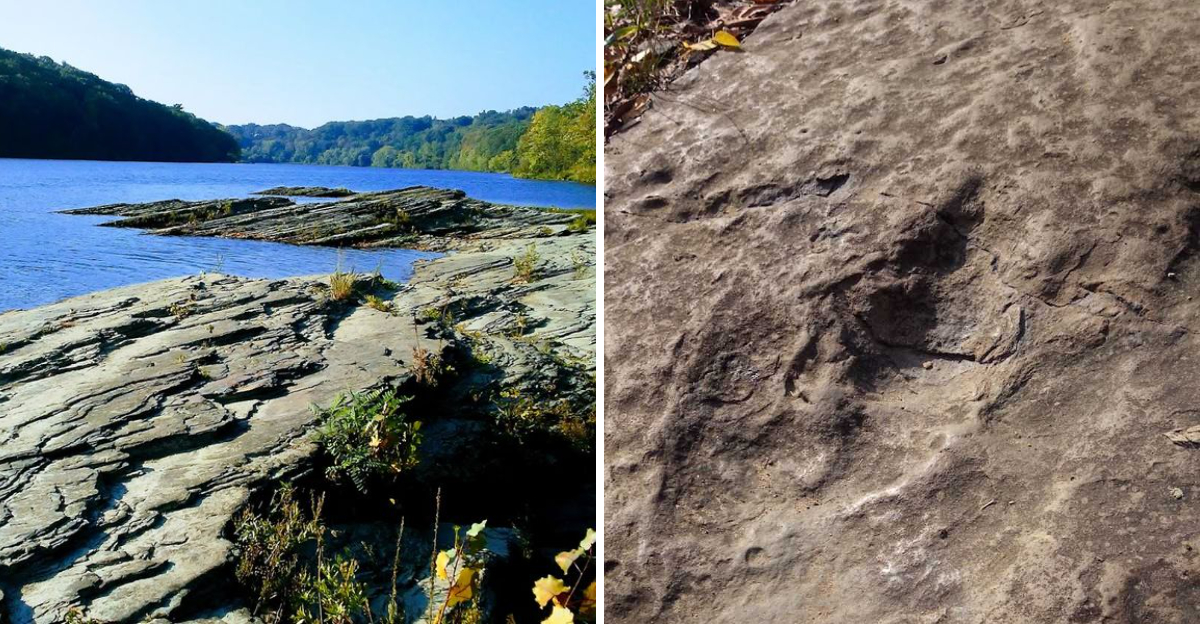
What if a quiet walk through Massachusetts could bring you face to face with evidence of creatures that lived nearly 200 million years ago?
At first glance, this nature preserve looks calm and familiar. Trees line the paths, rocky ground stretches beneath your feet, and the surrounding landscape invites an easy afternoon outdoors.
Then the story changes.
Certain sections hold clues left behind during a time when the region looked nothing like it does today. Scientists have studied these remarkable markings for generations, while curious visitors still arrive eager to see them with their own eyes.
The experience feels part nature walk and part journey into deep history. You do not need to be a fossil expert to appreciate how rare it is to stand beside something created so long ago.
This Massachusetts preserve proves that one of the most fascinating chapters of the past can still be found right beneath the open sky.
Ancient Footprints In Stone
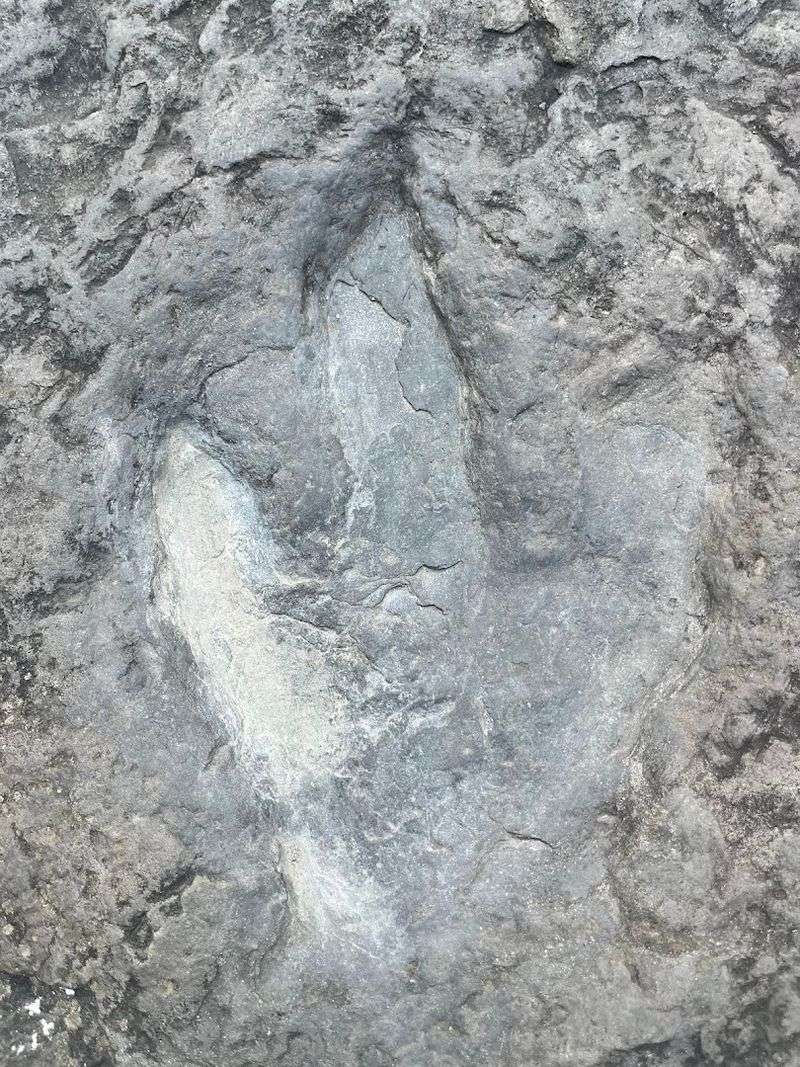
Few things stop a person mid-step quite like realizing the rock underfoot was once soft mud pressed down by a living dinosaur.
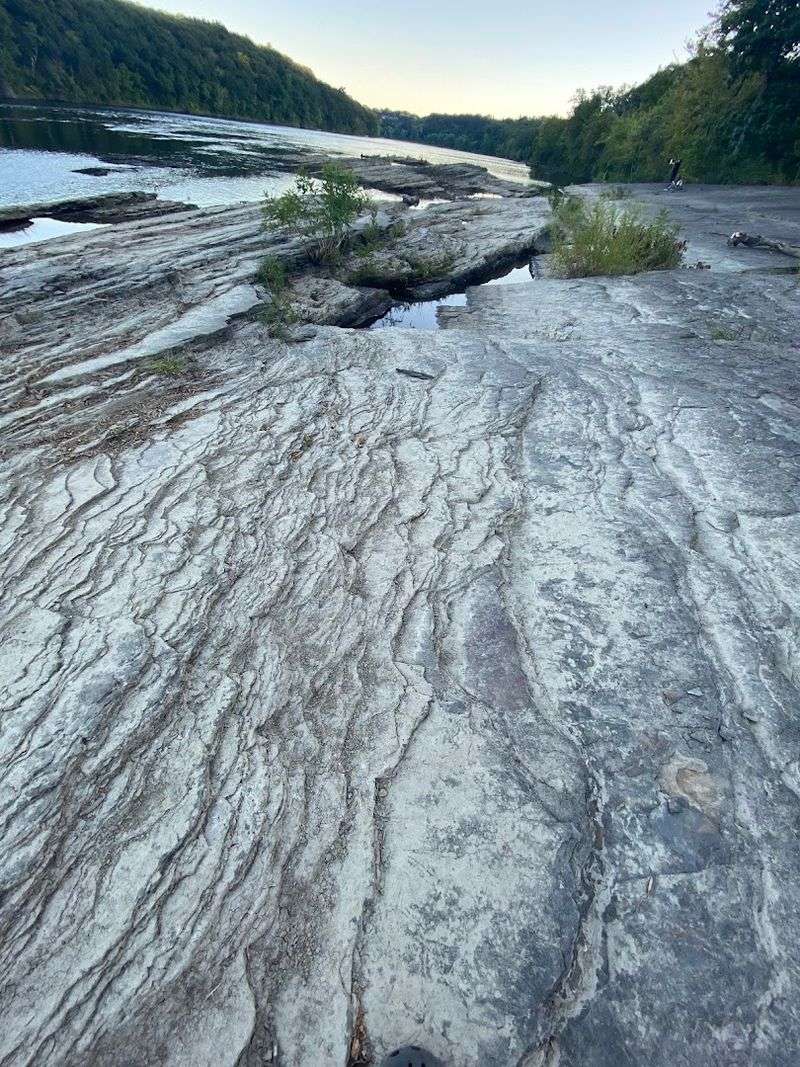
The footprints at this Holyoke preserve are set into broad sandstone slabs that slope gently toward the Connecticut River, and they carry an immediacy that no museum cast can replicate.
These tracks date to approximately 190 to 200 million years ago, placing them firmly in the Early Jurassic period.
The sandstone formed when ancient mudflats dried under a subtropical sun, baking the impressions into permanent record before layers of sediment buried and compressed them over geological time.
What makes this site especially significant is its documented history. In 1836, these prints became among the first dinosaur tracks ever formally described by science, making the preserve a landmark in paleontological research.
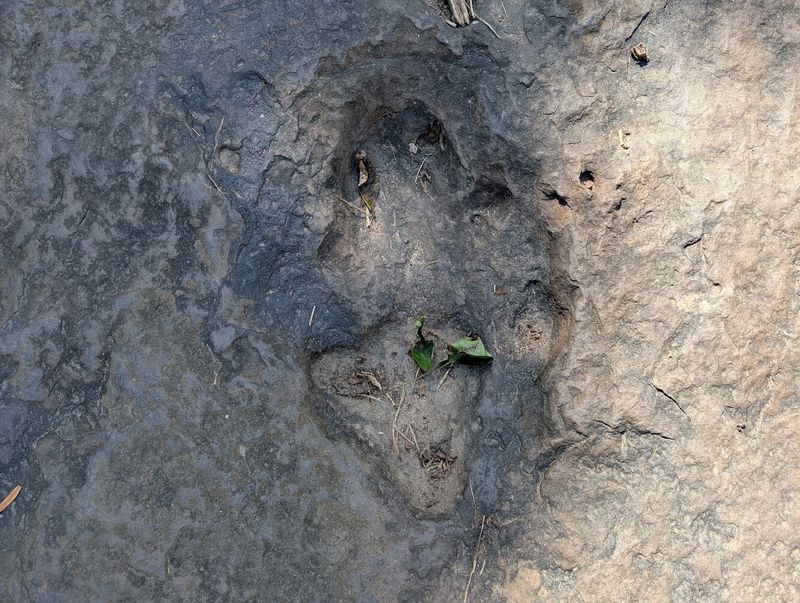
The tracks are three-toed, clearly defined in many places, and range considerably in size. Some are subtle enough to require a trained eye, while others are unmistakably bold.
Standing beside them, the scale of geological time becomes less abstract and considerably more personal.
A Glimpse Into The Jurassic Past
The Connecticut River Valley looked nothing like it does today when these tracks were made.
Two hundred million years ago, the region sat closer to the equator and carried the climate of a subtropical lowland, complete with shallow lakes, muddy shorelines, and dense vegetation suited to an early Jurassic world.
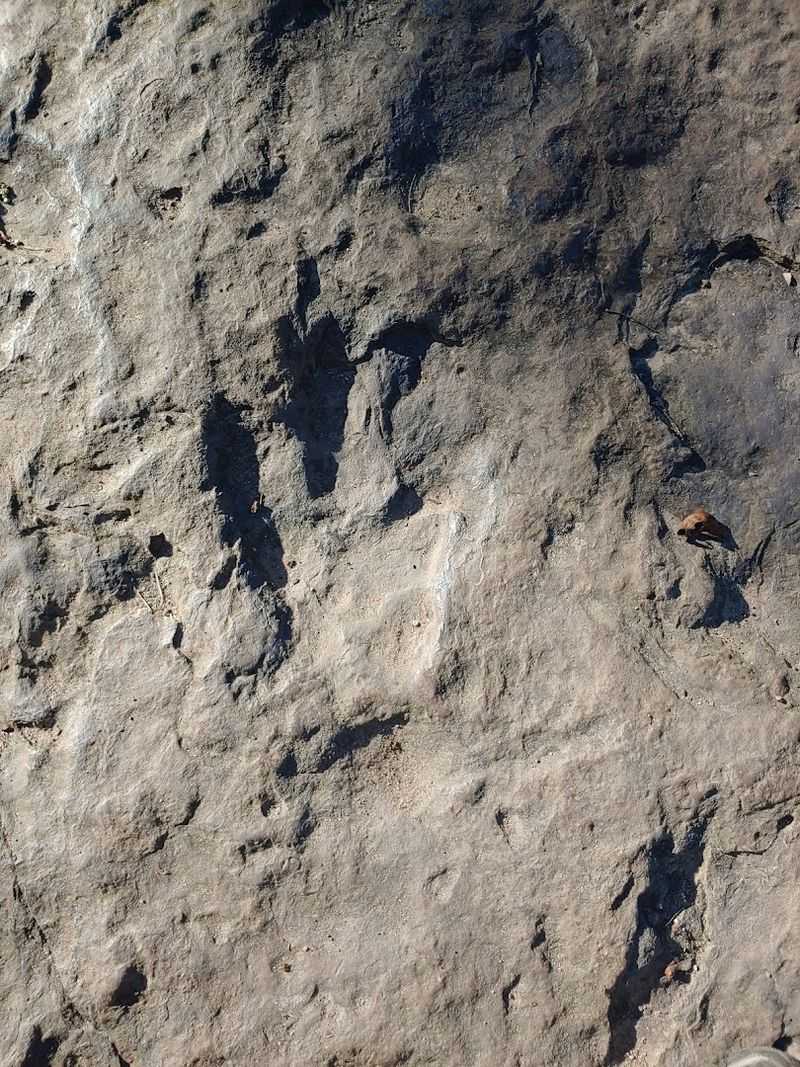
At least four distinct types of bipedal dinosaurs left their marks here. The largest prints, classified as Eubrontes, are thought to belong to theropods that may have reached up to 20 feet in length.
Smaller track types, including Anchisauripus and Grallator, also appear across the rock surface. Some paleontologists believe these smaller prints represent younger or smaller individuals of the same species that produced the Eubrontes tracks.
The sheer variety of print sizes across a single exposure of rock tells a story of an active, populated landscape. These were not isolated animals passing through empty terrain.
The rock surface reads more like a snapshot of a living community, one that was going about its daily patterns entirely unaware that mud would one day become stone, and stone would one day become history.
Paleontological Discoveries Unfolded
Edward Hitchcock, a professor at Amherst College, devoted much of his career to studying the tracks found across the Connecticut River Valley in the 1800s.
He catalogued hundreds of prints with careful attention, though he initially attributed them to giant ancient birds rather than reptiles.
His misidentification was understandable given what science knew at the time, and his meticulous documentation proved invaluable for researchers who came after him.
A century later, Yale paleontologist John Ostrom took a closer look at the Holyoke site in the 1970s. He mapped 134 individual tracks and analyzed their directional patterns with fresh eyes.
What he found was striking. The tracks did not wander randomly across the rock. They moved in consistent, parallel pathways, pointing in the same general direction.
Ostrom concluded this pattern indicated herding behavior, proposing that some of these early Jurassic dinosaurs traveled together in organized groups. That idea was genuinely controversial at the time.
The prevailing assumption had long been that dinosaurs were solitary, slow-moving animals. The evidence preserved at this Massachusetts site helped shift that understanding in a meaningful and lasting way.
The Trail Of Herding Giants
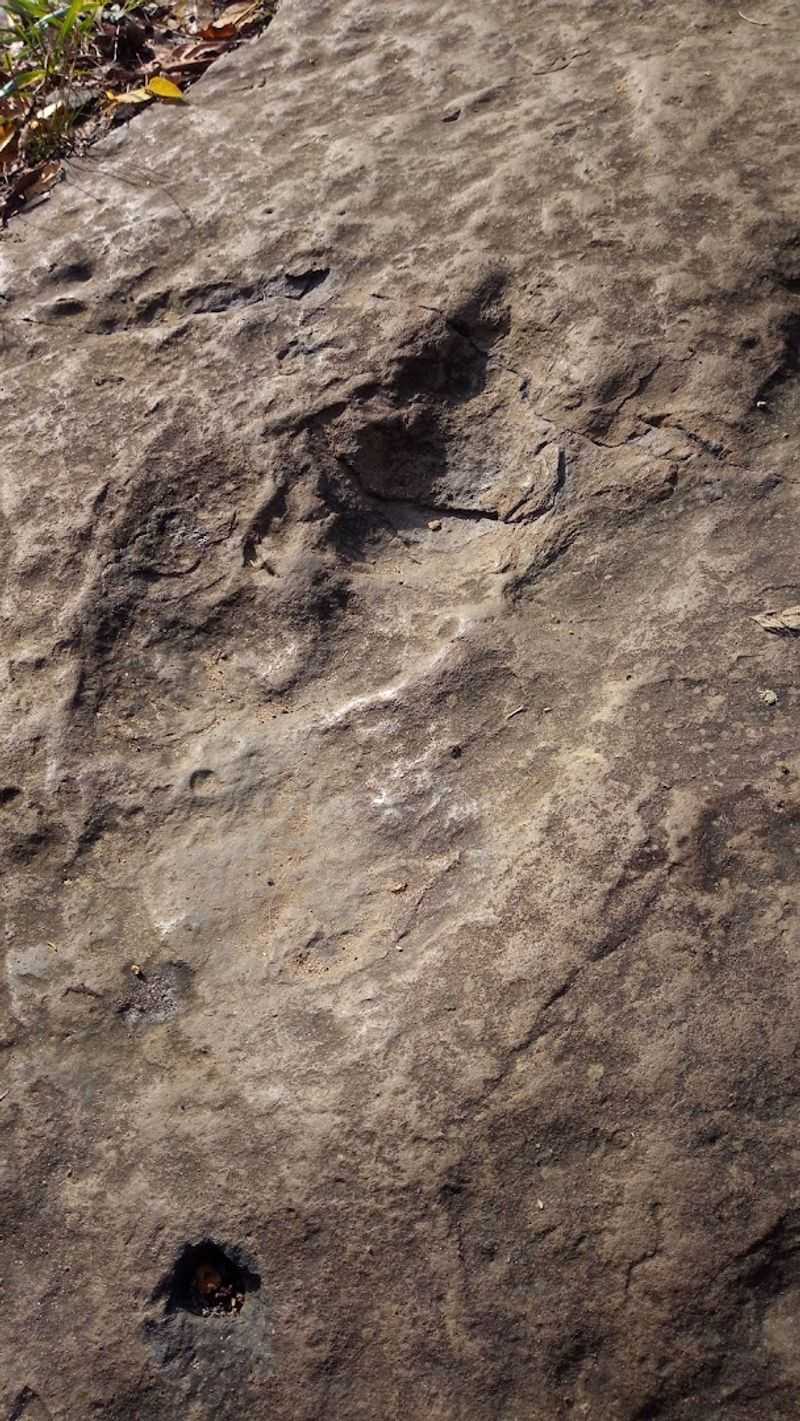
What John Ostrom observed in the 1970s was not just a collection of individual prints. It was a pattern.
Multiple trackways ran parallel to one another across the same rock surface, all heading in the same direction, with no signs of crossing paths or erratic movement. That kind of consistency does not happen by accident.
The conclusion Ostrom drew, that these dinosaurs were moving together as a group, fundamentally changed how paleontologists interpreted dinosaur social behavior.
Before this kind of evidence became widely accepted, the dominant image of dinosaurs was one of solitary, largely instinct-driven animals.
The trackways at Holyoke suggested something more organized and socially aware.
Looking at the rock today, the parallel lines of prints carry a quiet authority. There is no drama in the stone itself, no theatrical display.
Just the steady, repeated impression of animals moving with shared purpose across ancient mud. The fact that this behavior was recorded not in bone but in the act of walking makes it somehow more immediate.
Bones describe what an animal was. Footprints describe what it did, and in this case, what it did together with others of its kind.
A Landscape Shaped By Time
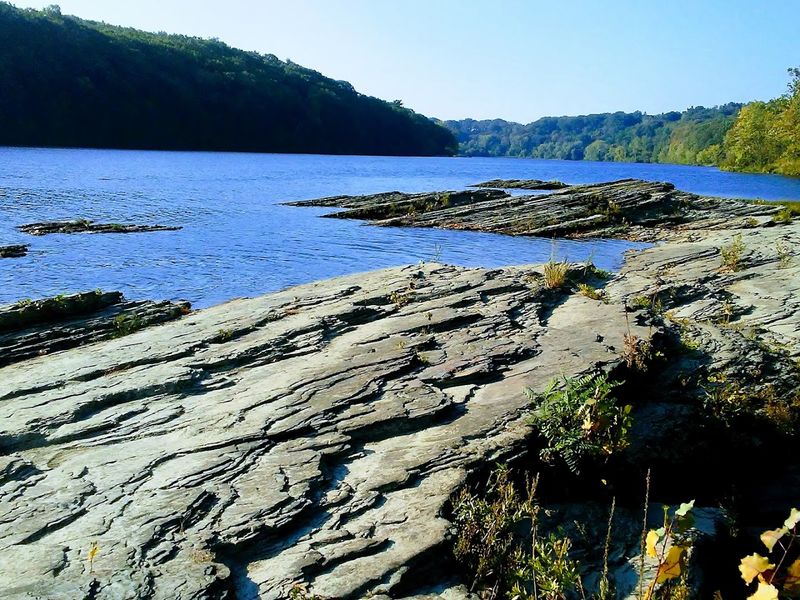
The geology of the Connecticut River Valley holds its own kind of narrative, one written in layers of sediment compressed across hundreds of millions of years.
The sandstone that preserves the tracks at this site formed from ancient mudflats that dried repeatedly under a warm Jurassic sun.
Each drying cycle helped set the impressions deeper before the next layer of sediment arrived to seal them in.
Over time, tectonic forces tilted these sedimentary layers, which is why the rock beds at the preserve slope at an angle rather than lying perfectly flat. That tilt actually works in favor of visibility.
The prints catch light differently depending on the time of day, making them easier or harder to read depending on when you arrive. Morning light and late afternoon tend to produce the most definition.
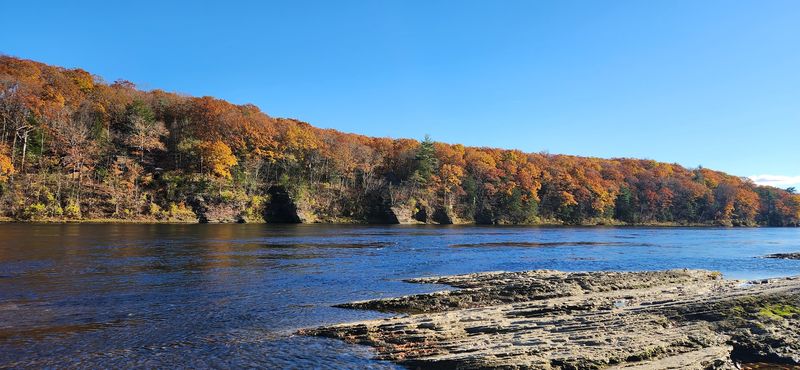
The Connecticut River running alongside the site adds a different kind of perspective. The river itself has carved and reshaped this valley for thousands of years, exposing rock layers that would otherwise remain hidden.
The landscape feels continuous and layered, as if the present and the very distant past are sharing the same physical space without particular concern for the distance between them.
The Prehistoric Story Continues Beyond The Dinosaur Tracks
Dinosaur tracks are the headline at this preserve, and rightfully so. But the sandstone slabs hold a broader catalog of prehistoric evidence that rewards anyone willing to look carefully beyond the obvious three-toed impressions.
Fossilized ripple marks are visible across portions of the rock surface, created when water moved across the ancient lakebed and left its pattern in the mud before it hardened.
These marks are almost meditative to look at, small waves frozen mid-motion for nearly 200 million years.
Alongside them, invertebrate burrows and traces of ancient plant material appear in the stone, offering fragments of the broader ecosystem that existed here long before the first human ever walked this continent.
Fish imprints have also been identified within the same geological formations, adding another dimension to the picture of life in this ancient subtropical basin. Taken together, these traces describe not just dinosaurs but an entire functioning world.
Predators, prey, plant life, water systems, and microscopic organisms all contributed to this landscape.
The dinosaur tracks draw the eye first, but the surrounding details tell the fuller story of a place that was genuinely alive in ways that go far beyond a single set of footprints.
Preserving A Primeval Legacy
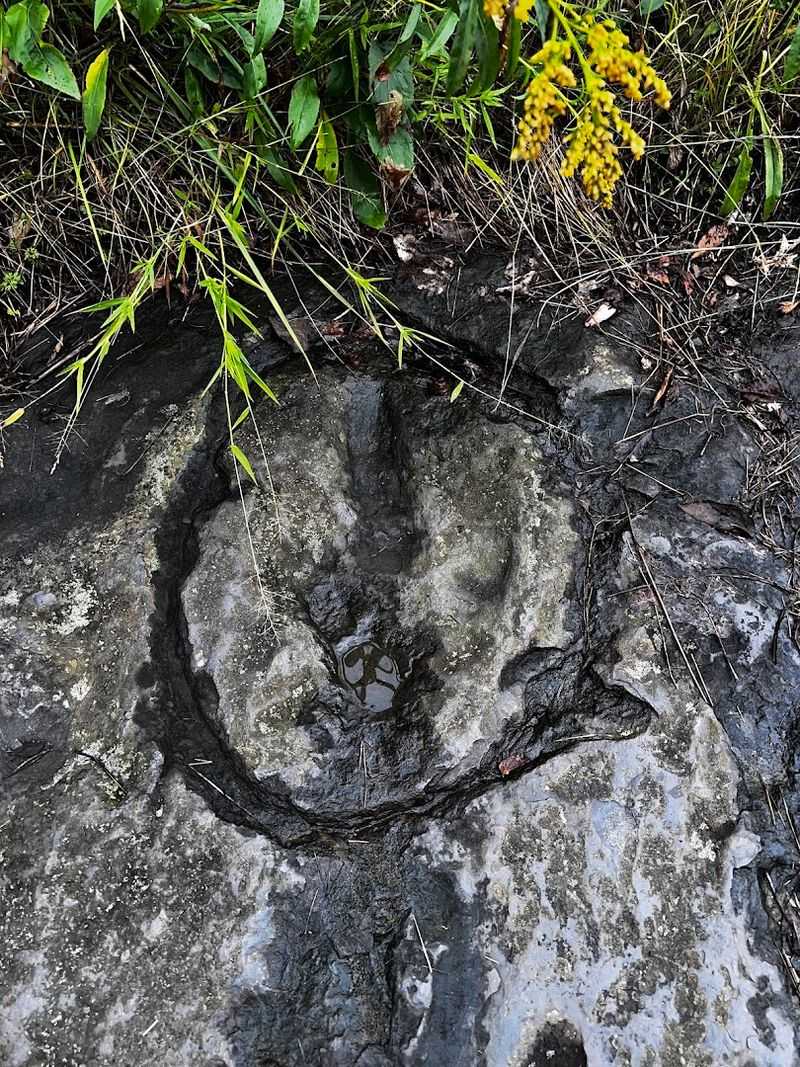
The preserve at 1099 US-5 in Holyoke covers eight acres and has been open to the public since 1935, when The Trustees of Reservations acquired it specifically to protect the fossil site from development and damage.
That decision ensured that one of North America’s most significant paleontological surfaces remained accessible and intact.
Today, the site is managed jointly by The Trustees of Reservations and the Massachusetts Department of Conservation and Recreation.
There is no admission fee, and the preserve is generally open daily from sunrise to sunset between April 1 and November 30.
A small pull-off parking area sits just off the highway, and the walk from the lot to the exposed rock beds takes only a few minutes on a clear, manageable path.
The openness of the site is part of its character. There are no fences around the tracks, no glass barriers, no guided tours required.
Informational signs provide context about the fossils and their geological history, giving enough background to orient a first-time observer without overwhelming the experience.
The preserve feels genuinely public in the best sense, maintained carefully but without the institutional distance that can make historical sites feel remote from the people they serve.
Where Earth’s History Unfolds
Massachusetts designated the dinosaur tracks of the Connecticut River Valley as the official state fossil, a recognition that speaks to how deeply these prints are woven into the geological identity of the region.
The designation is not ceremonial. It reflects the scientific weight of what this valley has contributed to the understanding of prehistoric life.
Standing at the rock surface, the prints carry a different quality than anything displayed in a museum. There is no mounting, no lighting designed to flatter the specimen, no interpretive layer between the observer and the object.
The tracks are simply there, in the same stone, in the same location where they were pressed into ancient mud nearly two centuries before anyone thought to study them scientifically.
The experience has a grounding quality that is difficult to manufacture elsewhere. Time compresses in an unusual way when the evidence of it is literally underfoot.
The preserve offers no spectacle, no theatrical presentation, just rock and light and the patient record of animals that moved through a world that no longer exists. That restraint is precisely what makes the place worth the detour.
Some of the most affecting things on Earth require no embellishment at all.