
This New York Trail Winds Through The Crumbling Remains Of A 1920s Lakeside Resort
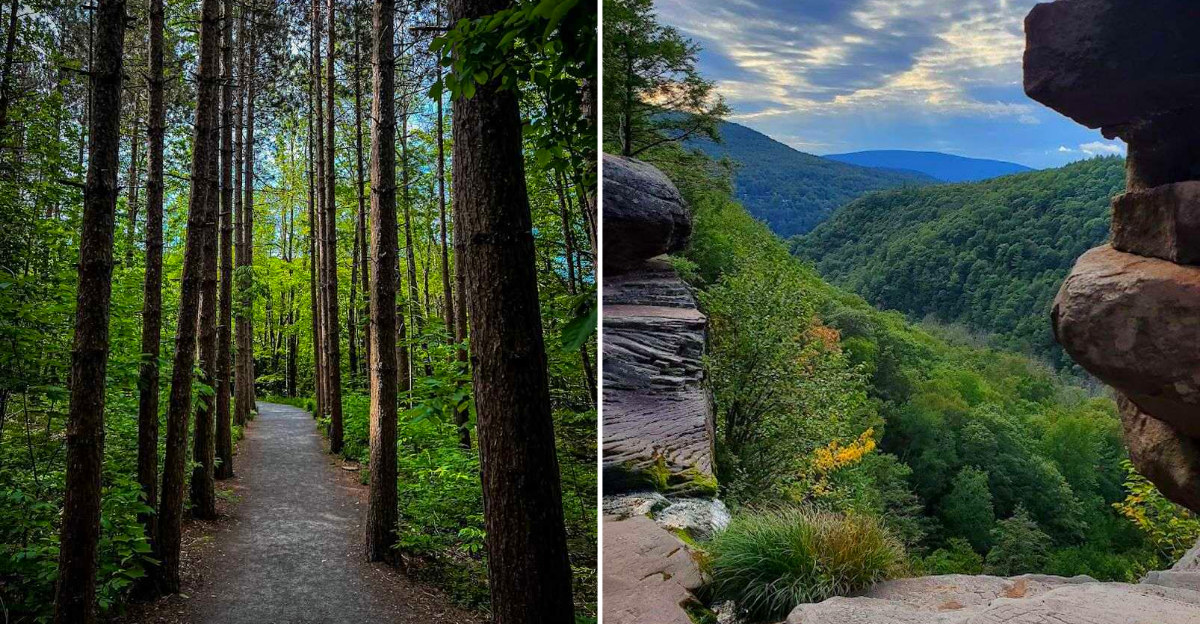
Presidents walked this New York ground. So did artists, writers, and anyone wealthy enough in the 1920s to consider a lakeside mountain resort a reasonable weekend plan.
The hotel is gone now. The trail through what remains is better than the hotel ever was. Stone remnants sit where grand rooms used to be. The clearing opens onto Hudson River Valley views that stopped people cold a century ago and have not lost a single step since.
This resort earned its reputation across a hundred years of hosting the kind of guests who got written about in newspapers, and then time and circumstance closed the chapter in the way they eventually close all chapters.
What got left behind is a hike that delivers two things most trails only manage one of. Genuine history underfoot and a view at the end that makes the whole climb feel like it was specifically arranged for the moment you arrive at the top.
A View That Built An Art Movement
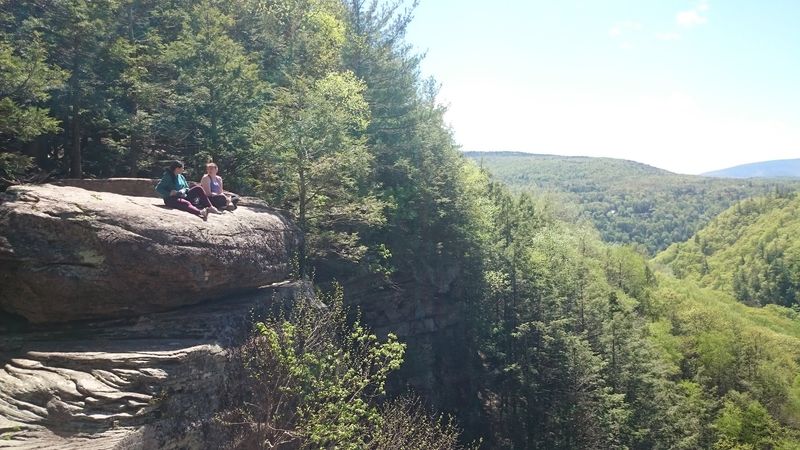
Before anyone had painted it, photographed it, or written a single word about it, this view was already doing something powerful to people. The overlook at the Catskill Mountain House Site sits roughly 2,200 feet above sea level on the Catskill Escarpment.
On a clear day, the Hudson River Valley spreads out below like a map drawn by someone who really wanted to show off.
Thomas Cole and Frederic Edwin Church both stood on this very ground and felt compelled to put it on canvas. Their work became the foundation of the Hudson River School, America’s first major art movement.
A single hilltop essentially launched an entire chapter of American cultural history.
The spot, historically called Pine Orchard, had already earned a reputation for its panoramic pull long before the hotel was built. Artists were not the only ones drawn in.
Presidents, industrialists, and writers all made the trek up the mountain to experience what many declared among the finest views in the entire country. Standing here today, it is genuinely hard to argue with them.
The landscape feels alive, layered, and completely worth the short walk from the parking area.
Welcome To The Site In Palenville, NY
America’s very first resort hotel once stood at this address, and its story is one for the books.
The Catskill Mountain House Site is found within the North South Lake Recreation Area near Palenville, NY 12463, and it has been drawing curious visitors long after the building itself disappeared from the landscape.
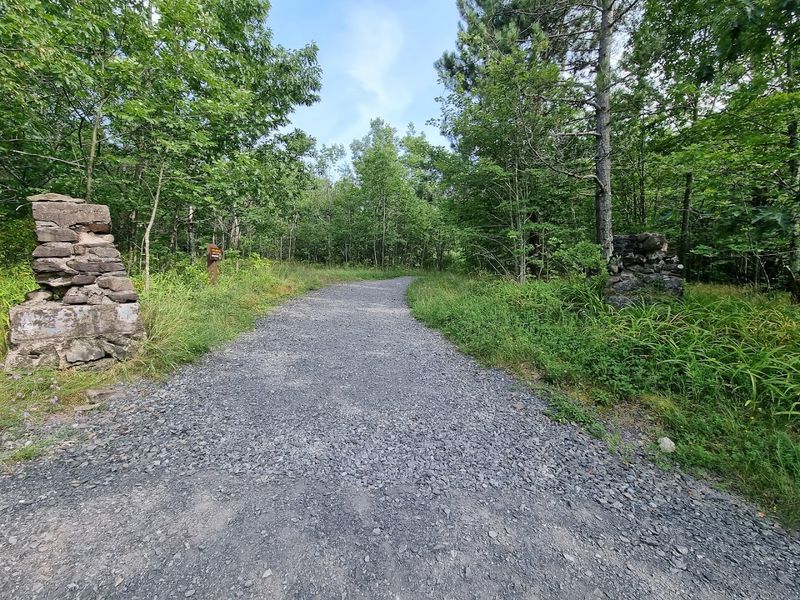
What remains is a grassy clearing, a few stone pillars, and a sense of occasion that hits you the moment the trees open up.
The hotel first opened in 1824 and grew steadily over nearly 140 years into a neoclassical landmark that welcomed everyone from everyday travelers to some of the most powerful figures in American history. Owner Charles L.
Beach oversaw its grandest transformation in the mid-1840s, giving the structure a stately presence that matched the magnificence of its setting.
By the time the resort closed after the 1941 season, it had already lived several lifetimes worth of stories. New York State acquired the property in 1962.
The structure was deliberately burned in January 1963 as part of an effort to restore the land to its natural state. What you walk through today is both a memorial and a marvel.
The place earns its 4.9-star reputation without a single wall standing.
The Trail That Surprises Everyone
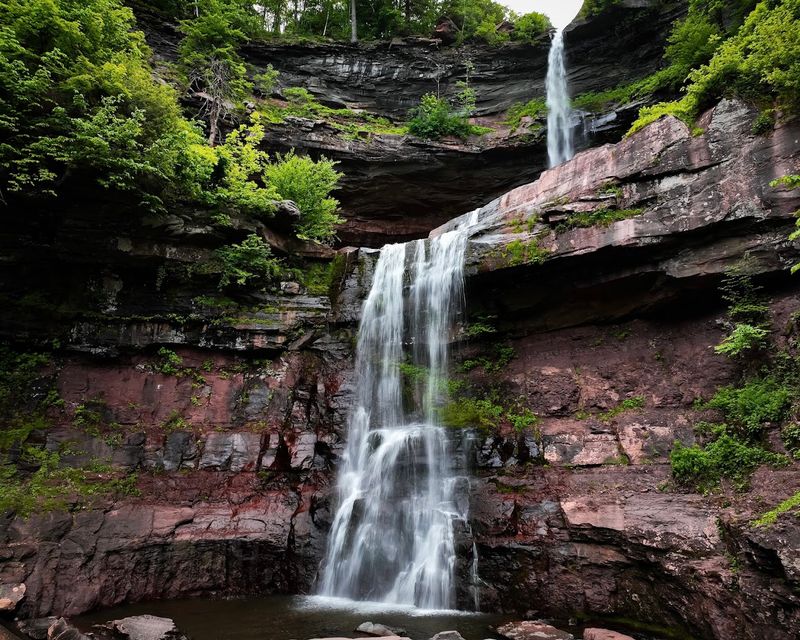
Most people expect a serious mountain hike to demand serious effort. The trail to the Catskill Mountain House Site flips that expectation completely on its head.
The route follows the blue-blazed Escarpment Trail for roughly half a mile out and back, starting from the public parking lot at North Lake Beach. Most hikers reach the clearing in about ten to fifteen minutes.
The path is accessible enough for young children and anyone who prefers a relaxed pace. It is not a flat stroll, but it is far from a grueling climb.
The modest incline builds just enough anticipation before the trees part and the view opens up in full force.
There is a small vehicle entry fee for day use of the campground area, which is a fair trade for everything the site delivers. Leashed dogs are welcome on the trail, making it a solid outing for the whole family.
The North South Lake Recreation Area also connects to a broader network of trails for anyone who wants to extend the adventure after visiting the main site. Arriving early on weekends is a smart move since the parking area fills up quickly during peak season.
The payoff at the end of the trail genuinely outpaces the effort required to get there.
Stone Pillars And Silent Stories
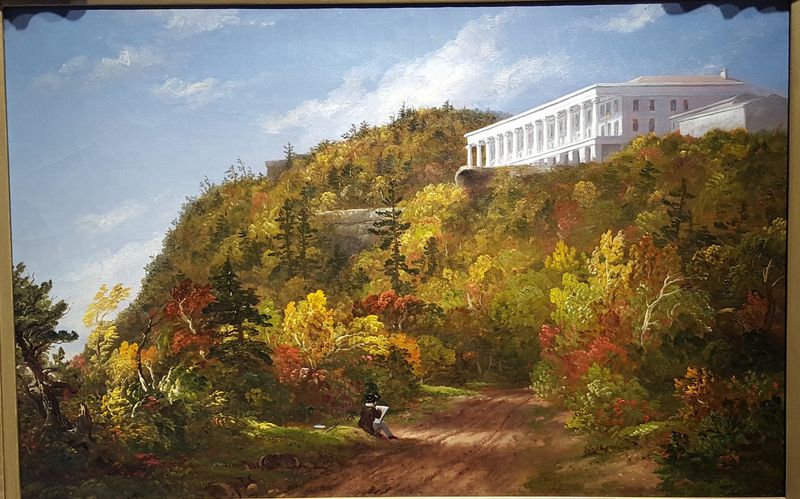
There is something quietly compelling about ruins that do not try to explain themselves. The stone pillars and scattered foundation remnants at the Catskill Mountain House Site let the landscape do the talking.
They mark the footprint of a hotel that once welcomed the cream of American society, and they do it without fanfare or drama.
Interpretive signage placed throughout the clearing adds context for those who want it. Old photographs on the boards show the grand neoclassical facade that once dominated this ridgeline.
Seeing the before and after side by side gives the ruins a weight that a simple stone wall could never achieve on its own.
The clearing itself is open and grassy, which means the remnants sit exposed to the same sky and wind that guests experienced from the hotel’s famous porch. There is no roof overhead, no velvet rope, and no admission booth.
Just open ground, old stone, and the same Hudson Valley view that inspired a generation of painters. It is the kind of place where you slow down automatically, not because a sign tells you to, but because the atmosphere earns it.
Spending a few quiet minutes among the remnants feels like a genuinely worthwhile part of the visit.
Names Carved In Rock, Centuries Old
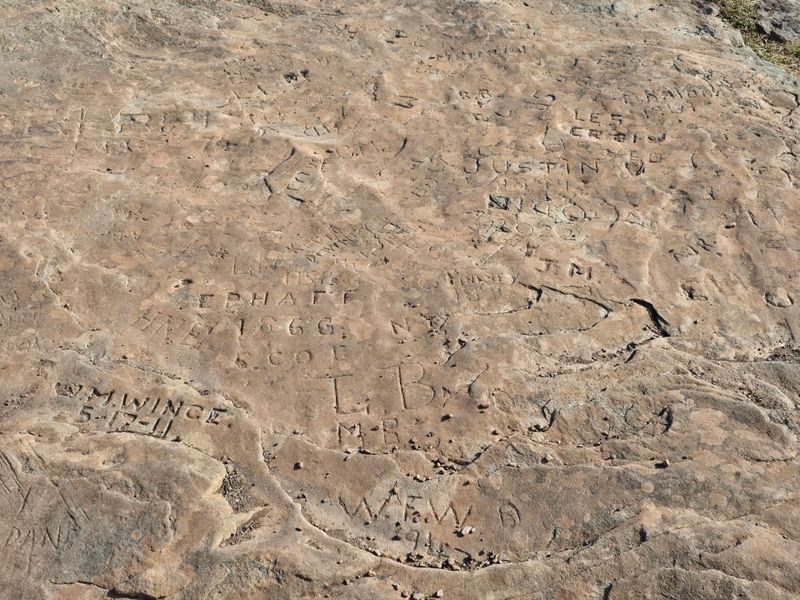
Along the rocky ledge at the edge of the clearing, the past has left a very literal mark. Guests who visited the Catskill Mountain House in the 1800s carved their names and dates directly into the pale rock face, and those carvings are still visible today.
Some of the oldest ones trace back to the 1850s, which means you are reading the actual handwriting of people who stood in the same spot over 170 years ago.
It is the kind of detail that transforms a scenic overlook into something more personal. A carved name from 1863 hits differently than a plaque on a wall.
You find yourself wondering who that person was, what they wore, and how long they traveled to reach a place they clearly felt was worth remembering forever.
The ledge area requires some caution since there is no guardrail along the cliff edge. Keeping a close eye on young children near the drop-off is genuinely important.
For adults comfortable with heights, the ledge offers an extraordinary vantage point over the valley below. The carvings and the view together create a layered experience that is hard to replicate anywhere else in New York.
It is history you can actually reach out and touch.
The Otis Railway That Conquered The Mountain
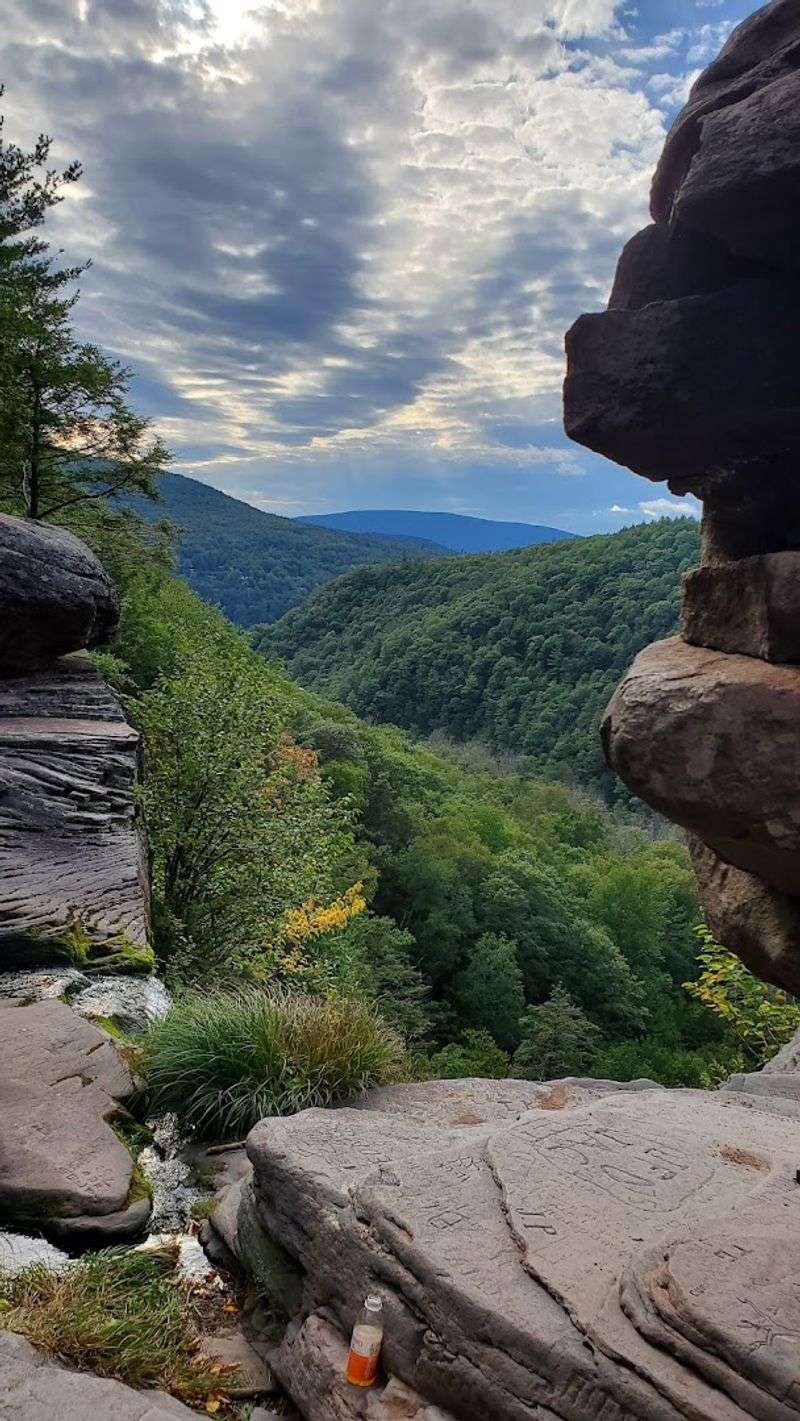
Getting to the Catskill Mountain House was never a casual affair in its early years. The original journey involved a five-hour stagecoach ride up a 1,600-foot climb from the valley below.
For the well-heeled guests of the 1800s, the effort was apparently worth every bumpy mile.
By 1892, a more elegant solution arrived in the form of the Otis Elevating Railway. The system could carry guests directly from Palenville up the steep mountain face to the hotel grounds.
For its time, it was a genuine feat of engineering and must have felt like something out of a Jules Verne novel.
The railway’s run was shorter than anyone hoped. High operating costs made it financially unsustainable, and by 1918 it was dismantled and sold for scrap.
Its story is a sharp reminder that even the most brilliant innovations can be undone by basic arithmetic. The railway’s brief existence added to the Mountain House’s reputation as a place that did things grandly, even if grandly did not always mean practically.
Today, no trace of the railway remains on the landscape, but the story of its construction and abandonment adds a satisfying layer of drama to an already rich history. It is the kind of footnote that makes the whole story feel even more human.
Hudson River School Art Trail Connection
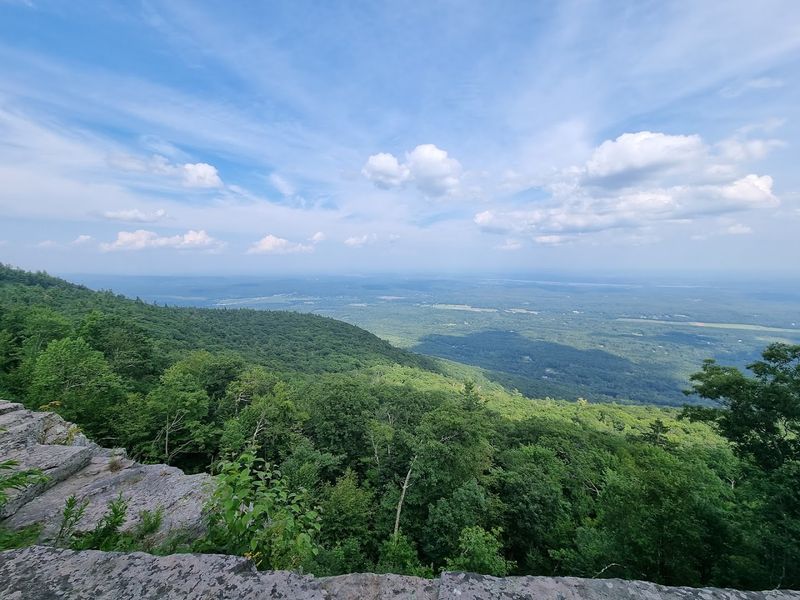
The Catskill Mountain House Site holds an official place on the Hudson River School Art Trail, which connects visitors to the landscapes that shaped America’s first major painting movement.
Thomas Cole, Frederic Edwin Church, and their contemporaries drew direct inspiration from the views found along this escarpment.
Visiting the site today puts you on the same creative ground that produced some of the most recognized American landscape paintings in history.
The trail designation is more than a historical footnote. It frames the entire visit differently, encouraging you to look at the view the way an artist would rather than just snapping a photo and moving on.
The light shifts constantly throughout the day, and the valley below changes character with every passing cloud. It is easy to understand why painters kept coming back.
For anyone interested in American art history, this stop carries genuine significance. The Hudson River School movement defined how Americans saw their own landscape at a time when the country was still figuring out its cultural identity.
Standing at the source of that inspiration feels less like a hike and more like a field trip to the original studio. New York has no shortage of art destinations, but few connect the natural world and creative history as directly as this one does.
North And South Lakes, The Shimmering Neighbors
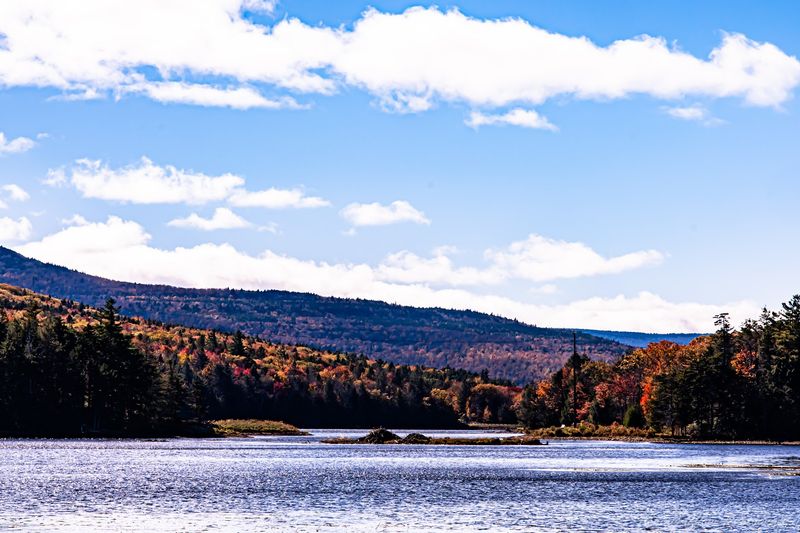
Just a short distance from the historic clearing, North Lake and South Lake offer a completely different kind of reward. The two lakes shimmer through the surrounding forest and provide a calm counterpoint to the windswept drama of the escarpment overlook.
Kayaking, fishing, and swimming are all available within the recreation area, making the site far more than a one-note history lesson.
North Lake Beach serves as the trailhead for the Escarpment Trail, so most visitors pass by the water on their way to and from the Mountain House Site. Stopping at the beach after the hike is a genuinely pleasant way to round out the day.
The water is clear, the setting is peaceful, and the mountain backdrop makes even a simple picnic feel elevated.
The campground facilities in the area are well maintained, including clean bathrooms and shower facilities for overnight guests.
Day visitors can enjoy the lakes and trails without camping, though spending a night or two in the area allows for a much deeper exploration of the connected trail network.
The combination of historical significance and recreational variety makes North South Lake Recreation Area one of the more well-rounded outdoor destinations in the entire Catskill region. It rewards visitors who stay a little longer than planned.
What The Clear Days Reveal
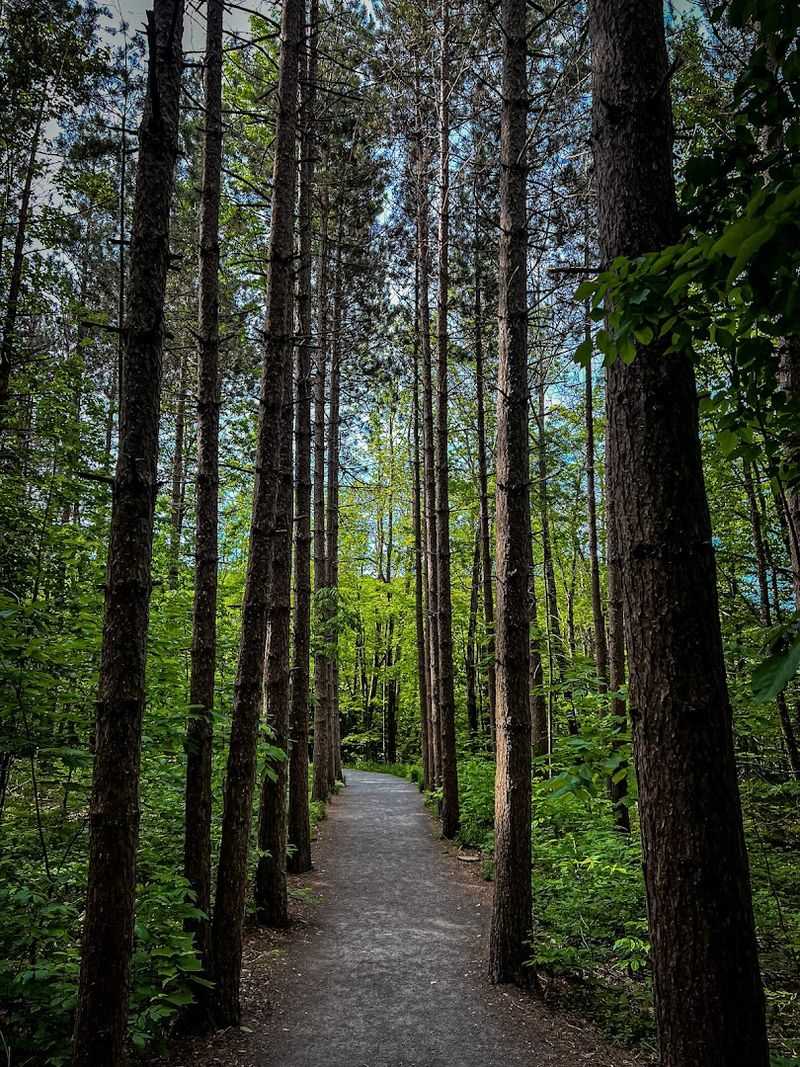
On an ordinary day, the view from the Catskill Mountain House Site is already extraordinary. On a truly clear day, it becomes something else entirely.
Visitors have reported spotting landmarks across four states from this single vantage point, including parts of Connecticut, Massachusetts, Vermont, and New Hampshire visible on the horizon.
The Hudson River catches the light far below, and the Rip Van Winkle Bridge can be spotted as two flashing lights hovering above the water.
The Alander Mountain range in Massachusetts occasionally appears as a faint blue outline in the far distance. Knowing that you can see into another state from a trail that takes fifteen minutes to walk is a fact that never really gets old.
The elevation of roughly 2,200 feet does most of the heavy lifting.
Morning visits tend to offer the clearest air and the most dramatic light, especially in autumn when the valley below turns into a patchwork of color.
Spring and summer bring lush green depth to the view, while winter strips the trees and opens up sight lines that disappear during warmer months.
Every season frames the same landscape differently, which is why so many people return to this spot year after year. The view never runs out of new things to show you.
Planning Your Visit To This Historic Hike
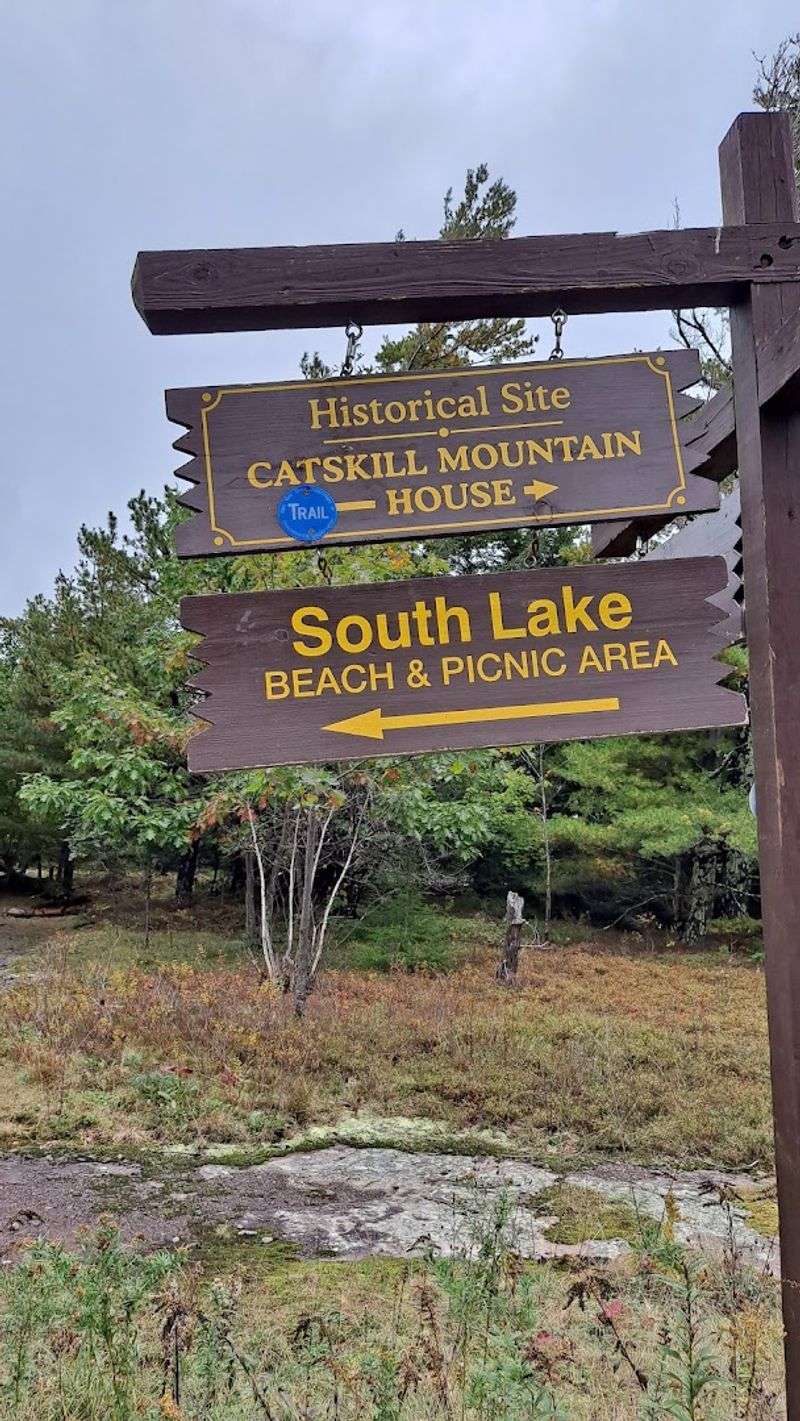
A little preparation goes a long way when visiting the Catskill Mountain House Site. The trail opens to day visitors through the North South Lake Recreation Area, and there is a modest vehicle entry fee to access the campground and parking area.
Arriving before 10 a.m. on summer weekends is a smart strategy since the lot fills up faster than you might expect for a spot this far off the highway.
The gate on the north side of the lake closes at 9 p.m., so timing your departure accordingly keeps you from an unplanned overnight stay in the parking area. Leashed dogs are welcome on the trail, and the path is manageable for most fitness levels.
Wearing sturdy shoes is still a good idea since the trail has a modest incline and some uneven ground near the ledge.
Tick awareness is worth taking seriously during warmer months, so checking yourself and your pets after the hike is a practical habit. The site is open year-round, though the campground operates seasonally.
Visiting in May through October offers the fullest range of recreational options.
Bringing a light snack and water makes the experience even more enjoyable, especially if you plan to linger at the overlook and soak in the view that once inspired an entire nation of artists and dreamers.