
This Stunning New York Home Was Designed By A Famous Artist And It’s A True Hudson Valley Gem
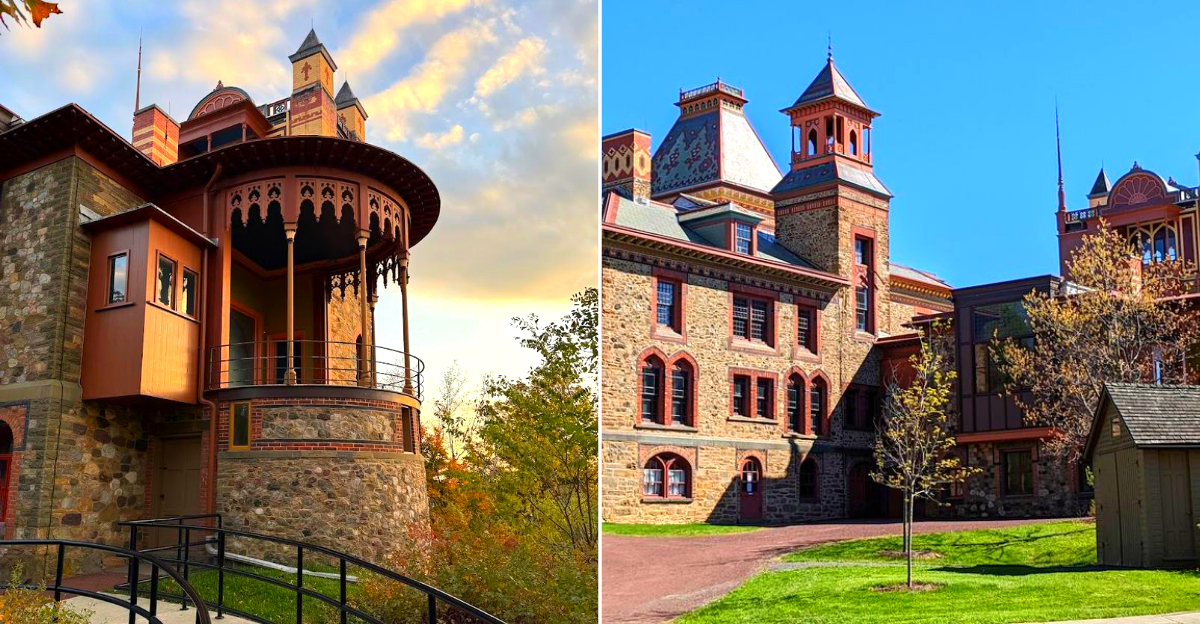
The first glimpse already feels different. Lines, textures, and small details come together in a way that clearly wasn’t accidental.
This New York home carries a creative touch you don’t usually see, shaped by someone who approached it with an artist’s eye rather than a standard blueprint.
A closer look reveals how much thought went into every corner. Light moves through the space in a way that feels intentional, and each room holds its own character without breaking the overall flow.
The setting adds another layer, with the Hudson Valley giving it room to breathe. It’s not just a place to see.
It’s a place to experience slowly, piece by piece, until the full picture comes into focus.
A Hilltop Estate Unlike Anything Else In The Northeast
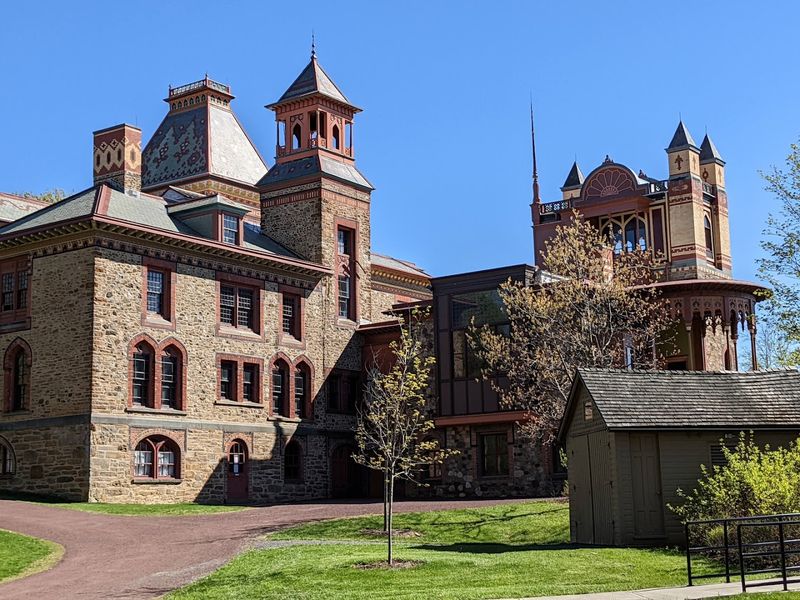
Few properties in the American Northeast carry the kind of deliberate artistic intention that defines this hilltop estate. Every element, from the placement of the carriage roads to the angle of the windows, was calculated to frame a specific view or create a particular mood.
The grounds feel curated in the way that a gallery wall feels curated, purposeful and deeply considered.
Frederic Edwin Church did not simply build a house and plant a garden. He excavated a man-made lake, planted thousands of trees, and shaped the terrain over decades to reflect his vision of an ideal landscape.
The property spans 250 acres and sits at an elevation that commands views across multiple states on a clear day.
Visitors who arrive expecting a typical historic house tour often leave genuinely surprised by the scale and ambition of the place. The estate functions as a three-dimensional artwork, one that changes with the seasons and the light.
Arriving in autumn, when the foliage turns the surrounding hills into warm waves of amber and gold, makes the experience feel almost theatrical without trying to be. The grounds alone justify the trip.
Planning Your Trip: Getting There And Making The Most Of Your Visit
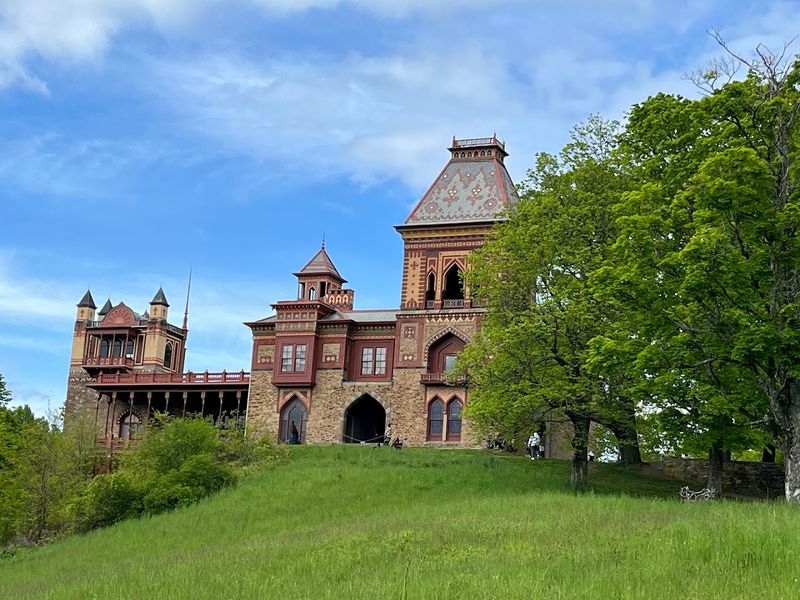
Olana sits just south of Hudson, New York, along Route 9G, and the approach by car offers its own preview of the landscape that defines the property. Drivers crossing the Rip Van Winkle Bridge from the west get a particularly dramatic first glimpse of the hilltop silhouette before descending into the valley and heading north to the entrance.
The address is 5720 NY-9G, Hudson, NY 12534, and the site is well-signed from the main road.
From New York City, the drive runs approximately two and a half hours under normal conditions, making Olana a comfortable day trip or an anchor for a longer Hudson Valley weekend that might also include the Thomas Cole National Historic Site in nearby Catskill.
Amtrak service to Hudson station puts the site within reach for those traveling without a car, though a taxi or rideshare is needed for the final few miles.
Arriving early on a weekend morning tends to yield the best parking near the house and the calmest experience on the grounds. Packing a lunch and planning to spend at least three hours allows time for both the house tour and a proper walk through the landscape.
The combination of free ground access and a reasonably priced house tour makes Olana one of the most accessible and rewarding cultural destinations in the entire Hudson Valley region. Bring comfortable shoes and a camera with a wide lens.
Frederic Edwin Church And The Hudson River School Legacy
Frederic Edwin Church was born in Hartford, Connecticut in 1826 and became one of the most celebrated American painters of the nineteenth century.
He studied under Thomas Cole, the founder of the Hudson River School, and quickly developed a style that combined precise naturalistic observation with grand compositional drama.
His large-scale canvases drew enormous crowds when exhibited in New York City.
Church traveled extensively, venturing to South America, the Arctic, Jamaica, and the Middle East in search of landscapes that could match the ambition of his imagination. Those journeys profoundly influenced not only his paintings but also the architectural and decorative choices he made at Olana.
The Persian and Moorish elements woven throughout the house reflect what he absorbed during his travels to the eastern Mediterranean.
His legacy within the Hudson River School remains singular. While contemporaries like Albert Bierstadt painted the American West with similar grandeur, Church anchored his artistic identity to the Hudson Valley with unusual devotion.
Olana stands as the most complete expression of that devotion, a place where his paintings and his personal vision of the world exist side by side in one continuous, coherent statement about beauty and place.
Walking The Grounds: Trails, Lakes, And Landscape Design
Access to the grounds at Olana is free, which makes it one of the more generous cultural offerings in the Hudson Valley. Visitors can walk more than five miles of carriage roads and footpaths that wind through meadows, woodlands, and along the edges of the man-made lake that Church excavated in the 1870s.
The trails are well-maintained and manageable for most fitness levels, with the longest loops running under two miles each.
Church designed the landscape with the same deliberate care he applied to his paintings. He managed sightlines, controlled the density of plantings, and positioned open meadows to create visual contrast with the wooded sections.
Modern restoration efforts led by landscape architects have worked to revive his original intentions, reopening viewpoints that had been obscured by decades of unchecked growth.
The lake trail from the visitor center to the mansion is a particularly pleasant walk, especially in the warmer months when the water reflects the surrounding trees and the house appears gradually through the canopy as you climb. Dogs are welcome on the grounds on a leash, and picnic spots are scattered throughout the property.
The experience of simply wandering the land, without entering the house at all, offers a satisfying and unhurried afternoon for anyone who appreciates thoughtfully designed outdoor spaces.
The Architecture: Persian, Moorish, And Victorian All At Once
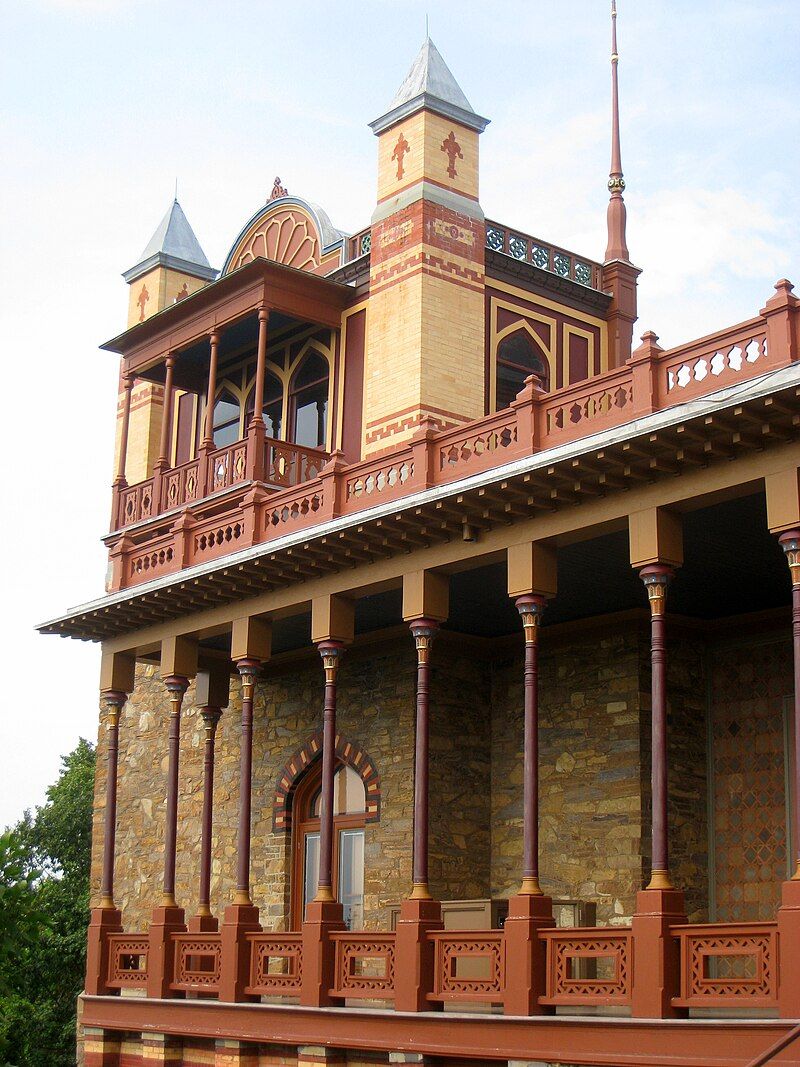
Church designed Olana in collaboration with architect Calvert Vaux, the same architect who co-designed Central Park with Frederick Law Olmsted.
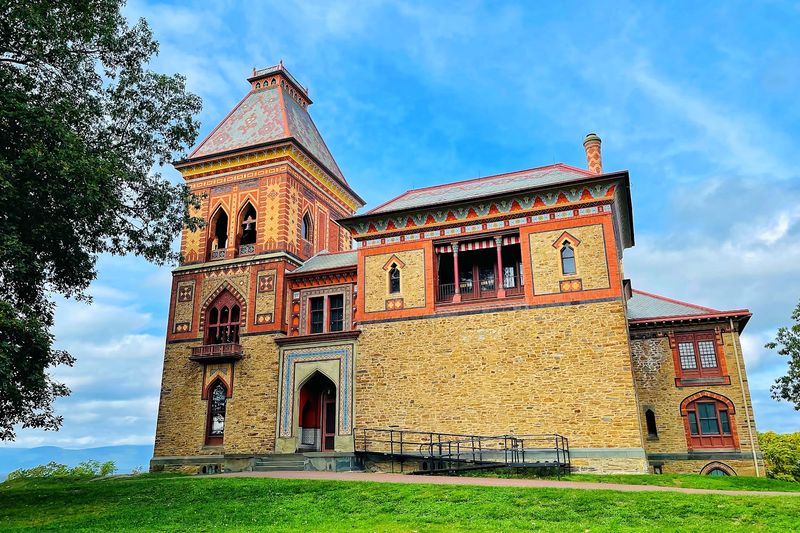
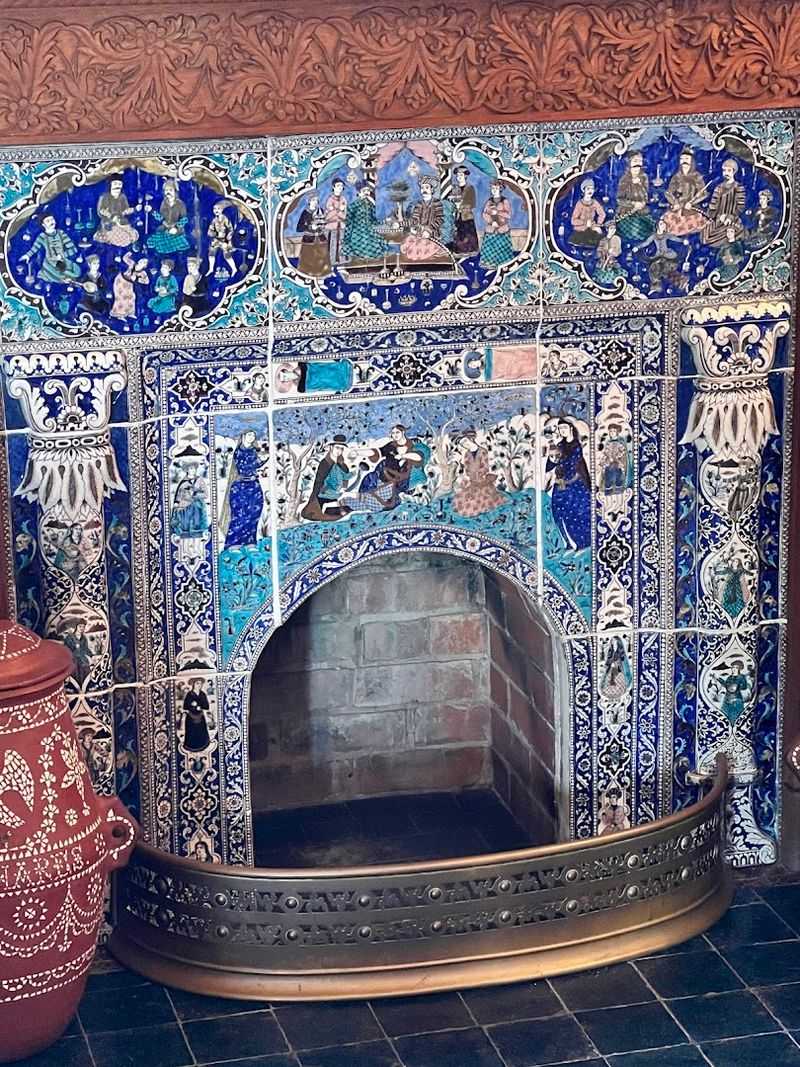
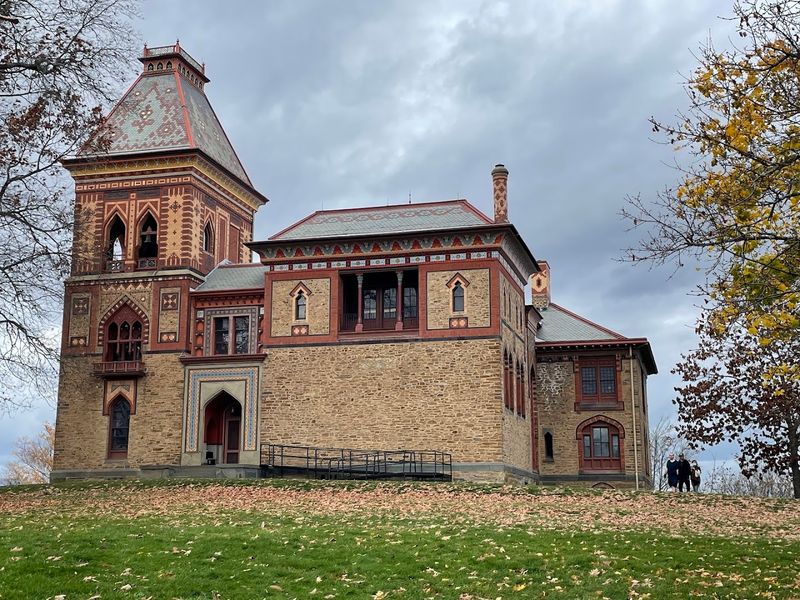
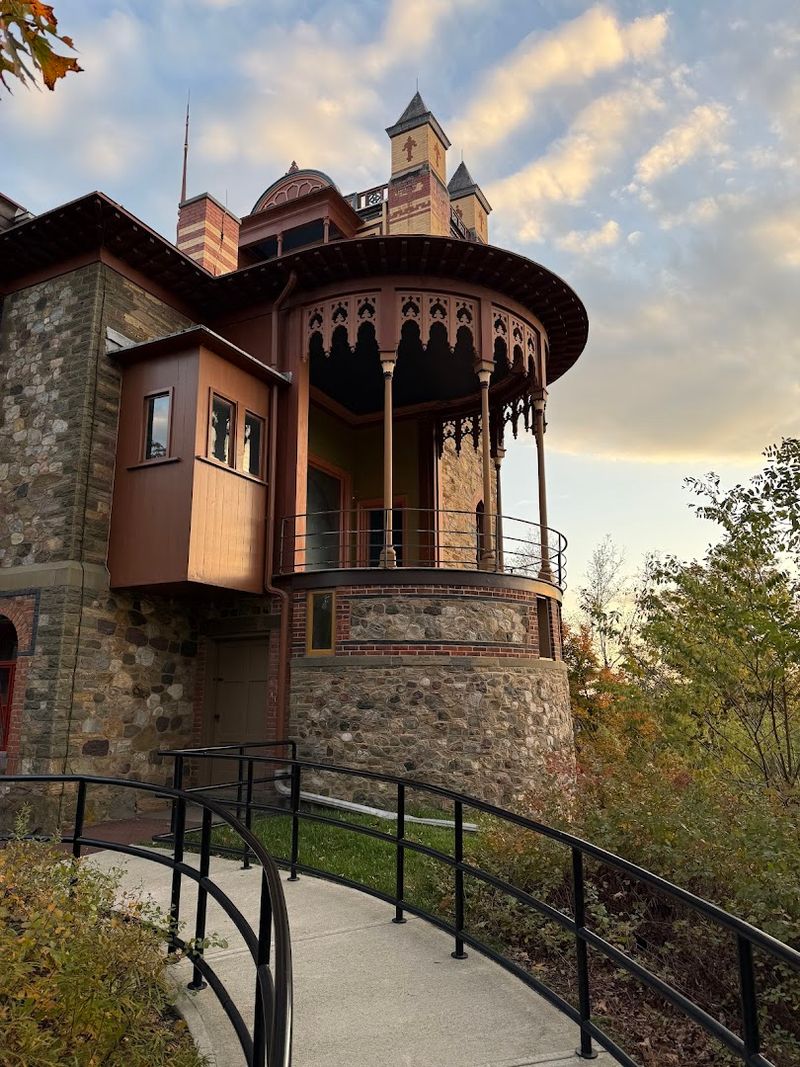
The result is a building that resists easy categorization, blending Victorian structure with Persian ornamentation, Moorish arches, and decorative tile work that Church selected and arranged himself.
No single architectural label fully captures what the house looks like from the outside.
The facade features stenciled friezes, patterned brickwork, and decorative elements that Church brought back from his travels or sourced through careful study of Persian design.
The towers and asymmetrical silhouette give the building a playful visual energy that keeps the eye moving without feeling chaotic.
It is a confident piece of architecture that clearly belongs to one person’s singular vision.
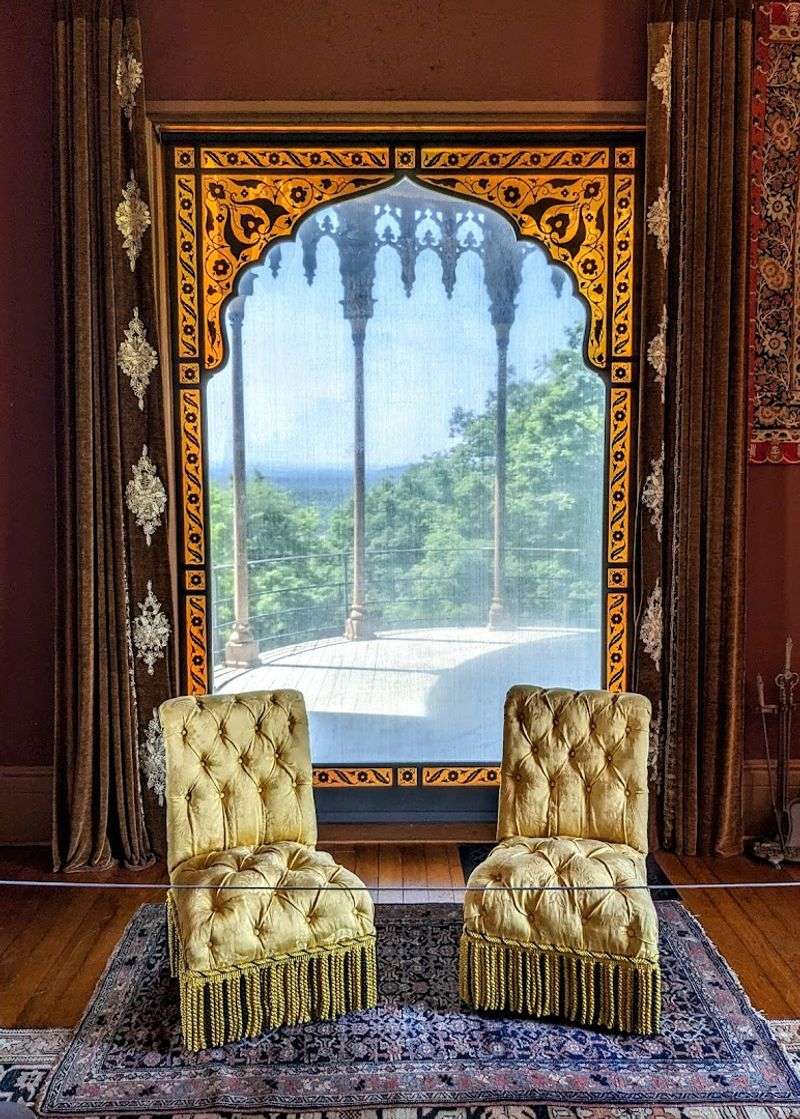
Inside, the rooms continue the theme with hand-painted surfaces, amber-tinted glass windows that cast warm light across the original furnishings, and collections of art objects gathered from around the world. The house retains its original finishes, which is increasingly rare among properties of this age.
Visitors can see the space largely as Church left it, which gives the interior an intimacy and authenticity that polished restorations often cannot replicate. Every surface tells a story worth reading slowly.
The Views That Made Church Choose This Exact Spot
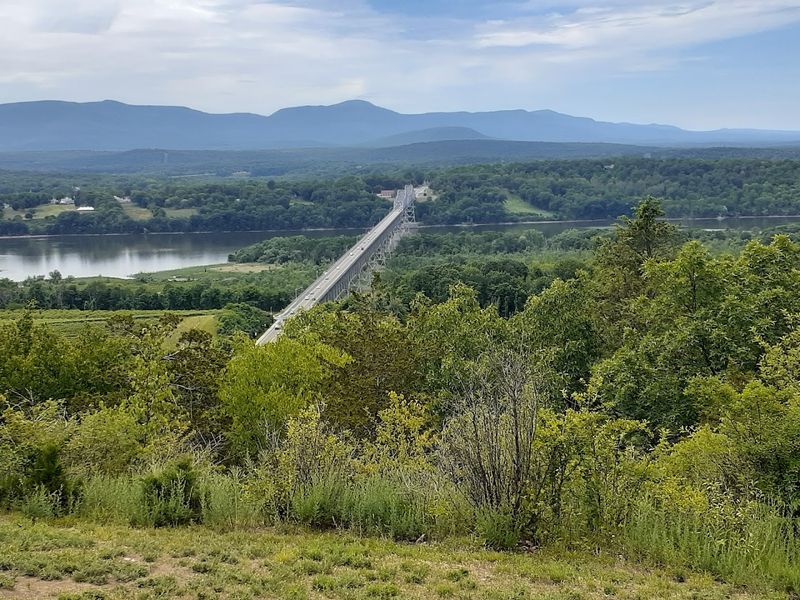
Church reportedly said that he could see seventeen counties from the ridge at Olana, a claim that feels entirely plausible once you stand at the back of the house and look west.
The Hudson River cuts a broad silver path through the valley below, and the Catskill Mountains rise beyond it with a weight and presence that even a photograph cannot fully convey.
The Rip Van Winkle Bridge appears in the middle distance, threading across the water with elegant simplicity.
Church chose this hilltop specifically because of what it offered to the eye. He purchased the land in 1860 and spent years shaping the surrounding landscape before the house was even built, treating the entire vista as a compositional problem to be solved.
The carriage roads were laid out to reveal specific views at specific moments, so the approach to the house becomes a sequence of carefully staged revelations.
Standing at the ridge on a clear afternoon, with the light dropping low over the Catskills and the river reflecting the sky, it becomes easy to understand why a painter would dedicate his life to this particular patch of earth. The view is not simply beautiful in a generic way.
It has character, depth, and a quality of stillness that feels genuinely earned. Church earned it too.
Inside The House: Original Furnishings And Artistic Interiors
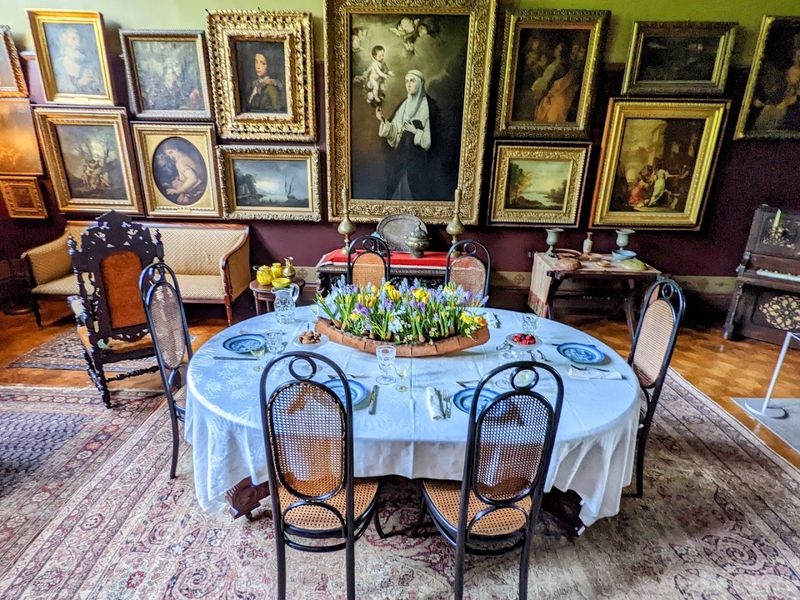
Stepping inside Olana feels like entering a space that has been paused rather than preserved. The house retains its original furnishings, decorative objects, and wall finishes, giving each room a density of detail that rewards slow, attentive looking.
Church collected objects from his travels, and the interior reflects that accumulation with Persian ceramics, Turkish textiles, and carved wooden pieces arranged alongside American furniture and his own smaller paintings.
The amber-tinted glass in several windows was chosen deliberately by Church to cast a particular quality of light across the rooms at different times of day. That choice alone demonstrates how completely he thought of the house as an extension of his painterly practice.
Light was not incidental at Olana. It was part of the design.
Guided tours run approximately 45 minutes and are led by knowledgeable staff who can speak to the history of individual objects, the architectural decisions behind specific features, and the broader story of Church’s life and work. Self-guided tours are also available during certain seasons, with interpreters stationed in each room to answer questions.
The house tour costs $20 per person and is worth every cent for anyone with even a passing interest in American art history or nineteenth-century domestic life. The gift shop carries thoughtful items related to Church’s work and the estate’s history.
Practical Visitor Information: Tours, Hours, And Tickets
Planning a visit to Olana requires a bit of advance preparation, particularly for those who want to tour the house interior. The site is open Friday through Sunday from 11 AM to 3:15 PM, with the house closed Monday through Thursday.
Tours of the interior cost $20 per person, and reservations are strongly recommended since timed entry keeps group sizes manageable and the experience more comfortable for everyone.
The grounds are free to access during open hours, which means a visit can be tailored to whatever level of engagement suits the day. Families with young children, hikers, and casual visitors all find something worthwhile without spending a cent on admission.
For those booking house tours, the process involves purchasing tickets at the visitor center near the base of the hill and then driving up to the mansion to meet the tour group.
Parking near the house is limited, so arriving early on busy weekend days is advisable. The staff at Olana earn consistent praise for their friendliness and depth of knowledge, and asking questions during a tour tends to unlock details not covered in the standard presentation.
The site can be reached by phone at 518-751-0344, and the official website at olana.org provides current scheduling and ticketing information. A visit here pairs naturally with a stop at the nearby Thomas Cole National Historic Site in Catskill.
The Man-Made Lake And Church’s Environmental Vision
Church excavated the lake at Olana in the 1870s as part of his broader effort to shape the landscape into a coherent artistic composition. The project required significant labor and engineering, but Church considered it essential to the overall design of the property.
The lake introduced a reflective element into the landscape that captured the sky and the surrounding foliage, adding a painterly quality to the view from the house above.
His approach to landscape design was rooted in the concept of borrowed views, a technique familiar to Japanese garden designers and European landscape architects, in which distant scenery is incorporated into the composition of a designed space.
Church extended this principle across hundreds of acres, treating the hills, river, and sky visible from Olana as integral parts of his artwork rather than background scenery.
The lake today serves as a focal point for the lower trail system and provides one of the most pleasant walking experiences on the property. Herons and other waterfowl frequent the shoreline throughout the warmer months, and the reflections on calm mornings can be genuinely arresting.
Modern restoration efforts have worked to maintain the lake and its surrounding plantings in alignment with Church’s documented intentions, ensuring that his environmental vision continues to be legible to contemporary visitors who may not even realize they are walking through a carefully composed picture.
Olana’s Place In American Cultural History
Olana occupies an unusual position in American cultural history, sitting at the intersection of fine art, architecture, landscape design, and the broader nineteenth-century project of defining what American identity might look like through its relationship with the natural world.
Church and his Hudson River School contemporaries believed that the American landscape carried a moral and spiritual significance that European landscapes could not match, and Olana was built as a physical expression of that conviction.
The site has attracted cultural figures throughout its history. Mark Twain reportedly described Olana as an exalted hill of art, a characterization that captures both the ambition and the slight grandiosity of the enterprise with good humor.
The estate has since become a touchstone for scholars of American art, environmental history, and nineteenth-century architecture, drawing researchers and enthusiasts from well beyond the Hudson Valley region.
Olana was designated a National Historic Landmark in 1965 and is now managed as a New York State Historic Site, which has provided the institutional support needed for ongoing preservation and restoration work.
The combination of public access and serious scholarly stewardship has kept the site vital and relevant rather than merely commemorative.
For anyone interested in understanding how American artists thought about the land they lived in, Olana offers evidence that is both beautiful and genuinely illuminating. The place earns its landmark status every day it stays open.