
10 Timeless Arizona Towns Where The Wild West Still Lives On In 2026
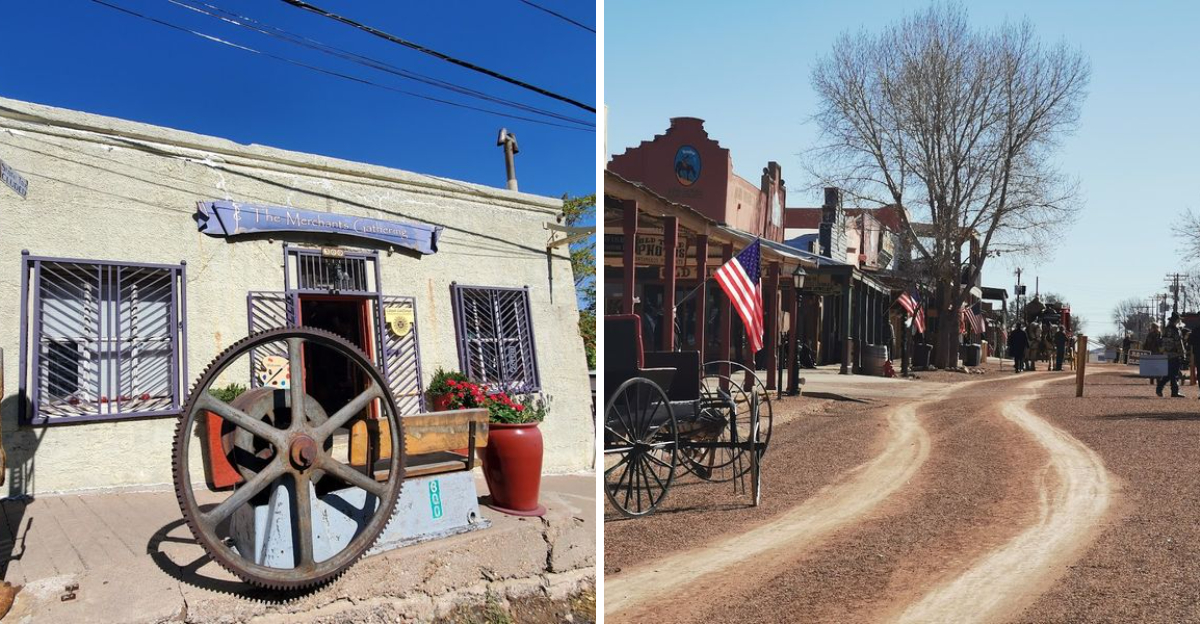
Picture yourself standing on a dusty main street, the sun blazing overhead, and the faint echo of boots on wooden boardwalks filling the air. Arizona has a way of pulling you back in time like nowhere else on earth, and its historic towns carry stories that feel too vivid to be just history.
From old silver mines to legendary gunfight sites, these places are alive with the spirit of the frontier. Pack your bags and get ready, because the Wild West is not just a memory here.
1. Bisbee
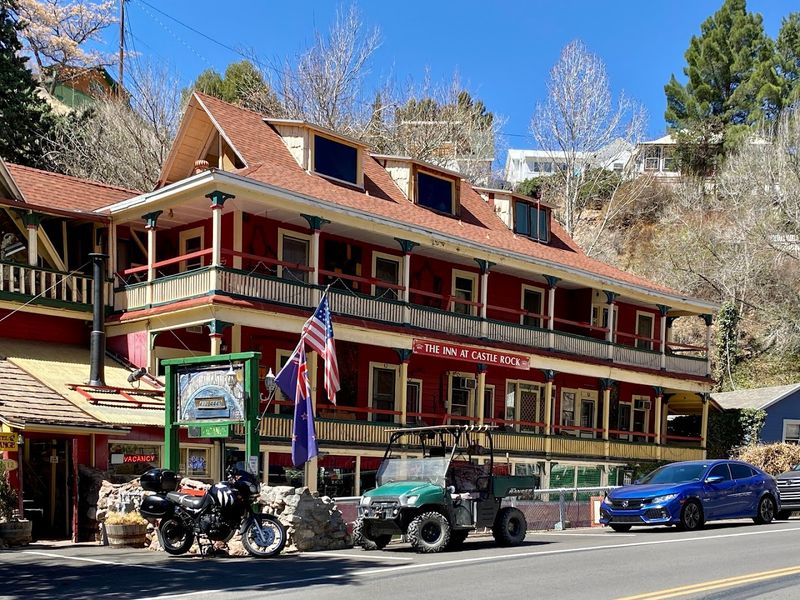
Bisbee is the kind of town that surprises you the moment you see it. Perched dramatically in the Mule Mountains at nearly 5,500 feet elevation, its Victorian buildings cling to canyon walls in a way that feels almost impossible.
It started as a copper mining boomtown in the late 1800s and grew into one of the largest cities in the American Southwest by the early 1900s.
The Copper Queen Mine Tour is the must-do experience here. You suit up in a yellow slicker and hard hat, then ride an old mine cart deep underground while a former miner guides you through tunnels that once produced billions of dollars in copper, gold, and silver.
It is genuinely thrilling, even for adults who think they are too cool to be impressed.
Above ground, Bisbee’s Brewery Gulch district buzzes with independent shops, art galleries, and local restaurants that have given the town a creative, bohemian personality unlike any other Arizona destination. The Bisbee 1000 stair climb event happens every October, challenging visitors to tackle over 1,000 stairs built into the hillside neighborhoods.
This town rewards slow exploration and spontaneous wandering more than anywhere else on this list.
2. Tombstone
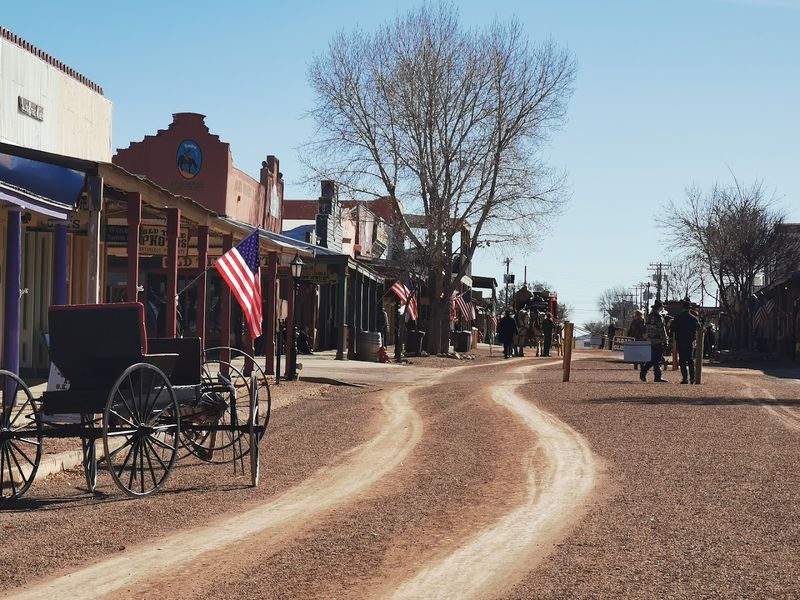
Few places on earth carry a name as loaded with legend as Tombstone. Known worldwide as “The Town Too Tough To Die,” this small Arizona gem sits in Cochise County and has been drawing curious travelers since the silver boom of the 1880s.
Walking down Allen Street feels like stepping straight into a black-and-white photograph that somehow got its color back.
The O.K. Corral is the crown jewel here, where the famous 1881 gunfight between the Earp brothers and the Clanton gang lasted only about 30 seconds but echoed through history forever.
Daily reenactments bring that moment back to life with impressive detail. You can practically smell the gunpowder.
Beyond the shootouts, Tombstone offers the Boot Hill Graveyard, the Bird Cage Theatre, and the Crystal Palace Saloon, each packed with artifacts and atmosphere. The Bird Cage operated continuously from 1881 to 1889 and still holds original furnishings.
Whether you spend one hour or one full day here, Tombstone never lets you leave without giving you something unforgettable to carry home.
3. Jerome
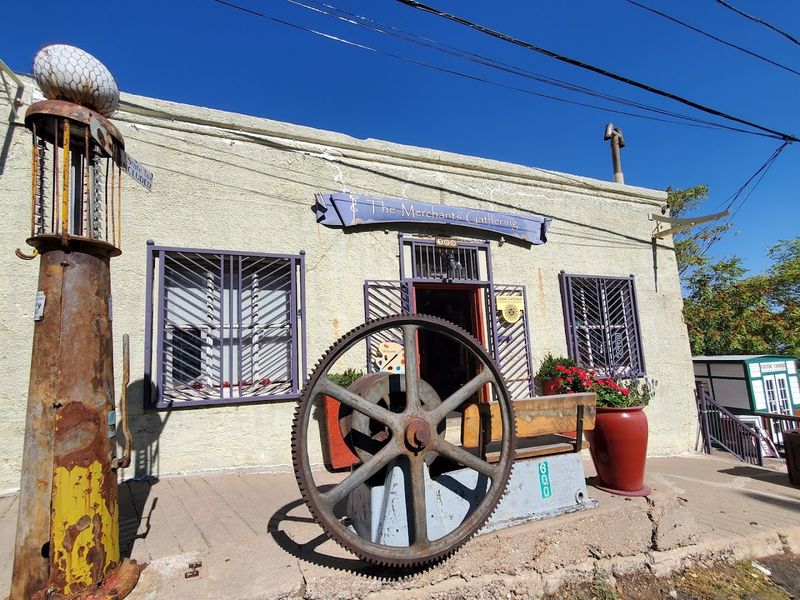
Clinging to the side of Cleopatra Hill at 5,000 feet above sea level, Jerome is one of America’s most dramatically situated towns. At its peak in the 1920s, this copper mining hub had nearly 15,000 residents and was considered one of the wickedest towns in the West.
Today, fewer than 500 people call it home, but the town buzzes with artists, musicians, and travelers who arrive in steady streams year-round.
Jerome State Historic Park preserves the Douglas Mansion, built in 1916 by mining magnate James Douglas Jr. The museum inside explains the town’s wild history with remarkable clarity, including the story of how entire buildings slid downhill over the years due to underground mine blasting. One old jail actually moved 225 feet from its original location and still sits crooked today.
The views from Jerome are absolutely jaw-dropping. On a clear day you can see the red rocks of Sedona, the San Francisco Peaks near Flagstaff, and the entire Verde Valley spread out below you like a living map.
Shopping for local art, stopping at the Spirit Room Bar, and catching live music on weekends make Jerome feel more like a living festival than a ghost town.
4. Prescott
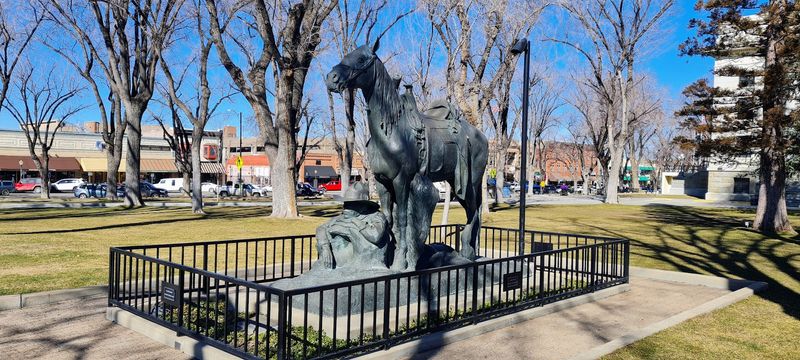
Prescott proudly calls itself “Everybody’s Hometown,” and after spending even a few hours there, you start to understand why. Founded in 1864 as Arizona’s first territorial capital, this mile-high city blends frontier history with a genuinely welcoming small-town energy that feels rare in 2026.
The elevation keeps summers cool, and the surrounding Prescott National Forest makes outdoor adventures incredibly accessible.
Whiskey Row on Montezuma Street is the heartbeat of downtown, a stretch of historic bars and shops that once served as the rowdiest saloon district in the Arizona Territory. The Palace Restaurant and Saloon, open since 1877, is the oldest frontier bar in Arizona and still pours drinks beneath original tin ceilings.
Locals and tourists mix here without any awkwardness, which says a lot about the town’s character.
Courthouse Plaza sits right across the street and hosts the legendary Prescott Frontier Days Rodeo every Fourth of July weekend, billed as the World’s Oldest Rodeo since 1888. Watching cowboys compete in bronc riding and barrel racing while fireworks light up the sky above the historic courthouse is an experience that puts a lump in your throat in the best possible way.
Prescott earns every bit of its beloved reputation.
5. Wickenburg
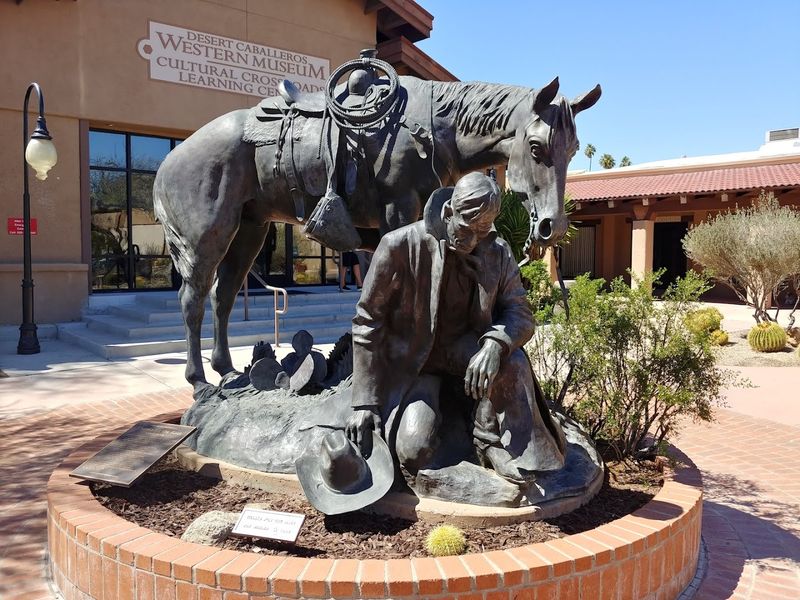
Called the “Dude Ranch Capital of the World,” Wickenburg sits about 60 miles northwest of Phoenix and operates on a completely different timeline than the rest of modern Arizona. The town was founded in 1863 by Henry Wickenburg after he discovered the Vulture Mine, which turned out to be one of the richest gold mines in Arizona Territory history.
That gold rush energy still hums quietly beneath the surface of this charming desert community.
Guest ranches have been a cornerstone of Wickenburg’s identity since the 1920s, when wealthy visitors from the East Coast came to experience cowboy life. Ranches like Rancho de los Caballeros still operate today, offering horseback riding, cattle drives, and genuine Western hospitality that feels nothing like a theme park.
It is the real thing, done with pride and tradition.
Downtown Wickenburg features the Jail Tree, a real mesquite tree where outlaws were reportedly chained because the town lacked a proper jail in its early years. The Desert Caballeros Western Museum houses one of the finest collections of Western art in the country, including works by Frederic Remington and Charles Russell.
Wickenburg moves at a slower pace by choice, and that pace turns out to be exactly what most visitors need.
6. Oatman
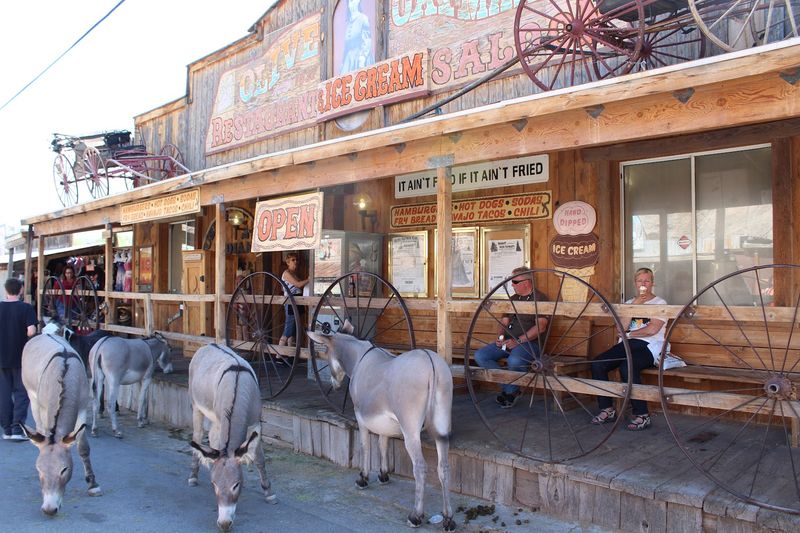
Oatman might be the most entertainingly weird town on this entire list, and that is meant as the highest compliment. Sitting in the Black Mountains along the original Route 66, this former gold mining town is best known today for its population of wild burros that freely roam the main street, stopping traffic, begging for carrots, and posing for photos with zero shame.
They are descendants of pack animals left behind when miners abandoned the area in the 1940s.
Gold was discovered here in 1915, and within two years the population exploded to around 3,500 people. The Oatman Hotel, built in 1902, is one of the oldest two-story adobe structures in the Mohave Valley and famously served as the honeymoon destination for Clark Gable and Carole Lombard in 1939.
Their old room is preserved exactly as it was, which is a genuinely touching detail in an otherwise wild place.
Gunfight reenactments happen on weekends right in the middle of the street, with actors tumbling dramatically into the dirt while burros wander through the scene completely unbothered. The shops sell gold panning kits, Route 66 memorabilia, and handmade crafts.
Oatman does not take itself too seriously, and that self-awareness is exactly what makes it so lovable.
7. Williams
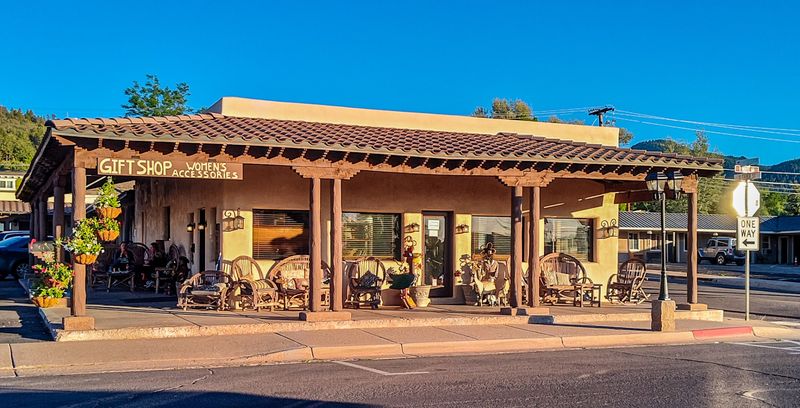
Williams holds a special distinction that very few American towns can claim: it was the last town on Route 66 to be bypassed by Interstate 40, which did not happen until 1984. That late farewell to the Mother Road gave Williams extra time to preserve its classic roadside character, and the town has leaned into that heritage ever since.
The main street still glows with original neon signs that feel like they belong on a vintage postcard.
The Grand Canyon Railway departs from Williams every morning, carrying passengers 65 miles north to the South Rim of the Grand Canyon in restored early 20th-century rail cars. Cowboys on horseback meet the train at the station, and live entertainment aboard the train includes Western music and mock train robberies that delight kids and adults equally.
It is genuinely one of the most fun travel experiences in all of Arizona.
Williams sits at 6,700 feet elevation, which means cooler summers and real snowfall in winter, making it a four-season destination unlike most Arizona towns. The surrounding Kaibab National Forest offers elk viewing, hiking, and fishing at Cataract Lake just minutes from downtown.
Grab a burger at the historic Goldie’s Route 66 Diner and watch the foot traffic on main street roll by like a living museum exhibit.
8. Winslow
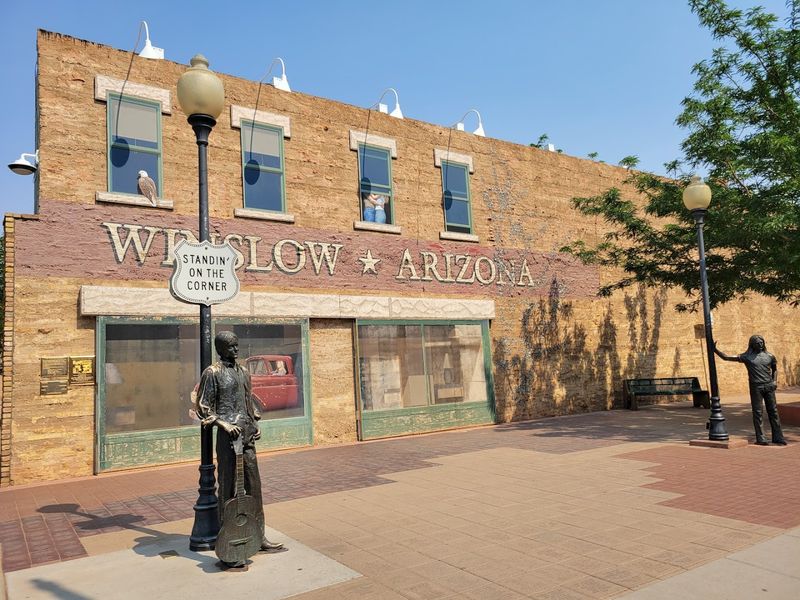
Most people know Winslow because of one Eagles lyric, and honestly, that song put this small northeastern Arizona town on the map in a way that local tourism boards could never have planned. “Standin’ on the Corner Park” exists as a real, official attraction on Route 66, complete with a bronze statue of a hitchhiker, a painted mural of a girl in a flatbed Ford, and a red brick corner that gets photographed thousands of times every year.
But Winslow has serious history beyond the song. La Posada Hotel, designed by legendary architect Mary Colter and opened by the Fred Harvey Company in 1930, is considered one of the finest examples of Spanish Colonial Revival architecture in the American Southwest.
After decades of neglect, the hotel was lovingly restored and reopened in 1997. Staying there feels like sleeping inside a beautifully preserved piece of American railroad history.
Just 20 miles east of Winslow sits Meteor Crater, the best-preserved meteorite impact site on Earth, formed roughly 50,000 years ago by a nickel-iron meteor traveling 26,000 miles per hour. The crater is nearly a mile wide and 550 feet deep.
Between the song, the hotel, and a literal crater from space, Winslow packs an almost unfair amount of character into one small town.
9. Kingman
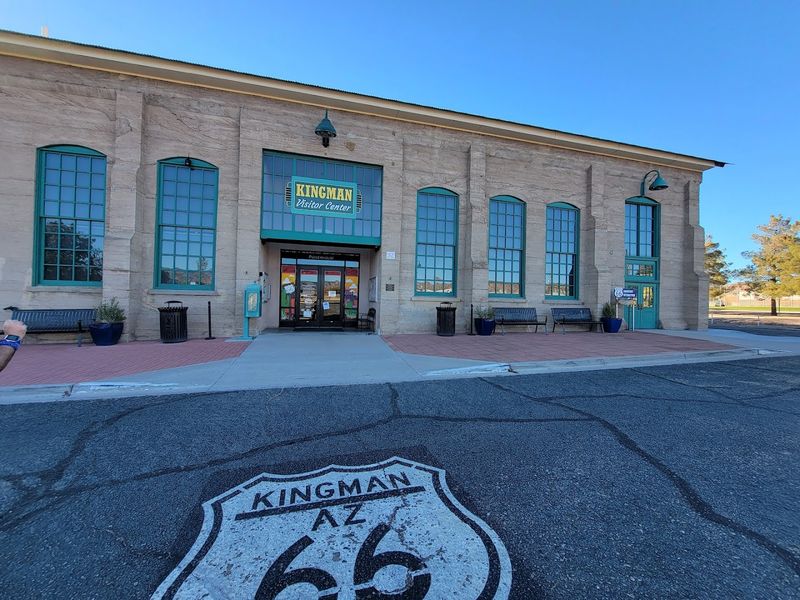
Kingman sits at the crossroads of two legendary American highways, Route 66 and US-93, which tells you everything about its identity as a travel hub built on movement and passage. Founded in 1882 as a railroad town by the Atlantic and Pacific Railroad, Kingman grew steadily and eventually became one of the most important stops on the entire Mother Road.
The Powerhouse Visitor Center, housed in a restored 1907 electric plant, serves as the gateway to everything Route 66 in this part of Arizona.
The Historic Route 66 Museum inside the Powerhouse traces the entire history of the road from its 1926 designation through the Dust Bowl migration era and the postwar road trip boom. Vintage vehicles, period photographs, and interactive displays make it genuinely engaging rather than just another dusty exhibit hall.
Plan at least 90 minutes to do it justice.
Kingman also sits just 30 miles from the Hualapai Mountain Park, which rises to nearly 8,500 feet and offers a completely different landscape of pine forests and rocky peaks above the desert floor. Andy Devine, the beloved character actor from 1930s and 1940s Westerns, was born in Kingman in 1905, and the main street through downtown still carries his name.
That kind of deep-rooted Western identity is not manufactured here.
10. Globe
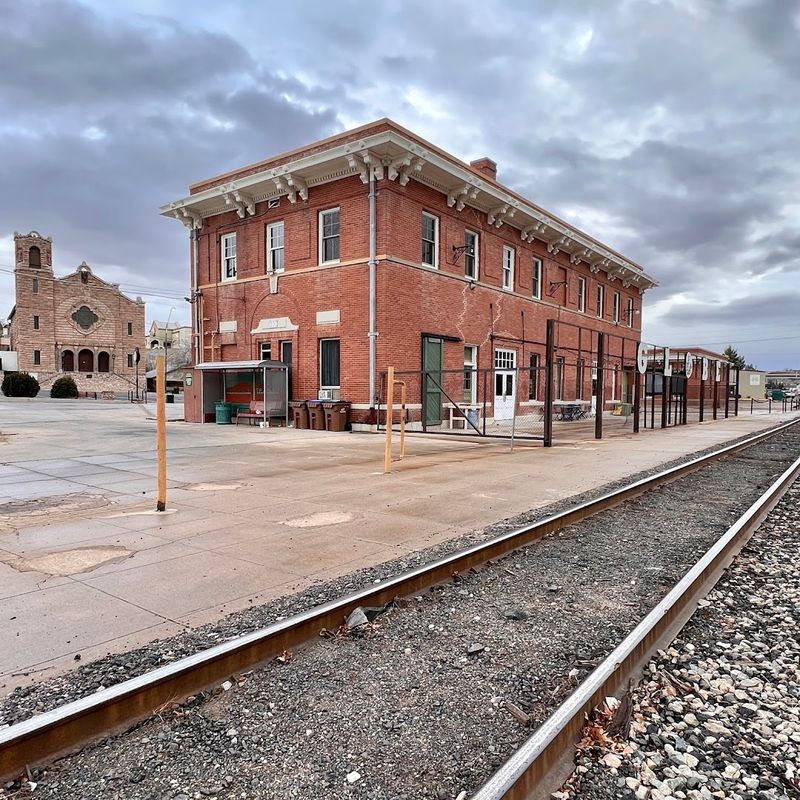
Globe does not shout for attention the way some Arizona towns do, and that quiet confidence is part of what makes it so genuinely rewarding to visit. Founded in 1876 after silver was discovered in the area, Globe quickly grew into a major copper mining center and became the seat of Gila County.
The historic downtown along Broad Street has been remarkably well preserved, with brick buildings dating back to the early 1900s lining the main corridor in an almost uninterrupted stretch.
The Besh-Ba-Gowah Archaeological Park just outside town protects the ruins of a Salado culture village occupied between roughly 1225 and 1400 AD. Walking through the partially reconstructed stone rooms and looking out over the Pinal Creek valley gives you a powerful sense of how long humans have found this rugged landscape worth calling home.
The on-site museum displays thousands of artifacts recovered from excavations.
Globe also serves as the gateway to the San Carlos Apache Reservation, where visitors can learn about Apache culture and history at the Apache Gold Casino and surrounding cultural sites. The Cobre Valley Center for the Arts, housed in the old Gila County Courthouse built in 1906, supports local artists and hosts rotating exhibitions year-round.
Globe rewards the kind of traveler who slows down enough to actually look around.