
This 48 Foot Tall Oklahoma Sculpture Honors Native American Heritage In A Striking Way
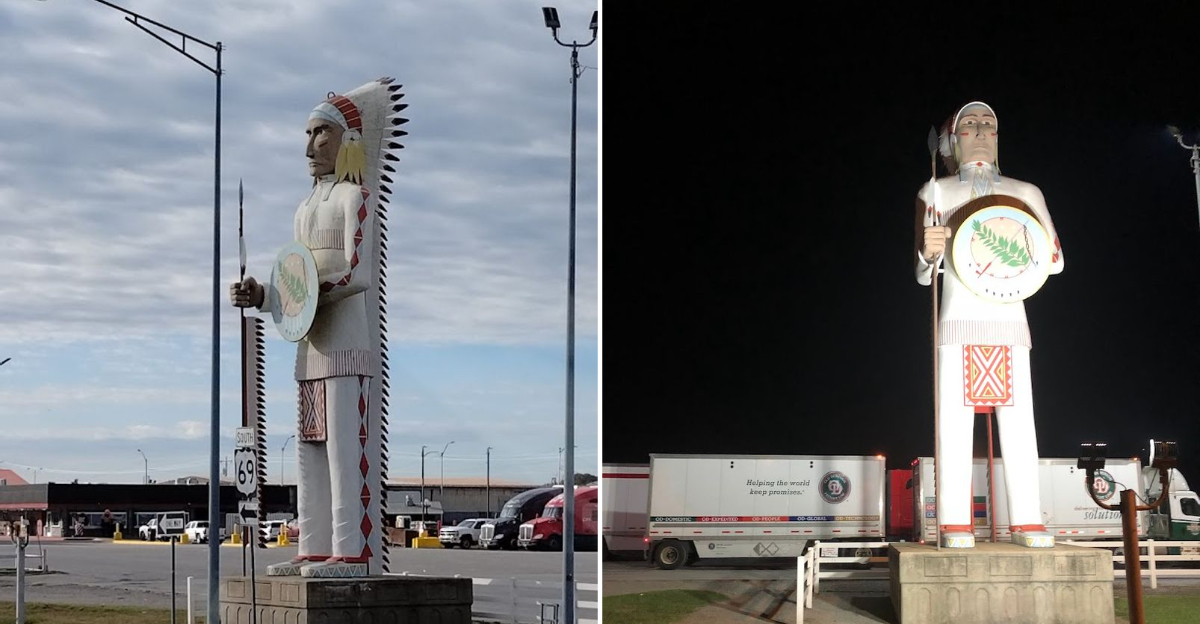
Rising from the Oklahoma plains without apology, this sculpture does not ask for attention so much as command it without effort. The monument earns its scale by carrying a story that required exactly that much space to tell properly.
Native American heritage rendered at this height produces something that photographs cannot fully prepare a visitor to experience. Arrival and actual encounter operate on entirely different frequencies.
The artistry here works on multiple levels simultaneously. Up close, the details demand time.
From a distance, the silhouette against an open sky makes its own separate and equally powerful argument. Monuments built with genuine intention rather than obligation carry a different weight than the ones erected out of civic duty.
This sculpture belongs to the first category completely, and the surrounding landscape seems to understand that, offering nothing to compete with what stands at its center.
History And Significance Of The Sculpture
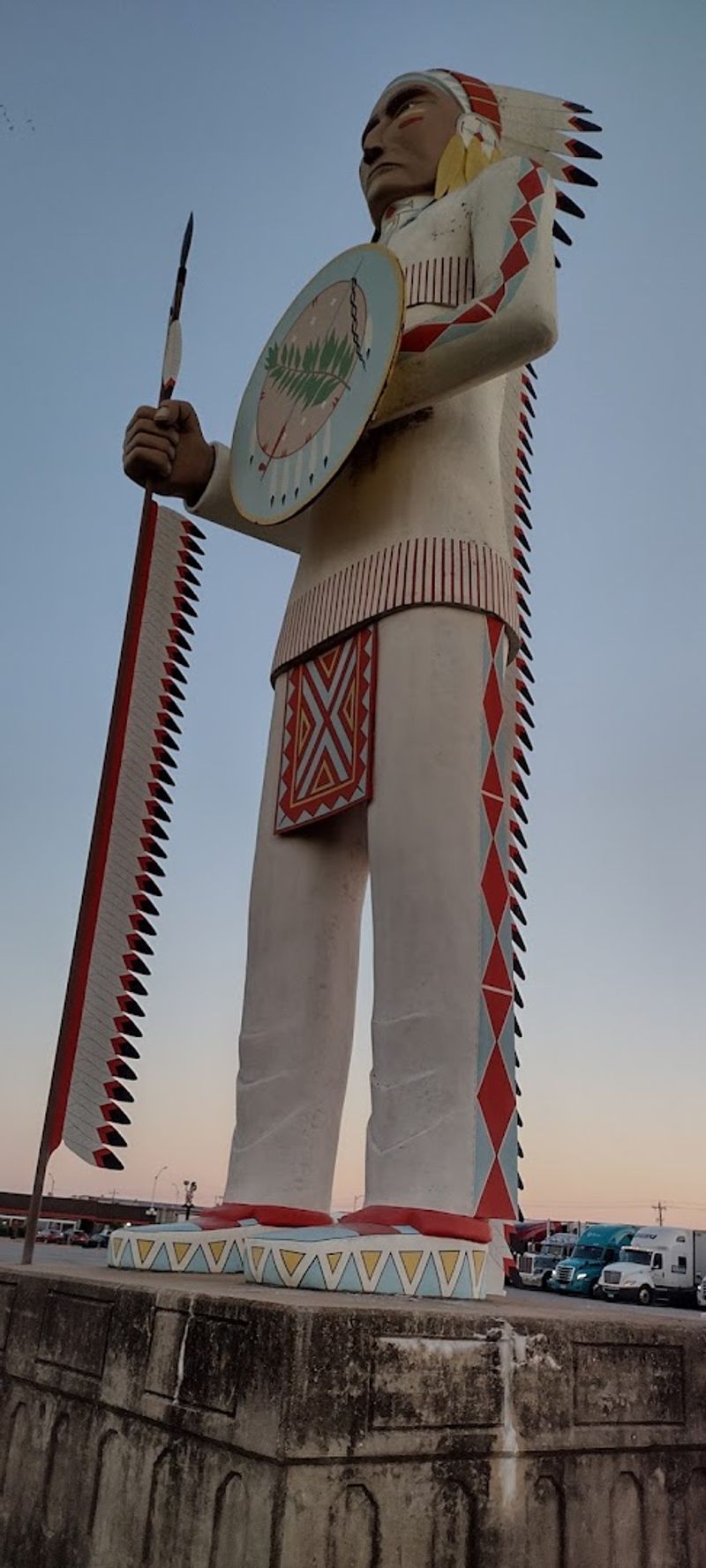
Chief Standing Brave didn’t just appear overnight. Artist Wade Leslie started building a model in 2000, driven by a vision to honor Oklahoma’s deep Native American roots.
The full-scale statue was completed in spring 2001. On August 9, 2001, it was raised upright for the first time, a moment that must have been absolutely jaw-dropping for anyone watching.
The sculpture stands 46 feet tall on its own. Add the base, and you’re looking at over 50 feet of pure tribute.
It weighs more than 15,000 pounds, which puts it in a league far beyond your average roadside attraction.
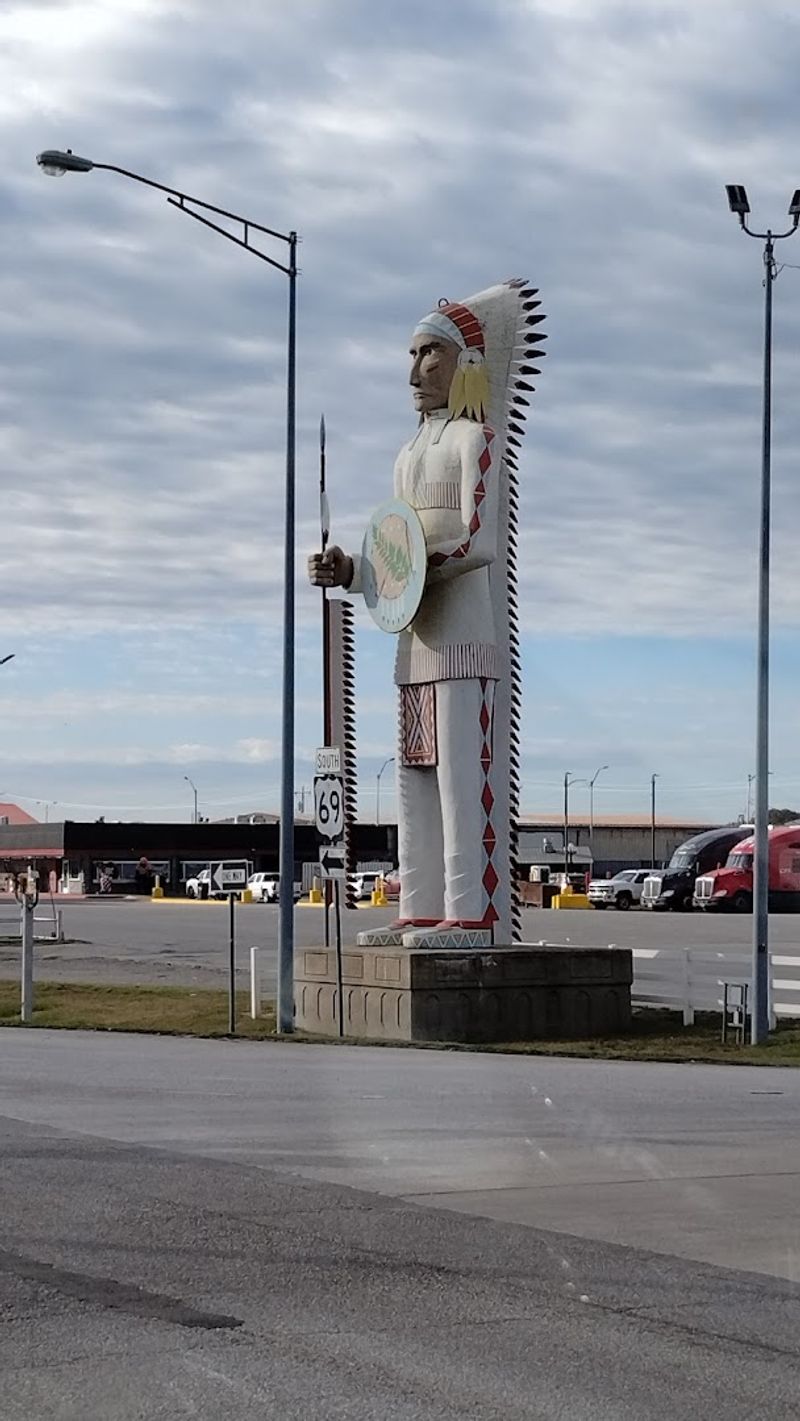
You can find it at 31209 S Hwy 69, Big Cabin, OK 74332, right outside the Woodshed of Big Cabin travel plaza. It’s visible from Interstate 44 and US-69, so missing it is honestly difficult.
Oklahoma has always had strong ties to dozens of Native tribes, and this sculpture makes that history visible to thousands of passing travelers every single day. It’s not just a statue, it’s a statement.
Big Cabin is a small town, but this sculpture gives it a presence that stretches far beyond its size. History has a way of standing tall here, literally.
Artistic Techniques Used In Creating The Sculpture
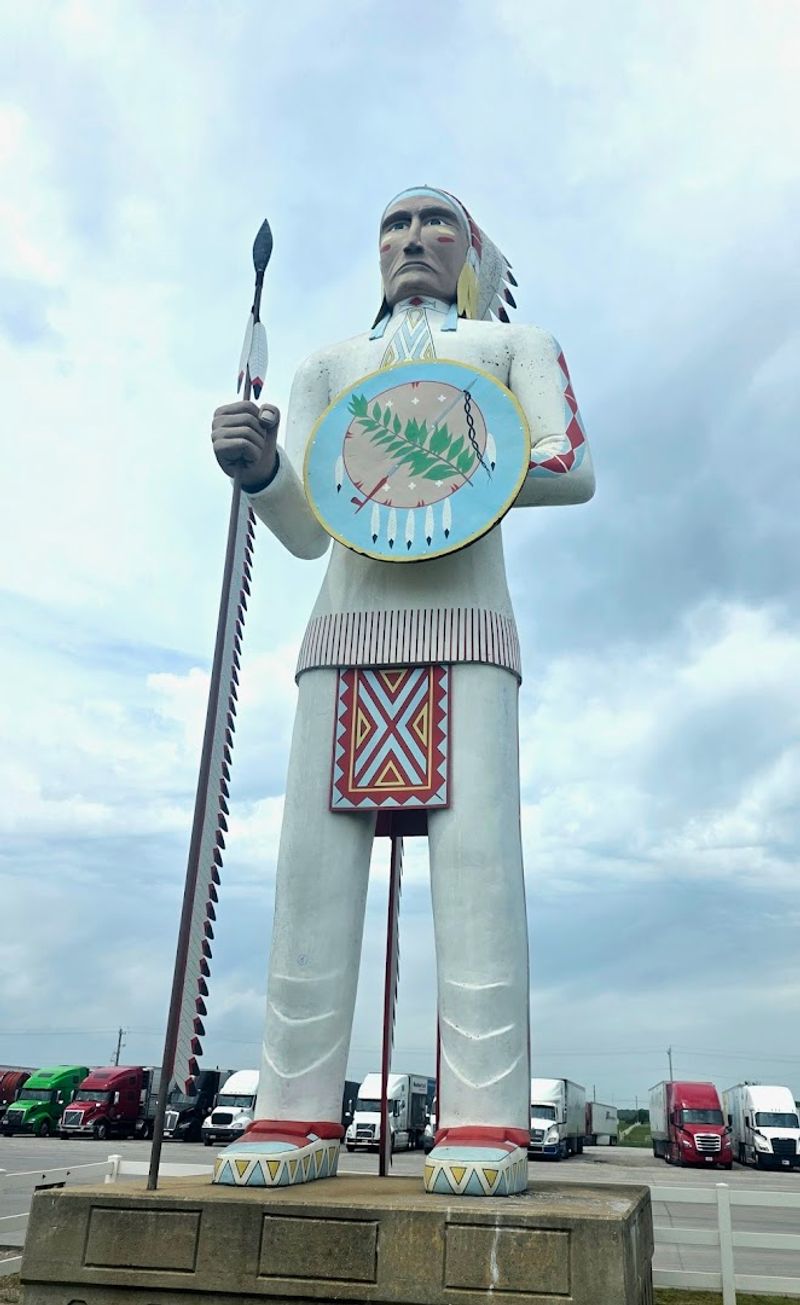
Wade Leslie didn’t use marble or bronze for Chief Standing Brave. The construction process was far more inventive than that.
He built the statue using wire mesh, rebar, and steel pipe as the internal skeleton. That framework gave the massive figure its structural strength and shape.
Once the skeleton was in place, Leslie applied expanding insulation foam over the surface. He then carved that foam into detailed, expressive forms.
The result was a textured surface that captured clothing folds, facial features, and feather details with real precision.
After carving, the entire statue was fiberglassed for durability. Sanding and priming came next, followed by painting to bring the figure to life visually.
This layered process required both engineering skill and artistic sensitivity. It’s a technique that blends sculpture, construction, and painting into one ambitious project.
The finished surface holds up against Oklahoma’s unpredictable weather, from summer heat to winter wind. Leslie’s approach was practical and creative at the same time.
He needed the statue to last outdoors for years, and the fiberglass coating was the smart solution. For a piece this size, every material choice mattered.
The construction timeline from model to finished statue spanned roughly a year. That kind of commitment to craft shows in every carved line and painted detail visible on the finished figure today.
Cultural Symbols Represented In The Artwork
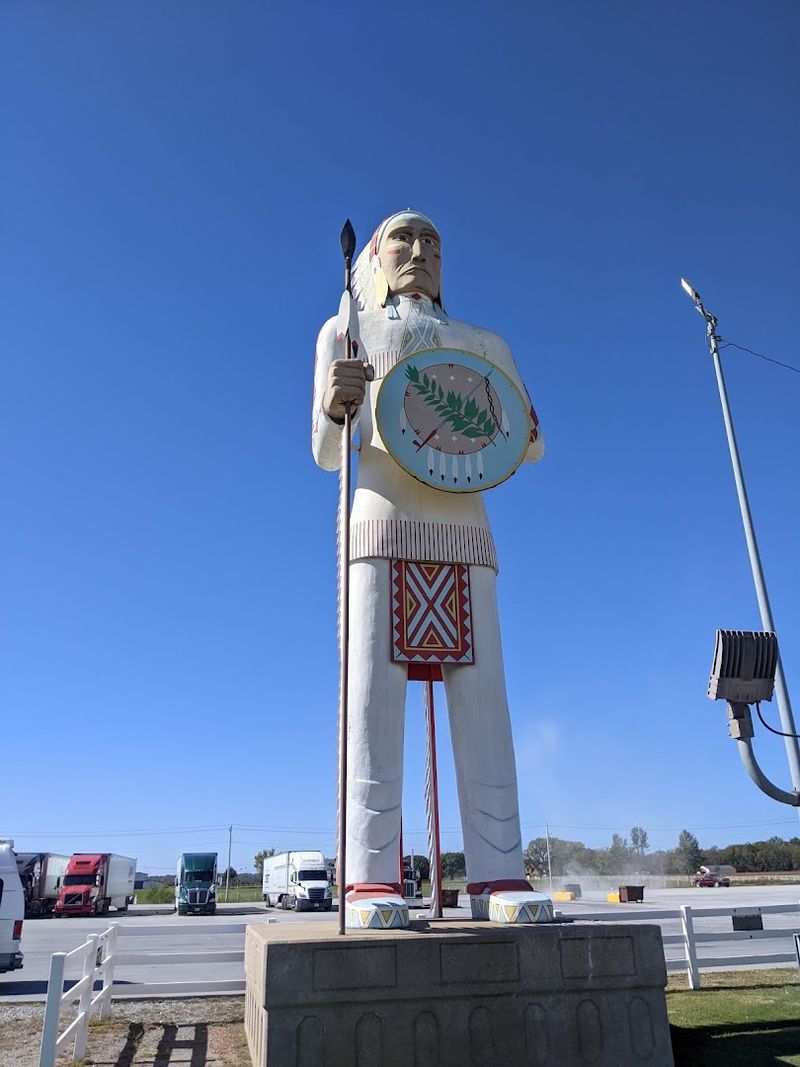
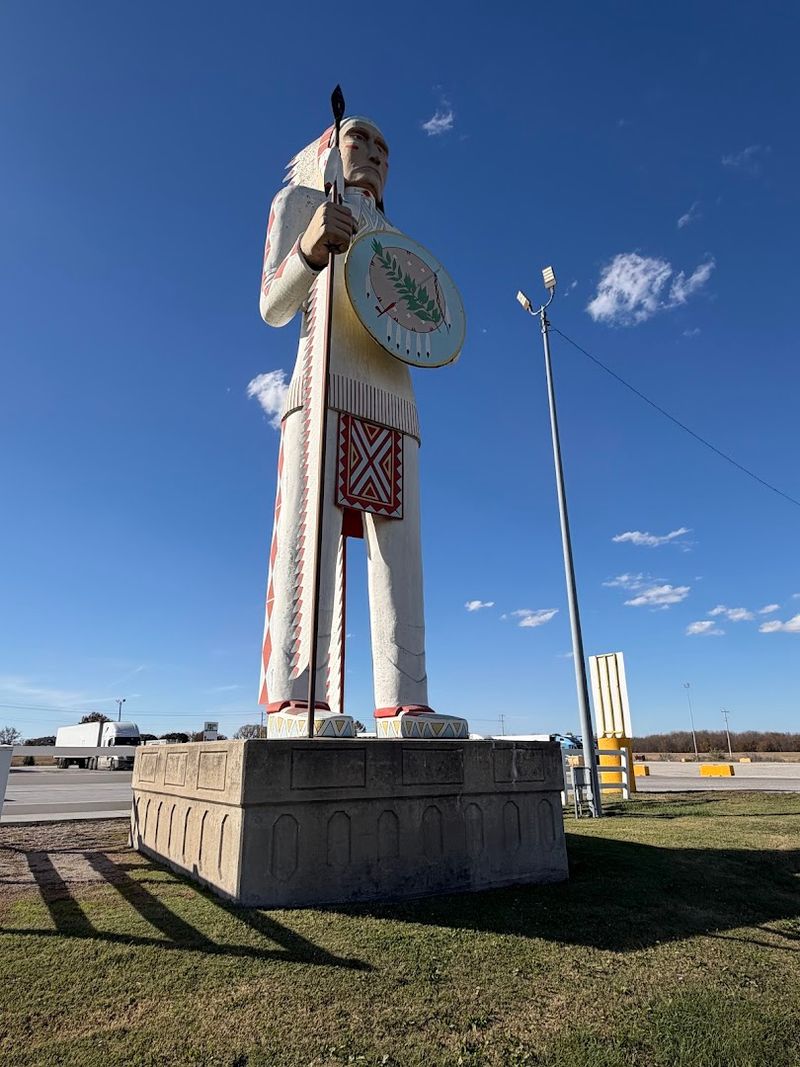
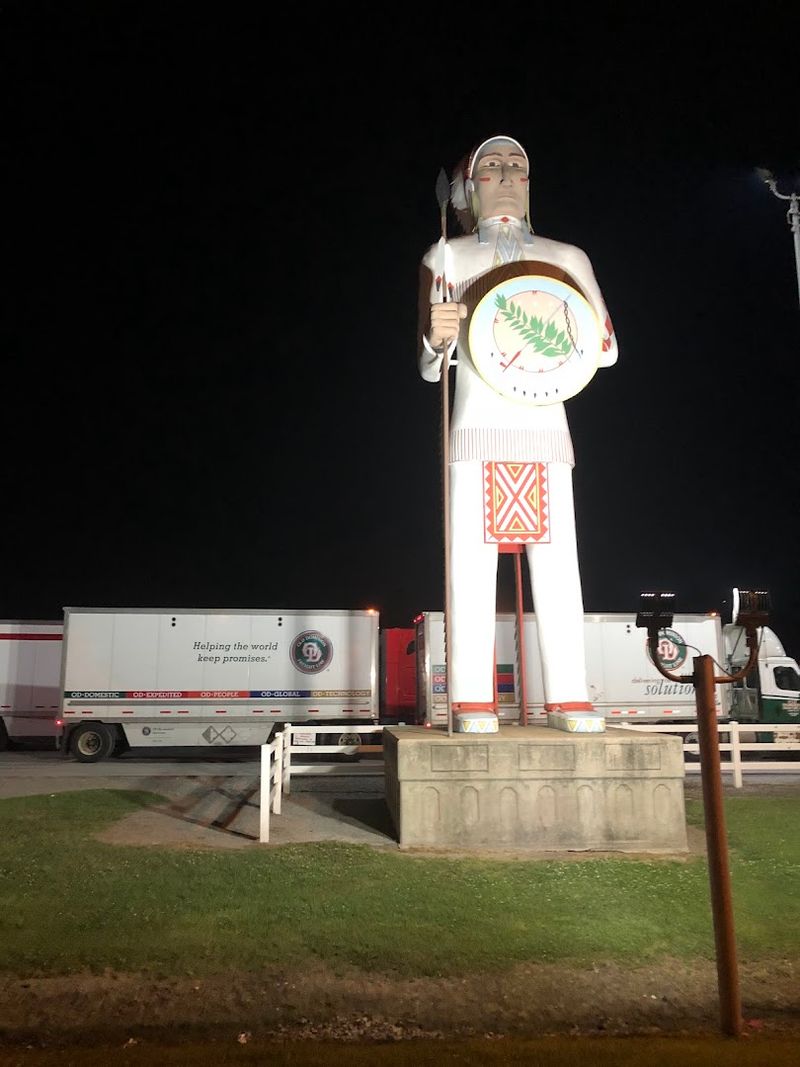
Every detail on Chief Standing Brave carries meaning. The headdress alone features 105 individual feathers.
That’s not a random number. Feathers in Native American traditions often represent honor, strength, and spiritual connection.
Each feather was carefully crafted and placed with intention.
The spear held by the chief includes 37 feathers. Spears historically symbolized protection and leadership among many Plains tribes.
Seeing one rendered at this scale makes the symbolism land differently than reading about it in a textbook.
Perhaps the most striking detail is the shield. It displays the Oklahoma state flag, directly connecting Native American identity to the state’s official identity.
Oklahoma’s flag itself features a Native American Osage warrior’s shield with an olive branch and peace pipe, so the layering of symbols here is genuinely thoughtful. The chief stands upright, facing outward, a posture of watchfulness and dignity.
His expression is calm and strong. Together, these symbols create a visual language that speaks to resilience, pride, and cultural continuity.
Visitors who take time to study the details come away with a much richer understanding of what the statue represents. It’s more than decorative.
It’s a carefully constructed visual story about identity, heritage, and the Native peoples who shaped Oklahoma long before statehood. Paying attention to those details, visits feel completely different.
Impact On Local Indigenous Communities
Oklahoma is home to 39 federally recognized Native American tribes. That’s more than almost any other state in the country.
Chief Standing Brave exists in a landscape where Native heritage isn’t historical, it’s present, living, and deeply felt by real communities today.
A sculpture of this scale sends a message. It says that Native identity is worth honoring publicly, not quietly.
Placing it along a major highway means millions of travelers encounter that message whether they planned to or not. That kind of visibility matters for communities whose histories have often been overlooked.
Local tribes have rich traditions in art, governance, language, and ceremony that continue today. A roadside tribute like this can spark curiosity in visitors who then seek out deeper engagement with those living cultures.
It’s a starting point, not a full story. The statue also gives local community members a point of civic pride.
Seeing your heritage honored at 46 feet tall, right off the highway, has a different emotional weight than a museum exhibit behind glass. It’s public, bold, and impossible to ignore.
For travelers who belong to Native communities themselves, stopping here can feel like a moment of recognition.
The statue doesn’t speak for all tribes or traditions, but it acknowledges the broad significance of Native peoples in shaping Oklahoma’s identity from the very beginning.
Visitor Experience And Interpretation
Pulling off the highway to see Chief Standing Brave is completely free. There’s no ticket booth, no timed entry, no guided tour required.
The statue is visible 24 hours a day, seven days a week. That kind of open access makes it one of the most effortlessly enjoyable roadside stops in the state.
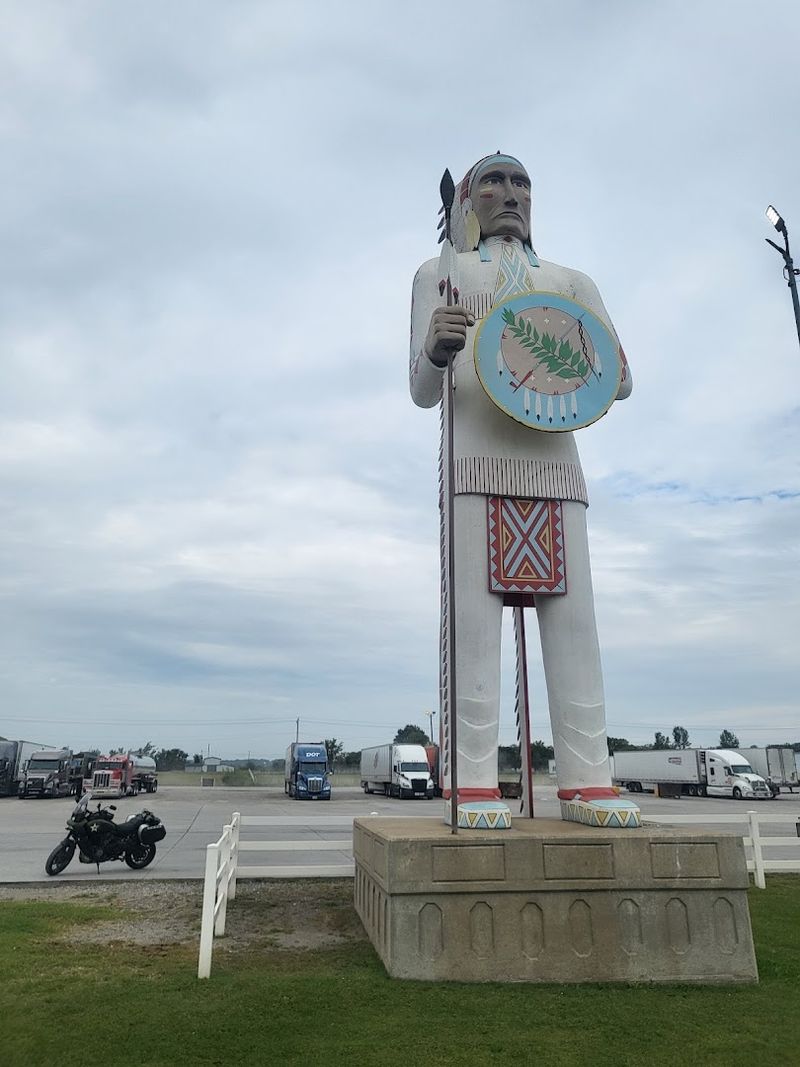
Standing at the base and looking straight up is a genuinely different experience from seeing photos online. The scale hits differently in person.
The detail on the headdress, the expression on the chief’s face, the shield, all of it becomes more vivid when you’re standing right there.
The Woodshed of Big Cabin travel plaza sits right next door, so you can grab a snack or pick up a souvenir magnet of the statue before heading back on the road. It’s a practical pit stop with an unexpected cultural moment built right in.
Families with kids, especially, tend to love it. There’s something about a statue this tall that captures a child’s imagination immediately.
Adults usually end up just as fascinated once they start noticing the carved details up close. The surrounding landscape is open and flat, giving you a clear view from a distance as you approach.
That slow reveal as you get closer is part of what makes arriving here feel like a genuine discovery every single time.
Preservation Efforts Of Outdoor Statues
Keeping a 15,000-pound outdoor statue in good shape is no small task. Oklahoma weather is not gentle.
Summers bring intense heat and UV exposure. Winters bring freeze-thaw cycles that can crack and shift materials.
Wind and rain work on painted surfaces constantly. Outdoor sculptures face challenges that indoor art never does.
The fiberglass coating on Chief Standing Brave was a deliberate preservation choice from the start. Fiberglass resists moisture better than raw foam or plaster.
It also provides a surface that can be repainted and touched up without requiring full reconstruction. That foresight from the original construction helps the statue hold up over the years.
Regular inspection is essential for any large outdoor piece. Checking for surface cracks, paint fading, and structural shifts keeps small problems from becoming major ones.
The statue has been standing since 2001, which means it has already survived more than two decades of Oklahoma weather. That’s a real accomplishment for a sculpture built using foam and fiberglass rather than traditional stone or metal.
Public awareness also plays a role in preservation. When visitors treat the statue respectfully and report visible damage, it helps the people responsible for its upkeep stay informed.
Roadside attractions often exist outside formal museum systems, so community care becomes part of the maintenance equation. Chief Standing Brave benefits from being genuinely loved by the people who stop to see it.
Role In Educating The Public About Heritage
Education doesn’t always happen in classrooms. Sometimes it happens on a highway in northeastern Oklahoma when a 46-foot statue makes you stop and ask questions you never thought to ask before.
Chief Standing Brave works as an educational tool precisely because it’s impossible to pass without noticing.
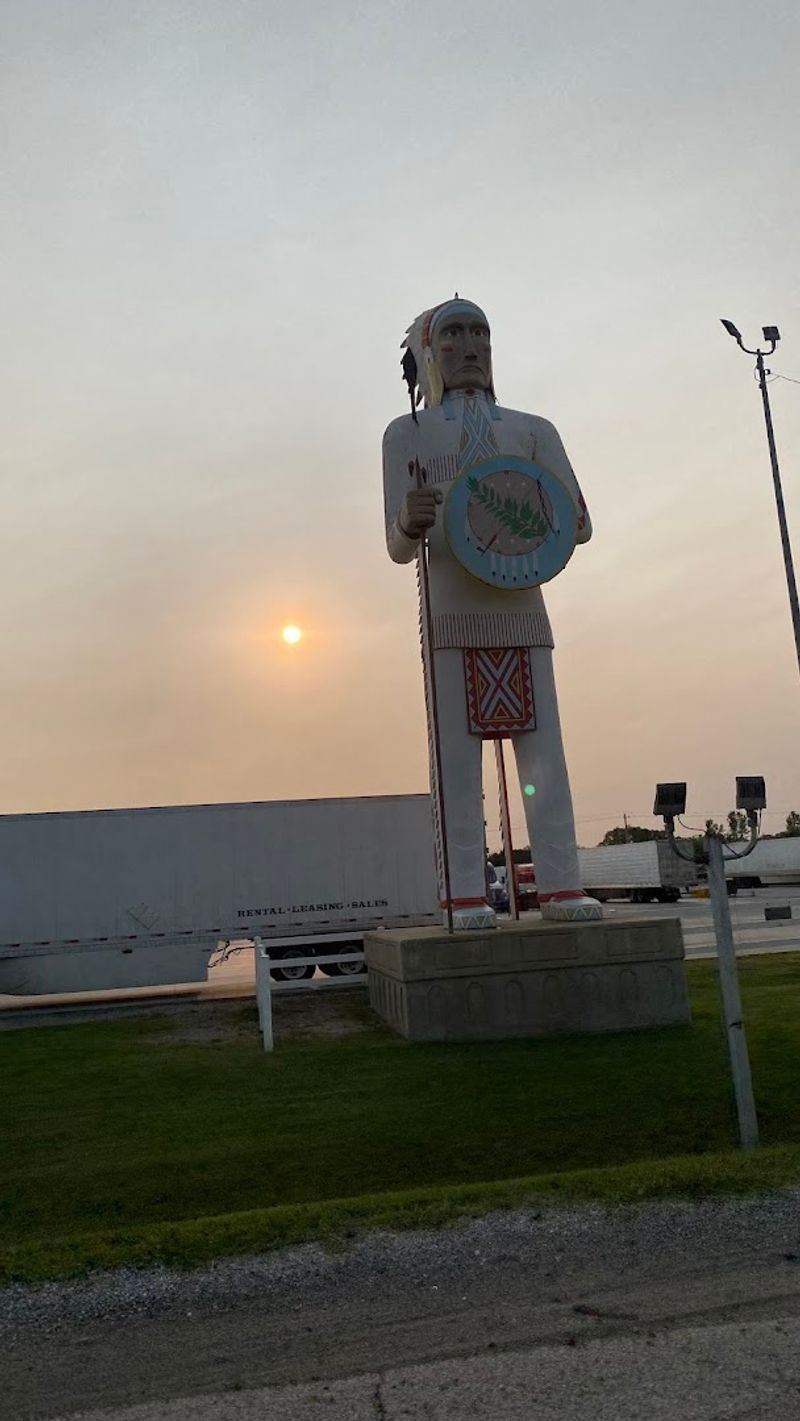
The visual storytelling built into the statue covers a lot of ground quickly. The headdress, the spear, and the shield with the Oklahoma flag each point toward larger histories and traditions worth exploring further.
A curious visitor who spends ten minutes here might go home and read about Oklahoma’s tribal nations for the first time.
That kind of informal education has real value. Not everyone visits museums or reads history books.
Roadside attractions reach people who are simply passing through, offering a brief but meaningful encounter with a subject they might not have sought out intentionally. The statue’s location along a heavily trafficked highway maximizes that reach significantly.
Travelers from across the country pass through this corridor regularly. Some are on cross-country road trips.
Others are local commuters who drive past daily. For all of them, Chief Standing Brave is a consistent, visible reminder that Native American heritage is central to Oklahoma’s story, not a footnote, but a foundation.
That kind of repeated, public exposure builds cultural awareness in a quiet but lasting way over time.
Connection To Regional Native Traditions
Big Cabin sits in northeastern Oklahoma, a region with deep ties to the Five Civilized Tribes the Cherokee, Choctaw, Chickasaw, Creek, and Seminole nations.
These tribes were forcibly relocated to Indian Territory in the 1830s along what became known as the Trail of Tears. Their descendants still live, govern, and thrive in this region today.
Chief Standing Brave’s visual design draws on Plains Indian traditions, particularly the style of headdress associated with nations like the Lakota or Cheyenne.
Oklahoma’s tribal landscape is diverse, representing many different traditions and regions of origin. The statue honors that broad spectrum rather than representing any single specific nation.
The connection to regional tradition also lives in the land itself. Northeastern Oklahoma’s rolling terrain, rivers, and open skies have been home to Native peoples for thousands of years before European contact.
Driving through this area and encountering a sculpture of this scale reinforces that long timeline in a visceral way. The Cherokee Nation’s capital, Tahlequah, is just a short drive away.
Visitors who stop at Chief Standing Brave and then continue to explore the region will find museums, cultural centers, and living communities that add even more depth to what the statue represents. The sculpture is a doorway, not a destination in itself.
Regional Native traditions are alive and present throughout northeastern Oklahoma, waiting to be discovered by anyone willing to look a little closer.