
This Storybook Castle In California Feels Like Stepping Into A Fairytale

Perched high above the Pacific Ocean along California’s central coast, Hearst Castle stands as one of the most extraordinary estates ever built in the United States. Officially known as La Cuesta Encantada, meaning The Enchanted Hill, this remarkable property was the lifelong passion project of newspaper magnate William Randolph Hearst.
Designed by pioneering architect Julia Morgan, the castle took nearly 28 years to build and remains a jaw-dropping testament to ambition, artistry, and excess. Located at 750 Hearst Castle Rd, San Simeon, CA 93452, it welcomes visitors daily from 9 AM to 4 PM and continues to captivate everyone who makes the scenic journey up the hill.
A Hilltop Estate With Sweeping Pacific Ocean Views
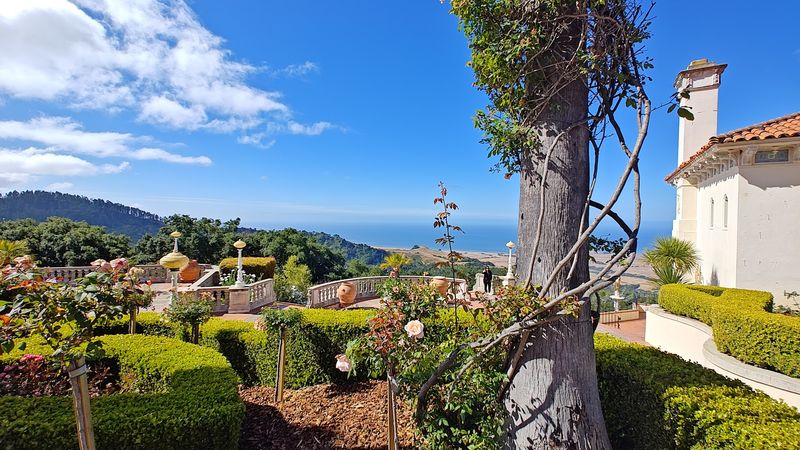
Few estates in the world can claim a setting quite like this one. Hearst Castle sits atop the Santa Lucia Mountains at an elevation of roughly 1,600 feet, offering panoramic views of the Pacific Ocean that stretch far beyond what any photograph can fully capture.
On clear days, the horizon seems endless, and the light shifts dramatically depending on the hour.
William Randolph Hearst chose this land deliberately. He had camped on these hills as a boy with his family, and the memory of those views stayed with him for decades.
When construction began in 1919, preserving those sightlines was a central part of architect Julia Morgan’s design brief.
Visitors arriving by the estate bus frequently remark that the views from the terraces alone justify the trip. The combination of manicured gardens, classical architecture, and that vast blue expanse of ocean creates a visual experience that feels genuinely unreal, even standing right in the middle of it.
Built By Newspaper Magnate William Randolph Hearst
William Randolph Hearst inherited his father’s mining fortune but built his own empire through newspapers, eventually controlling 28 major publications across the country. His wealth was staggering, and his appetite for beauty, history, and grandeur was equally immense.
The castle at San Simeon was his most personal and enduring expression of both.
Construction on the estate began in 1919 and continued almost without pause until 1947, when Hearst’s declining health finally forced him to leave the property for the last time. During those nearly three decades, he worked closely with architect Julia Morgan, sending her detailed letters about his wishes, his frustrations, and his ever-evolving vision for the place.
Hearst was famously hands-on, sometimes requesting that entire completed rooms be redesigned. His perfectionism drove costs to extraordinary levels, but it also produced something genuinely singular.
The estate is as much a reflection of his personality as it is a work of architecture, and that human dimension makes it endlessly fascinating to explore.
Inspired By European Castles And Grand Estates
Hearst first traveled to Europe as a ten-year-old boy, accompanying his mother on a grand tour of the continent. What he saw in Spain, Italy, France, and England left a permanent impression on him.
The cathedrals, palaces, and hilltop monasteries he encountered as a child became the visual language he would eventually use to build his California estate.
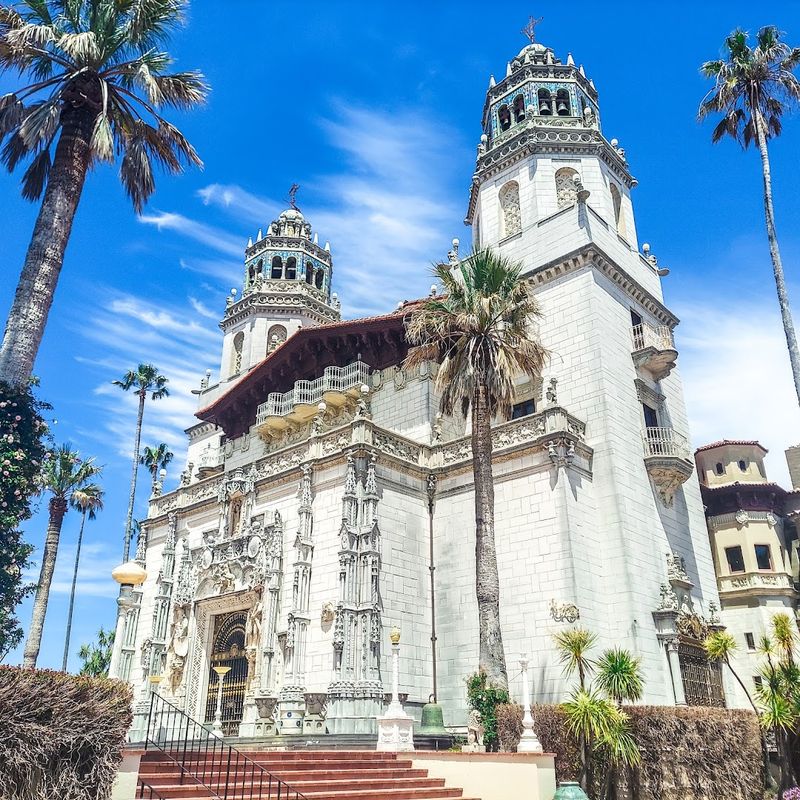
Julia Morgan translated those influences with remarkable skill and discipline. The main building, Casa Grande, draws heavily from the ornate Spanish Colonial Revival style, particularly the Cathedral of Santa Maria la Mayor in Ronda, Spain, whose twin towers directly inspired the castle’s iconic facade.
Inside, Gothic, Renaissance, and Baroque elements appear throughout the rooms in layered, carefully considered arrangements.
What prevents the estate from feeling like a chaotic pastiche is Morgan’s architectural intelligence. She understood how to unify wildly different historical periods under a coherent design logic, so each room feels purposeful rather than accidental.
The European influences feel absorbed rather than simply copied, which is a meaningful distinction.
The Neptune Pool Is One Of The Most Recognisable Features
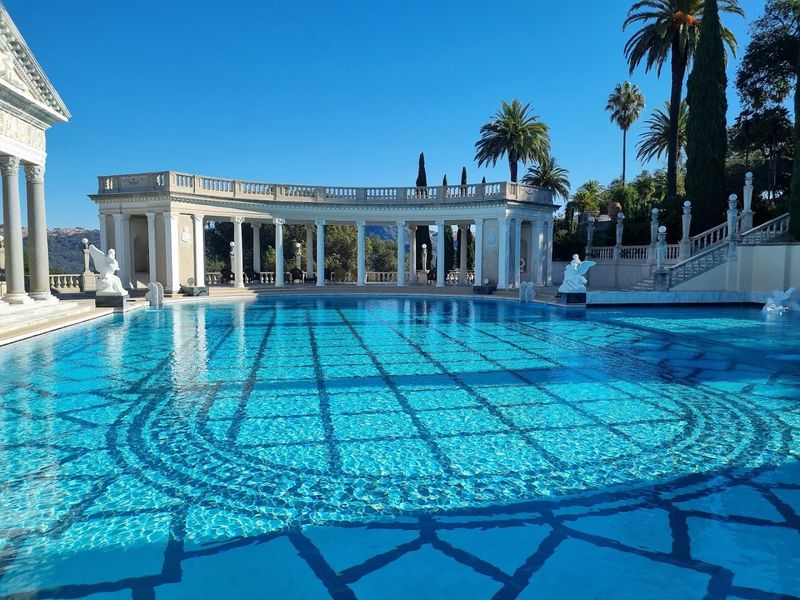
The Neptune Pool is the kind of place that makes people stop mid-sentence. Surrounded by a Vermont marble colonnade and anchored by an ancient Roman temple facade, the pool holds 345,000 gallons of water and sits at an elevation that frames the Pacific Ocean as a backdrop.
It looks, as more than one visitor has noted, like something generated by a computer trying to design the most beautiful pool imaginable.
Hearst rebuilt the pool three times before he was satisfied, each version larger and more elaborate than the last. The final design incorporated 3,400-year-old Egyptian statues of the goddess Sekhmet flanking the steps, because Hearst considered ordinary pool ornaments insufficiently interesting.
That instinct toward excess, combined with genuine aesthetic judgment, defines the Neptune Pool completely.
Visiting on a bright afternoon, when the marble glows white against the blue water and the hills roll away in every direction, produces a sensation that is difficult to name precisely. Awe is close, but it does not quite cover the full experience of standing beside it.
The Indoor Roman Pool Feels Like A Work Of Art
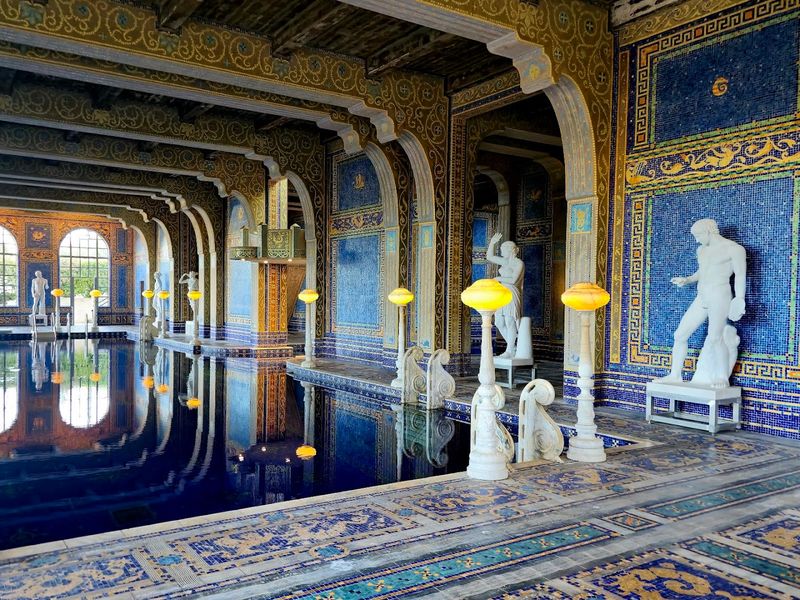
If the Neptune Pool is theatrical, the Roman Pool is something closer to sacred. Situated underground beneath the tennis courts, this indoor swimming pool is lined from floor to ceiling with millions of Murano glass tiles, many of them infused with genuine 24-karat gold.
The effect under artificial light is extraordinary, somewhere between a Byzantine cathedral and a dream sequence.
Hearst commissioned the tiles from Italy, and the installation alone took years of meticulous work. The pool’s design draws from ancient Roman and Byzantine bath traditions, filtered through the kind of budget that very few individuals in history have possessed.
Eight marble statues of Roman deities stand in alcoves around the room, adding to the ceremonial atmosphere.
Guests who visit the Roman Pool as part of the Upstairs Suites tour often describe it as the single most visually overwhelming space in the entire estate. That is a bold claim given the competition, but standing inside the room, watching the gold tiles shimmer in the carefully calibrated light, it is genuinely difficult to argue with.
Rooms Filled With Art Collected From Across Europe

Hearst spent decades acquiring art from European collections, monasteries, auction houses, and private estates. By the time construction at San Simeon was underway, he had accumulated so many pieces that warehouses in New York were overflowing with crates waiting to be unpacked and installed.
The art did not decorate the castle so much as it defined it.
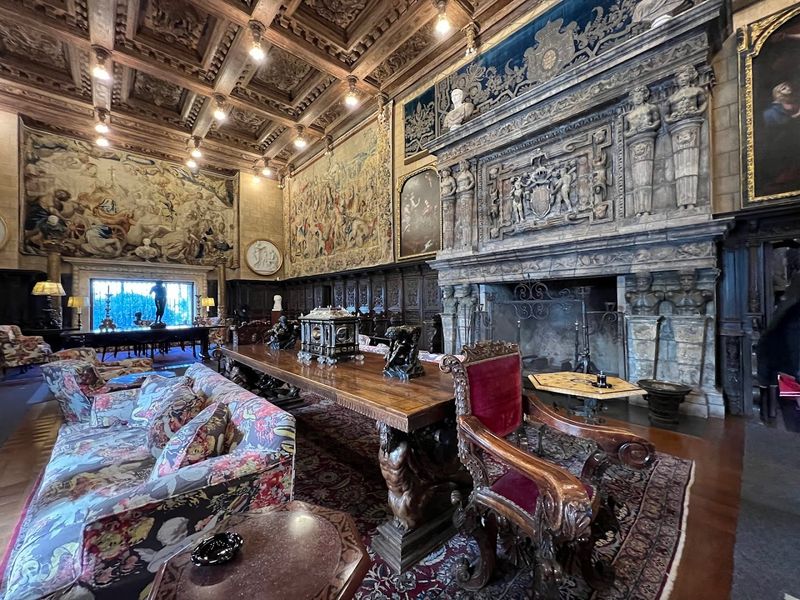
The Assembly Room contains 16th-century Flemish tapestries that once hung in European royal residences. The Refectory, where Hearst hosted his famous dinner parties, features a 500-year-old painted ceiling from an Italian monastery and choir stalls salvaged from a Spanish cathedral.
Every surface tells a story that predates the building by centuries.
Wandering through these rooms, visitors frequently pause to read the labels and discover that an object they assumed was a reproduction is, in fact, a genuine artifact from medieval Europe. That moment of recalibration happens repeatedly throughout a tour, and it never loses its effect.
The sheer density of authentic historical material inside one private residence remains genuinely astonishing.
The Estate Once Hosted Hollywood’s Biggest Names
During the 1920s and 1930s, an invitation to spend the weekend at Hearst Castle was among the most coveted in American social life. Hearst and his companion Marion Davies entertained a remarkable roster of guests, including Charlie Chaplin, Cary Grant, Clark Gable, Joan Crawford, and Winston Churchill, among many others.
The guest list reads like a collision of Hollywood royalty and global political power.
Hearst had specific rules for his guests, some of which became legendary. Alcohol was strictly rationed despite Prohibition being the law of the land elsewhere.
Guests were expected to gather for communal dinners in the Refectory, where Hearst himself presided at the center of the long table. Tardiness was not encouraged.
The private theater on the estate screened films before they reached commercial cinemas, and the swimming pools were open around the clock. For guests accustomed to luxury, the scale and quality of hospitality at San Simeon still managed to astonish.
The estate’s social history is as compelling as its architecture, and the two are impossible to fully separate.
Towering Facades Give It A True Storybook Appearance
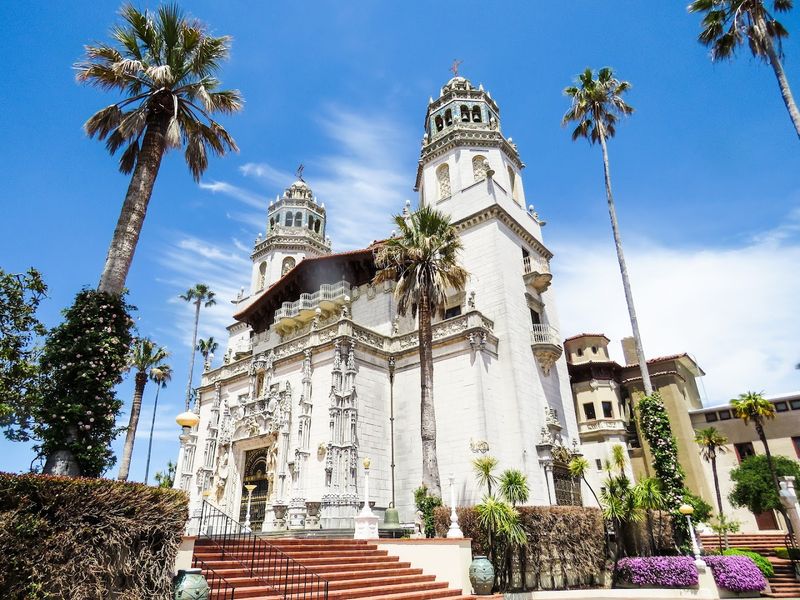
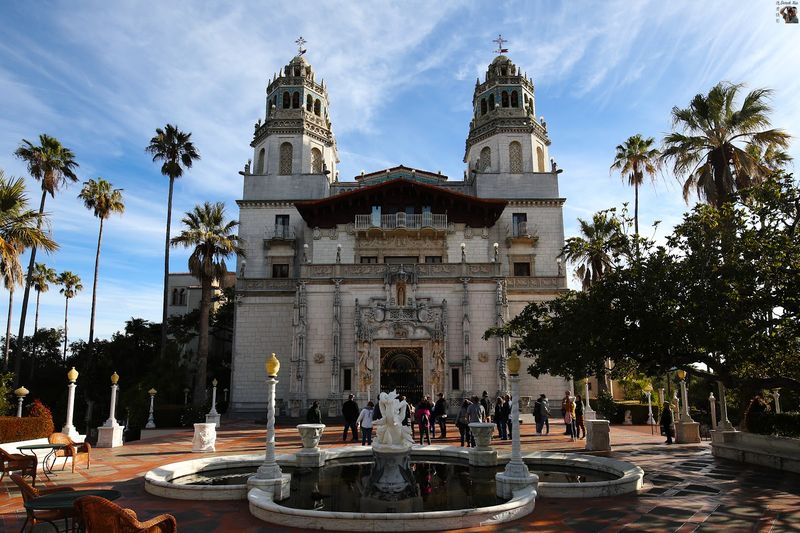
From a distance, the twin towers of Casa Grande rise above the hilltop with a confidence that feels almost theatrical. The facade combines Spanish Colonial Revival stonework with Gothic detailing and Moorish accents, producing a silhouette that does not resemble any single historical building but somehow feels entirely coherent.
Julia Morgan’s ability to synthesize those competing references into something unified is the central architectural achievement of the project.
The entrance approach reinforces the storybook quality. Formal terraces, reflecting pools, and classical sculptures line the path leading toward the main doors, creating a procession that builds anticipation deliberately.
By the time visitors reach the entrance, the scale of the building has fully registered, and the effect is considerable.
Photographing the facade is a reliable way to understand why no single image captures the estate adequately. The building changes character depending on the light, the angle, and the time of day.
Morning fog softens it into something almost mystical, while afternoon sun renders it crisp and commanding. Both versions are worth experiencing if the schedule allows.
Gardens And Terraces That Feel Like A Mediterranean Retreat
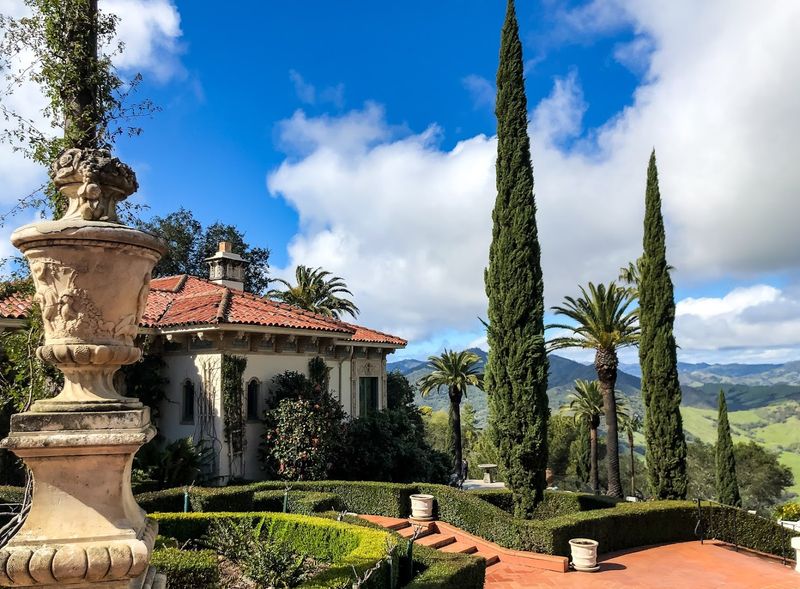
The gardens at Hearst Castle occupy a different register from the architecture, quieter and more contemplative, but no less carefully considered. Julia Morgan and Hearst collaborated on the outdoor spaces with the same attention they brought to the interiors, sourcing mature trees, antique garden ornaments, and rare plant varieties to create something that feels simultaneously ancient and immaculately maintained.
Italian cypress trees line the upper terraces, lending the hillside a distinctly Mediterranean character. Ornamental fountains, antique urns, and carved stone benches appear throughout the grounds, many of them genuine European antiques rather than reproductions.
The planting scheme shifts with the seasons, so the gardens present a different face depending on when visitors arrive.
Walking the terraces on a clear morning, with the ocean visible between the cypress trees and the scent of roses drifting across the path, produces a specific kind of contentment that is hard to manufacture artificially. The gardens are frequently overlooked by visitors focused on the interior rooms, which means they offer a degree of quiet that the busier parts of the estate do not.
Guided Tours Bring The Entire Estate To Life
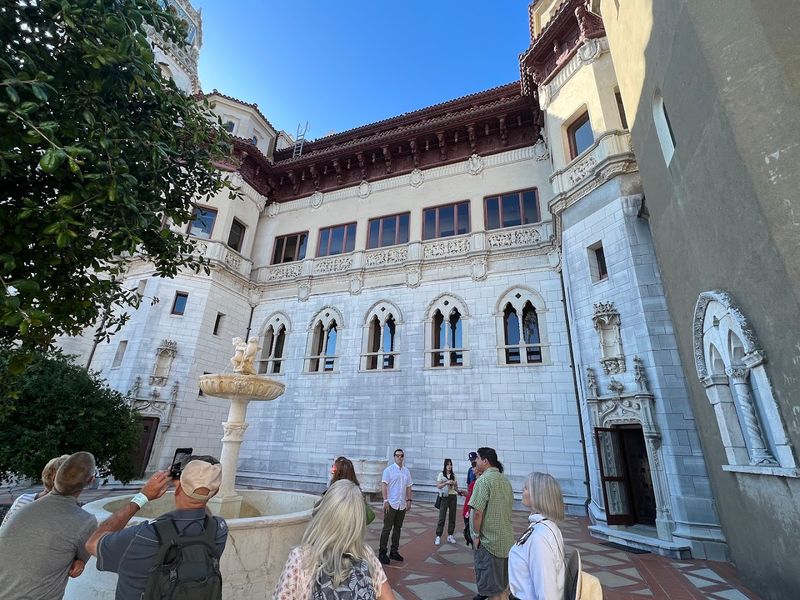
Hearst Castle is managed by California State Parks, and the guided tour program reflects the organization’s genuine commitment to the property’s history and preservation. Tours run daily from 9 AM to 4 PM, and several different options exist, each focusing on different areas of the estate.
The Grand Rooms Tour is the standard recommendation for first-time visitors, covering the main public spaces and both pools.
The quality of the guides is consistently praised by visitors, and for good reason. They carry detailed knowledge of the art, architecture, and social history, and most of them deliver that information with a natural ease that keeps the experience engaging rather than academic.
The bus ride up from the Visitor Center, narrated by the late Alex Trebek in a recording, adds a layer of context before guests even reach the hilltop.
Booking in advance is strongly recommended, particularly during summer and holiday weekends. The Visitor Center at the base of the hill houses a theater screening a documentary about the estate’s history, and watching it before the tour noticeably deepens the experience once visitors are walking through the rooms themselves.
A Remote Setting That Adds To The Fairytale Feel
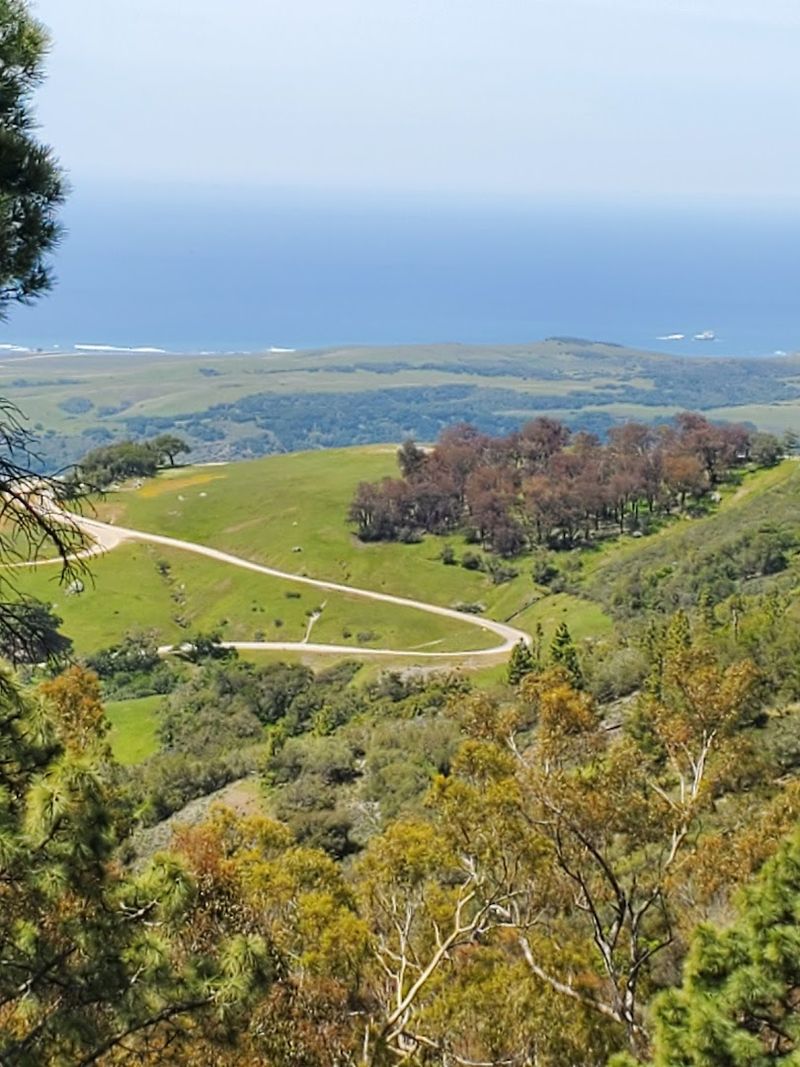
San Simeon sits roughly halfway between Los Angeles and San Francisco along Highway 1, a stretch of California coast that ranks among the most scenically dramatic in the country. The nearest city of meaningful size is San Luis Obispo, about 45 miles south.
That geographic remoteness was not accidental on Hearst’s part, and it remains one of the estate’s most quietly powerful qualities today.
Driving north along the coast toward San Simeon, with the ocean on the left and the Santa Lucia Mountains rising steeply to the right, the sense of leaving ordinary life behind builds gradually. By the time the Visitor Center appears, visitors have already been primed by the landscape for something out of the ordinary.
The castle, appearing on the hilltop above, delivers accordingly.
Wildlife roaming the property adds an unexpected layer to the remoteness. Zebras, descendants of Hearst’s original private zoo animals, can occasionally be spotted grazing on the hillsides near the approach road.
Seeing them against the California grassland, with the Pacific glinting beyond, is one of those genuinely strange and memorable details that no amount of advance reading fully prepares visitors for.
Still One Of California’s Most Visited Historic Landmarks
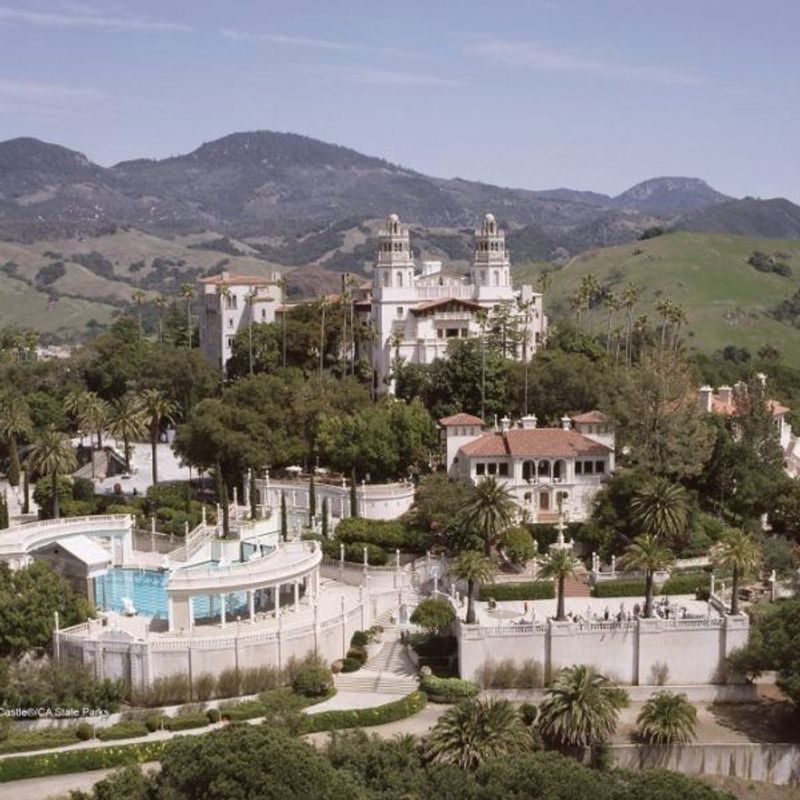
Hearst Castle draws visitors from across the world and holds a rating of 4.6 stars from more than 13,000 reviews, a number that reflects consistent quality rather than novelty. The estate became a California State Monument in 1958, seven years after Hearst’s death, when the Hearst Corporation donated the property to the state.
Since then, it has welcomed millions of visitors and shows no signs of losing its appeal.
The experience holds up across multiple visits, which is itself a meaningful endorsement. Several reviewers note returning for a second or third tour specifically to access different parts of the estate they had not seen before.
Each tour option reveals a distinct side of the property, making repeat visits genuinely worthwhile rather than merely familiar.
For anyone traveling the California coast, skipping Hearst Castle would require a deliberate decision to do so, and it would be a difficult one to justify afterward. The estate operates at a level of historic and artistic significance that places it comfortably alongside the great house museums of Europe, with the added advantage of a Pacific Ocean backdrop that none of those institutions can match.