
The World’s Largest Round Barn In Wisconsin Is A One-Of-A-Kind Sight You Won’t Forget
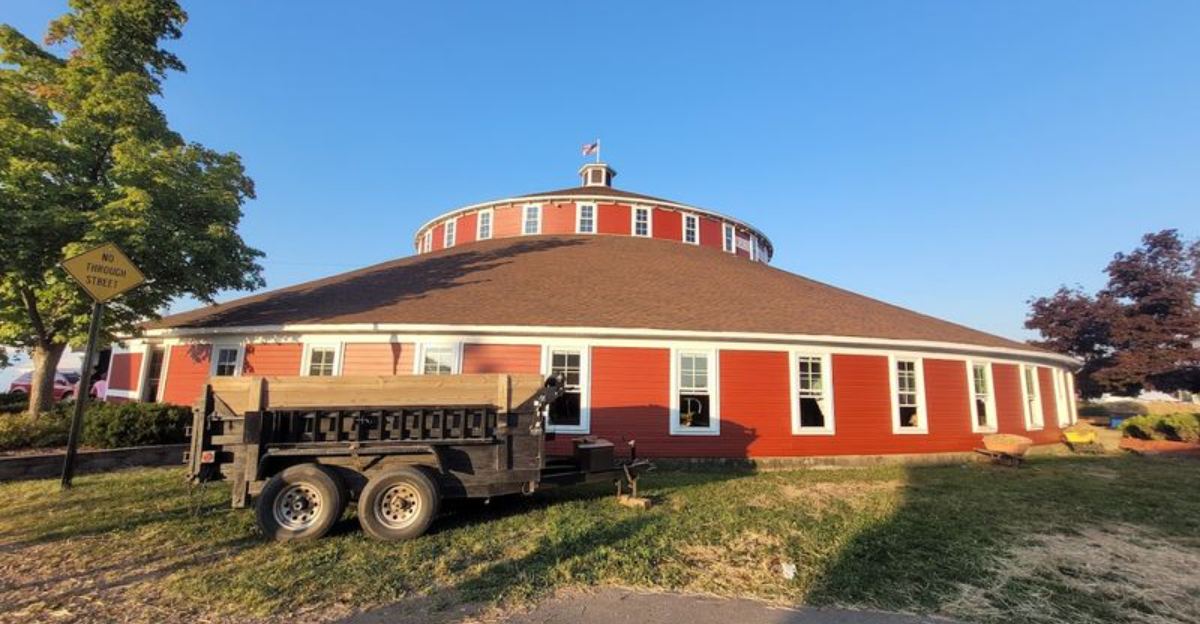
A building like this makes you slow down long before you know what you’re looking at. Rising above the fairgrounds is a massive circular structure that feels almost impossible at first glance.
Its shape alone sparks curiosity, and its scale only adds to the surprise. For more than a century, this unusual landmark in Marshfield, Wisconsin has caught the attention of travellers passing through the area.
Generations have stopped to admire it, photograph it, and wonder how such an enormous round building came to exist. Few roadside sights in the state feel quite this unexpected or memorable.
The Barn Stands At The Racine County Fairgrounds
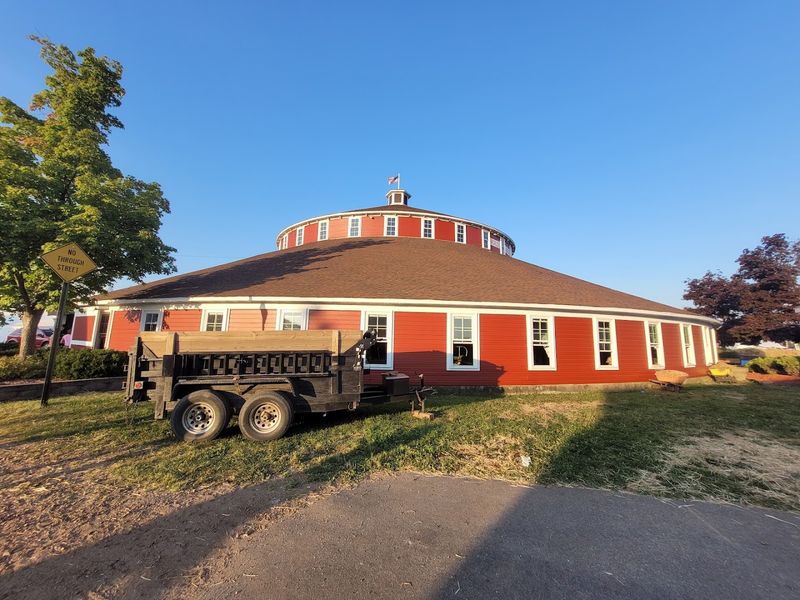
Most fairgrounds have a signature feature that sets them apart from every other patch of grass and gravel in the state. At the Central Wisconsin State Fair in Marshfield, that feature is unmistakable.
The World’s Largest Round Barn anchors the entire property with a presence that feels both agricultural and architectural at the same time.
Visitors approaching the grounds often spot the barn before they notice anything else. Its sheer circumference breaks the visual rhythm of the surrounding landscape in a way that a conventional rectangular barn simply could not.
The structure does not blend into its surroundings so much as it presides over them.
Located at 513 E 17th St in Marshfield, the fairgrounds serve as the barn’s permanent home. The site transforms during fair season into a lively hub of activity, but even on quieter days, the barn alone gives the grounds a sense of purpose and identity.
The Structure Was Built In 1916
Construction of the barn began in 1916, placing it firmly in an era when Wisconsin dairy farming was at a creative and practical peak. Builders of that period were experimenting with form as much as function, and the round barn represented one of the boldest expressions of that spirit.
The men who raised this structure were working without modern machinery, relying instead on skilled craftsmanship and sheer determination.
The year 1916 carries its own historical weight. The country was on the edge of entering World War One, and rural communities across the Midwest were focused on maximizing agricultural efficiency.
Building a barn of this scale at that particular moment speaks to a real confidence in the land and the people working it.
More than a hundred years have passed since those first beams went up, yet the barn still stands with remarkable solidity. That kind of longevity does not happen by accident.
The Barn Measures About 150 Feet In Diameter
One hundred and fifty feet in diameter is a measurement that sounds impressive on paper, but standing beside the barn makes that number genuinely register. The scale of the structure shifts your sense of proportion almost immediately.
A person standing at the base looks notably small against the sweeping curve of the outer wall.
For context, a standard basketball court measures about 94 feet in length. The barn’s diameter exceeds that by more than 50 feet, which gives some idea of just how much floor space sits beneath that circular roof.
The interior square footage is substantial enough to accommodate livestock, equipment, and crowds of fair visitors simultaneously.
That diameter also contributes to the barn’s visual drama from a distance. Circular structures tend to read as compact from afar, but this one defies that expectation entirely.
Its width is visible from across the fairgrounds, and the silhouette it cuts against the Wisconsin sky is genuinely commanding.
It Originally Served As A Dairy Barn
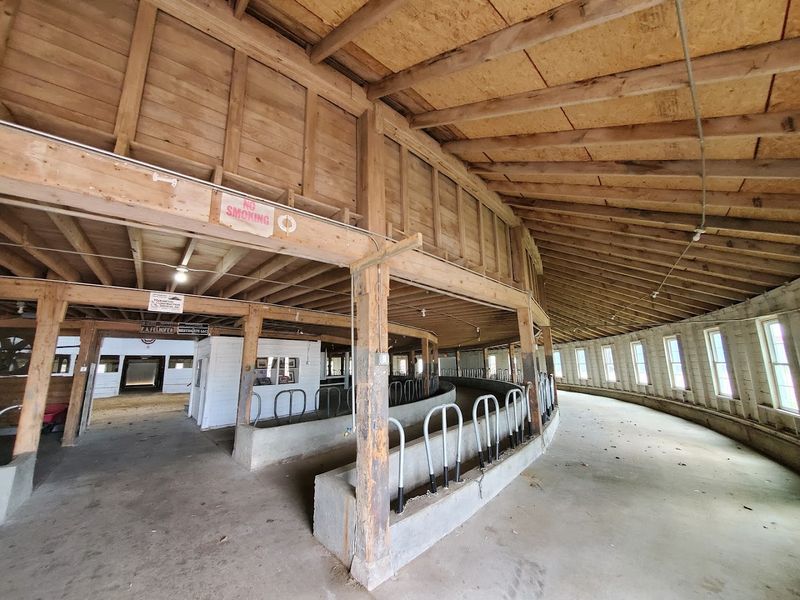
Dairy farming shaped Wisconsin’s identity long before tourism or industry arrived to complicate the picture. The round barn was built with that agricultural purpose at its core, designed to house cattle and support the daily rhythms of a working dairy operation.
Efficiency and practicality drove every decision made during its construction.
Cows were arranged in a circular pattern around a central feeding area, which allowed a single farmer to distribute feed without walking long distances back and forth. That design logic was straightforward and effective, reducing labor while improving the overall management of the herd.
The barn was essentially an early example of workflow optimization, even if nobody called it that at the time.
The connection to dairy farming still echoes through the barn today. During fair season, the structure often houses cattle exhibits that pay quiet tribute to the agricultural tradition the barn was originally built to serve.
That continuity feels earned rather than sentimental.
The Circular Design Helped Farmers Work Efficiently
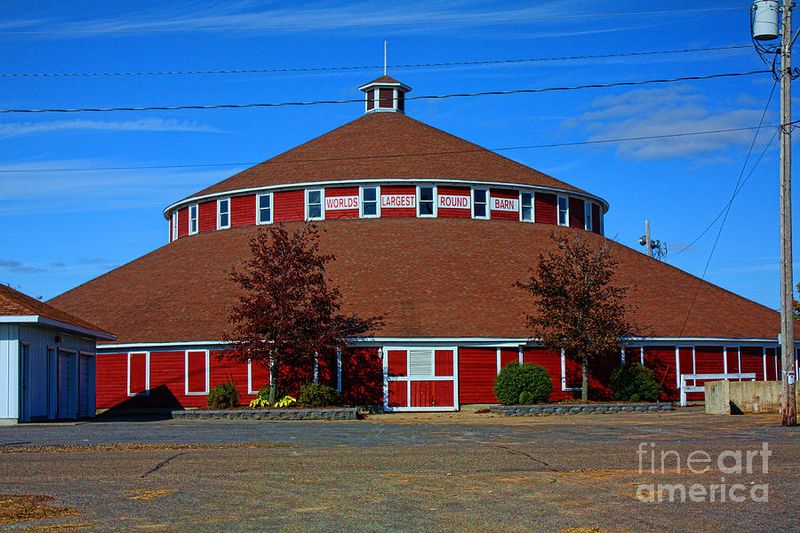
Round barns were never just an aesthetic choice. The circular layout solved real problems that rectangular barns created, particularly around labor and material use.
Farmers in the late 19th and early 20th centuries were drawn to the design because it promised more productive workdays with less wasted effort.
A circular structure encloses more square footage per linear foot of wall than any rectangular building of comparable size. That meant less lumber, fewer materials, and a stronger overall frame.
In an era when every dollar spent on a farm building was a dollar not spent on seed or livestock, that kind of economy mattered enormously.
Inside the barn, the central hub design allowed one worker to oversee the entire floor with a single pivot rather than a long walk. Feed could be stored at the center and distributed outward in all directions.
The logic was elegant, and the World’s Largest Round Barn in Marshfield stands as one of the finest surviving examples of that thinking.
The Dome Roof Makes The Barn Instantly Recognisable
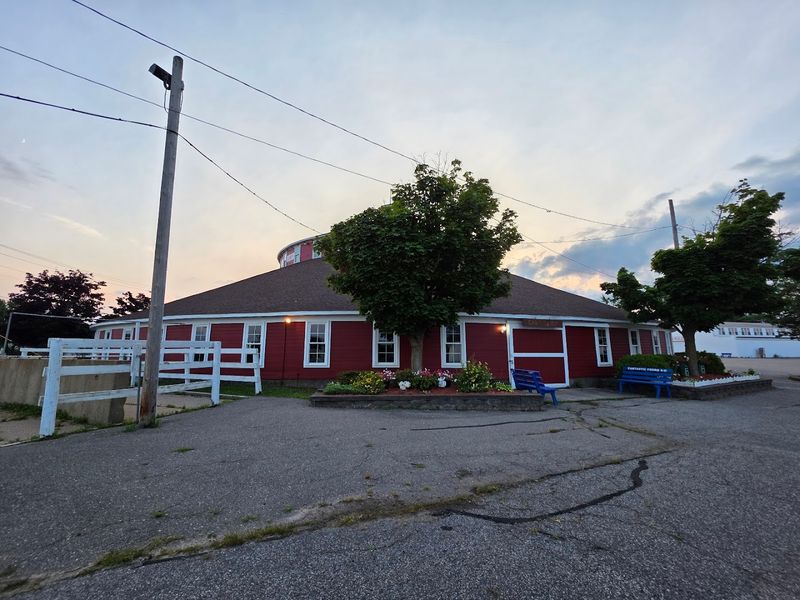
There is something almost theatrical about a dome roof sitting atop a barn. Most agricultural buildings wear flat or gabled rooflines that blend into the rural landscape without much ceremony.
The round barn in Marshfield takes a different approach entirely, and the dome is the feature that makes it impossible to mistake for anything else.
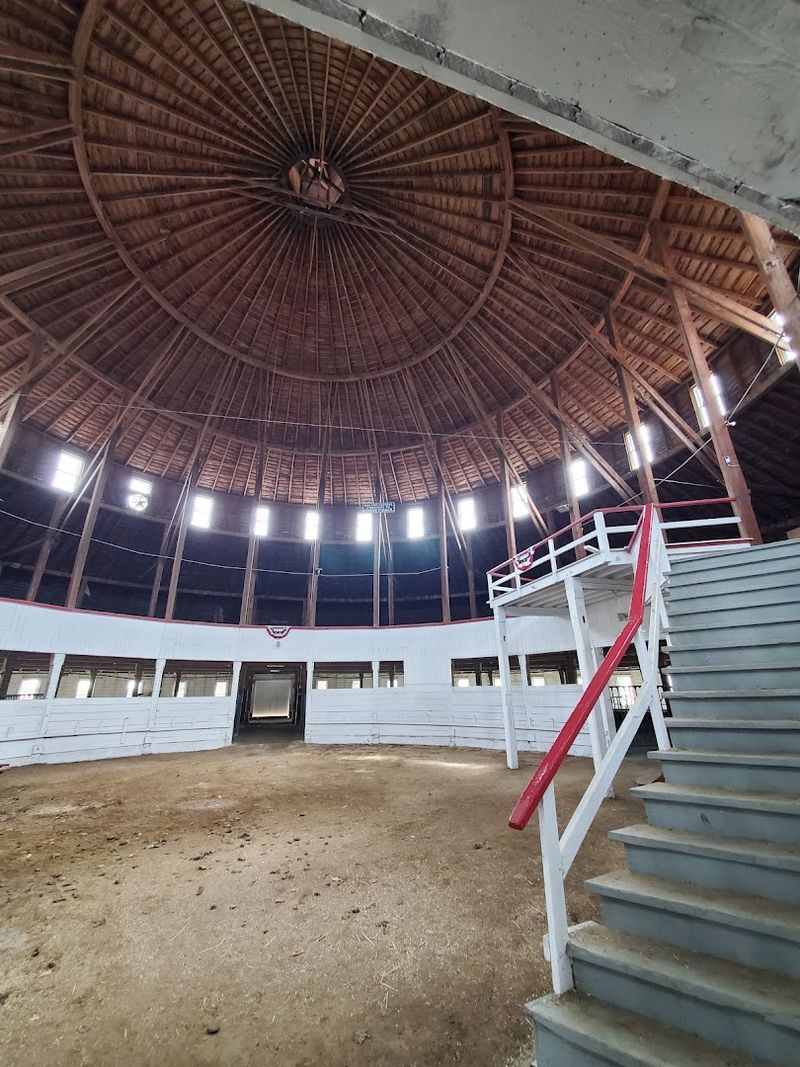
The roof curves upward from the outer walls in a continuous arc, creating a silhouette that reads as both historic and slightly improbable. Constructing a dome of that diameter in 1916 required a level of carpentry skill that most builders today would find genuinely challenging to replicate.
The wooden framework supporting the roof is a feat of joinery that deserves its own quiet admiration.
From a distance, the dome gives the barn a gravity that pulls the eye toward it. Photographers who visit the fairgrounds almost universally point their lenses upward at some point, trying to capture the way the roof meets the sky.
Few succeed in doing it full justice.
Thousands Visit During The Racine County Fair
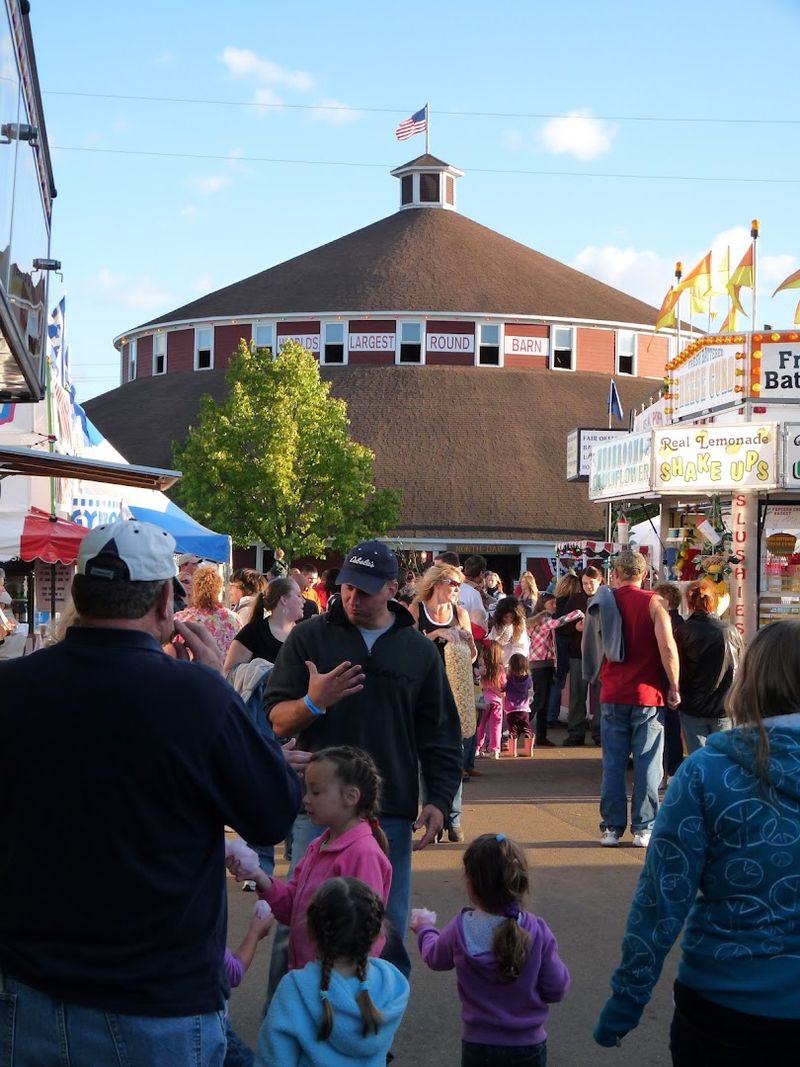
Fair season in Wisconsin is a serious matter. Communities organize around their annual fairs with a dedication that outsiders sometimes find surprising, and the Central Wisconsin State Fair in Marshfield is no exception to that tradition.
The World’s Largest Round Barn serves as both anchor and attraction during fair week, drawing visitors who come specifically to see the structure alongside those who arrive for the broader fairground experience.
The barn becomes a focal point of activity during the fair, hosting livestock exhibits and providing a backdrop for the kind of agricultural storytelling that Wisconsin does particularly well. The combination of a working fair atmosphere and a genuinely historic landmark creates an experience that feels layered rather than one-dimensional.
For many families, visiting the barn during the fair has become a personal tradition passed from one generation to the next. That kind of repeated, voluntary return says something meaningful about what the place offers.
Information about upcoming fair dates is available at centralwisconsinstatefair.com.
It’s One Of Wisconsin’s Most Unusual Historic Barns
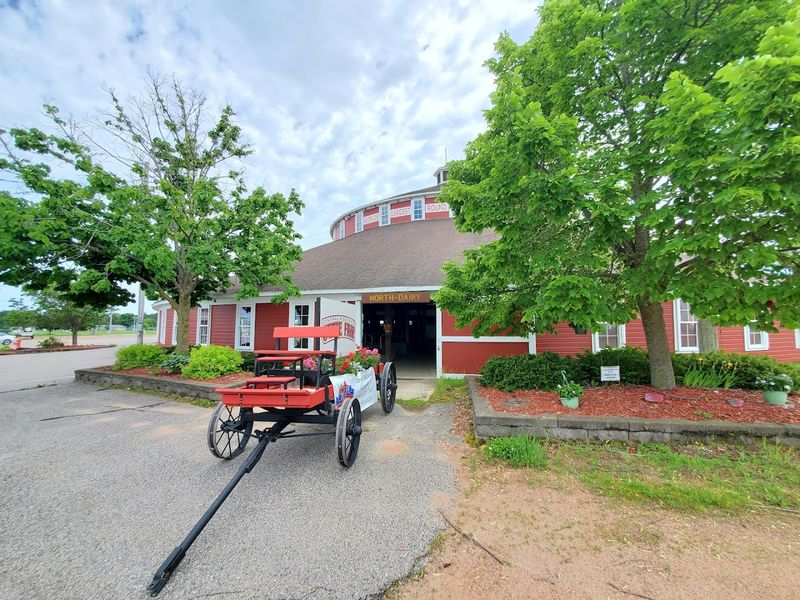
Wisconsin has no shortage of historic barns. Drive through almost any rural county in the state and you will pass weathered structures that tell quiet stories about generations of farming life.
Most of them are rectangular, practical, and largely invisible to anyone not specifically looking for them. The round barn in Marshfield belongs to a different category entirely.
Circular barns were never common, even during the period when agricultural reformers were actively promoting the design. The round barn movement peaked in the late 1800s and early 1900s, and relatively few examples survive today in the condition that the Marshfield barn maintains.
That scarcity adds a layer of significance to every visit.
The barn carries a listing as a historical landmark, which reflects its standing not just as a curiosity but as a genuine piece of American agricultural heritage. Visitors who approach it with that context in mind tend to leave with a richer appreciation for what they have actually seen.
Restoration Projects Have Helped Preserve The Landmark
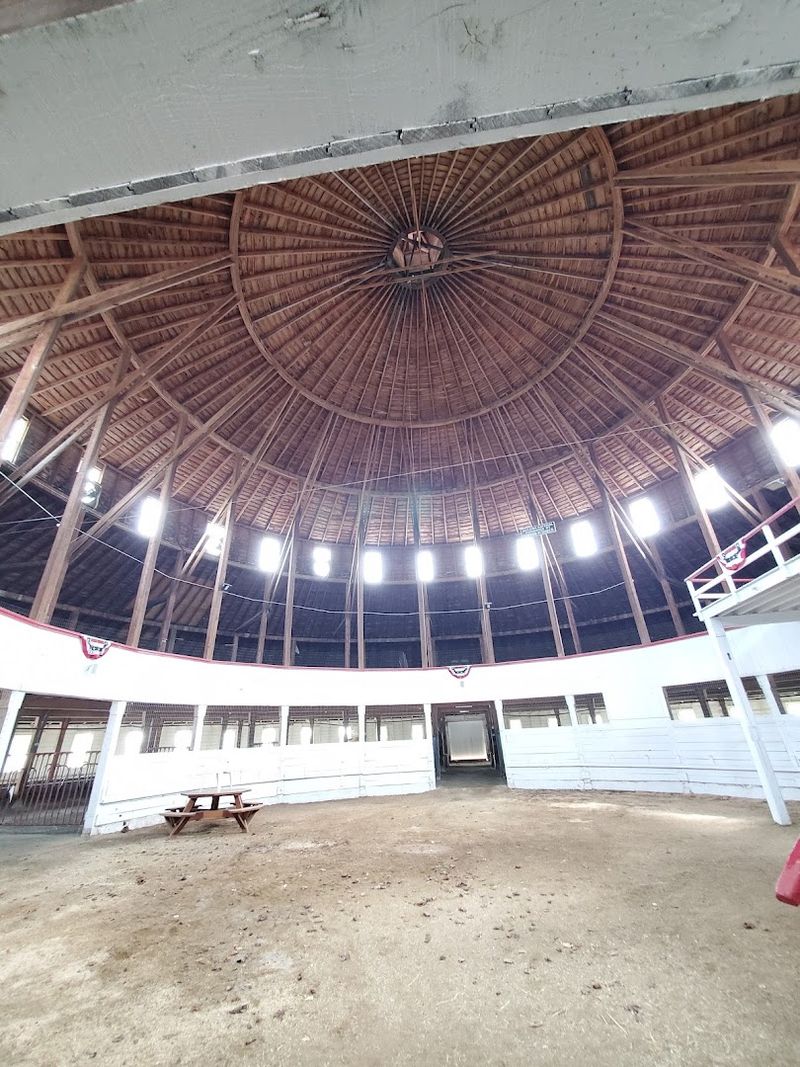
A wooden structure over a century old does not survive through neglect. The continued existence of the World’s Largest Round Barn owes a great deal to deliberate preservation efforts carried out over the decades.
Restoration work has addressed everything from structural integrity to exterior weatherproofing, each project adding another chapter to the barn’s ongoing story.
Preserving a circular building presents challenges that go beyond what standard rectangular barn restoration requires. The curved walls, the dome framing, and the original joinery all demand a level of craftsmanship that mirrors what was required to build the thing in the first place.
Finding workers with both the skills and the historical sensitivity to do that work well is not a straightforward task.
Community investment has played a meaningful role in keeping the barn standing. Local organizations and fair supporters have contributed time, funding, and advocacy to ensure that the landmark remains structurally sound and visually intact for future generations of visitors to encounter.
Today The Barn Hosts Exhibits And Fair Events
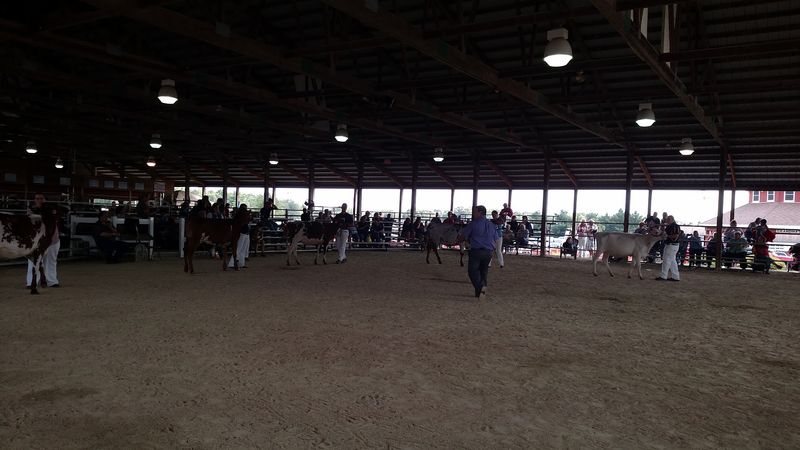
The barn’s role has evolved considerably since its days as a working dairy facility. Today it functions as a central venue for exhibits and events during the Central Wisconsin State Fair, filling its circular floor with livestock displays, agricultural demonstrations, and the general organized energy of a well-attended fair.
The space adapts to these purposes with a natural ease that speaks to the flexibility of the original design.
Walking through the barn during fair season offers a sensory experience that combines the smell of sawdust and livestock with the sound of conversations bouncing off curved walls. The acoustic quality of a circular interior is distinct, and the barn amplifies the ambient noise of a crowd in a way that feels oddly intimate for such a large space.
Outside of fair season, the barn stands as a point of interest for road trippers and history enthusiasts who contact the site at +1 715-387-1261 to confirm access. The structure rewards a visit regardless of what is happening inside it.