
Riverboating from Cambodia to Vietnam: Part 1 of 2
By Eileen Ogintz
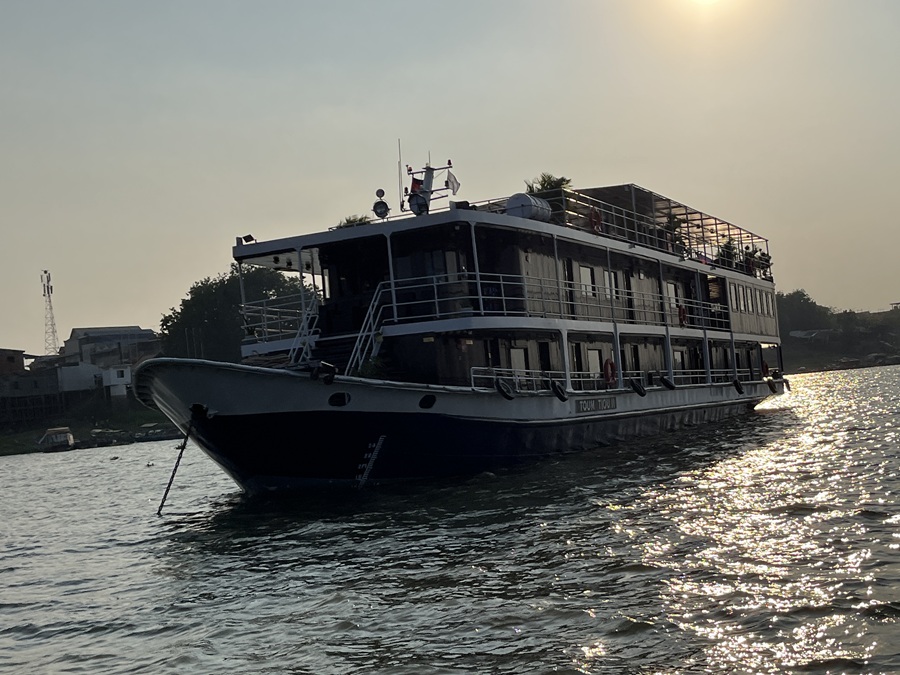
I wish we were here in the winter. Sailing on the Mekong River in Southeast Asia during the first week in April is hot—really hot, 100 degrees. We are on CroisiEurope’s RV Toum Tiou II riverboat, which has just 14 cabins on board. I am not complaining.
Unlike the company’s other ships sailing on the Mekong, including the newest, the Indochine II, there are no indoor air-conditioned gathering places other than a small dining room. There is no swimming pool. The cabins are tiny, with barely room to turn around. Our dining room is intimate. Again, no complaints.
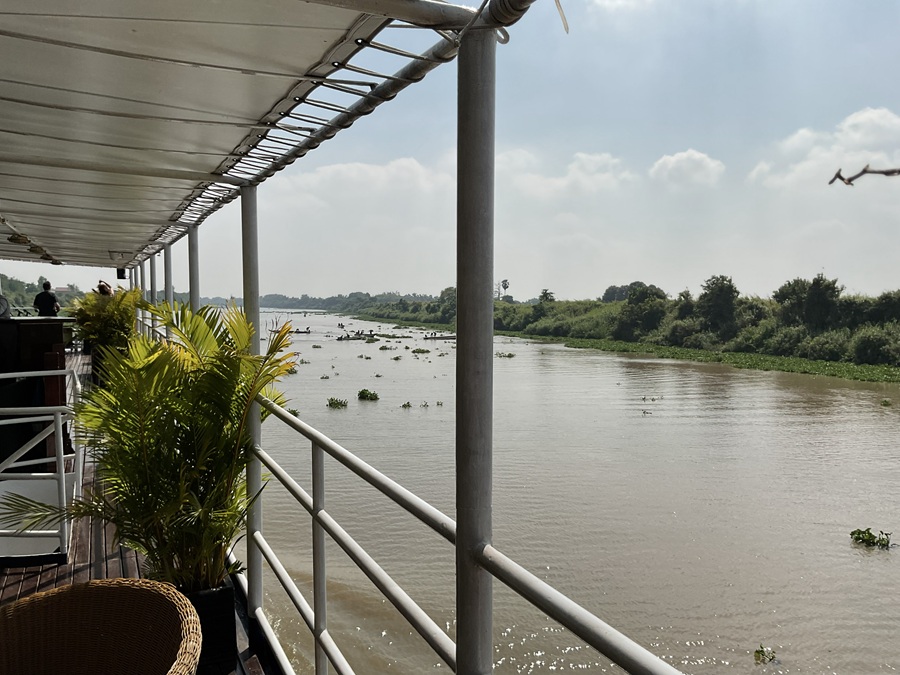
This is all part of the adventure and sailing the way it would have been years ago. There are options for hiking up some 300 steps for a panoramic view at Oudong, Cambodia’s former capital and location of the Vipssana Dhura Buddhist Meditation Center. There is also the option to cycle to a small village when we visited the port of Kampong Chhnang and to a rural primary school in Kampong Tralach.
Our boat is just 28-meters long and eight meters wide. There are nearly as many crew as passengers – 15 crew and 19 passengers on this nine-day trip through Cambodia and ending in Ho Chi Minh City (formerly Saigon) in southern Vietnam.
“The advantage is this is a more personal experience,” says our Purser Mitch Liwag, who also has worked on CroisiEurope’s larger Mekong ships. Families, he explains, can charter this entire boat and create a customized itinerary. Another plus: This offers the option for a more active experience, though a challenge in this heat that we’re told is unseasonably warm for early April.
We are four Americans, two Germans, and six French, including a CroisiEurope manager who has been given the trip as a reward for her 20th anniversary. She is traveling with her grown daughter. She particularly chose this trip, she said, because of the small boat and the chance to be more active (even biking and kayaking in 100-degree temperatures.) We have English-speaking and French-speaking guides on board.
“Because we are small, we treat the passengers as family. With nearly 60 passengers, the larger boats can’t do that,” he said.
“It does feel like we are at someone’s home,” opined one of the Americans.
Toum Tiou is named for the legend of Cambodian lovers whose parents disapproved of the match; the lovers ultimately died for their love, like Romeo and Juliet.
The food is uniformly very good, with breakfast and lunch bountiful buffets—omelets and eggs made to order, pastries, yogurt, and fruit for breakfast; salads and hot dishes like BBQ chicken and snapper for lunch, and dinner either plated or served family style.
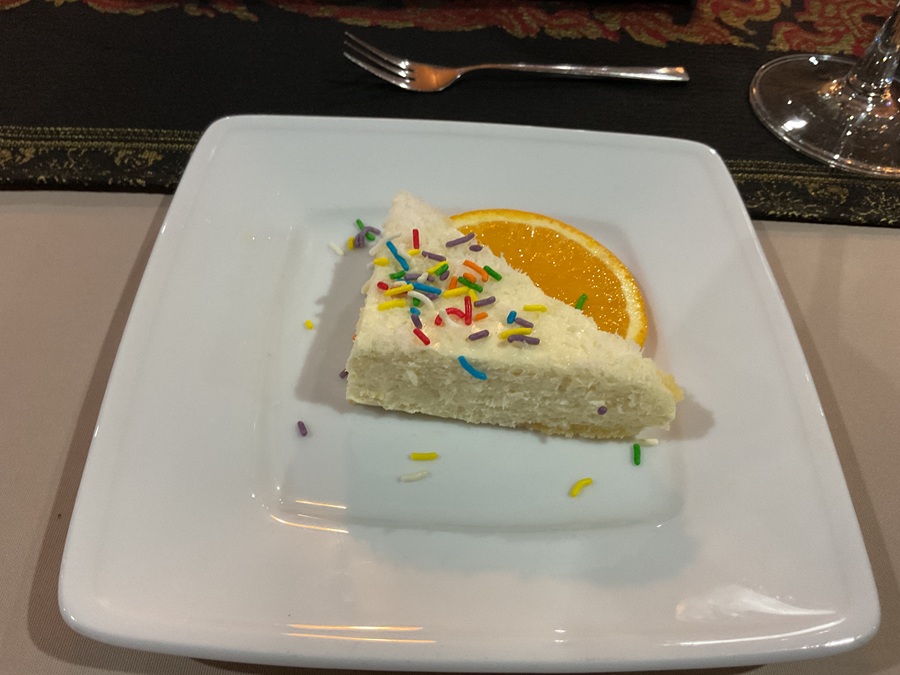
One night we had Lotus stem salad, vegetable curry, grilled chicken and fish, wok fried rice noodles and cooked bananas with rum and butter for dessert. Another night we have a tomato and eggplant salad, pumpkin cream soup, a choice of grilled pork, wok fried prawns or potato gnocchi and delicious cheesecake for dessert. There are always soft drinks, beer, coffee, tea, and cookies available on the sundeck with comfortable rattan furniture. This is where everyone gathers.
In Phnom Phem, we were treated to an onboard performance of traditional dances by a young troupe. Their costumes with plenty of gold embellishment are fabulous, as are the dances and music played on a traditional drum and xylophone.
Cambodians are very friendly, even if we don’t speak a word of the same language. Poverty is apparent everywhere. When we visited the school, a group of about 16 kids ranging from 5-10 came to greet us even though they were on vacation. They hugged us, sang songs, and thanked us for the candy, the pencils, and notebooks we brought them. The school was bare bones with wooden benches and desks. There is no AC.
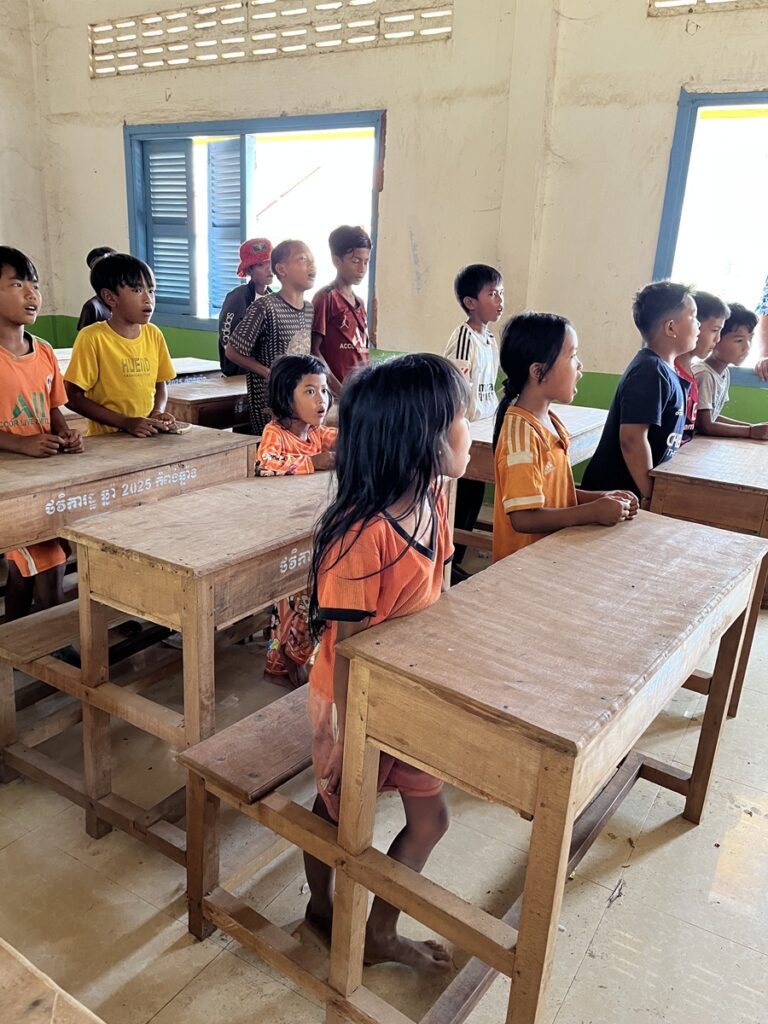
Some 300 children come to this rural school but not all finish, our English- speaking Cambodian guide Thea Vann explained. Though the government mandates that all children attend school, attendance is not enforced, Van said, with many children dropping out to help their families earn money. The schools are crowded so kids can only attend half days.
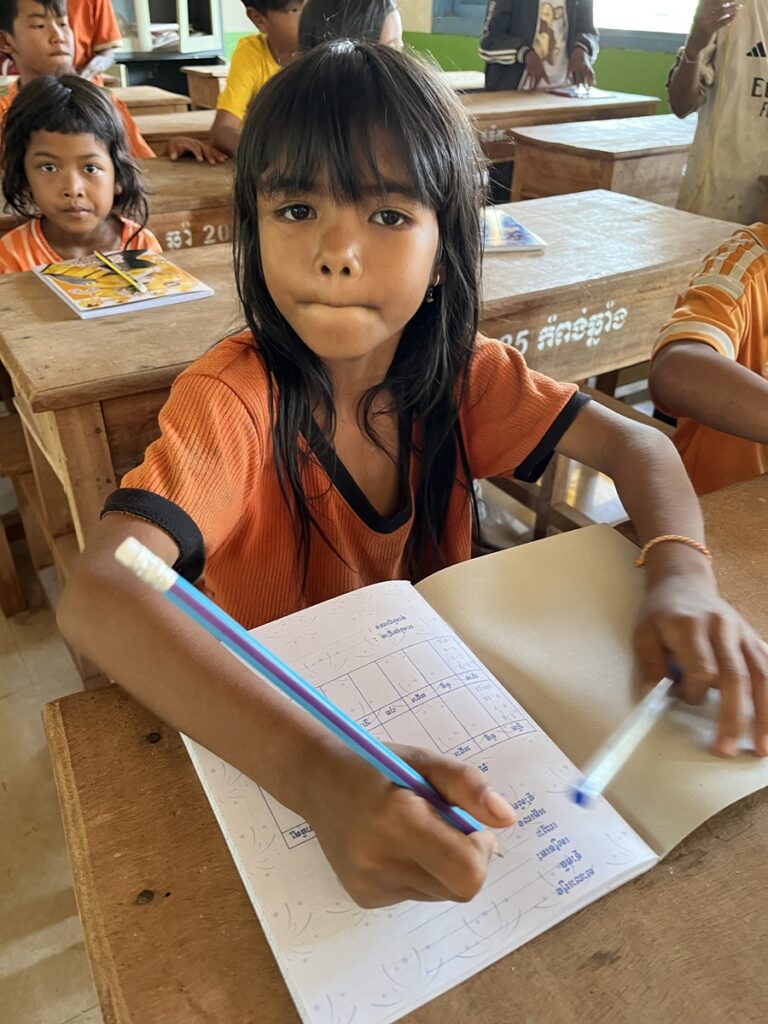
It is sobering to see what life is like here. But kids, like kids everywhere, are laughing, teasing, and playing on the basic metal swing set, despite the heat.
It is a jarring counterpoint to the lavish Royal Palace complex in Phnom Penh—nearly twice the size of Buckingham Palace. It has soaring golden roofs and a Silver Pagoda famous for its silver floor (some five tons of silver, though only a small bit visible). There are more than 1,000 Buddha statues, including a life-sized one adorned with nearly 2100 diamonds (the largest 25 carats!) and the famous Emerald Buddha that is atop a gilded pedestal. The famous emeralds that were around the pedestal are gone now, replaced with jade. All of this was built between 1904-1907.
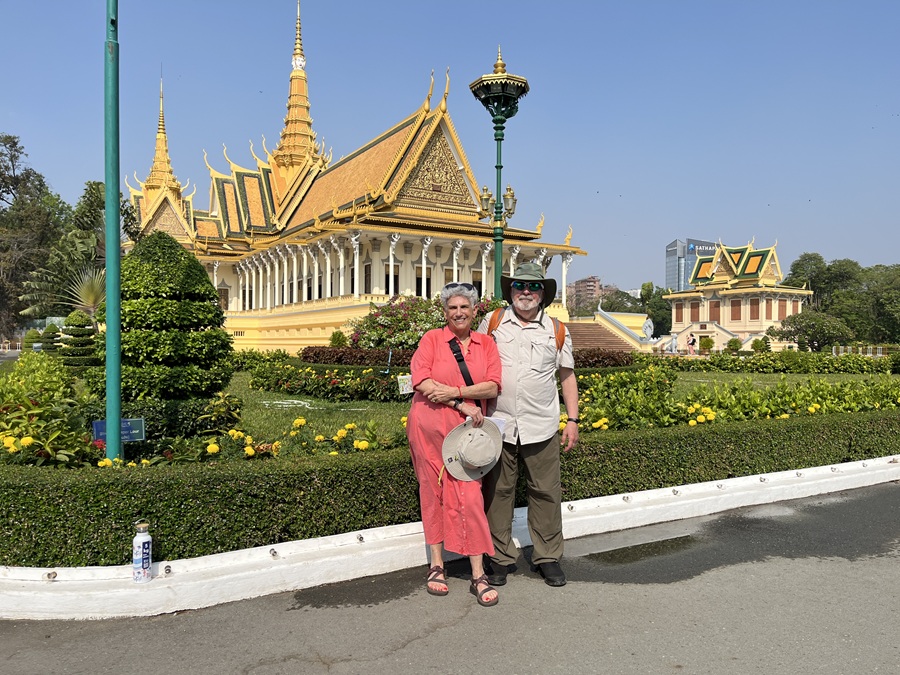
The royal residence is nearby in the complex, as are the final resting places of royals in sacred stupas. There is a shrine that is dedicated to Kantha Bopha, the young daughter of former King Father Sihanouk who died of Leukemia when she was just four. Today there are several Kantha Bopha children’s hospitals in Cambodia, including a large one in Phnom Phen, that treat the nation’s sick children free of charge.
Phnom Penh is a big bustling city with skyscrapers, a lot of traffic, and narrow back alleys where locals ply their trades, whether styling hair, doing nails, selling cold drinks, food, or clothing. There is a strange dichotomy between the modern and the traditional way of life, of prosperity and poverty.
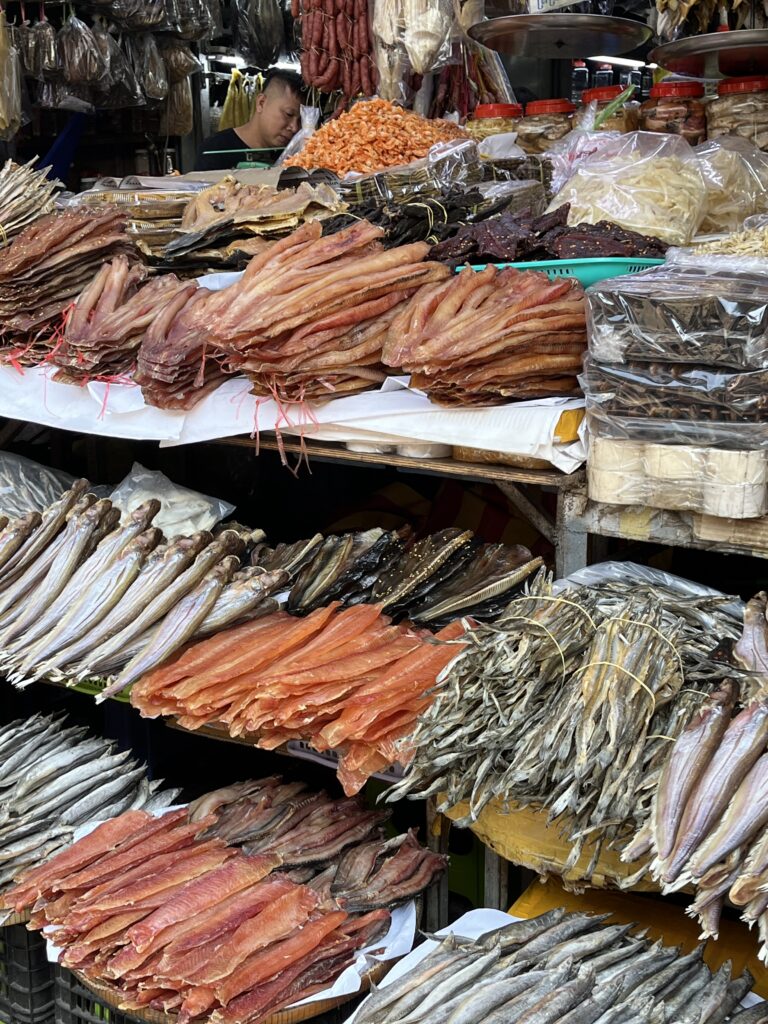
We walked through the Central Market, a huge domed hall built in 1937 where locals were shopping for everything from pots and pans to fruits we usually don’t see (dragon fruit, duran, tiny white berries, rose apples) vegetables, cashews, dried mango… Locals were eating lunch—everything from BBQ skewers, noodles, and pig and cow intestines
Throughout Cambodia and Vietnam along the Mekong, street vendors were selling dried fish and live snails and lobsters kept in big buckets of cold water. And case after case of glittering jewelry.
There were the traditional souvenirs too—scarves and pants and shirts with elephants; tee shirts with local beer logos and elephants, tiny buddhas
Phom Penh, we learned, was founded in 1372 and named for Grandmother Penh, a wealthy widow, who supposedly found four buddha statues in a floating tree after a storm. She raised an artificial hill to build a shrine for them (Phnom means hill). Later in the 15th century the capital was moved here. Now at the top of the hill there is a Buddhist temple and a pagoda named after her.
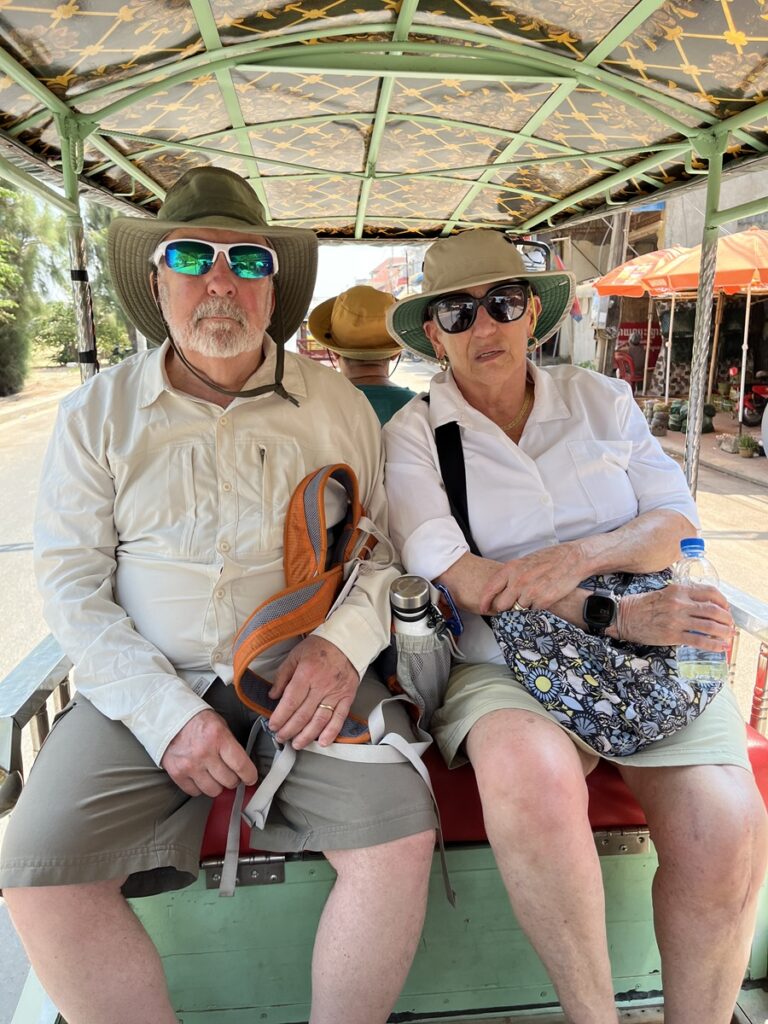
Yesterday we got another look at rural Cambodian life when we visited two families making their living through traditional crafts outside the fishing port of Kampong Chhang in the village of Andong Russei, home to about 300 families. The busy open-air markets also were a revelation—grilled frog, fried grasshoppers as well as whole chickens, salted fish, vegetables, and meat. Those of us who opted not to cycle took a traditional Tuk-tuk, powered by a driver on a motor bike rather than a bicycle. Motor bikes are everywhere here.
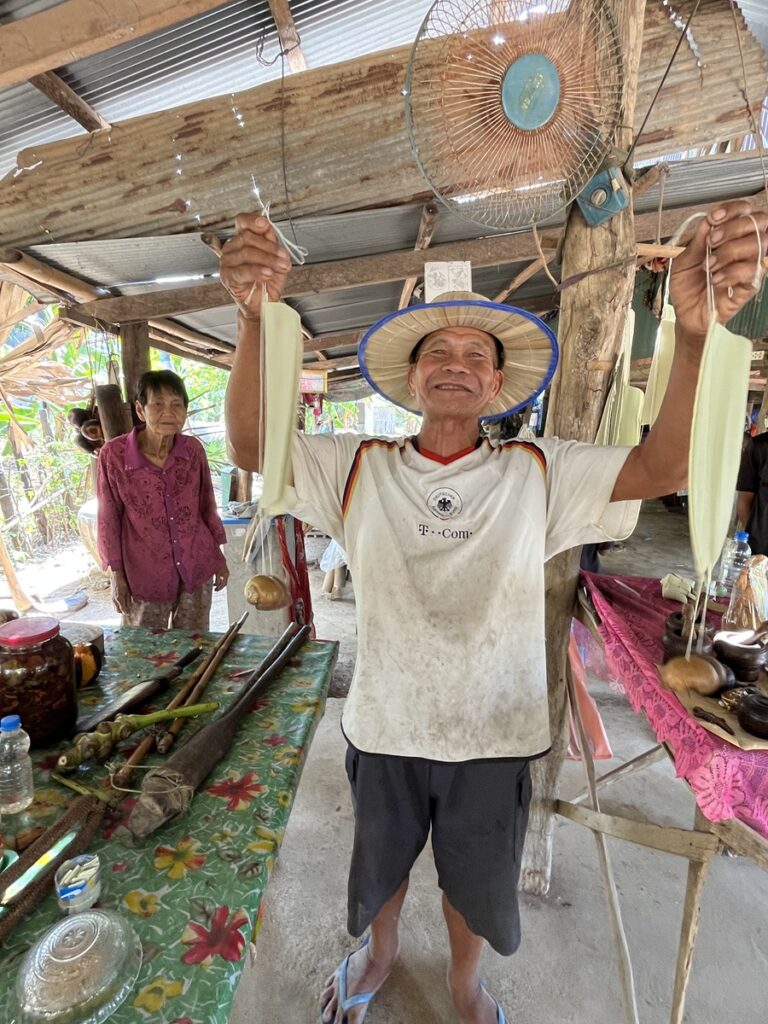
We met Ry who told us his moniker is “Happy Man,” and indeed he didn’t stop smiling as he explains the arduous process of making palm syrup, sugar and wine starting with gathering the sap high on the 50+ feet sugar palm trees. Palm wood is used for building and furniture; palm leaves are used for roofing and weaving hats and baskets. He showed off a traditional palm leaf hat; his wife demonstrated how locals fashion cotton scarves on their heads to care pottery jugs of water.
“Palm trees are deeply connected to Cambodian culture,” explained our guide. “Every family has palm sugar at home for cooking.”
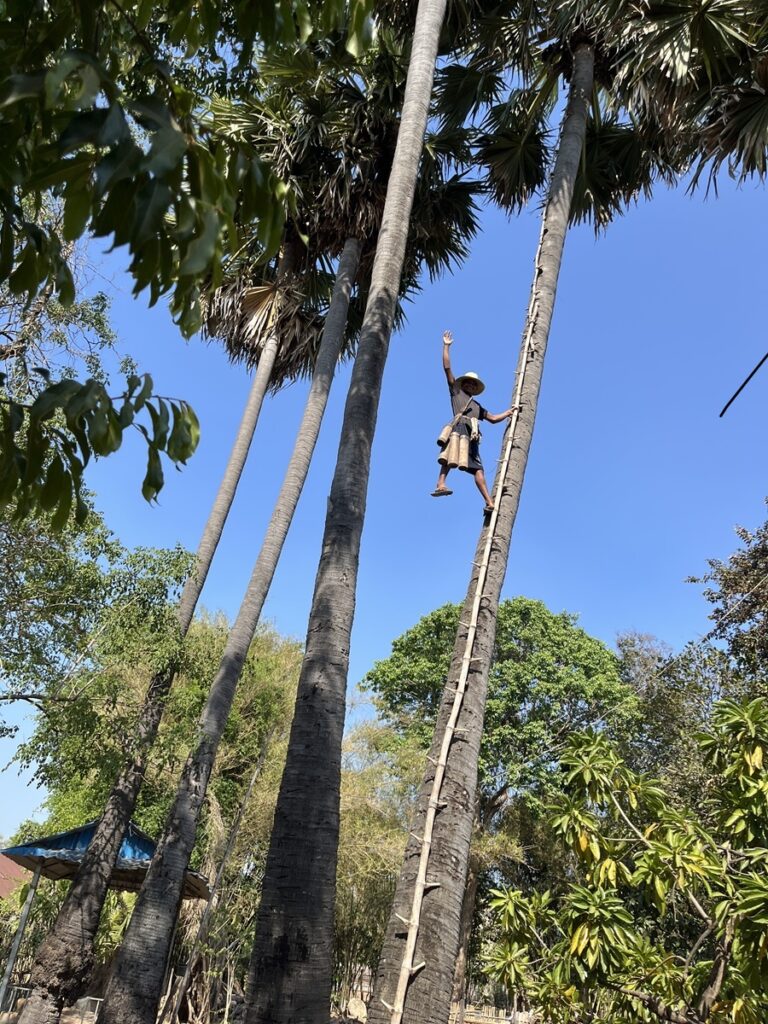
In his seventies, “Happy Man” explained that he stopped climbing last year—he had started when he was 16–when he fell from a tree. The very strong palm wine infused with herbs—he gave us a taste—greatly helped his recovery, he said. His nephew, Chan Keo, 35, showed us how he climbs one of the family’s trees on a ladder fashioned from a bamboo branch to get the sap, crossing a bamboo bridge near the top to a second tree. It takes 100 liters of sap to make just 10 kg of palm sugar, and the trees must be tapped twice daily. Certainly not an easy way to make a living.
We crossed the dusty yard to see another traditional and difficult way to earn a living, making pottery by hand. This is a skill passed down from mother to daughter as it has been for generations. Pottery has been made the same way here for hundreds of years and is a symbol of Cambodian cultural pride. The pots are used for cooking as well as religious ceremonies. One woman is making traditional pottery stoves.
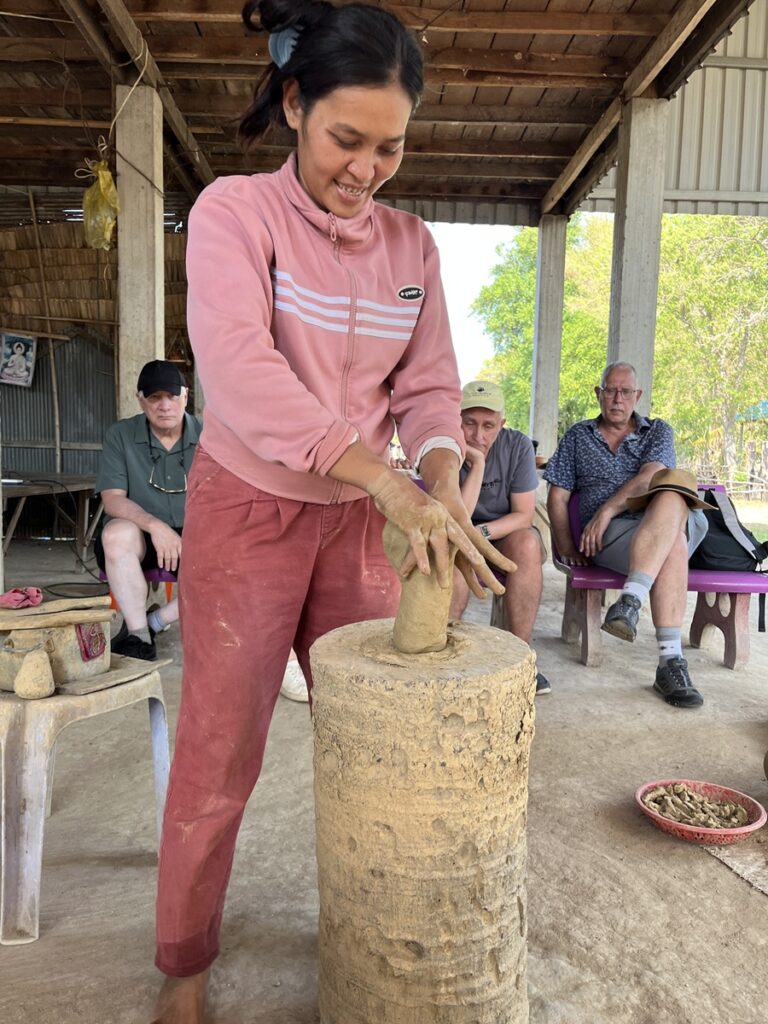
Sophat Rin, 38 and a mom of three, said she often begins work at 5 am and doesn’t finish until the evening. She can make 40 pots a day, selling them to a broker for just 25 cents each. She demonstrates her skill at shaping and decorating the pots entirely by hand, turning round and round as a pottery wheel would. The kiln is open air, fired by wood.
Why not use more modern techniques, we asked? That wouldn’t be traditional, she explained. Soon, she will start to teach her eight-year-old daughter as her mom taught The little girl smiled while sipping a cold fruit drink.