
8 Strange Wisconsin Grottos, Folk-Art Gardens, And Handmade Worlds You Have To See
Wild ideas do not always belong behind museum walls. Sometimes they rise from backyards, hillsides, and patches of open ground.
Stone stacks become shrines. Scrap metal turns into towering creatures. Concrete figures gather in strange, colorful worlds built one piece at a time.
Wisconsin holds a remarkable collection of these handmade creations. Many took years to finish, and some consumed entire lifetimes. Their builders followed personal visions instead of rulebooks. The results can feel playful, mysterious, moving, or completely unexpected.
Every stop reveals another layer of imagination and determination. Small details hide around corners. Larger works demand a long pause. These spaces are imperfect, personal, and impossible to forget.
Come ready to look closely, wander slowly, and enjoy the sheer creativity on display. One person, a few basic materials, and a stubborn idea can create something far more powerful than anyone expected.
1. Jurustic Park
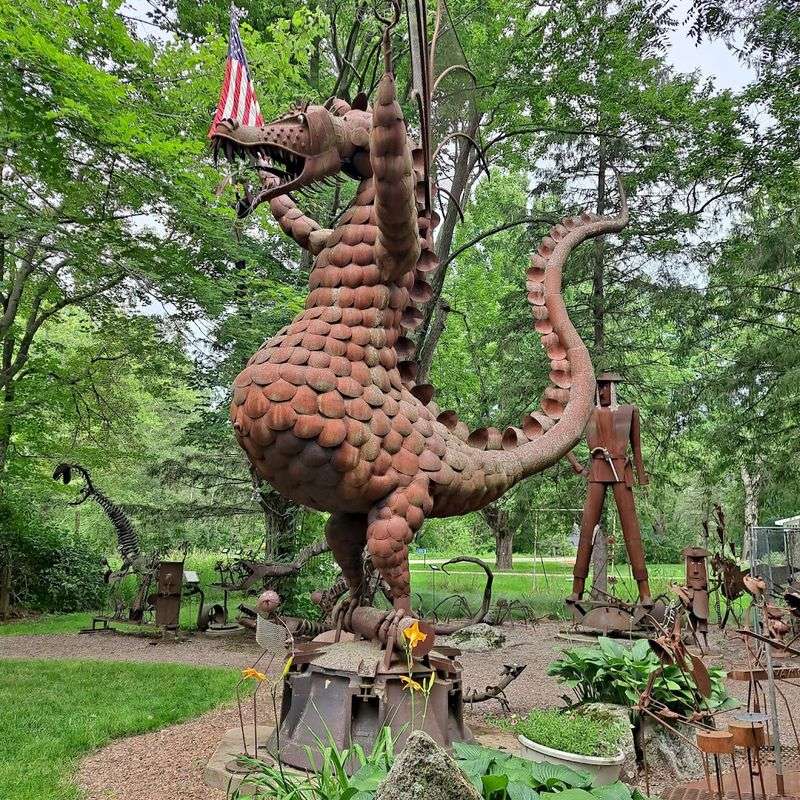
Some places earn their reputation slowly, but Jurustic Park announces itself the moment you spot the first towering metal creature rising from the trees.
This one-of-a-kind outdoor sculpture park in Marshfield, Wisconsin, was created by attorney Clyde Wynia. He began welding prehistoric animals and mythical beasts from scrap metal in the early 1990s.
What started as a personal creative outlet grew into a sprawling collection of over 150 hand-welded sculptures spread across a marshy woodland property.
The creatures here range from massive dinosaur-like figures to winged dragons and strange hybrid animals that look like they walked out of a dream.
Each piece has its own name and personality, and Wynia often placed them in poses that suggest movement, drama, or even humor. You will find yourself stopping at nearly every turn to look closer at the detail work pressed into each figure.
Visiting feels like wandering through a living storybook. The natural setting adds to the atmosphere, with trees, water, and wildlife surrounding the sculptures at every angle.
There are no ropes or barriers keeping you at a distance, which makes the experience feel unusually personal and intimate for an outdoor art space.
Jurustic Park is open to the public, though it is best to check current hours before you go since visits are often guided by Wynia himself when he is available. The address is 112021 Old Sugarbush Lane, Marshfield, WI 54449.
Admission is free, though donations are warmly welcomed. For a central Wisconsin stop far beyond the usual roadside attraction, this is the kind of place you will remember long after leaving.
2. Dr. Evermor’s Sculpture Park
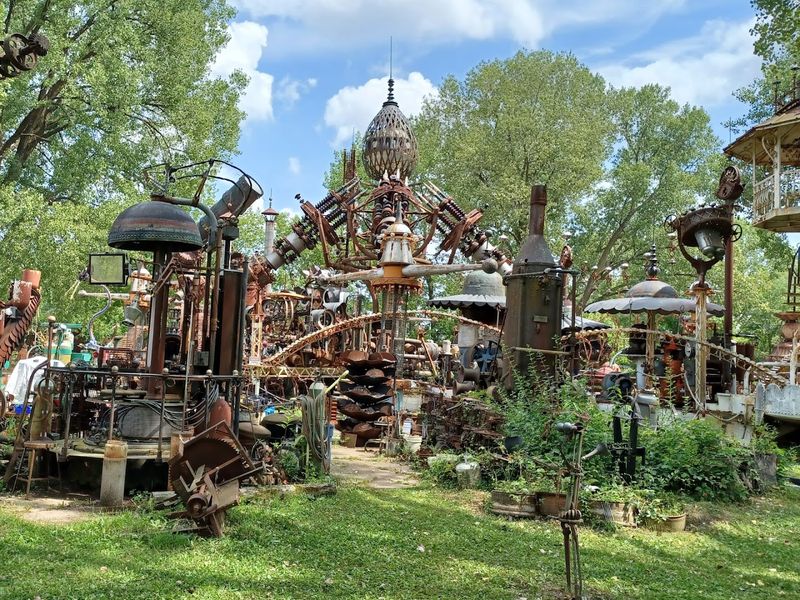
Few places in the United States can match the sheer scale and imagination of Dr. Evermor’s Sculpture Park.
Artist Tom Every, known as Dr. Evermor, built this outdoor environment near Sumpter, Wisconsin, over several decades. Its centerpiece is the Forevertron, a colossal machine-like sculpture made from salvaged industrial parts.
For years, the Forevertron held the Guinness World Record as the largest scrap metal sculpture on Earth.
Tom Every spent his career dismantling industrial sites and saving machinery, boilers, and hardware that others would have discarded. He used those materials to construct an entire fantasy world filled with birds, beasts, and elaborate mechanical figures.
The result is something that sits at the crossroads of art, science fiction, and folk vision.
Walking through the park feels like exploring a forgotten industrial civilization. Giant metal birds perch on structures. Enormous spheres and towers loom overhead. The scale of everything is genuinely hard to process until you are standing right next to it.
Photography enthusiasts especially love this place because every angle offers a new composition.
Dr. Evermor passed away in 2020, but his work lives on through the efforts of those who continue to preserve and maintain the park. The site is located at S7703 U.S. Highway 12, Town of Sumpter, WI 53591. It is open during daylight hours, and visiting is free.
This Wisconsin destination proves how one person’s creative drive can build something lasting. The result leaves visitors amazed for all the right reasons.
3. Fred Smith’s Wisconsin Concrete Park
Fred Smith spent most of his life working as a logger and tavern keeper in northern Wisconsin before he picked up a trowel and started building.
Beginning in 1948 and working until a stroke stopped him in 1964, Smith created over 200 concrete sculptures on his property in Phillips, Wisconsin.
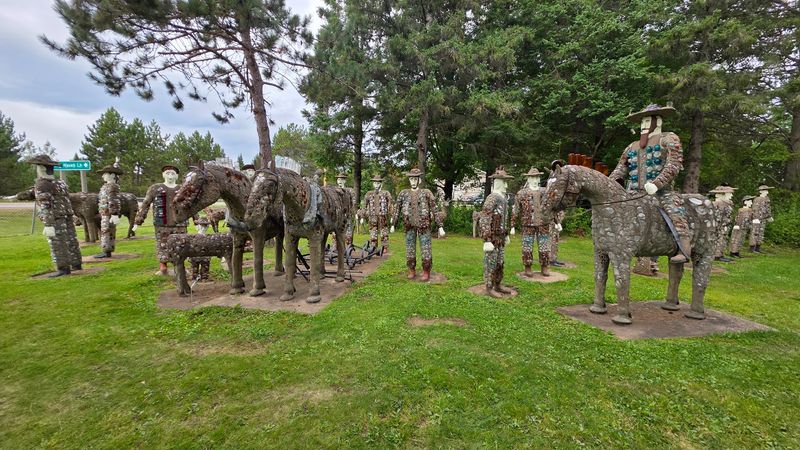
He embedded glass, bottles, mirrors, and found objects into each figure, giving them a sparkling, mosaic-like quality that catches sunlight in unexpected ways.
The sculptures depict scenes from Wisconsin history, American folklore, and everyday rural life. You will see loggers, Native American figures, animals, and historical characters rendered in concrete at larger-than-life scale.
Smith worked without formal training and built everything himself, often using wire armatures and whatever materials were close at hand. The results are raw, powerful, and deeply expressive in ways that trained academic art rarely achieves.
After Smith passed away in 1976, the park fell into disrepair. A preservation effort led by the Kohler Foundation restored the sculptures and transferred the property to Price County.
Today it is maintained as a public park and listed on the National Register of Historic Places, which gives you a sense of just how significant this place is considered to be.
The park is open year-round and free to visit, making it one of the most accessible folk-art destinations in the state. You can find it at N8236 State Highway 13, Phillips, WI 54555.
Plan to spend at least an hour walking the grounds, because there is so much detail packed into each sculpture that a quick pass through will not do it justice. This is Wisconsin folk art at its most honest and enduring.
4. Prairie Moon Sculpture Garden & Museum
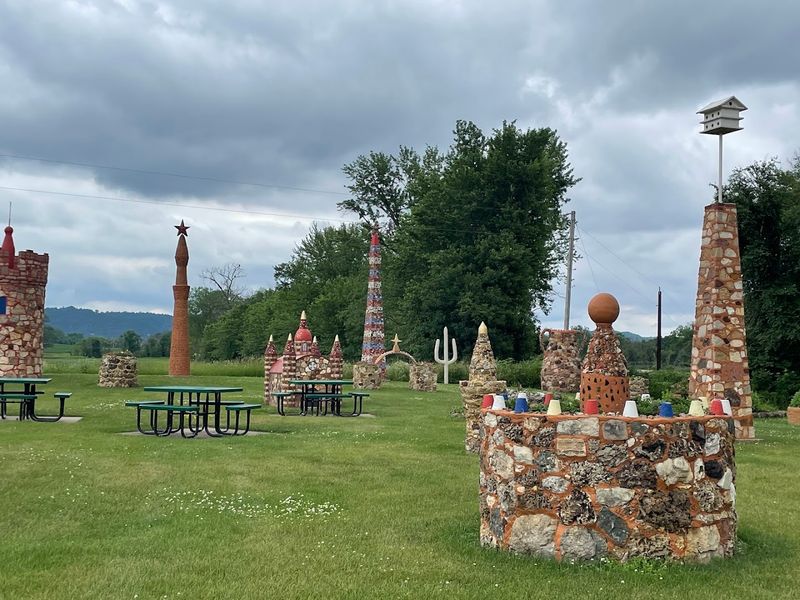
Herman Rusch was already in his 70s when he started building. A retired farmer living in Cochrane, Wisconsin, Rusch began constructing elaborate concrete sculptures and ornamental structures on his property in 1952 and did not stop until he was 90.
What he created over those two decades is one of the most charming and quietly impressive folk-art environments in the entire Midwest.
The Prairie Moon Sculpture Garden features dozens of concrete figures, decorative arches, and ornamental columns spread across a compact rural property.
Rusch had a fondness for symmetry and pattern, and many of his structures have an almost architectural quality to them despite being entirely self-taught.
He embedded colored glass, stones, and ceramic fragments into his work, creating surfaces that glow softly when the light hits them right.
A small museum building on the property houses additional artifacts and information about Rusch’s life and creative process. The combination of outdoor sculptures and indoor exhibits gives you a fuller picture of who he was and what drove him to keep building well into old age.
There is something genuinely moving about a person who finds their creative voice late in life and pursues it with that kind of energy.
The Kohler Foundation played a key role in preserving and restoring this site, just as it did with the Wisconsin Concrete Park. The garden is at S2727 Prairie Moon Road, Cochrane, WI 54622, in the bluff country along the Mississippi River.
It is open seasonally, so checking ahead for current hours is a smart move before making the trip. For anyone exploring the folk-art landscape of Wisconsin, Prairie Moon is a stop that rewards patience and a slow, attentive walk.
5. James Tellen Woodland Sculpture Garden
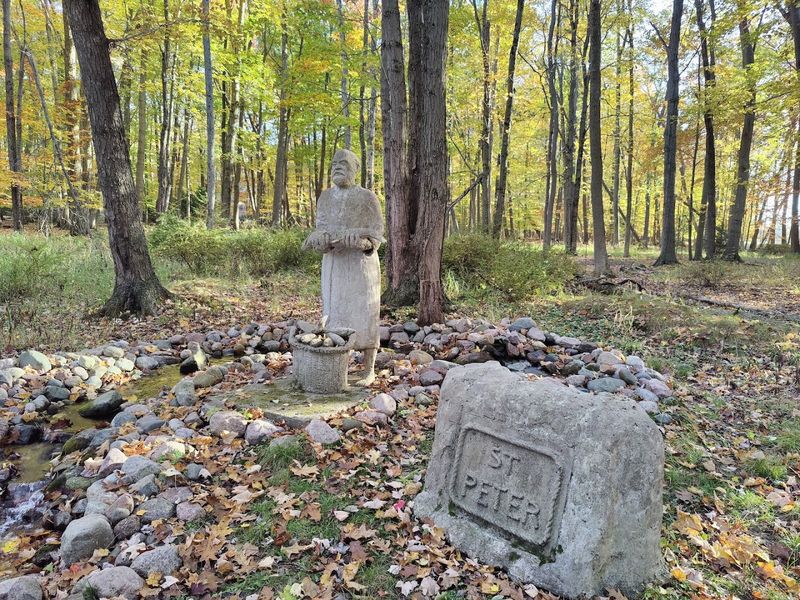
There is a quiet, almost meditative quality to the James Tellen Woodland Sculpture Garden that sets it apart from other folk-art environments in Wisconsin.
Tellen, a Lithuanian immigrant who settled in the Sheboygan area, created this shaded outdoor garden over several decades starting in the 1940s.
He built his figures from concrete, stone, and found materials, placing them among the trees on his wooded property in a way that feels organic rather than staged.
The sculptures include religious figures, animals, and decorative forms that reflect Tellen’s personal faith and his connection to the natural world. Many pieces are covered in moss and surrounded by roots and undergrowth, making the garden seem to rise naturally from the earth.
It is the kind of place where you slow down without being asked to.
Unlike some folk-art sites that have been heavily restored or relocated, the Tellen garden retains much of its original atmosphere. The setting feels intimate and personal, as if you are visiting someone’s private sanctuary rather than a public attraction.
That intimacy is part of what makes it so affecting for people who take the time to explore it carefully.
The garden is maintained by the John Michael Kohler Arts Center, which has been instrumental in preserving folk-art environments throughout Wisconsin. You can find it at 5634 Evergreen Drive, Sheboygan, WI 53081.
Access may be limited depending on the season and current preservation work, so reaching out to the arts center before your visit is a good idea.
For those drawn to places where art and nature genuinely intertwine, this garden offers an experience that is hard to replicate anywhere else in the state.
6. Paul Bobrowitz Spectacular Sculpture
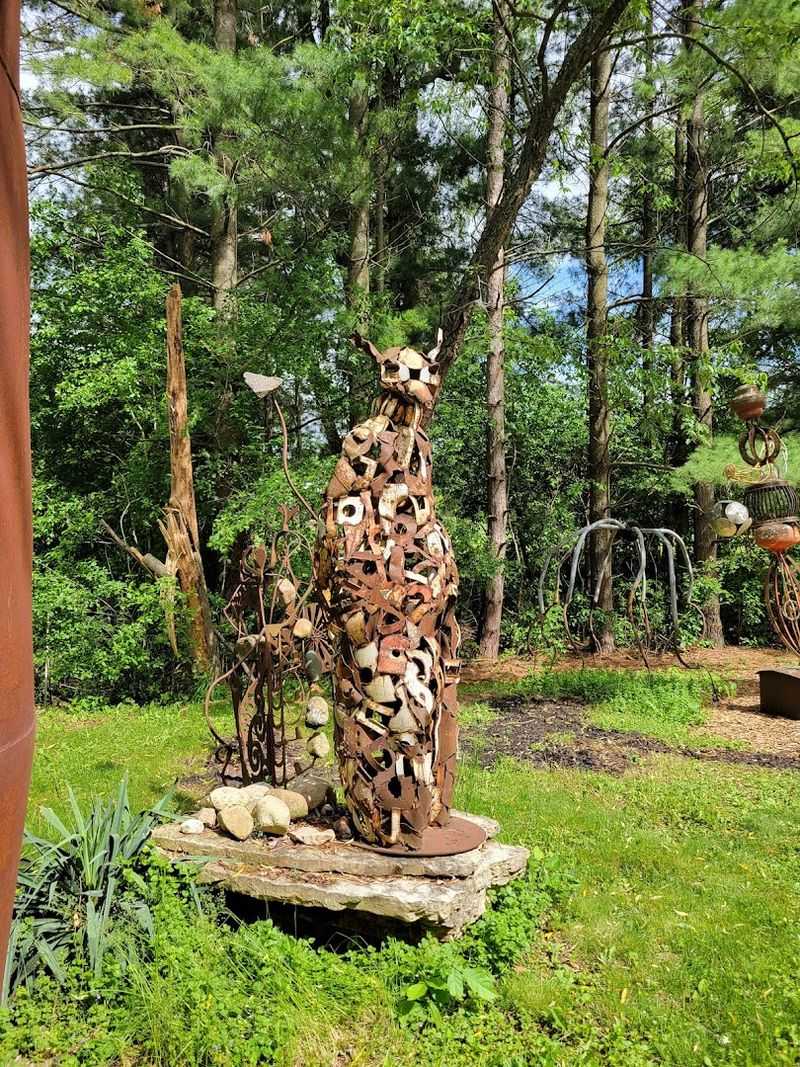
Not every folk-art destination in Wisconsin comes with a long history or a famous preservationist backing it up. Paul Bobrowitz built his roadside sculpture environment in Colgate simply because he had ideas he wanted to make real.
His Woodchuck Way property features large, colorful sculptures and decorated structures that have evolved for years.
Bobrowitz works with a variety of materials, and his aesthetic is bold and direct. The pieces are not subtle. They demand your attention from the road, which is very much the point.
Folk art of this kind has always been about communication, about putting something out into the world where passing strangers can encounter it without warning. That element of surprise is part of the experience.
What makes this site particularly interesting is that it is a living, active environment rather than a preserved historical one. Bobrowitz continues to add and modify his work, which means no two visits are exactly the same.
If you have been before and think you know what to expect, you will likely find something new waiting for you. That ongoing creative energy gives the place a vitality that more polished art spaces sometimes lack.
Because this is a private property, it is important to be respectful when visiting and to observe from the road or seek permission before entering. The address is N93W29174 Woodchuck Way, Colgate, WI 53017.
It sits in the southeastern part of Wisconsin, making it a reasonable stop if you are exploring the region between Milwaukee and the Kettle Moraine area.
Folk art fans who appreciate work that is still actively being made will find this stop especially rewarding and genuinely unlike anything else on this list.
7. Paul & Matilda Wegner Grotto
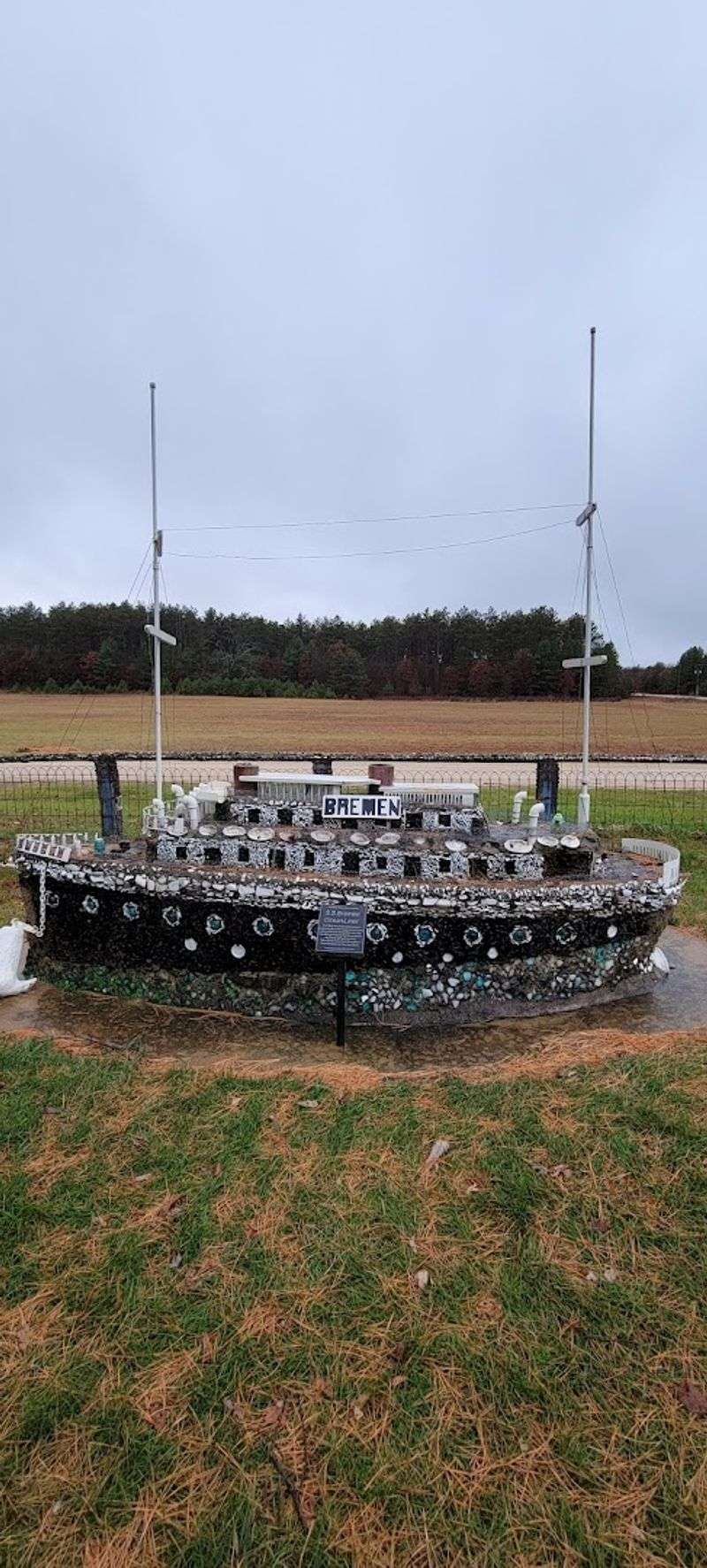
Paul and Matilda Wegner began building their grotto in 1929, when Paul was already in his late 60s. German immigrants who had farmed in Monroe County for decades, the Wegners devoted their retirement to creating a remarkable outdoor environment.
They built it on their property near Sparta, Wisconsin.
The centerpiece of the grotto is a full-scale concrete ship called the Glass Church, encrusted with colored glass, mirrors, and ceramic fragments that shimmer in sunlight.
The grotto also includes a series of religious shrines, decorative arches, and sculptural figures, all built from concrete and embedded with found materials. The Wegners worked together on the project, and you can sense the shared purpose and devotion in every piece they made.
There is a tenderness to the work that feels different from the bold, individual expression you find at some other folk-art sites.
Paul Wegner continued building until he was 90 years old, which gives you some sense of the determination behind this project. After both Wegners passed away, the property went through several ownership changes before the Kohler Foundation stepped in to restore and preserve it.
That restoration work has helped ensure that the site remains accessible and in good condition for future generations of visitors.
The grotto is located at 7788 Daylight Road, Sparta, WI 54656, in the driftless region of western Wisconsin. It is open seasonally, and visiting is free.
The surrounding landscape of rolling hills and farmland adds a peaceful backdrop that feels appropriate for a place built with so much quiet intention.
For anyone traveling through this part of the state, stopping here is one of those decisions you will not regret making.
8. Dickeyville Grotto & Shrines
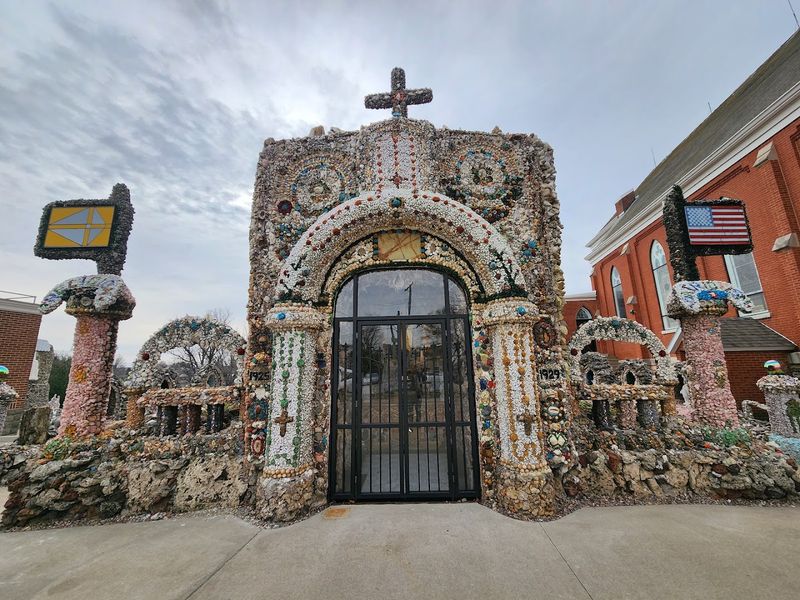
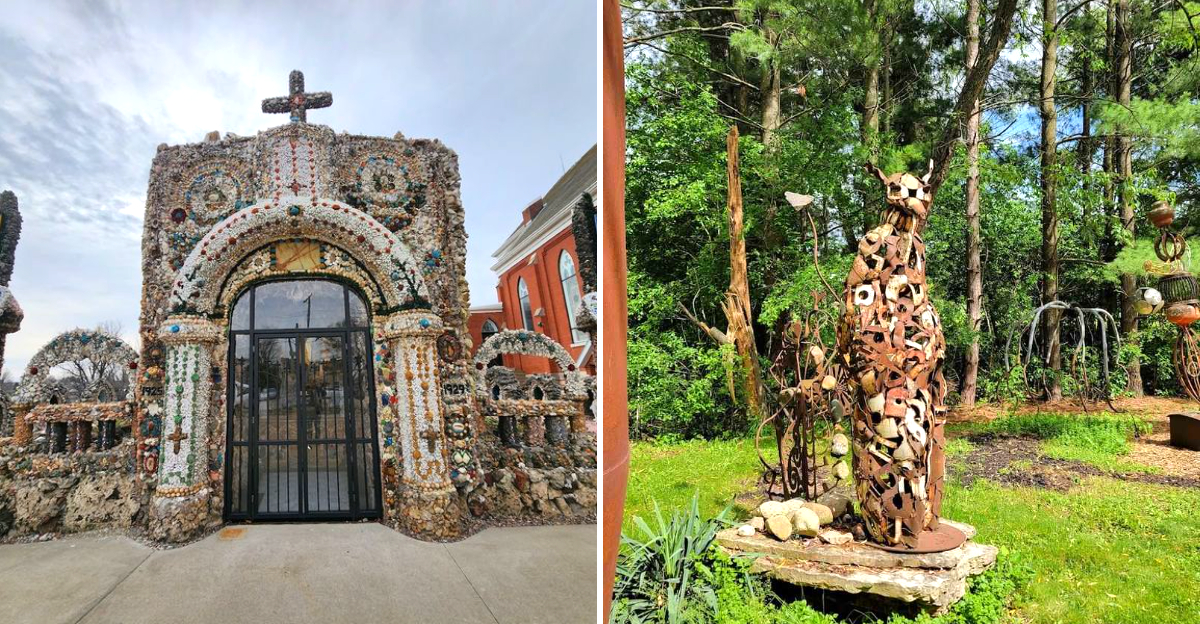
Built by Father Mathias Wernerus between 1925 and 1930, the Dickeyville Grotto is one of the country’s most elaborate folk-art environments. The grotto is on the grounds of Holy Ghost Parish in Dickeyville, Wisconsin.
Its dense mix of materials creates a striking expression of religious devotion. Shells, fossils, gemstones, glass, pottery, and petrified wood cover every surface in intricate mosaic patterns.
Father Wernerus was a Catholic priest who believed that beauty in the physical world could inspire spiritual reflection. He gathered materials from around the world and enlisted help from parishioners to construct the grotto and its surrounding shrines.
The level of detail in the work is staggering. You can spend a long time examining just one small section of wall and keep finding new objects embedded within it.
Beyond the main grotto, patriotic shrines honoring American historical figures connect religious faith with national identity. That combination is unusual and thought-provoking, and it adds depth to what might otherwise seem like purely decorative work.
The whole complex feels like a labor of love compressed into stone and glass.
The Dickeyville Grotto is open to the public year-round and is free to visit, though donations help with ongoing maintenance. You can find it at 305 West Main Street, Dickeyville, WI 53808, near the Illinois border in the far southwestern corner of Wisconsin.
It is a place that rewards slow, attentive looking. Come prepared to be patient, and you will leave appreciating what sustained effort and creativity can achieve.