
This Mississippi Trail Follows A Sunken Road Walked By Travelers More Than 200 Years Ago
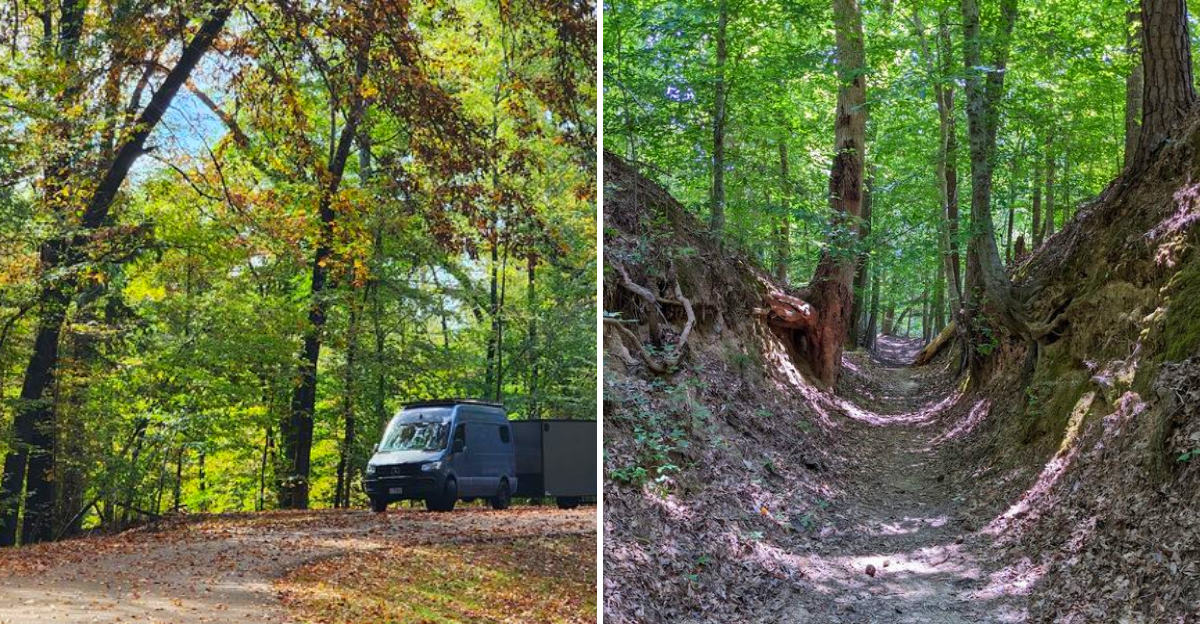
Two hundred years is a long time for a road to keep its shape. Somewhere in Mississippi, wagon wheels and boots wore a path so deep into the earth that walls of dirt now rise on both sides.
Rain carved it deeper over time. Nobody ever filled it back in.
Walking through feels less like a nature trail and more like slipping into someone else’s memory. Old roads usually disappear under highways or parking lots. That one refused.
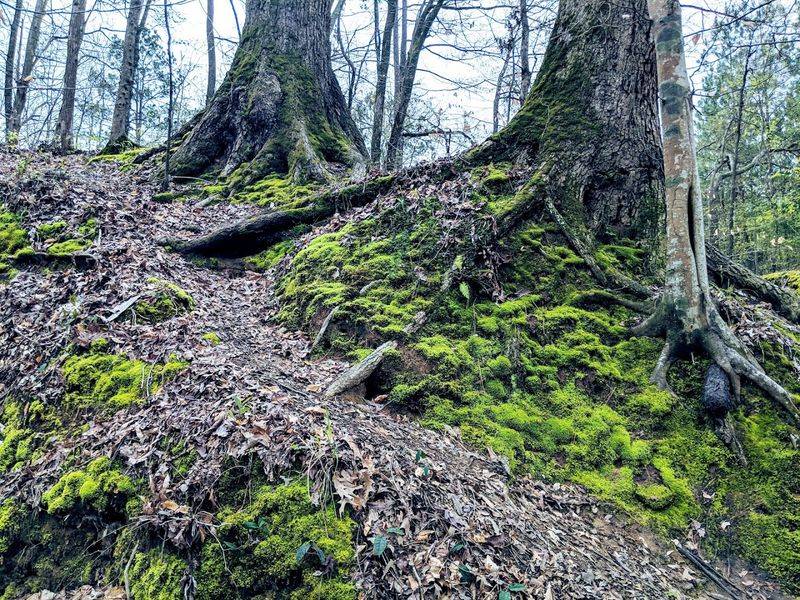
Trees grew tall along the edges, roots thick enough to hold the banks in place. Traders and settlers once passed through here on their way to somewhere else, boots sinking into the same dirt you’re about to walk on.
Standing at the bottom of that sunken path, you get to be the next name in a very long line of feet.
A Road The Earth Swallowed Whole
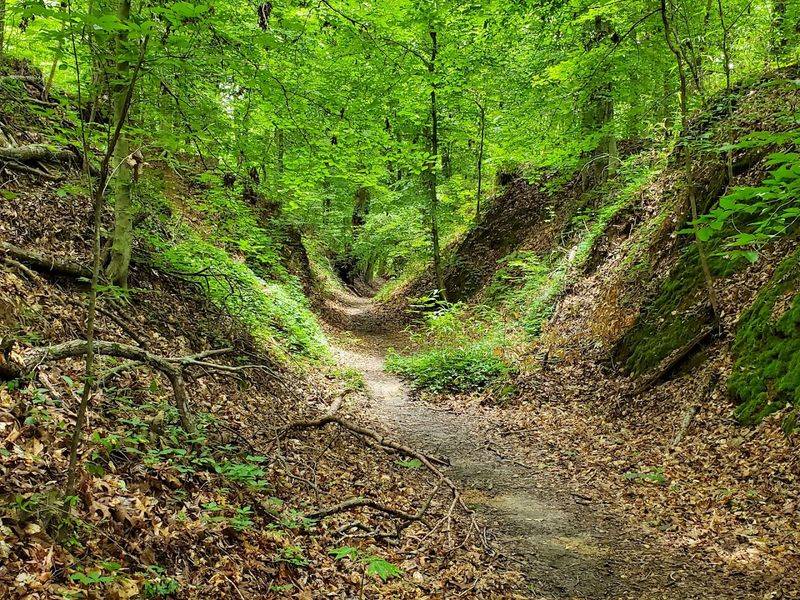
Few trails in America carry this kind of weight underfoot. The path you walk here was not built by engineers or carved out by machines.
It was worn down, slowly and relentlessly, by the feet of thousands of people and animals over many generations.
The soil in this part of Mississippi is called loess, a soft, sandy clay mix that erodes with surprising ease. Every step taken by Native Americans, traders, soldiers, and settlers pushed the ground a little lower.
Over centuries, the trail sank so far into the earth that the walls on either side now rise six to twenty feet above your head in some spots.
Standing inside the corridor feels different from any ordinary hike. The air is cooler.
The sounds of the outside world fade. Green roots poke through the clay walls like fingers holding history in place.
You are not just on a trail. You are inside a living record of human movement that stretches back thousands of years, and that feeling does not leave you easily once you have experienced it.
Welcome To The Sunken Trace, Milepost 41.5
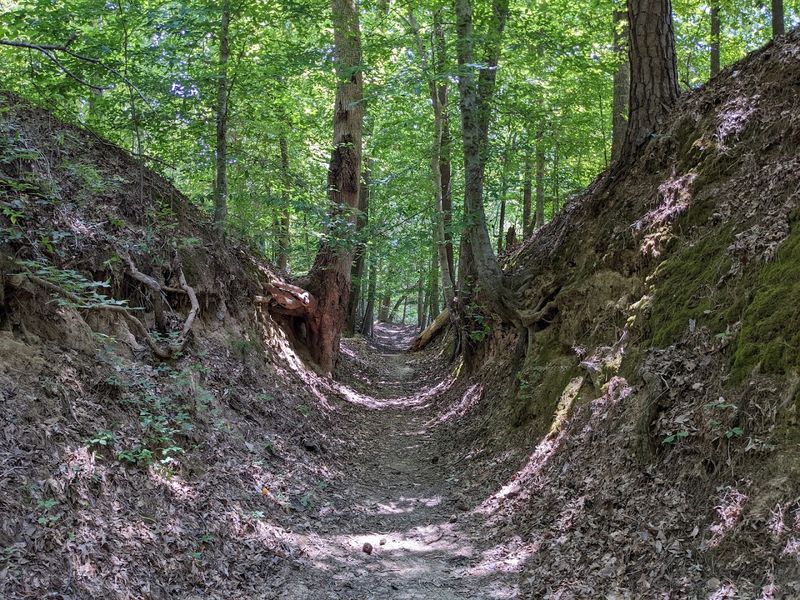
Marked at Milepost 41.5 on the Natchez Trace Parkway, the Sunken Trace sits near Port Gibson, Mississippi, with the address Natchez Trace Pkwy, Port Gibson, MS 39150.
Pulling off the parkway here is one of the best decisions you can make on any road trip through the Deep South.
The parking area is easy to access and well maintained by the National Park Service. A short walking trail of about a quarter mile leads you down into the sunken corridor, looping back in an oval shape so you never have to retrace your steps.
The whole walk takes roughly five to ten minutes, but most visitors linger far longer than that.
A picnic table on site gives you a quiet place to sit and absorb the surroundings after your walk. The trail is not steep or physically demanding, making it welcoming for visitors of nearly every age and fitness level.
Cell service along the Natchez Trace Parkway can be limited, so it helps to know your stop in advance. The National Park Service website at nps.gov/natr has current trail conditions and additional information worth checking before your visit.
Thousands Of Years Before The First Settler Arrived
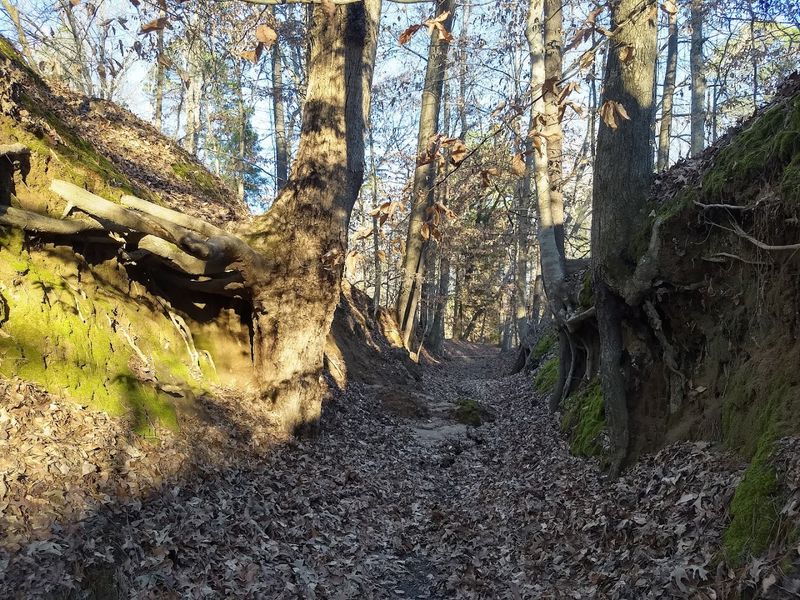
Long before European settlers ever set foot in Mississippi, the Natchez Trace was already a well-traveled network of paths.
Native American tribes including the Natchez, Chickasaw, and Choctaw used these routes for trade, hunting, and communication across vast stretches of land.
The trails connected communities across what is now the southeastern United States. Generations of people walked the same corridors, and with each passing year the soft loess soil gave way a little more beneath their feet.
The sunken shape of the trail was not the result of any single era. It was the accumulated work of countless human lives over thousands of years.
Walking the Sunken Trace today means walking a path that predates the United States by a very long stretch. That is not something most trails can claim.
The historical depth here goes far beyond what a roadside marker can capture. The ground itself holds the evidence, and the depth of the corridor is a more honest record of that history than any written account.
Recognizing that before you even step down into the path makes the entire experience land differently.
The Kaintucks And Their Long Walk Home
By the late 1700s and early 1800s, the Natchez Trace had become the main highway for a very specific group of travelers.
They were called Kaintucks, boatmen mostly from Kentucky and surrounding states who floated goods down the Mississippi River to markets in Natchez or New Orleans.
After selling their cargo and even their flatboats for lumber, they had no river to ride home. The only option was to walk, sometimes more than 400 miles back north through wilderness, heat, mosquitoes, and unpredictable terrain.
The Sunken Trace was part of that brutal return journey. Thinking about that while standing inside the carved corridor gives the whole experience a new layer of meaning.
These were not tourists. They were working people, tired and loaded down with earnings, pushing through rough country to get back to their families. The path they wore into the earth was not made for sightseeing.
It was made out of pure necessity. And yet here you are, centuries later, walking the same groove they left behind.
That kind of connection across time is genuinely rare, and the Sunken Trace delivers it without any fanfare at all.
Famous Boots That Walked This Ground
General Andrew Jackson traveled the Natchez Trace. So did Meriwether Lewis, John James Audubon, Jefferson Davis, and Ulysses S. Grant. The Trace was not a backroad curiosity.
For a stretch of American history, it was the most important overland route in the entire Southeast.
Most travelers, though, were not famous. They were farmers, merchants, soldiers, and settlers moving through a landscape that offered very little comfort and a fair amount of risk.
Disease, extreme heat, limited food, and rough terrain were constant companions on the Old Trace.
The fact that so many ordinary people made that journey, and that their collective movement carved this visible corridor into the Mississippi soil, is what makes the Sunken Trace feel so democratic and so human. No monument was built here to honor any single person.
The monument is the trail itself, shaped equally by the famous and the forgotten. Every person who passed through contributed to what you see today, and the ground does not distinguish between generals and grain merchants.
That quiet equality, written in eroded clay, is one of the most moving things about this entire stop.
What Steamboats Did To Save A Trail
Here is an unexpected twist in the story of the Sunken Trace. The very thing that nearly made it obsolete is also what helped preserve it.
When steamboat travel became reliable on the Mississippi River in the early 1800s, the Kaintucks no longer needed to walk home. They could simply ride upstream on a boat.
Traffic on the Natchez Trace dropped sharply. The path that had seen thousands of travelers a year suddenly grew quiet.
And because fewer people were using it, fewer improvements were made to it, and fewer sections were converted into roads or developed into towns.
That neglect turned out to be a gift. Large portions of the original Old Trace survived intact simply because nobody had a reason to change them.
The Sunken Trace at Milepost 41.5 is one of the most striking examples of what that preservation looks like in practice. You are not walking a reconstruction or a re-creation.
You are walking the original path, in its original condition, shaped by original human use. Steamboats, of all things, deserve a small measure of credit for keeping this piece of Mississippi history exactly as it was left.
Spring Visits And The Green Cathedral Effect
Timing your visit to the Sunken Trace can genuinely change the experience.
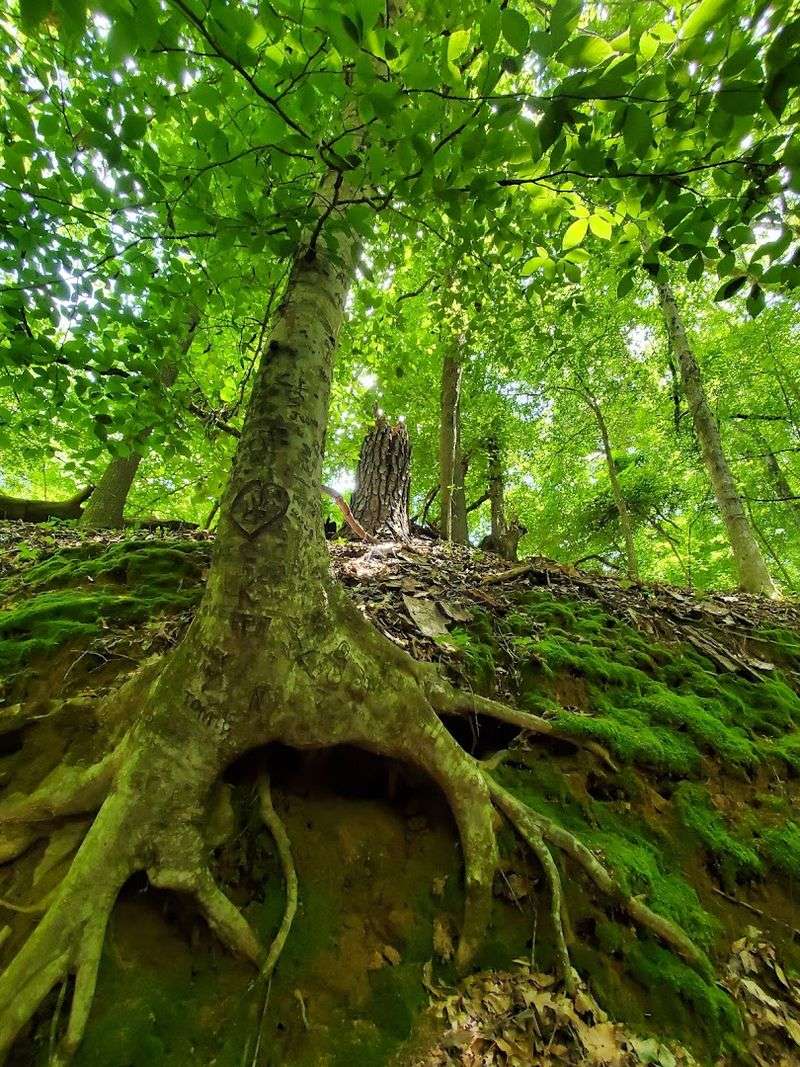
Spring is widely considered the best season to walk the trail, when the surrounding trees and vegetation are fully leafed out and the corridor glows with a soft green light that filters through the canopy above.
The walls of the sunken path are covered in roots, moss, and climbing plants during warmer months.
The contrast between the pale clay soil and the rich green growth creates a visual atmosphere that photographs beautifully but lands even harder in person.
No filter needed and no enhancement required.
Summer visits are still worthwhile, though the Mississippi heat is a real consideration. Fall brings a different kind of beauty as the leaves change color and the light shifts to something warmer and more amber.
Winter strips the trees back and lets you see the full architecture of the eroded corridor more clearly, which has its own stark appeal. Whatever season brings you here, the trail delivers something worth your time.
The quarter-mile loop is short enough that you can walk it more than once and notice something new on each pass through the corridor.
How To Make The Most Of Your Stop
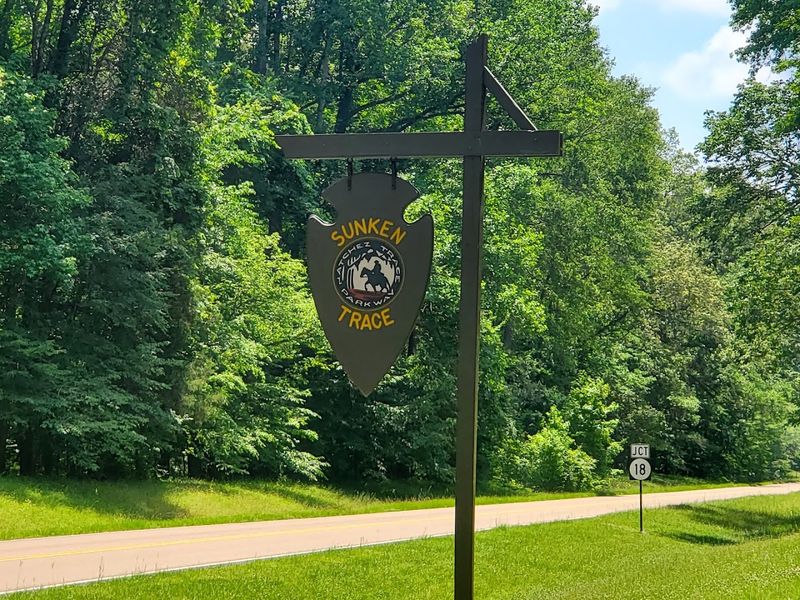
A quarter-mile loop does not sound like much on paper, but the Sunken Trace earns every second you give it. Plan to spend at least 20 to 30 minutes here rather than treating it as a quick photo stop.
The longer you stay, the more the scale of the erosion starts to settle in around you.
Bring water, especially in warmer months. The trail itself is not strenuous, but the Natchez Trace Parkway has limited services along its length, so being prepared before you arrive is always a smart move.
Restroom facilities are not available at this specific stop, so plan accordingly before pulling off the parkway.
A camera or a fully charged phone will serve you well here. The Sunken Trace is consistently rated among the most photographed stops along the entire Natchez Trace Parkway, and it earns that reputation honestly.
The depth of the corridor, the textures of the walls, and the canopy overhead create a composition that practically frames itself. Go slow, look closely at the roots and layers in the soil walls, and let the quiet of the place do its work.
The Sunken Trace rewards patience more than speed.