
This Small California Community Turned A Forgotten Military Base Into An Off-Grid Paradise
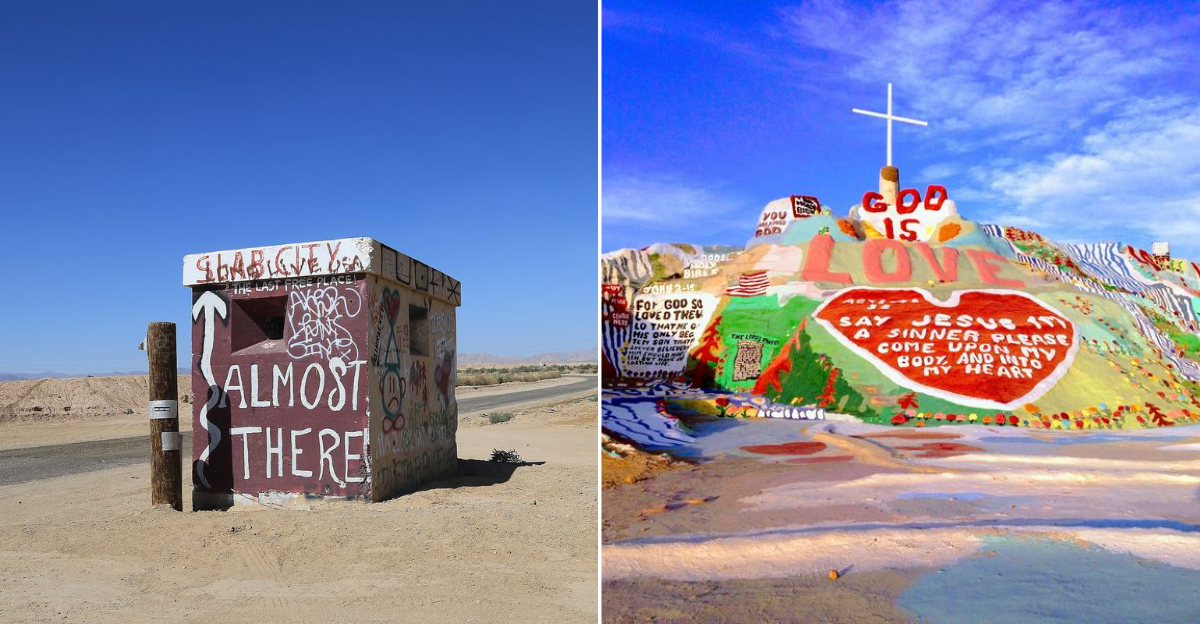
Far out in the southeastern desert of California, the pavement runs thin, the heat shimmers off the sand, and something wonderfully strange appears on the horizon. Painted mountains.
Sculpture gardens made of scrap metal. Trailers wrapped in murals. Buses turned into stages.
It looks like a movie set, but real people live here, and they built every bit of it themselves. Eighty years ago, this flat stretch of Sonoran Desert echoed with artillery practice as thousands of Marines trained for war.
When the military packed up and left, all that remained were bare concrete pads baking in the sun. Then came the dreamers, the veterans, the artists, and the road travelers who looked at those empty slabs and saw free land, open sky, and a chance to start over.
Today the community runs on solar panels, generators, hauled water, and pure stubbornness.
Where Concrete Slabs Remain
Flat gray rectangles of concrete stretch across the sand, and they are the reason this place got its name. Locals call it the Slabs.
On maps it reads Slab City.
Each slab was once the floor of a military building. Today they hold campers, converted buses, plywood shacks, and shade porches built from wooden pallets.
Nobody pays rent. There is no mayor, no water line, no trash truck rolling through on Tuesdays.
Residents cheerfully call themselves Slabbies. Tourists get the nickname Normies, usually said with a friendly laugh rather than an insult.
The mailing address is simply California 92233, out in Imperial County near the Salton Sea. Niland sits closest for fuel, ice, and snacks.
About 150 people stay through the brutal summer, when the thermometer climbs past 120 degrees. Winter feels like a completely different town.
Have you ever walked through a neighborhood where every single home was built by hand from salvaged material?
A hand-painted sign greets drivers at the entrance with four words people repeat everywhere: the last free place.
Roads are dirt, washboarded, and dusty, so drive slowly and watch for dogs, bicycles, and kids.
Photographers love the light here in late afternoon, when shadows stretch long across the old foundations.
Salvation Mountain Glows Pink
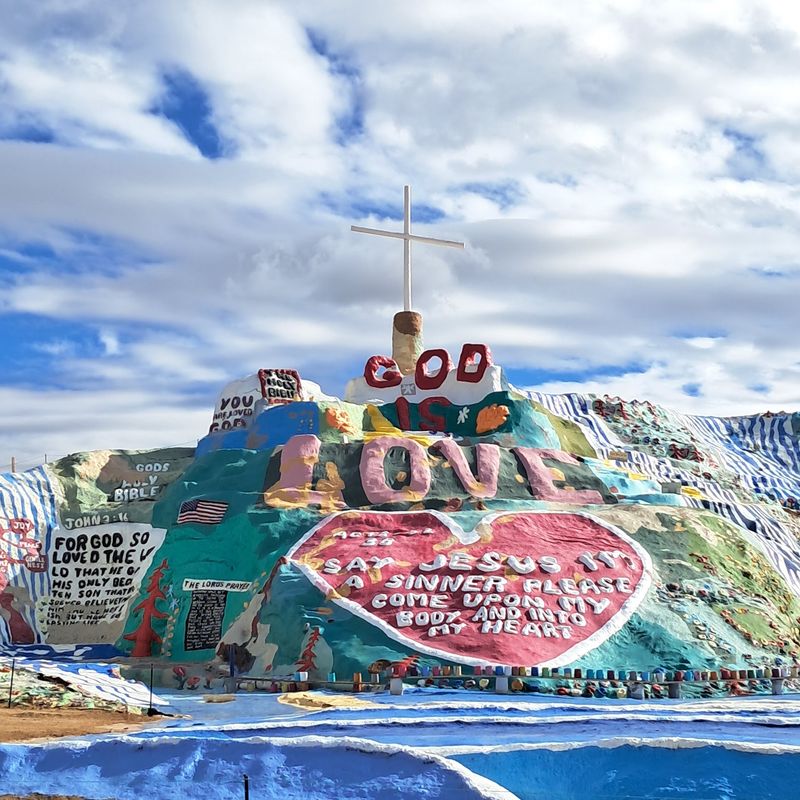
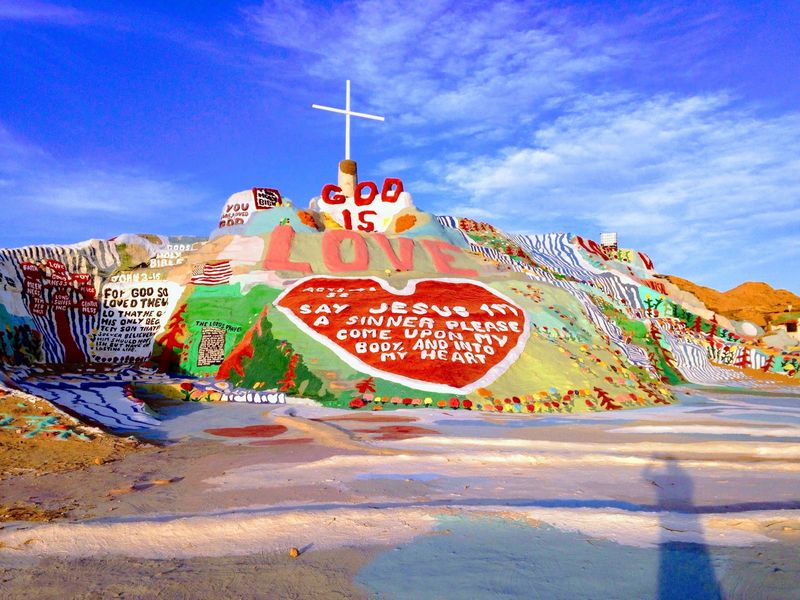
Roughly 100,000 gallons of donated paint went into one small hillside. Salvation Mountain rises right beside the entrance road, glowing pink, yellow, and robin-egg blue.
Leonard Knight spent close to thirty years shaping it from adobe mud, straw, and paint. His message was short and painted in giant letters across the slope: God is love.
Congress recognized the artwork as a national folk-art treasure. Not bad for a hill made of desert clay and hay bales.
Visitors may climb, but only on the painted yellow brick path. Those bright footpaths protect the fragile surface underneath.
Duck inside the Museum, a cave-like room held up by tree trunks, tires, and straw. Sunlight sneaks through the gaps and turns the colors into something close to stained glass.
Early morning brings soft light, cool air, and fewer people. Photographers who arrive before nine usually get the whole place to themselves.
Could you imagine dedicating thirty years of your life to painting one hill in the desert?
Volunteers keep the paint fresh, and gallons of latex paint make the best gift. Many travelers grab a can in Brawley on the drive out.
Admission is free, donations help, and the whole stop takes about an hour.
It may be the most photographed landmark in this stretch of California, and the reason most road trips start here.
East Jesus Sculpture Playground
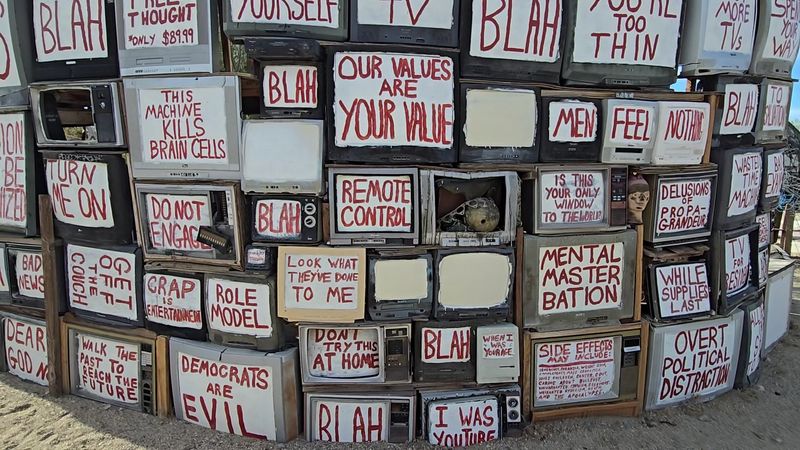
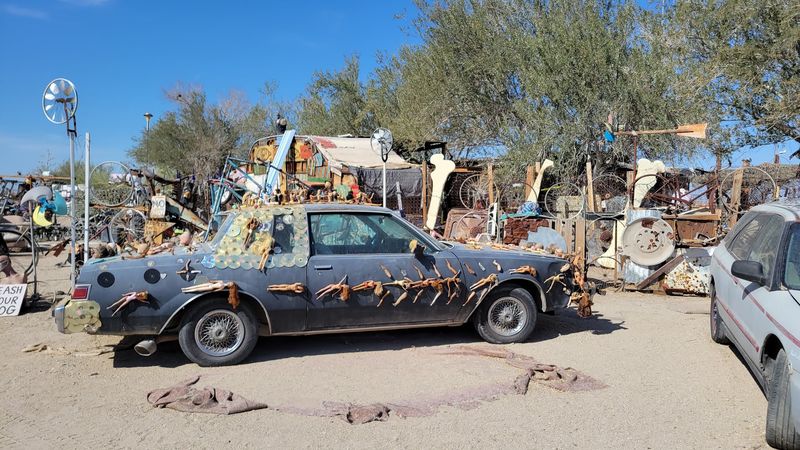
A wall of burnt-out televisions, each screen painted with a punchline about modern life, greets you near the entrance. Welcome to East Jesus, the wildest art yard in the desert.
Everything here is built from things other people threw out. Bottles, bowling balls, car parts, tires, teeth of old machinery, mannequin arms.
The name has nothing to do with religion. Out here, saying something is east of Jesus just means it is way past the middle of nowhere.
A registered nonprofit keeps the garden running, and resident artists live on site year-round. They welcome walk-in visitors during daylight hours.
Guided walks happen often, and the storytelling is half the fun. Sculptures get explained, rebuilt, retired, and replaced constantly.
Touching is sometimes encouraged, since several pieces make noise, spin, or clank when you interact with them. Just ask first.
Which would you rather photograph: a metal mammoth made of scrap or a piano growing out of the sand?
Donations keep the gates open, so drop something in the box on your way out.
Shade is limited, so a hat and a full water bottle make the visit far more comfortable.
Give yourself at least forty-five minutes. Rushing through means missing the tiny jokes hidden inside bigger pieces.
Nothing else in California looks quite like this, and no two visits ever show you the same garden twice.
Saturday Nights At Range
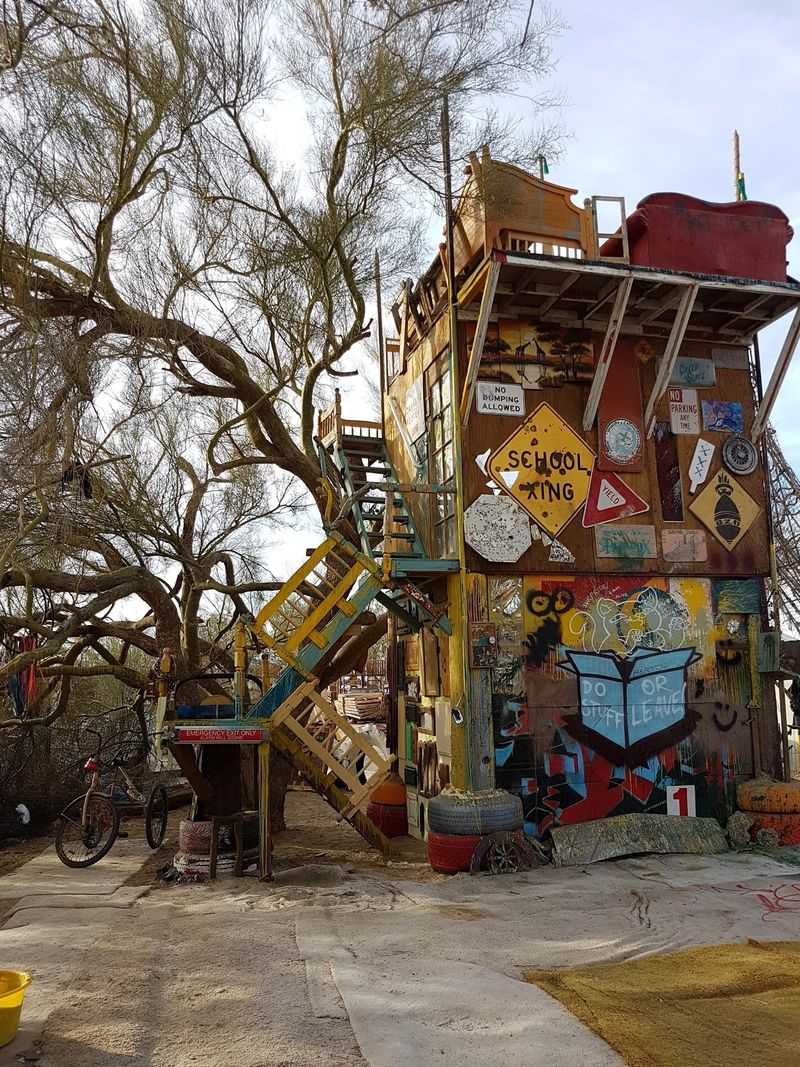
Old couches sit in rows on the sand, facing a stage cobbled together from two retired buses and salvaged lumber. This is The Range, the community living room.
Saturday night is showtime. Musicians plug in, poets step up, comedians test jokes, and dancers take over the plywood floor.
Anybody can sign up for the open mic. Talent level varies wildly, and honestly that is the charm.
Strings of lights flicker on as the sky turns orange and purple behind the Chocolate Mountains. Sound carries a long way across flat desert.
Seating is first come, first served, and the sofas are gloriously mismatched. Some visitors bring folding chairs and blankets instead.
Would you have the nerve to grab the microphone in front of a desert crowd of total strangers?
Winter shows draw the biggest audiences, when snowbird season fills the camps with hundreds of travelers.
Bring cash for the donation bucket, since performers and organizers run on generosity alone.
Nights get chilly fast once the sun drops, so pack a jacket even if the afternoon felt hot.
A flashlight or headlamp helps enormously afterward, because the roads have no streetlights at all.
Locals and visitors mix easily here, trading stories about road trips, van builds, and desert survival tricks.
For many travelers, this stage becomes the favorite memory of the whole trip through southern California.
Echoes Of Camp Dunlap
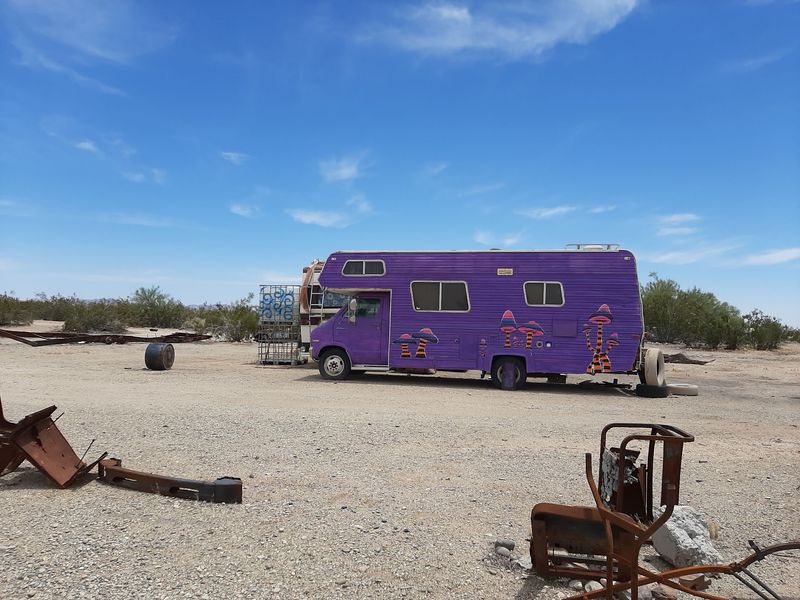
Back in October 1942, this quiet desert roared. The Marine Corps commissioned a training base here called Camp Dunlap, and it sprawled across roughly 250,000 acres.
Artillery crews and anti-aircraft units practiced under punishing sun. The heat and open ground made ideal preparation for overseas combat.
Engineers laid roads, water lines, sewer systems, and electrical service. For a few years, a full town hummed along out here.
By 1949 activity had dropped sharply, and by 1956 the buildings were gone entirely. Crews hauled away lumber, pipes, and wiring.
What they left behind was the concrete. Hundreds of foundation slabs, poured to last, sitting empty in the sand.
The land eventually returned to the State of California, and it has never been formally developed since.
Starting in the mid-1960s, veterans and travelers with campers noticed those free, flat, ready-made platforms. Word spread fast.
If you found hundreds of acres of free foundations in the desert, what would you build on yours?
Sharp-eyed explorers still spot old bunker remains, drainage channels, and rusted hardware half-buried nearby.
Watch your footing around abandoned concrete, and skip climbing on anything that looks unstable or fenced off.
Knowing the military history changes how the whole scene looks. Those slabs are not random, they are leftovers from a chapter of California and American history that quietly reinvented itself.
Library, Showers, Desert Comforts
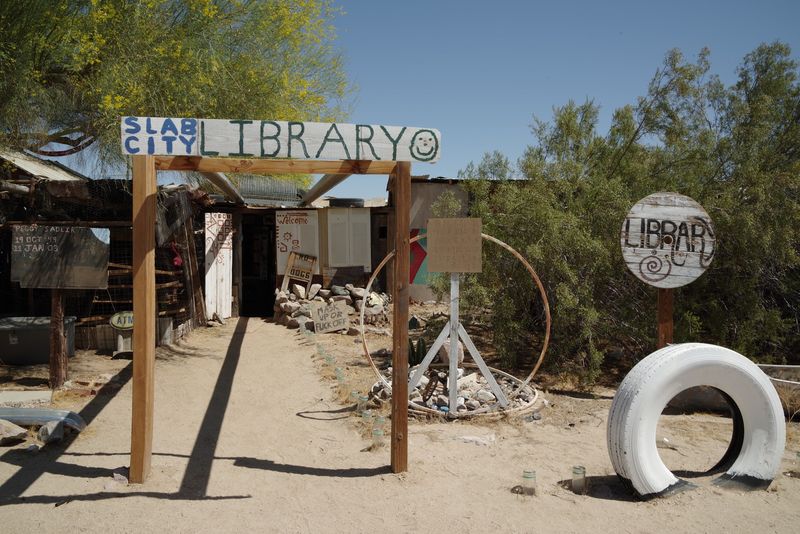
No power grid, no water pipes, no sewer, and yet somehow there is a library. Shelves packed with donated paperbacks sit inside a hand-built shack open to anyone.
Borrowing works on trust. Take a book, leave a book, nobody checks a card.
An internet cafe operates nearby, powered by solar panels and a whole lot of improvisation. Signal comes and goes with the weather.
Small churches hold services, and community pantries help neighbors share extra food during lean stretches.
A short drive away, a natural hot spring feeds a communal shower. Residents call it a small miracle in a place with no plumbing.
Solar panels shine on nearly every roof, paired with generators for cloudy days and hot nights.
Water arrives by truck, jug, and tank, hauled in from town and rationed carefully.
How long do you think you could last with only the water you carried in yourself?
Visitors should bring their own supplies rather than using community resources meant for people living here.
Trash goes home with you, since there is no pickup service anywhere on the slabs.
Donations of books, paint, batteries, and bottled water always get a warm welcome.
Seeing how much this off-grid community built from nothing gives you a new appreciation for every faucet and light switch back home in California.
Snowbird Season Fills Camps
Come November, the desert fills up. Thousands of travelers roll in with RVs, vans, and trailers, chasing warm winter weather and free camping.
They are called snowbirds, and many return to the same patch of sand year after year.
Retirees park beside artists, hikers, musicians, and long-haul road trippers. Conversations start easily around camp chairs.
Peak season runs roughly from October through April, when daytime temperatures feel closer to pleasant than punishing.
Potlucks, jam sessions, swap meets, and morning coffee circles pop up all over the community during those months.
Then spring arrives, the heat builds, and most vehicles disappear north within a couple of weeks.
Only about 150 hardy residents remain for summer, when readings above 120 degrees are not unusual.
Would you park your camper here for an entire winter, with no hookups and no bills?
First-timers should arrive with a full tank, plenty of water, and a level spot picked before dark.
Cell service is patchy, so download maps ahead of time and tell someone your plans.
Newcomers are usually greeted with directions, tips, and stories rather than suspicion.
That mix of independence and neighborliness explains why so many people keep driving back to this odd, sunbaked corner of California every single winter.
Pack Smart, Tread Kindly
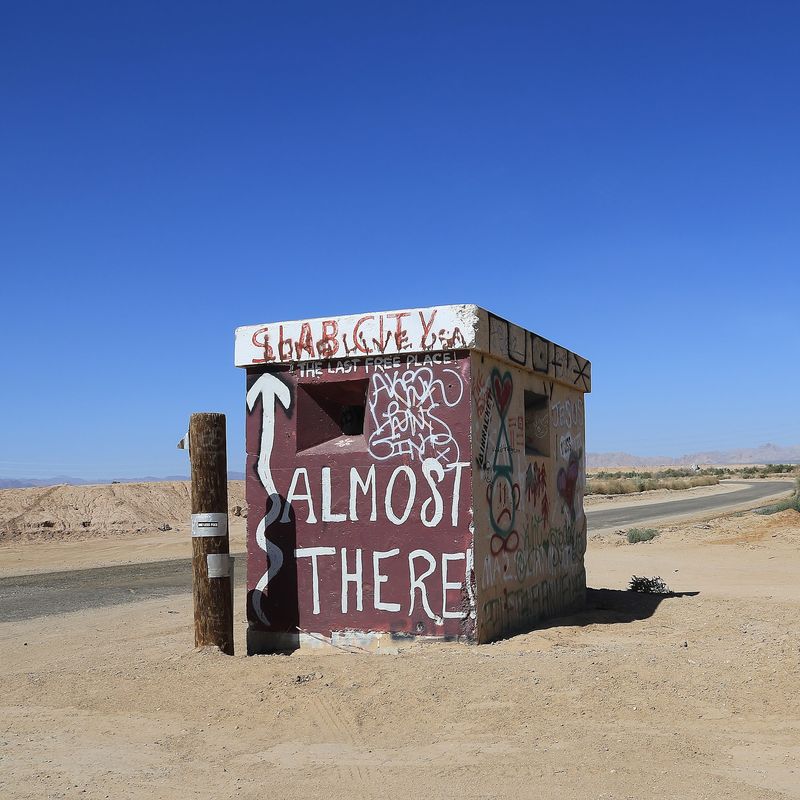
A little preparation turns this trip from stressful into unforgettable. Start with water, more than you think you need, plus sunscreen and a wide hat.
Fill your gas tank in Niland or Brawley, because there are no stations, stores, or ATMs on the slabs.
Carry small bills for donation boxes at the art sites and community projects.
Homes here look unusual, but they are still homes. Ask before photographing people or their property, and never wander onto a private slab.
Stick to main roads and well-known spots like the mountain, the art garden, and the stage.
Daytime is the friendliest time for first visits, and isolated areas after dark are best skipped entirely.
Summer heat is genuinely dangerous, so plan your trip between late fall and early spring.
What would you bring along as a thank-you gift for a community that shares everything it has?
Paint, bottled water, pet food, batteries, and books all get used immediately.
Leave no trash behind, keep music low near camps, and drive slowly on dirt roads.
Half a day covers the highlights, though many travelers stretch it into a full one.
Treat the visit like being invited into someone’s living room, and you will drive back out with the best kind of California story to tell.