
The Mississippi Back Roads, Cemeteries, And Ruins With Ghost Stories That Most People Have Never Heard
Some stories leave us speechless, others only deepen the mystery, and after visiting these Mississippi spots, you’ll probably start forming your own theories. Back roads here wind past cemeteries and ruins most people never even knew existed.
Headstones date back further than most visitors expect, some barely legible after decades of weather. Structures nearby stand quietly overtaken by nature, blurring the line between history and neglect.
Stories shift depending on who tells them, though certain details rarely change no matter the source. Nobody claims to have proof of anything supernatural, only feelings hard to explain once actually there.
Locals share these tales carefully, treating them as part of the area’s identity rather than tourist attractions. These places proved that sometimes the scariest stories are the ones nobody can fully confirm.
1. Stuckey’s Iron Bridge
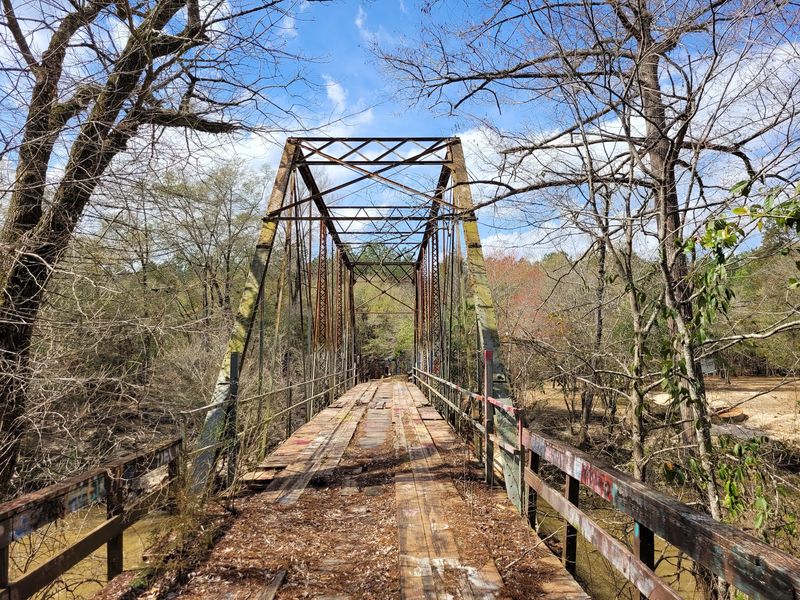
An iron truss bridge sitting over the Chunky River sounds harmless enough. Then you hear who it is named after.
Local legend tells of a man called Stuckey, said to have run an inn near the river in the 1800s and rumored to have ties to the Dalton Gang. Travelers stopped for the night, and according to the story, many never left.
The tale claims he robbed and hurt around twenty guests, burying them along the riverbank. When he was finally caught, he was hanged from the bridge that now carries his name, which is one way to be remembered forever.
Reports from the area describe a figure carrying a lantern along the water’s edge at night. Others claim to see a shape hanging beneath the bridge deck, visible only for a second.
The strangest detail involves sound. People describe a heavy splash in the river below, with nothing visible to explain it, and the story says it echoes the moment his body dropped.
The actual bridge is more interesting than the ghost, honestly. Built in 1901 by the Virginia Bridge and Iron Company, it is a genuine piece of engineering history with riveted steel and a narrow deck that feels impossibly tight for modern vehicles.
Cars no longer cross it. Foot traffic is allowed, and the surrounding woods stay quiet enough that footsteps on the boards carry a long way.
Getting there takes commitment. The route runs down winding country roads outside Enterprise, and cell service gets thin fast, so downloading directions ahead of time saves a lot of frustration.
Daylight visits are smarter for a first trip. The riverbank is uneven, the vegetation is thick, and Mississippi mosquitoes treat visitors like a buffet.
Photographers love the spot because the rust, the river, and the tree canopy create a strong frame no matter the season. Fall light hits it especially well.
Respect matters here since the bridge is fragile and historic. Look, listen, and leave everything exactly where it stands at 6170 Stuckey Bridge Road, Enterprise, MS 39330.
2. The Towers Of Natchez
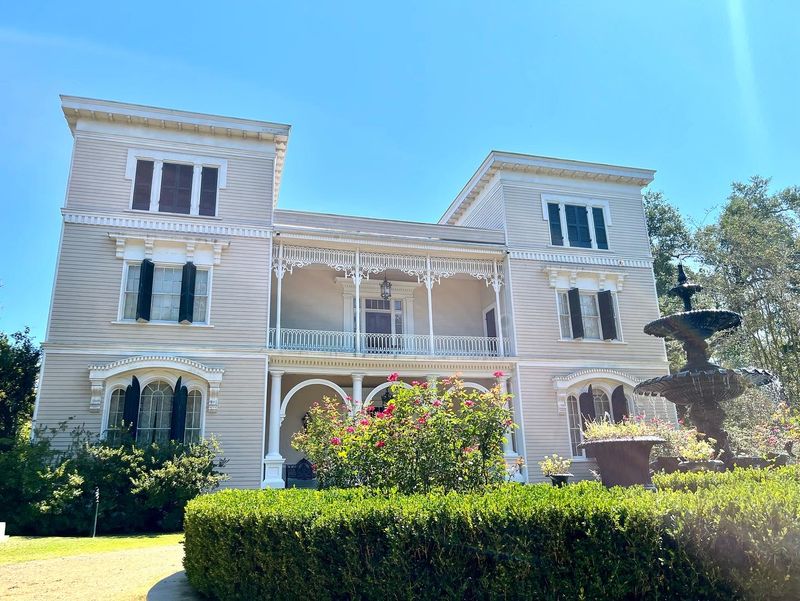
Few houses in Natchez have a construction timeline as odd as this one. Sections went up between 1798 and 1858, which means the building grew across three generations like a family that kept adding rooms and never stopped.
The result is an Italianate mansion with a distinctive tower, elaborate detailing, and a floor plan that reflects decades of changing tastes. Architecture fans notice the seams immediately.
During the Civil War, Federal troops used the property as a headquarters. Soldiers moved through the halls, orders were given, and the house absorbed a chapter of history that had nothing to do with its original owners.
That period feeds most of the ghost stories. Apparitions described as Federal soldiers have been reported near the grounds, appearing and vanishing without much drama.
Members of the Fleming family, who lived there in the 1800s, also turn up in the accounts. Their years in the house included real tragedy, and the stories tend to circle back to those losses.
Then there is the tower theory. Some people suggest the unusual vertical design somehow holds energy in place, a claim that sounds like nonsense until you stand under it at dusk.
Strange lights near the structure show up repeatedly in reports. So do figures glimpsed at windows when no one should be inside.
The house has undergone extensive restoration, and the interior showcases period furnishings, plasterwork, and details that reward slow looking. Natchez is packed with historic homes, but this one has personality.
Visiting works best combined with other stops in town since the historic district is compact and walkable. Parking near Myrtle Avenue is straightforward.
Photography from the sidewalk captures the tower nicely, especially in the golden hour when the brick warms up. Evening light flatters the ironwork too.
Skeptics still get value here because the craftsmanship alone justifies the trip. Believers get an extra layer of chills at 801 Myrtle Ave, Natchez, MS 39120.
3. Windsor Ruins
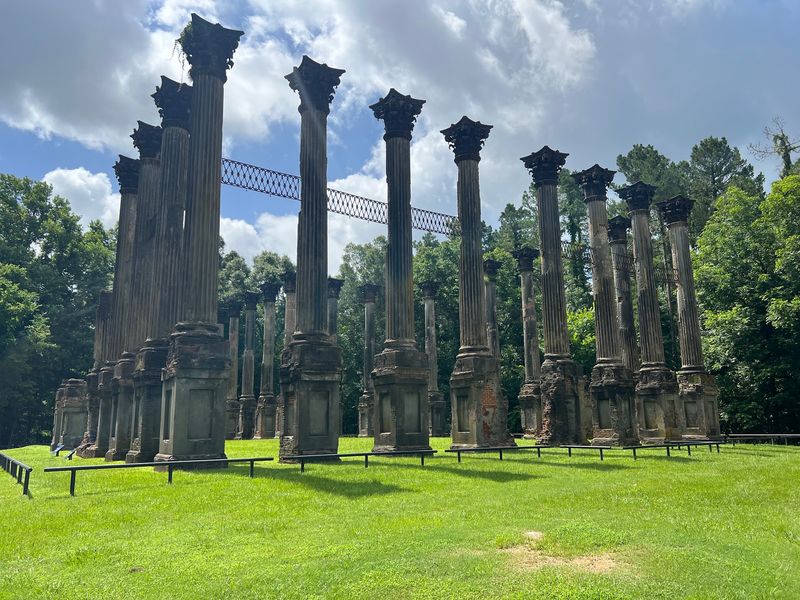
Twenty-three Corinthian columns stand in a Mississippi field with absolutely nothing between them. That image alone explains why filmmakers keep showing up.
The mansion they once supported was built between 1859 and 1861 for cotton planter Smith Coffee Daniell II. It had twenty-five rooms and a rooftop observatory, which was showing off even by antebellum standards.
Daniell passed away just weeks after the house was finished. He barely got to enjoy the place he spent a fortune building.
Union forces later used the site as an observation station and a field hospital. Hundreds of wounded soldiers were treated inside those walls, and the house saw more suffering than celebration.
Fire ended everything in 1890. A dropped cigar is the accepted culprit, which is a spectacularly small cause for such a large loss.
What survived is the colonnade and some iron balustrades. Vines climb the brick, cattle sometimes graze nearby, and the whole scene looks staged even though it is entirely accidental.
Ghost stories collected here run long. Daniell is said to pace between the columns as though still checking on his land.
A Union soldier reportedly hurt in the doorway is described as lingering near the front of the ruins. A figure known as the Woman in White appears in accounts near the northern edge, identified by some as a nurse and by others as a grieving Southern woman.
Sound plays a big role in the legends too. Phantom music, distant cannon fire, and marching footsteps show up again and again in the retellings.
The site has boardwalks and interpretive signage, so walking the perimeter is easy, and the columns stay protected. Sturdy shoes still help since the grass gets soggy after rain.
Late afternoon gives the best photos because the sun slips between the columns and throws long shadows across the field. Bring water, since shade is limited on Rodney Rd, Port Gibson, MS 39150.
4. Chapel Of The Cross Cemetery
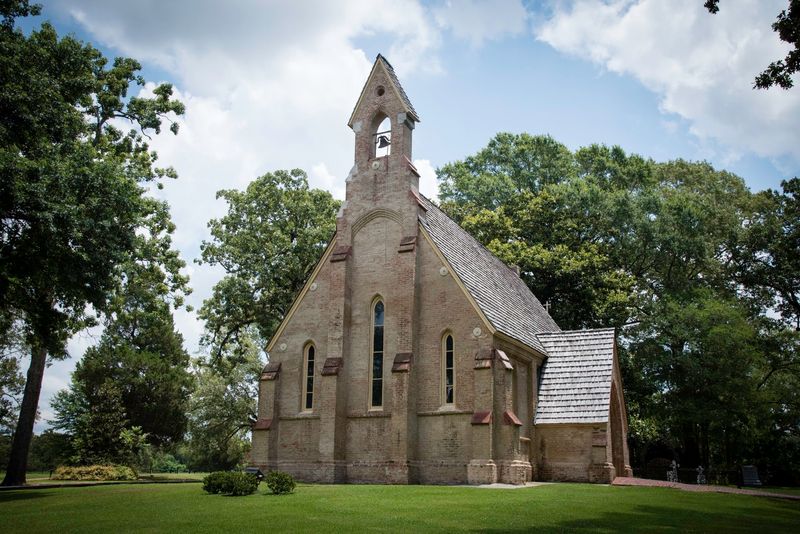
A wedding dress worn to a funeral is the kind of detail that sticks with people for a century and a half. That is the heart of the story here.
Helen Johnstone, daughter of the chapel’s founder, was engaged to Henry Grey Vick in 1859. Days before the wedding, Henry was hurt in a duel.
Heartbroken, Helen reportedly attended his funeral in the gown she was supposed to marry him in. Henry was buried in the churchyard, and Helen visited that grave for years afterward.
Generations of visitors have described a woman in white near his headstone. Sometimes she is sitting on a bench, sometimes standing quietly, always in the dress.
The chapel itself is a Gothic Revival brick building completed in 1855, and it is genuinely beautiful without any supernatural help. Pointed windows, dark wood, and a churchyard shaded by massive old trees.
Other accounts get stranger. Bloodstains are said to reappear on the chapel floor, connected to a tragedy involving a former caretaker.
Two children have also been reported, passing through an iron gate or perched in a tree before disappearing. Nobody has ever explained who they were.
The congregation is active, which matters a great deal for anyone planning a visit. Services, weddings, and funerals happen here regularly, so quiet respect is non-negotiable.
Mornings are the calmest time to walk the grounds. The light filters through the moss-draped branches and the whole churchyard feels like a painting.
Reading the headstones is worth the time since many go back to the mid-1800s and tell short, sad stories in a few carved lines. Rubbing or touching fragile stones is a bad idea.
History buffs come for the architecture and stay for the romance. Ghost hunters come for Helen and end up appreciating the craftsmanship at 674 Mannsdale Rd, Madison, MS 39110.
5. Rose Hill Cemetery
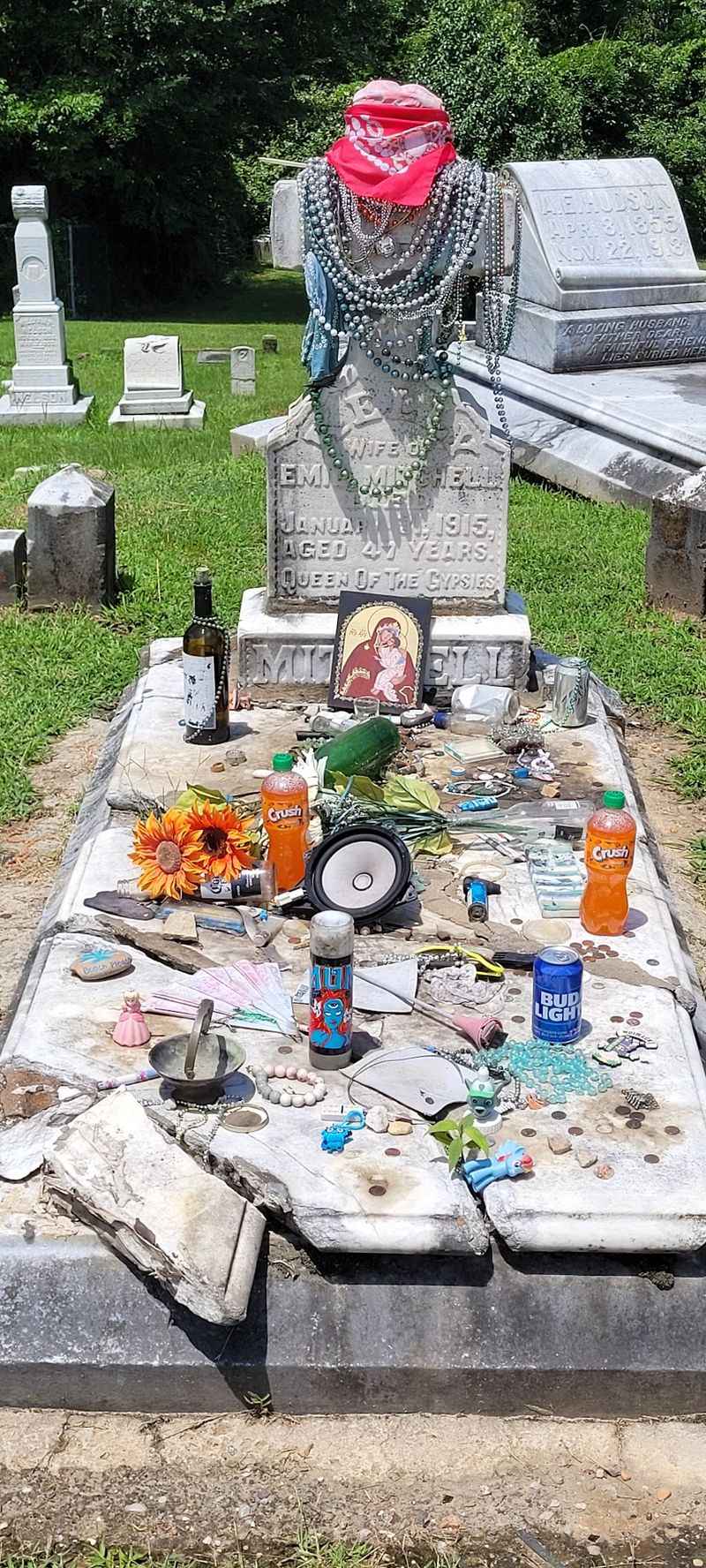
Twenty thousand people showed up for a funeral in Meridian in 1915. The woman being buried was Kelly Mitchell, known as the Queen of the Gypsies.
Her husband Emil, the King, is buried beside her. Their graves remain the most visited spot in the cemetery, and people still leave offerings on the stones.
Coins, beads, small trinkets, and handwritten notes collect there. Visitors seeking guidance or luck have kept the tradition going for over a century.
Rose Hill opened in 1853 and holds city founders, war veterans, and a Confederate burial mound containing more than a hundred soldiers. The layout rolls across gentle hills with Victorian monuments scattered throughout.
Official tours focus on history rather than hauntings, which is a refreshingly honest approach. The local legends still circulate anyway.
One involves a figure called the white witch of Rose Hill. Some identify her as Miss Sarah Norton, a midwife whose funeral was supposedly interrupted by a storm and wandering livestock.
Her spirit is described as drifting between the tombstones. Nobody agrees on the details, which is how the best legends work.
Another account describes a procession of figures moving through the grounds, vanishing the moment anyone got close. That story gets repeated often enough that it has become part of the cemetery’s identity.
Meridian treats the place as a genuine heritage site rather than a spooky attraction. Preservation work and guided history walks happen throughout the year.
Walking the paths takes a while since the grounds are large and the older sections have uneven footing. Comfortable shoes make a real difference.
Photographers should note the ironwork on family plots and the carved details on the Victorian markers, which are far more elaborate than most people expect. Overcast days actually work better for detail shots.
Leaving something small at the Mitchell graves is customary, but taking anything is deeply frowned upon at 701 40th Ave, Meridian, MS 39307.
6. Mount Holly Plantation
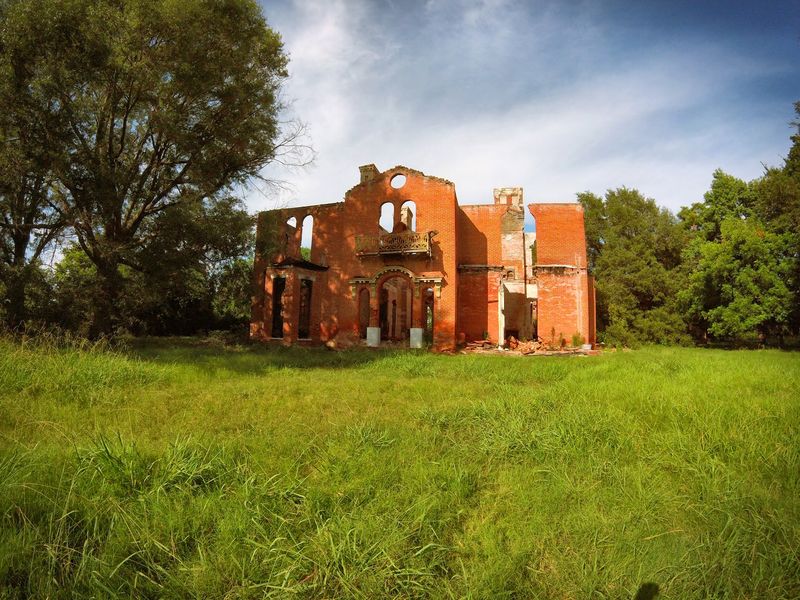
Novelist Shelby Foote wrote a book inspired by this house, and his ancestors were connected to the property. That detail alone puts Mount Holly on the literary map.
The mansion went up in 1855 and 1856, an Italianate giant with thirty-two rooms overlooking Lake Washington in the Delta. It was built for Margaret Johnson, one of the largest slaveholders in the state, who freed the people she enslaved before the Civil War.
The architecture drew attention for decades. Deep porches, tall windows, and interior details that belonged in a much larger city.
Then came 2015. Fire destroyed the house, leaving brick fragments and blackened beams where thirty-two rooms used to be.
What remains is a ruin in the truest sense. No roof, no floors, just outlines and scorched material sinking slowly into Delta soil.
Stories from the years before the fire keep circulating. A baby grand piano in the parlor was said to play on its own, notes drifting through empty rooms.
During one historical tour, a door reportedly slammed shut with no wind to explain it. A figure was seen running away immediately afterward, and nobody could identify who it was.
The property sits in a stretch of the Delta where the landscape stays flat and open, with Lake Washington nearby and cotton fields stretching in every direction. The drive alone shows a side of Mississippi most travelers skip.
Access is limited since the ruins are on private land and structurally unsafe. Viewing from the public road is the responsible move.
Photographers still get striking images from a distance because the surviving brick stands out sharply against the flat green horizon. Sunrise light in the Delta is hard to beat.
Preservation groups have documented the site extensively, and old photographs of the intact house are worth looking up before any visit. Comparing them to the ruins hits harder than expected near 1835 Lake Washington Rd E, Hollandale, MS 38748.
7. Friendship Cemetery
Nearly three thousand Confederate soldiers who passed away after the Battle of Shiloh in 1862 were buried in Columbus. Most of their names were never recorded.
Friendship Cemetery opened in 1849 and became one of the oldest and most significant burial grounds in Mississippi. Local citizens, soldiers, and prominent families share the same shaded acres.
The military section is where the ghost story lives. A Confederate soldier is described as walking those rows, appearing calm rather than threatening.
People who report him say he simply moves between the graves and then is gone. No dramatic flourishes, no cold spots, just a figure in uniform.
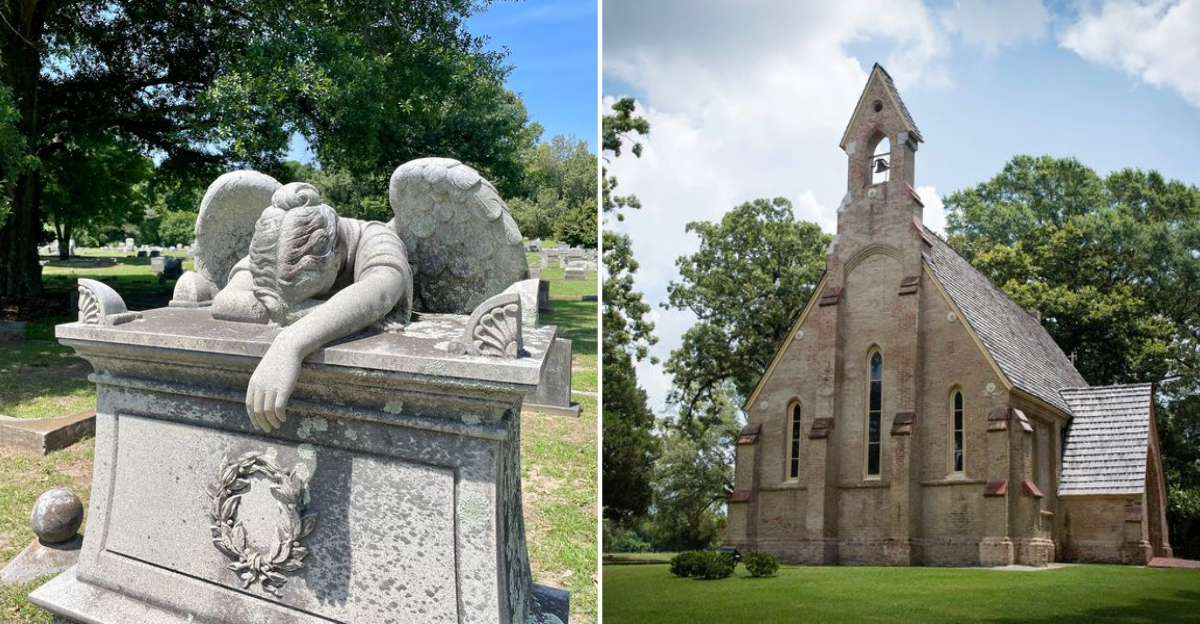
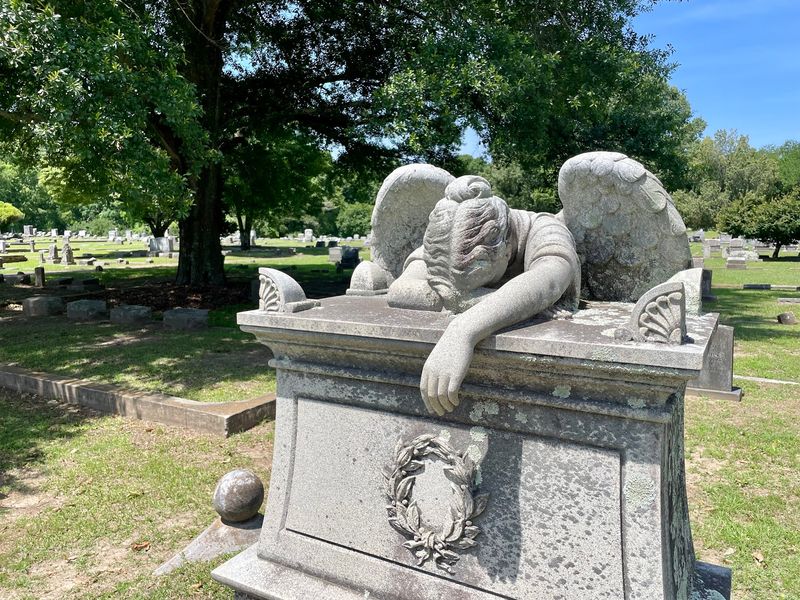
The other famous feature is a weeping angel carved over the grave of Reverend Thomas Teasdale. It is a genuinely gorgeous piece of funerary sculpture.
Visitors who take the angel’s hand sometimes describe the stone as feeling warm and oddly lifelike. Marble does hold heat on a Mississippi afternoon, but the sensation still catches people off guard.
Beyond the legends, the cemetery has real historical weight. The tradition of decorating both Union and Confederate graves here contributed to the origins of Memorial Day observances in the United States.
The grounds are laid out with winding paths, mature oaks, and family plots enclosed by cast iron fencing. Monument styles range from simple slabs to elaborate Victorian sculpture.
Columbus itself is worth exploring afterward since the downtown has well-preserved architecture and a walkable historic district. The cemetery pairs naturally with that route.
Spring brings azaleas and dogwoods into bloom across the grounds, which softens the whole atmosphere considerably. Autumn brings better light for photos.
Guided walks are offered periodically and cover the history rather than the hauntings, which suits the place. The stories tend to surface on their own anyway.
Quiet behavior is expected since burials still take place here. Park along the street and enter on foot at 4th St S, Columbus, MS 39701.