
8 Areas In New York Where Meteorites Have Actually Fallen From Space

Space has been sending things to New York for centuries, and the state has not always seen them coming.
Rocks from outer space, arriving without warning, landing in backyards and farm fields and at least one very unlucky parked car that had absolutely nothing to do with any of this.
Eight areas across the state have the kind of cosmic history that makes local lore feel significantly more dramatic than it already did.
Some meteorites announced themselves loudly enough that entire towns heard the impact and went looking. Others sat quietly in the ground for years before someone picked one up and realized it was not from anywhere nearby.
Not nearby in the way that a neighboring county is not nearby. Nearby in the way that the nearest star is not nearby.
New York has always had a flair for the unexpected, but the moments that came from outside the atmosphere entirely deserve their own category. Outer space, it turns out, has been paying attention to this state for a very long time.
1. Peekskill

On October 9, 1992, a space rock decided to park itself in someone else’s parking spot in Peekskill, New York.
The meteorite crashed straight through the trunk of a red 1980 Chevrolet Malibu owned by Michelle Knapp, who was sitting inside her house when she heard the crash.
She probably did not expect her evening to end with a call about a rock from space.
What makes Peekskill truly extraordinary is the documentation. Sixteen separate video recordings captured the fireball as it blazed across the sky, filmed by fans taping high school football games that night.
That makes this one of the most well-documented meteorite falls in United States history, and honestly, the most dramatic parking lot story ever told.
The meteorite, classified as an H6 monomict breccia, weighed 12.57 kilograms, which is roughly 27.7 pounds. It contained about 20% nickel-iron and had slowed to approximately 164 miles per hour before impact.
That is still fast enough to punch clean through a car trunk, as Michelle Knapp discovered firsthand.
The car was parked near the coordinates 41 degrees 17 minutes N, 73 degrees 54 minutes W, in a quiet Peekskill neighborhood. After the event, both the car and the meteorite were purchased and toured internationally as a pair.
The Peekskill meteorite became one of the most recognized space rocks on the planet, and the Malibu became the world’s most famous victim of a cosmic fender-bender.
If you ever feel unlucky about a dent in your car, just remember it probably did not come from 250 miles above Earth’s surface.
2. Seneca Falls

Seneca Falls, New York, is best known for its role in the history of women’s rights, but long before any conventions were held there, something far older arrived from the cosmos.
In 1850, a 4-kilogram iron meteorite classified as Iron, IIIAB, was found in the area.
Nobody saw it fall, making it what scientists call a find rather than a witnessed fall.
The coordinates for the Seneca Falls meteorite are recorded at 42 degrees 55 minutes N, 76 degrees 47 minutes W. Iron meteorites like this one are especially fascinating because they are thought to come from the cores of ancient, shattered asteroids.
Basically, someone in 1850 stumbled upon a chunk of an asteroid’s heart, which is either deeply poetic or just really heavy, depending on your perspective.
IIIAB is one of the most well-studied iron meteorite groups. These space rocks formed billions of years ago in the molten cores of proto-planets before those bodies broke apart in collisions.
Finding one in upstate New York means that a piece of early solar system history was just sitting in a field waiting to be noticed.
The fact that no one saw it fall means it could have been resting there for years, decades, or even longer before someone picked it up. That kind of quiet arrival is almost more impressive than a dramatic fireball.
Not every space rock needs a grand entrance. Seneca Falls has always been a place where history shows up in unexpected ways, and this meteorite fits right into that tradition.
It is a heavy little reminder that the universe has been paying attention to this small town for a very long time.
3. Schenectady

Most people discover damage to their roof after a storm. Joseph W.
Kowalski discovered his after a meteorite. On April 12, 1968, around 8:30 PM Eastern time, a stony meteorite came screaming through the night sky above Schenectady, New York, and made itself at home on Kowalski’s property.
He found the fragment two days later when he noticed something had punched through his roof.
The Schenectady meteorite is classified as an H5 ordinary chondrite and weighed 283 grams. It was recovered in Glenville, near Schenectady, at coordinates 42 degrees 51 minutes 39 seconds N, 73 degrees 57 minutes 1 second W.
The fragment was later donated to the Schenectady Museum, where it became a prized piece of the collection and a genuine conversation starter.
H5 chondrites are among the more common types of stony meteorites, but finding one on your roof is anything but ordinary. The fact that Kowalski noticed the damage and connected it to the meteorite fall so quickly is a small miracle in itself.
Most people would have blamed squirrels.
Schenectady is a city with a rich history in science and technology, home to the famous General Electric research labs. So it feels oddly fitting that a piece of space science landed right on top of a local home.
The city has always had a thing for big discoveries, even when those discoveries arrive uninvited through the ceiling.
If you are ever passing through upstate New York, Schenectady deserves more credit than it usually gets, especially now that it has a certified cosmic credential to its name.
4. Bethlehem

Few meteorite stories come with a dog as a supporting character, but Bethlehem, New York, delivers exactly that.
On August 11, 1859, at around 7:20 in the morning, a small stone fell at the residence of Mr. Garritt Vanderpool, about seven miles from Albany and one mile west of Bethlehem church.
A dog on the property reportedly tried to grab the rock but quickly dropped it because of its warmth and strong sulphurous smell. Even dogs have standards.
The meteorite was a single stone weighing just 13.9 grams, classified as an H6 ordinary chondrite. Its revised coordinates are 42 degrees 34 minutes 40 seconds N, 73 degrees 49 minutes 20 seconds W.
Roughly 8 grams of the original stone are preserved in the New York State Museum in Albany, making it one of the few meteorites in New York with a confirmed institutional home.
H6 chondrites are highly metamorphosed stony meteorites, meaning they spent a long time being heated inside a parent body before being knocked loose and eventually landing on Earth.
The fact that only 13.9 grams survived recovery tells you how small and fleeting this cosmic visit really was. It is remarkable that any of it was preserved at all.
The New York State Museum at 222 Madison Avenue in Albany holds this meteorite in its collection, which means you can technically go visit a piece of space that once confused a dog. The Bethlehem meteorite may be tiny, but its story packs a serious punch.
It is proof that even the smallest arrivals from space can leave a lasting impression, on science and on household pets alike.
5. Cambria

Way back in 1818, long before most of New York looked anything like it does today, someone in Cambria stumbled upon a hefty chunk of iron that had no business being there.
The Cambria meteorite is classified as an ungrouped iron meteorite, meaning scientists have not been able to match it to any known family of iron meteorites.
It is essentially a space rock with no known relatives, which is either mysterious or just very independent.
The meteorite weighed approximately 16.3 kilograms, making it one of the more substantial space rocks ever recovered in New York.
Iron meteorites are already denser and heavier than most stony varieties, so 16.3 kilograms of extraterrestrial iron is genuinely impressive.
Whoever found it in Cambria must have been very confused about why the ground was hiding something that heavy.
Ungrouped iron meteorites are particularly valuable to scientists because they represent parent bodies that have not yet been identified. Every ungrouped meteorite is a clue pointing toward a lost chapter of solar system history.
The Cambria meteorite, sitting quietly in the record books since 1818, is one of those rare clues that has never been fully decoded.
Cambria is a town in Niagara County in western New York, and most people passing through would never guess it has a connection to outer space.
But the ground there once held a piece of iron forged in the core of an ancient asteroid billions of years before humans existed.
That is the kind of fact that makes a quiet town feel a whole lot bigger. Not every landmark has a sign, and Cambria’s most extraordinary one has been hiding in plain sight since the early 1800s.
6. Tomhannock Creek
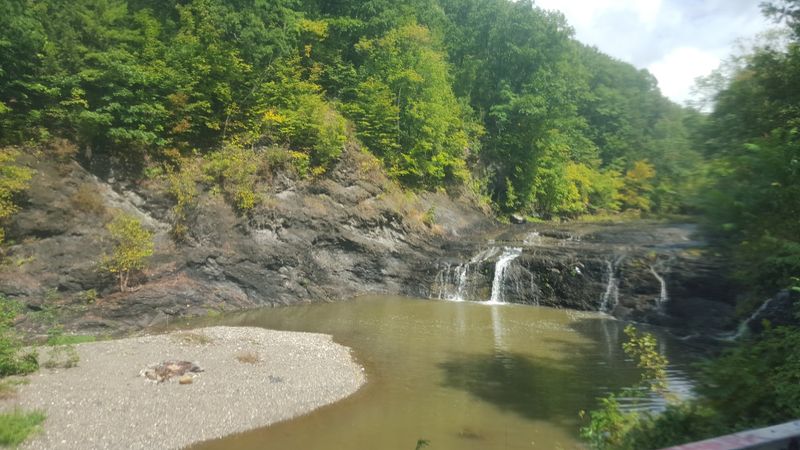
Rensselaer County, New York, earned its spot in the cosmic record books back in 1863, when an H5 chondrite meteorite was found near Tomhannock Creek. The meteorite weighed 1,500 grams, which is 1.5 kilograms, making it a reasonably solid specimen by any standard.
It was a find rather than a witnessed fall, so nobody was watching when it arrived, but it showed up nonetheless.
Like the Bethlehem meteorite, the Tomhannock Creek specimen is part of the New York State Museum’s collection in Albany. Having two meteorites from the same state in one museum collection is actually a notable distinction.
The New York State Museum at 222 Madison Avenue in Albany holds both of these space rocks, which means their collection quietly punches above its weight in the meteorite department.
H5 chondrites are stony meteorites that have been moderately heated and recrystallized inside their parent asteroids.
They are common in the grand scheme of meteorite classification, but finding one along a creek bed in upstate New York in 1863 was anything but routine.
The person who found it probably had no idea they were holding a piece of the early solar system.
Tomhannock Creek itself is a tributary of the Hoosic River in eastern New York, a peaceful and largely rural area that feels a world away from the chaos of space. That contrast is part of what makes this story so satisfying.
A quiet creek, a curious rock, and suddenly you are connected to events that happened billions of years before the first human ever walked on Earth.
Sometimes the universe delivers its greatest gifts to the most unassuming places, and Tomhannock Creek is living proof of that.
7. Mount Morris
Good things really do come in small packages. The Mount Morris meteorite, found in 1897 in Mount Morris, New York, weighed just 12.5 grams, which is lighter than most smartphones.
Despite its modest size, it is classified as an H5 ordinary chondrite and holds a spot in the New York State Museum’s collection, which means it earned its place among the state’s most notable space rocks.
Mount Morris is a small village in Livingston County in western New York, surrounded by the kind of quiet countryside that makes you forget the outside world exists. Finding a meteorite in that kind of setting in 1897 must have felt like a genuinely surreal moment.
There were no smartphones to film it, no social media to post it on, just a person, a field, and a rock that traveled millions of miles to land right there.
H5 chondrites like this one are characterized by well-defined chondrules, which are small spherical structures that formed in the early solar system before planets even existed. Every H5 meteorite is essentially a time capsule from the birth of our solar neighborhood.
The Mount Morris specimen may be tiny, but its scientific story is enormous.
The New York State Museum in Albany, at 222 Madison Avenue, keeps this small traveler in its collection alongside other New York meteorites. It is a fitting home for a rock that spent billions of years drifting through space before landing in upstate New York.
Size is not everything in the meteorite world, and Mount Morris is the best possible argument for that point. Small, unassuming, and completely out of this world.
8. Yorktown

September 1869 was a busy month for Yorktown, a town in Westchester County, New York. While most people were going about their post-Civil War lives, a 250-gram L5 chondrite meteorite came dropping out of the sky and made history.
The coordinates for the fall are recorded at 41 degrees 17 minutes N, 73 degrees 49 minutes W, placing it squarely in the rolling hills of Westchester County.
L5 chondrites are stony meteorites that have experienced significant thermal metamorphism inside their parent asteroids. They are part of the Low iron group of ordinary chondrites, which makes them a bit lighter in composition than their H-type cousins.
At 250 grams, the Yorktown meteorite is not the biggest space rock to land in New York, but it is one of the few confirmed witnessed falls, meaning someone actually saw it come down.
Yorktown today is a suburban community known for its parks, historical sites, and connection to Revolutionary War history. Adding a meteorite fall to that resume gives the town a rather impressive timeline.
Not many places can claim battles, history, and a certified piece of the solar system all in the same zip code.
What makes the Yorktown fall especially interesting is its timing. The late 1860s were a period when meteorite science was still developing as a formal field of study.
A witnessed fall in 1869 would have been genuinely exciting for the scientific community of the era.
Westchester County has always been known as a place where interesting things happen, and on one September morning in 1869, the sky itself decided to contribute to that reputation in the most literal way possible.