
7 Scenic Mississippi Hikes Where Forgotten Antebellum Estates And Lost Ghost Towns Still Stand
A long week of staring at screens always leaves me craving the quiet stillness of the woods. Finding a trail that offers both physical release and a glimpse into forgotten history turns a simple weekend walk into an unforgettable journey.
The quiet forests of Mississippi hold these exact kinds of secrets beneath their thick green canopies. Crumbling brick columns from grand old homes now stand swallowed by wild vines right next to the dirt paths.
Further along the trail, the empty wooden shells of old shops show where a bustling river town used to be. The damp earth smells of pine needles and old timber that has rested there for a century.
Walking through these silent spaces puts the daily stress of modern life into immediate perspective. Nature has a beautiful way of turning human history into a peaceful sanctuary.
1. Clark Creek Natural Area
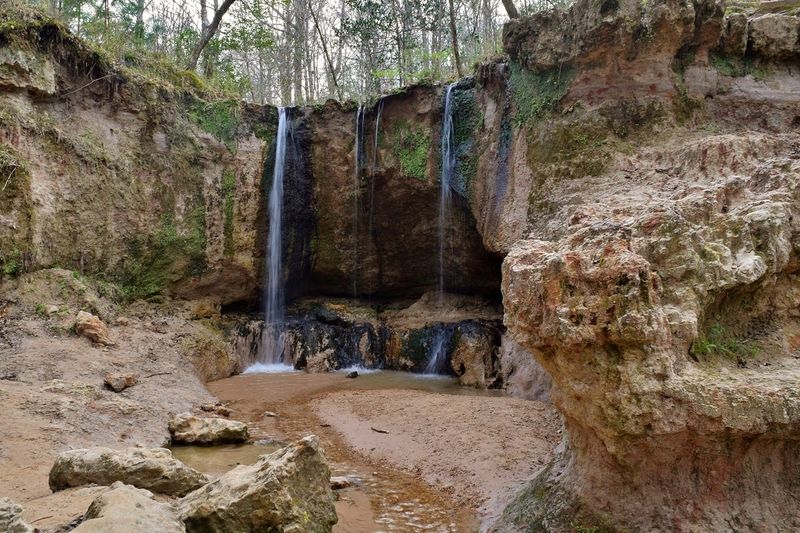
Nobody talks about Clark Creek enough, and honestly, that is a crime. This natural area near Woodville hides more than 50 waterfalls inside its wild, tangled landscape.
Some drop just 10 feet. Others crash down more than 30 feet in full dramatic fashion.
The trails here are not Sunday strolls. Expect steep climbs, slippery rocks, and creek crossings that will test your balance.
Wear proper hiking shoes because sandals will betray you fast.
Southern magnolias grow thick throughout the forest, filling the air with a faint sweetness. Chipmunks dart across the trail like tiny hyperactive locals.
Bird calls echo constantly, making it feel alive in every direction.
What makes this hike special is how remote it feels. You can go an entire morning without seeing another soul.
Just you, the waterfalls, and the sound of rushing water bouncing off sandstone bluffs.
The geology here is rare for Mississippi. Sandstone layers create natural shelves and overhangs that feel almost prehistoric.
Ferns and mosses cling to every wet surface, giving the whole place a lush, almost jungle-like texture.
If you visit after rain, the waterfalls are absolutely roaring. The creeks swell, and the whole forest seems to wake up.
Just be careful because trails get slick fast after wet weather.
Photographers love this spot for good reason. Every turn reveals a new waterfall framed by green canopy.
You will use your entire camera roll before finishing the first mile. Bring snacks, bring layers, and plan for at least three hours.
Find it located at 366 Ft Adams Pond Rd, Woodville, MS 39669.
2. Emerald Mound
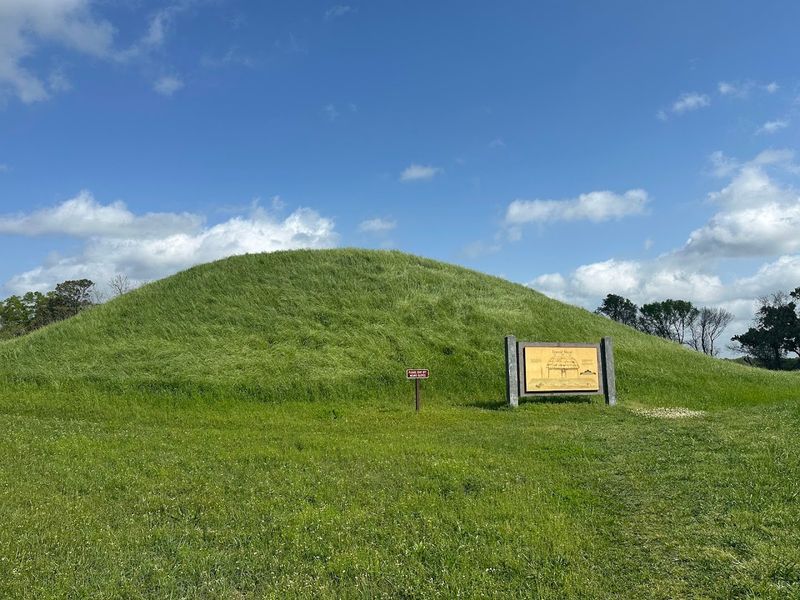
Standing on top of Emerald Mound genuinely makes your brain do a double-take. This thing is enormous.
It rises 35 feet high and covers eight full acres at its base, making it the second-largest pre-Columbian earthwork in the entire United States.
The Natchez Indians used this site as a major ceremonial center starting around 1200 CE. They shaped this massive mound entirely by hand.
No machines, no cranes, just human labor over generations.
Walking up the slope gives you a real sense of scale. The view from the top stretches across open fields and tree lines in every direction.
It is quiet up there in a way that feels intentional.
Historians believe the mound supported smaller temple mounds on its flat summit. Two of those secondary mounds are still partially visible today.
You can walk around the top and trace where ancient structures once stood.
The site was actively used until around 1730 CE, which means this is not some dusty ancient relic. People gathered, celebrated, and conducted ceremonies here within the last few centuries.
That detail hits differently when you are standing on the grass.
Emerald Mound sits right along the Natchez Trace Parkway, making it an easy stop during any road trip through the region. Access is free, parking is simple, and the walk up takes only a few minutes.
Kids love climbing it because it looks like a giant grassy hill. Adults love it because the history is genuinely staggering once you understand what you are looking at.
Find it at Emerald Mound Rd, Natchez, MS 39120.
3. Vicksburg National Military Park
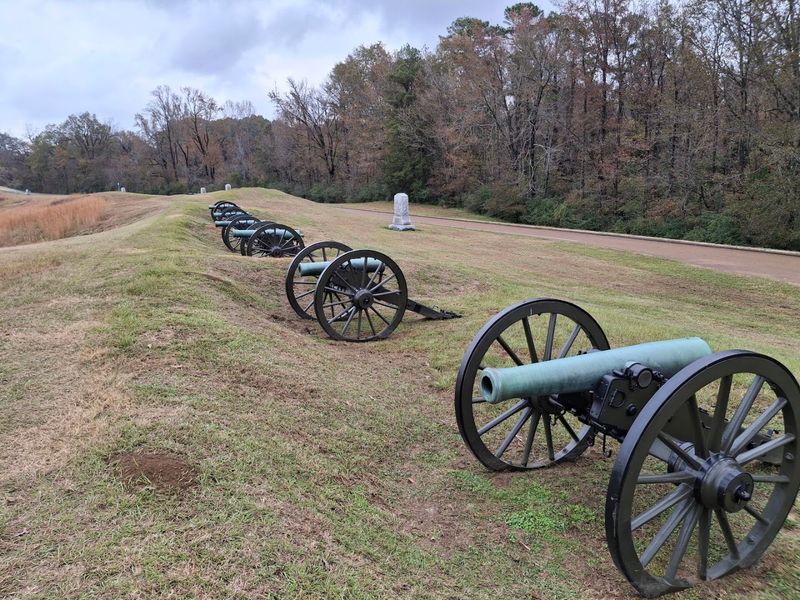
Vicksburg National Military Park is one of those places that grabs you before you even finish parking. The scale of it is almost incomprehensible.
Over 1,300 monuments, markers, and tablets spread across miles of preserved battlefield terrain.
The 47-day siege here in 1863 was one of the most brutal chapters of the Civil War. Thousands of soldiers lost their lives fighting for control of the Mississippi River.
The city eventually surrendered on July 4th, a date Vicksburg did not celebrate for decades afterward.
Visitors consistently report strange experiences along the old siege lines. Some say they hear distant sounds that have no clear source.
Others mention an odd smell, like gunpowder, drifting through the air on still days.
The Shirley House still stands inside the park, and it is the only original wartime structure that survived the conflict. Walking past it feels oddly personal.
You can imagine families huddled inside while artillery echoed outside.
The park also preserves the USS Cairo, a Civil War ironclad gunboat raised from the Yazoo River in 1964. It is the only surviving example of its kind in the world.
The museum attached to it tells the story of river warfare in remarkable detail.
The driving tour covers about 16 miles of winding road through the park. You can also hike or bike sections of the route.
Each stop reveals a different piece of the battle’s complicated story.
Bring patience and curiosity because this place rewards both. There is always one more marker, one more cannon, one more story hiding around the bend.
Find it at 3201 Clay St, Vicksburg, MS 39183.
4. Natchez Trace Parkway
The Natchez Trace Parkway is one of America’s most underrated road trips, and it doubles as a hiking destination that most people completely overlook.
Stretching 444 miles through Mississippi, Alabama, and Tennessee, this corridor has been a travel route for thousands of years.
Native Americans walked it first. Then traders, soldiers, and pioneers followed those same footsteps.
Today, you can hike preserved sections of the original path and feel that layered history under your feet.
The parkway is commercial-free by law. No billboards, no fast food signs, no gas stations cluttering the views.
Just forest, rolling hills, and the occasional historic pull-off that begs you to stop and explore.
Wildlife is everywhere along this route. White-tailed deer graze near the road at dawn.
Red-tailed hawks circle lazily above open meadows. During spring, wildflowers line the shoulders in colors that feel almost too bright to be real.
Historic sites dot the entire length of the parkway. Ancient mounds, Civil War landmarks, and early settler traces appear regularly along the way.
Each one adds another layer to the story of this ancient corridor.
The Mississippi section alone offers dozens of hiking opportunities at various pull-offs. Trail lengths vary from short interpretive walks to longer wilderness routes.
You can tailor your adventure based on how much time and energy you have.
Cycling is also hugely popular here because the road is smooth and traffic moves slowly. Many people combine hiking, cycling, and driving into one long weekend.
5. Windsor Ruins
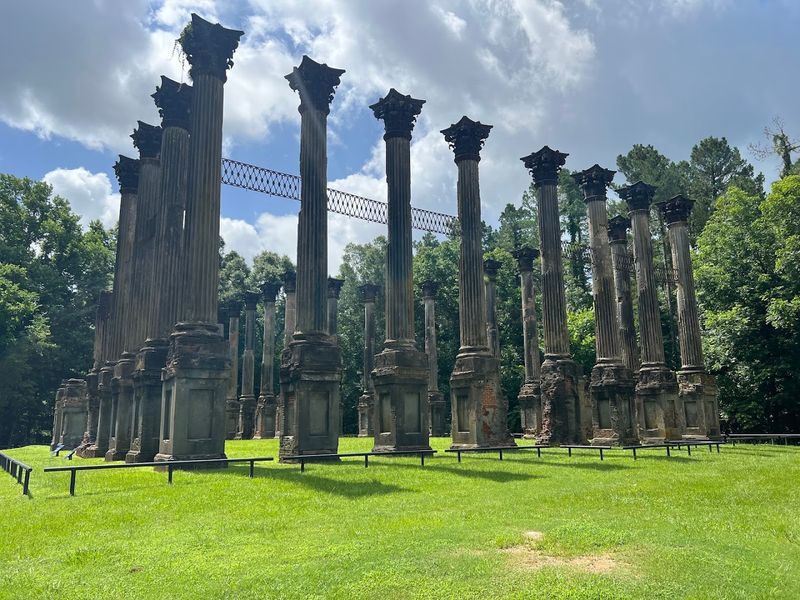
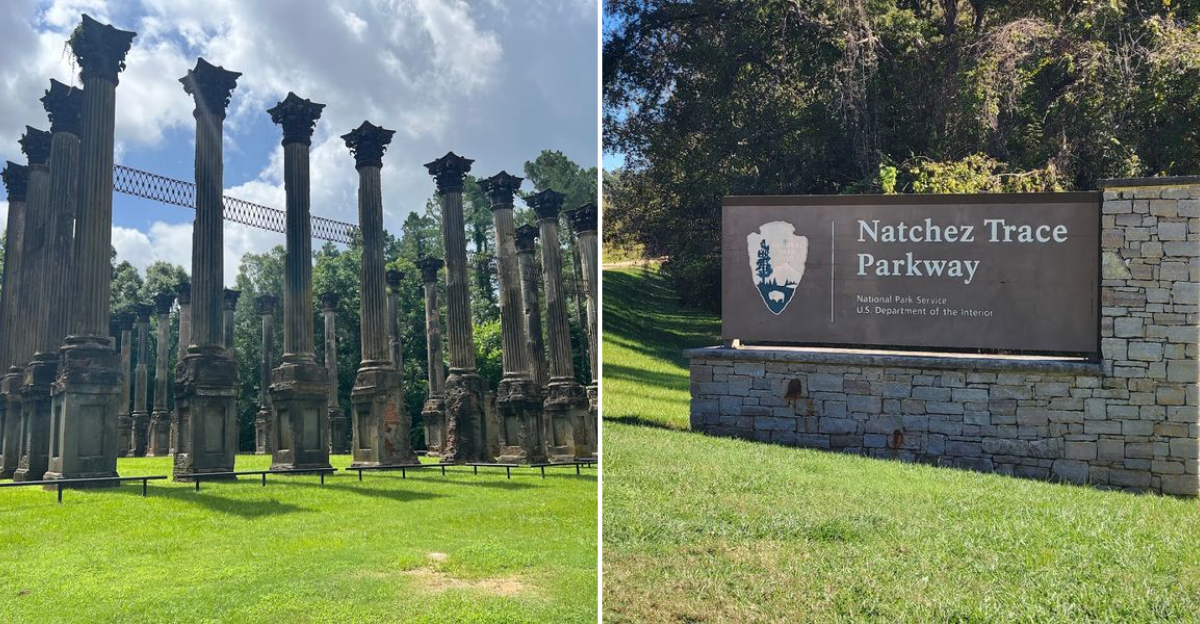
Twenty-three massive Corinthian columns rising from a Mississippi forest are not something your eyes expect to process. Yet there they are at Windsor Ruins, standing like sentinels over a story that ended in fire and never fully recovered.
Windsor was the largest Greek Revival mansion in Mississippi when it was completed between 1859 and 1861. The main house had five floors and featured cast-iron balconies on every level.
It was genuinely breathtaking by any era’s standards.
Then in 1890, an accidental fire started by a careless guest reduced the entire structure to ash in a single night. Only the 23 columns survived.
They have stood here ever since, slowly being reclaimed by vines and time.
The columns are massive up close. Each one rises about 45 feet tall and was crafted with great architectural skill.
Walking among them gives the whole site a feeling that people love comparing to Stonehenge, and honestly, the comparison earns it.
What many visitors miss is the deeper history embedded in this site. Enslaved people built Windsor with their labor and skill.
Their stories are woven into every stone, every column, every inch of what remains standing.
The surrounding forest has grown thick around the ruins over the decades. Spanish moss drapes from nearby trees, adding to the atmosphere without needing any help.
Photographers make pilgrimages here specifically for golden hour shots between those columns.
There is no admission fee to visit. The site is accessible and relatively easy to walk around.
Plan your visit during cooler months to avoid the mosquitoes that claim the area in summer. Visit it located at Rodney Rd, Port Gibson, MS 39150.
6. Grand Gulf Military State Park
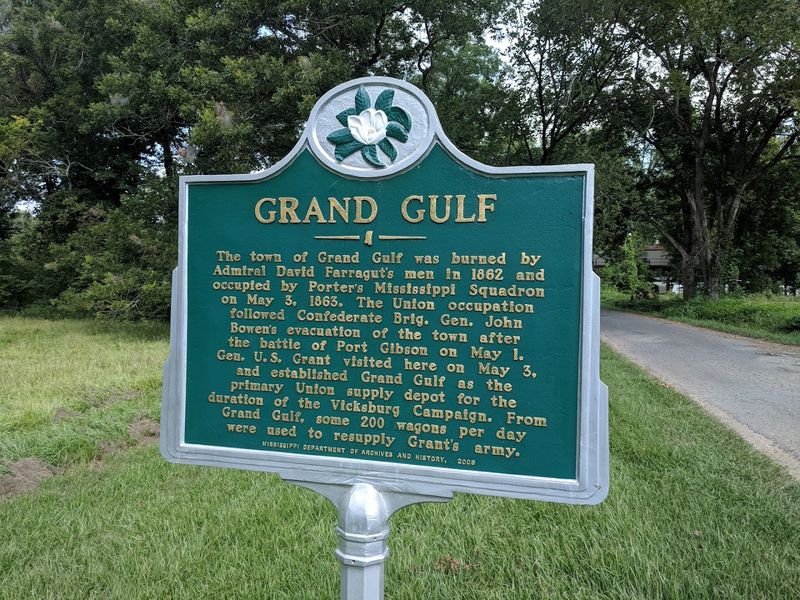
Grand Gulf was once one of the busiest ports on the Mississippi River. Ships lined its docks, merchants crowded its streets, and the town buzzed with commerce and ambition.
Then the Civil War arrived and changed everything.
The park preserves the earthworks of Fort Cobun and Fort Wade, two Confederate fortifications that played a key role in the Vicksburg Campaign. General Grant attempted to land troops near here in April 1863.
The Confederate guns pushed him back, at least temporarily.
After the war, the river itself finished what the fighting started. Flooding and channel shifts gradually swallowed the old townsite.
Buildings slid into the water. Streets disappeared under silt.
Grand Gulf became a ghost town not through abandonment but through geography.
Walking the park today, you can still trace the outlines of those earthen forts. The trenches and embankments are remarkably well preserved.
Standing inside them, you get a vivid sense of what soldiers experienced during the bombardment.
The museum on site is genuinely impressive for a state park of this size. It holds Civil War artifacts, antique equipment, and historical photographs that document the town’s rise and fall.
The Spanish House is one of the oldest structures still standing in the area.
A historic cemetery sits within the park grounds, shaded by old trees and surprisingly peaceful. Many of the graves belong to soldiers and early settlers who helped build this community before it vanished.
Picnic areas and river views make this a great half-day stop. The combination of military history and ghost town atmosphere is hard to beat anywhere in Mississippi.
Visit at 12006 Grand-Gulf Rd, Port Gibson, MS 39150.
7. Rocky Springs Trail
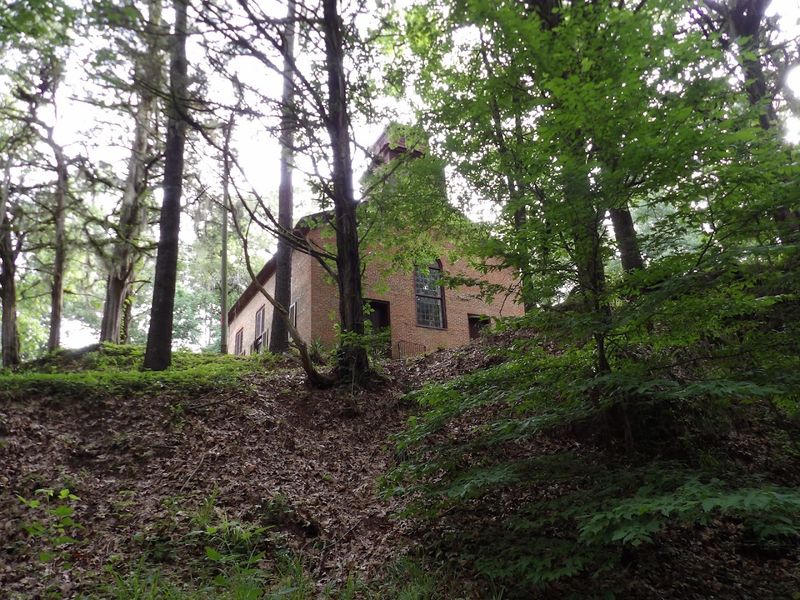
Rocky Springs is the kind of ghost town that sneaks up on you. One minute you are hiking a quiet forested loop.
The next, you are standing in front of an 1837 Methodist church that still has its original walls and a cemetery full of weathered headstones.
This community once had over 2,600 residents in its prime during the mid-1800s. It had stores, homes, a post office, and all the energy of a growing Southern town.
Then everything started falling apart at once.
Yellow fever tore through the population in repeated waves. The Civil War disrupted trade and the economy.
Then the boll weevil destroyed the cotton crops that the town’s survival depended on. Rocky Springs did not stand a chance against all three hitting back to back.
By the early 1900s, the community was essentially empty. Nature moved in quickly after the last residents left.
Trees grew through foundations, vines covered walls, and the forest reclaimed almost everything within a few decades.
The trail itself is a comfortable loop that most hikers finish in about an hour. Interpretive signs placed along the route explain what each remaining structure was and who used it.
Reading them while standing among the ruins makes the history feel immediate and real.
The church is the undisputed highlight. It sits in a small clearing, surrounded by old oaks, looking both abandoned and somehow still dignified.
The adjacent cemetery holds graves dating back to the early 1800s, some barely readable now.
Camping is available nearby at the Rocky Springs campground, making this a perfect overnight destination. Pack your curiosity alongside your gear.
The trailhead is at Natchez Trace Pkwy, Hermanville, MS 39086.