
The New Mexico Road Trip That Leads Through Ghost Towns Red Rock Landscapes And Stunning White Sands
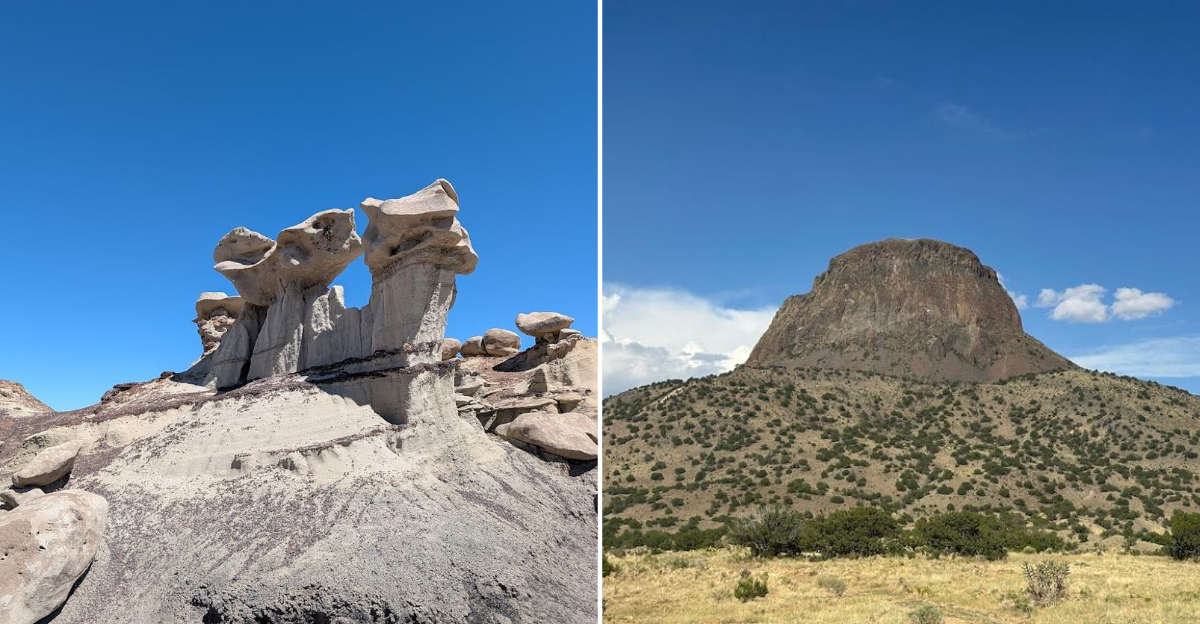
Silica and oxidized iron take turns dominating the horizon as the pavement yields to wilderness. This southwestern asphalt ribbon pulls drivers through three distinct geological eras over the course of a single afternoon.
Wind-scoured mining frames stand like skeletal monuments on the parched hillsides. They whisper stories of silver rushes that faded away a century ago.
Suddenly, the gray sagebrush vanishes as towering crimson formations hem in the two-lane highway. These jagged stone monoliths swallow the midday glare before releasing it as a deep, radiating warmth.
Just when your eyes adjust to the intense rust tones, the world goes blindingly pale. Bleached gypsum dunes ripple toward the horizon like frozen ocean waves.
New Mexico wraps these contrasting environments into one continuous loop. It leaves little room for monotony behind the wheel.
1. The Mine Shaft Tavern
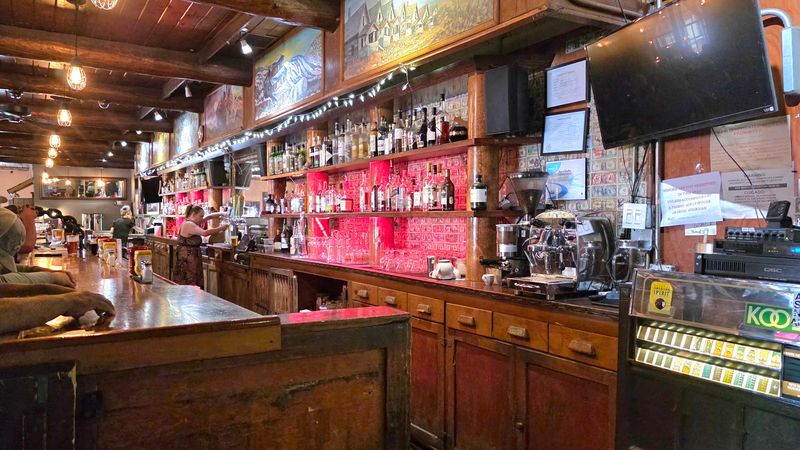
Madrid used to be a full-on ghost town in the 1950s, and honestly, it still carries that haunted energy. The Mine Shaft Tavern is one of the oldest continually operating taverns in New Mexico.
It was rebuilt in 1947 after a Christmas Day fire wiped out the original.
Walk inside and the first thing you notice is that massive 40-foot lodge pole pine bar. It was built specifically for coal miners who needed to unwind after brutal shifts underground.
The whole place hums with that old-school grit you just cannot manufacture.
Locals will tell you without hesitation that this is the most haunted spot in Madrid. Glasses reportedly fall on their own.
Doors swing open with nobody nearby. Whether you believe in ghosts or not, the atmosphere alone is worth the stop.
The tavern also doubles as a live music venue on weekends. Local bands fill the room with sound, and the crowd gets lively fast.
It is the kind of place where strangers start talking and end up swapping road trip stories for hours.
Right next door, you can pop into the Madrid Old Coal Town Museum. It tells the full story of this quirky little town that refused to stay empty.
Madrid went from abandoned mining settlement to thriving arts community, and that transformation is genuinely fascinating.
The surrounding area along NM-14, also called the Turquoise Trail, is scenic enough to justify a slow drive. Pull over, take photos, breathe in the high desert air.
This stretch of road delivers big on character and charm at every single turn. Find this spot at 2846 NM-14, Madrid, NM 87010.
2. Casa Grande Trading Post
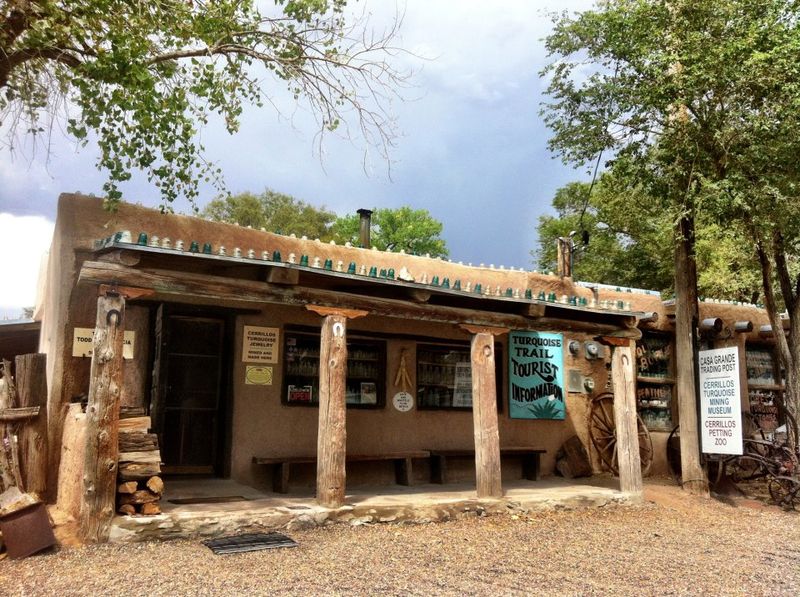
Not every road trip stop has a petting zoo, a turquoise mine museum, and handmade jewelry all in one spot. Casa Grande Trading Post in Los Cerrillos is genuinely one of a kind.
It sits along the scenic Turquoise Trail and pulls you in before you even park the car.
The building itself is a 28-room adobe hacienda, and here is the wild part. Todd and Patricia Brown molded every single one of those 65,000 adobe bricks by hand.
That level of dedication to a place is rare, and you can feel it in every wall.
Los Cerrillos has a long history tied to turquoise mining, stretching back centuries. Native American tribes, Spanish colonists, and later American settlers all came here chasing that green stone.
The trading post honors that legacy with a small but fascinating mining museum on site.
The jewelry sold here is made from Cerrillos turquoise, which has its own distinct green hue. It looks different from the blue turquoise you see everywhere else.
Picking up a piece feels like taking home a slice of actual New Mexico history.
Do not skip the petting zoo in the back. There are goats and a llama who are very enthusiastic about meeting visitors.
Kids go absolutely wild for it, and honestly, so do most adults.
The whole environment feels like a living Old West village rather than a tourist trap. Everything here has a story and a purpose.
It is the kind of stop that makes your road trip feel richer and more memorable long after you drive away. Visit it at 17 Waldo St, Los Cerrillos, NM 87010.
3. Lincoln Historic Site
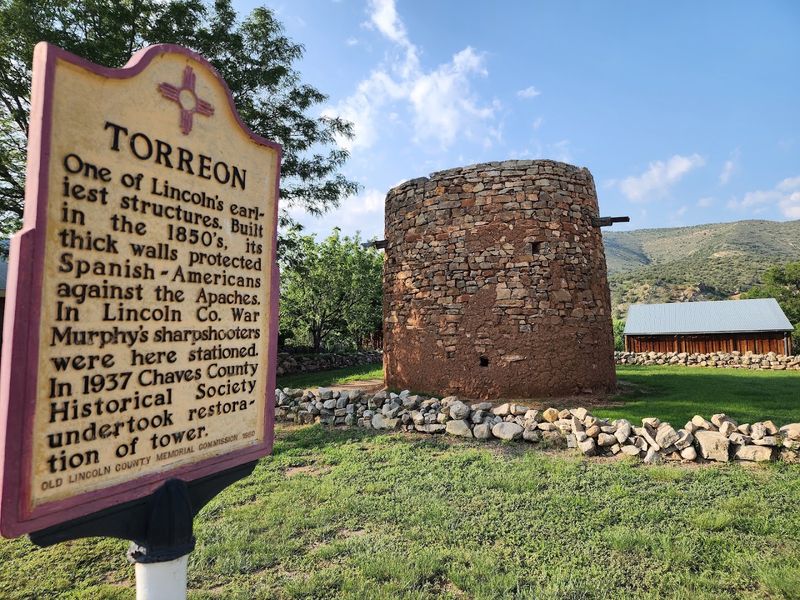
President Rutherford B. Hayes once called the main street here the most dangerous street in America.
That is quite a reputation for a small New Mexico town. Lincoln Historic Site preserves that wild, lawless era better than almost anywhere else in the West.
The town became ground zero for the Lincoln County War in the late 1870s. It was a violent conflict over land, cattle, and power between rival factions.
Billy the Kid rose to notoriety right here, and his legend soaks into every adobe wall.
Walking down the main street feels genuinely different from other historic sites. No chain restaurants or souvenir mega-stores are cluttering the view.
The town looks remarkably close to how it did during its most dangerous days.
Lincoln includes 17 historic structures that you can actually explore. The Old Lincoln County Courthouse is a must-see.
Billy the Kid made a dramatic escape from that very building in 1881, and the bullet holes are still visible.
The Tunstall Store is another highlight. It was owned by John Tunstall, whose death essentially sparked the Lincoln County War.
Standing inside, you get a real sense of how tense and volatile life was here back then.
History lovers will want to spend at least half a day here. The site is managed by the New Mexico Historic Sites division.
Rangers and staff do a great job bringing the stories to life without making it feel like a dry history lecture.
Plan your visit around the annual Billy the Kid Pageant in August. It is a community event that reenacts the escape and draws crowds from across the country.
The address is 1027 Calle La Placita, Lincoln, NM 88338.
4. Ghost Ranch
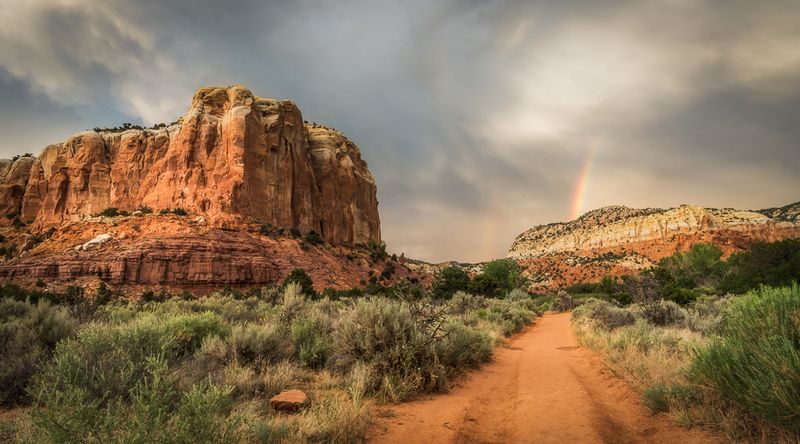
Georgia O’Keeffe spent decades painting at Ghost Ranch, and once you see it, you completely understand why. The cliffs here glow in shades of red, orange, and yellow that shift with every hour of sunlight.
No painting fully captures it, but she came closer than anyone.
Ghost Ranch covers 21,000 acres near Abiquiu, and it operates as an education and retreat center. Guided tours take you to the exact spots where O’Keeffe set up her easel.
Standing in those locations with the cliffs looming overhead is genuinely moving.
Before it was an artist’s paradise, the ranch had a darker reputation. Cattle rustlers used the remote canyon lands to hide stolen herds.
Local legends about ghosts and strange happenings gave the place its memorable name.
The ranch also has two impressive museums. One focuses on anthropology and the region’s indigenous history.
The other is dedicated to paleontology, because Ghost Ranch sits on one of the richest dinosaur fossil sites in North America.
Coelophysis fossils were found here in massive numbers. This small, fast dinosaur is now the official state fossil of New Mexico.
Seeing the exhibits gives the landscape an extra layer of deep, prehistoric wonder.
Hiking trails wind through the property and offer views that feel almost unrealistic. The Chimney Rock Trail and Box Canyon Trail are both popular options.
Each one rewards you with scenery that sticks in your memory long after the trip ends.
Ghost Ranch welcomes visitors year-round, though spring and fall offer the most comfortable temperatures for exploring. The elevation keeps things cooler than you might expect in the desert.
Find it at 280 Private Drive 1708 Highway, US-84, Abiquiu, NM 87510.
5. Bisti/De-Na-Zin Wilderness
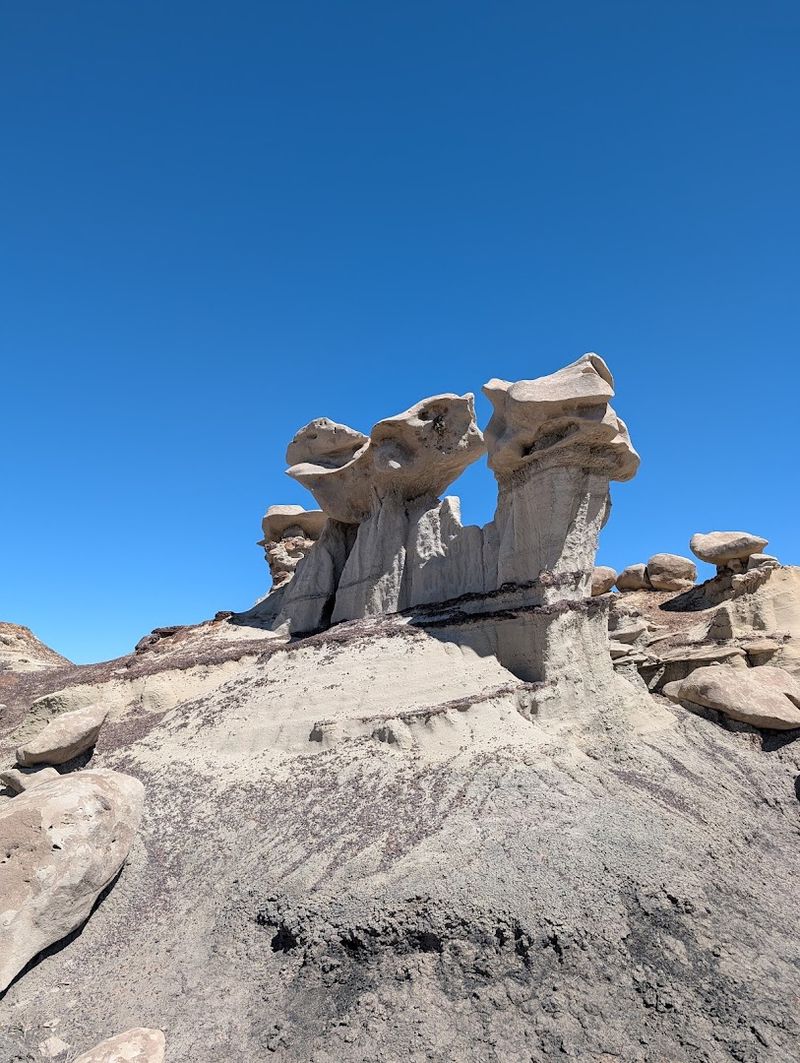
If someone told you this place was on another planet, you might actually believe them for a second. Bisti/De-Na-Zin Wilderness looks like nothing else in the American Southwest.
The eroded badlands create shapes so strange and beautiful that your brain takes a moment to process them.
The wilderness covers about 45,000 acres in northwestern New Mexico. Colorful hoodoos, twisted spires, and mushroom-shaped rock formations rise from the cracked earth.
Every direction you look offers a completely different and equally bizarre composition.
The name comes from the Navajo language. Bisti means large area of shale hills.
De-Na-Zin means cranes, referring to the petroglyphs of cranes found in the area.
Millions of years ago, this landscape was a lush coastal swamp near an ancient inland sea. Dinosaurs roamed here, and their bones got buried in the sediment.
Today, you might stumble across petrified wood or fossil fragments just lying on the surface.
There are zero marked trails in this wilderness. That is intentional.
The experience is designed to be raw, unstructured, and genuinely wild. Bring a compass or download an offline GPS map before you head in, because getting turned around is easy.
Early morning and late afternoon light transform the colors dramatically. The hoodoos glow gold and purple during golden hour in a way that feels almost theatrical.
Photographers make special trips here just for those fleeting windows of perfect light.
Water and shade are essentially nonexistent out here. Pack more water than you think you need.
Wear sun protection and sturdy shoes, because the terrain is uneven and sharp in places. The address is County Road 7297, Bloomfield, NM 87413.
6. Cabezon Peak
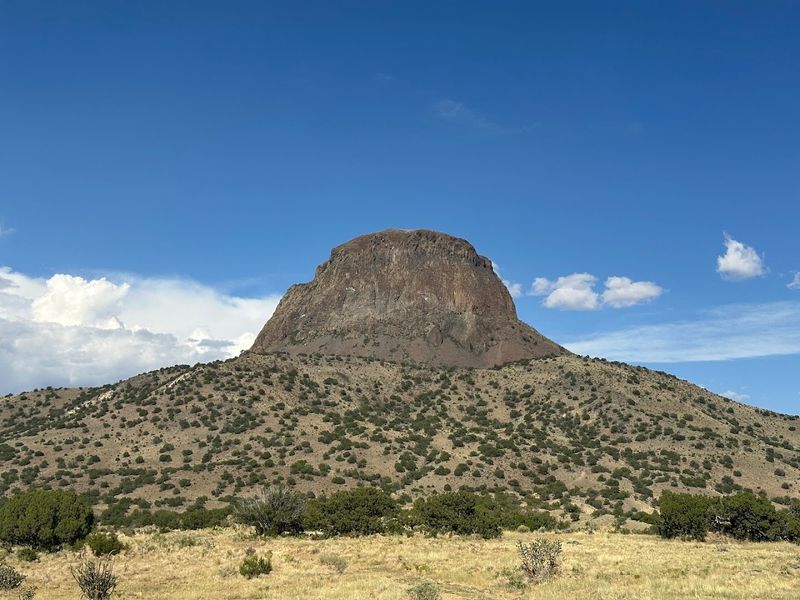
Cabezon Peak is the kind of geological feature that stops you mid-sentence when you first spot it from the road. This massive volcanic plug rises dramatically from the flat desert floor of the Rio Puerco Valley.
Nothing around it comes close to matching its scale or presence.
The name means big head in Spanish, which is perfectly fitting. Navajo tradition says it is literally the severed head of a giant slain by Hero Twins in a sacred story.
That legend gives the peak a mythological weight that makes standing near it feel different.
Cabezon is the largest volcanic neck in a region full of them. The surrounding area is dotted with similar formations, but none command attention the way Cabezon does.
It formed millions of years ago when magma hardened inside a volcano, and the outer rock slowly eroded.
The hike to the summit is not casual. It is challenging, steep, and requires solid experience with scrambling on rocky terrain.
The elevation sits close to 8,000 feet, and the exposure near the top can catch you off guard.
Views from the summit stretch across northern and central New Mexico in every direction. On clear days, you can see major mountain ranges and volcanic formations scattered across the horizon.
The effort to get up there is absolutely worth every step.
Wildlife in the area includes raptors that nest on the peak’s sheer walls. Golden eagles are occasionally spotted riding thermals above the summit.
Watching one glide past at eye level is a moment you do not forget quickly.
Start your hike early to avoid afternoon heat and wind gusts near the top.
7. Chimney Rock Trailhead
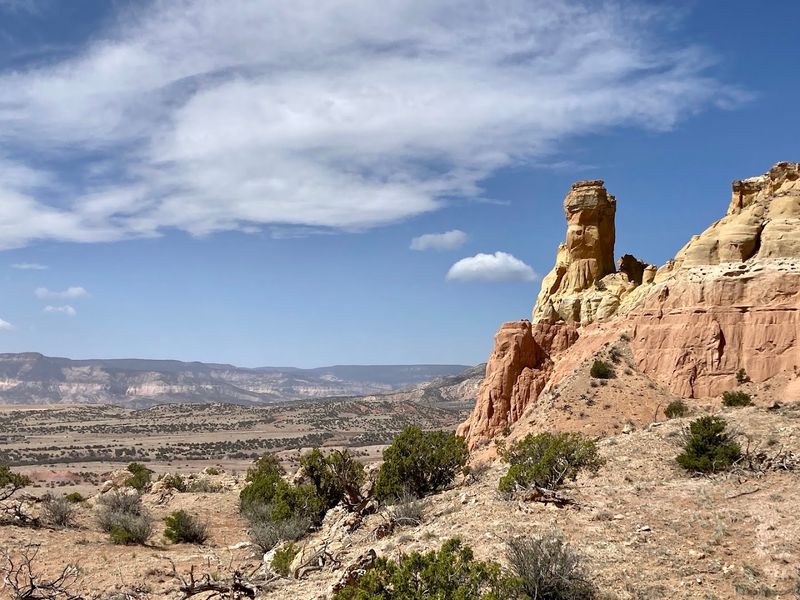
Georgia O’Keeffe painted the distinctive spire at Chimney Rock so many times that it became one of her most recognizable subjects. Standing at the trailhead and looking up at that rock formation, you immediately understand her obsession.
It is striking, angular, and completely impossible to ignore.
The trail climbs steadily through red rock formations and open juniper woodlands. It is a moderate hike that rewards effort with increasingly dramatic views.
The Piedra Lumbre basin spreads out below you as you gain elevation, and it is gorgeous.
At the top of the mesa, the panoramic views stretch in every direction. Abiquiu Lake glints in the distance on clear days.
The wide-open sky above northern New Mexico feels enormous up here in a way that is hard to describe without sounding dramatic.
The trail sits within the Ghost Ranch property, so check in at the visitor center before heading out. Staff can give you current trail conditions and point out any closures.
They are genuinely helpful and clearly love the place.
Spring and fall are ideal seasons for this hike. Summer afternoons bring afternoon thunderstorms that roll in fast.
Winter can bring snow and ice on the upper sections, so check conditions before you lace up.
The rock formations along the trail are rich in color. Deep reds, burnt oranges, and pale yellows layer across the cliff faces.
It is easy to stop every few minutes just to look around and take it all in.
Wildlife sightings on this trail include mule deer, ravens, and the occasional coyote trotting across the open terrain. Keep your eyes moving and your camera ready at every bend.
8. White Sands National Park
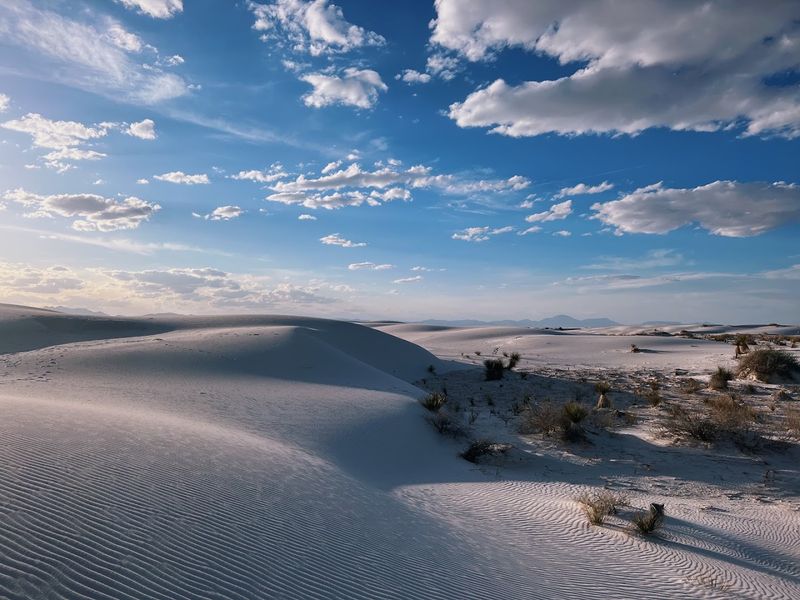
Nothing quite prepares you for the moment White Sands comes into view. The dunes are so blindingly white that they look like a snowstorm froze mid-drift and never melted.
Your brain keeps insisting it must be cold, but the air is warm and dry.
White Sands holds the largest gypsum dune field on Earth. It stretches across 275 square miles of southern New Mexico.
The gypsum crystals that make up the dunes stay cool to the touch even in peak summer heat, which feels like a small miracle.
Unlike regular beach sand, gypsum does not absorb heat from the sun. That means you can actually walk barefoot here without burning your feet.
It is a small but delightful detail that surprises most first-time visitors.
The park protects a remarkable collection of plants and animals that have adapted specifically to this extreme environment. Some lizard species have evolved lighter coloring to blend into the white dunes.
That kind of rapid adaptation happening in real time is genuinely wild to think about.
Sledding down the dunes is a popular activity, and the park actually sells sleds at the visitor center. Watching adults abandon all dignity to slide down a sand hill is consistently entertaining.
Kids are not the only ones screaming with joy out there.
Ancient fossilized human footprints were discovered in the park in recent years. They date back thousands of years and represent some of the oldest evidence of human presence in North America.
The discovery made international headlines and added a whole new dimension to the park’s story.
Sunsets here are legendary. The white dunes turn pink, lavender, and gold as the light fades.
Stay for it. You will not regret it for a single second.