
This 1963 Nevada Cathedral Hides Glowing Stained Glass Behind Plain Concrete Walls
I pulled off a busy Nevada boulevard expecting nothing more than a shortcut, and instead found a white triangular building that looked like a folded paper tent dropped into the desert. From the sidewalk it reads as plain concrete and sharp angles, the kind of place your eyes slide right past.
Then you step through the doors and the whole thing changes, because sunlight pours through panels of colored glass that you simply cannot see from outside. Admission costs nothing, parking is free, and the quiet hits you faster than you would expect this close to so much noise.
An A-Frame Sanctuary Just Steps Off The Strip
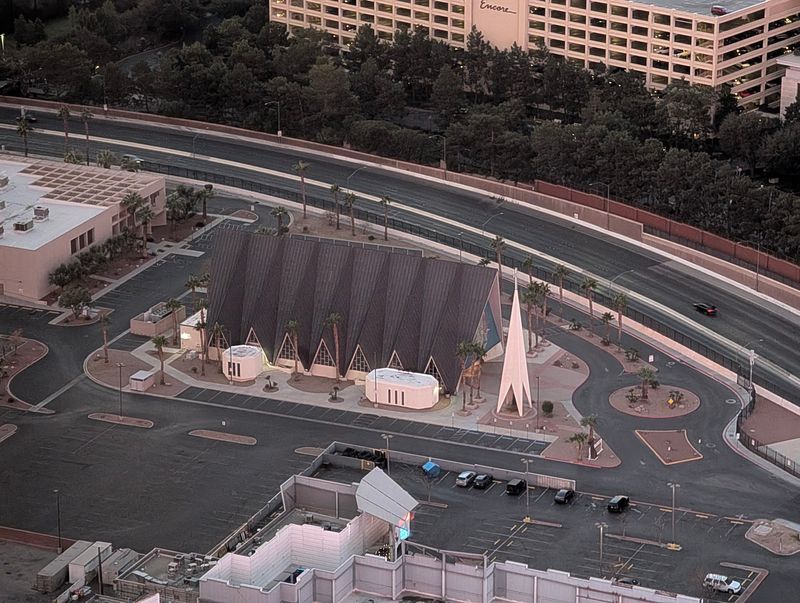
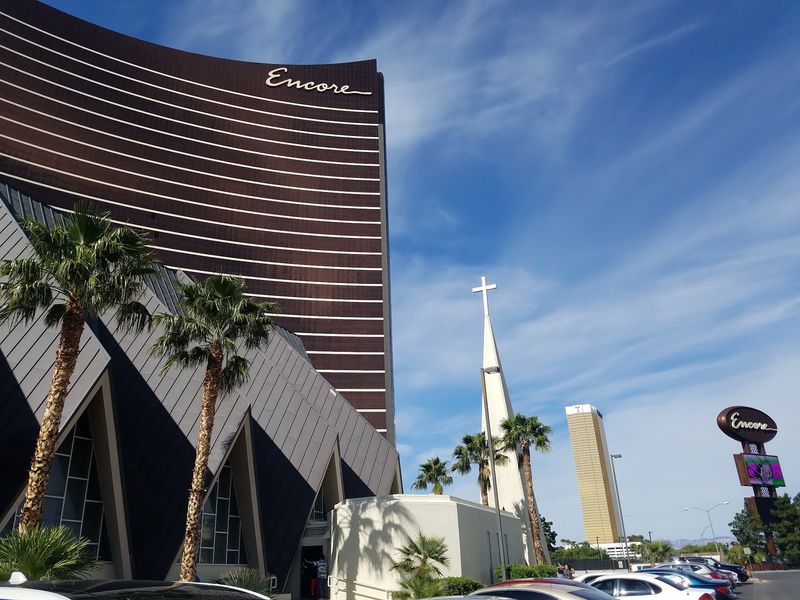
Guardian Angel Cathedral sits at 302 Cathedral Way in Las Vegas, tucked behind the hotel towers at roughly 36.13 degrees north, close enough to the Strip that you can walk over from the Wynn and Encore area in a few minutes.
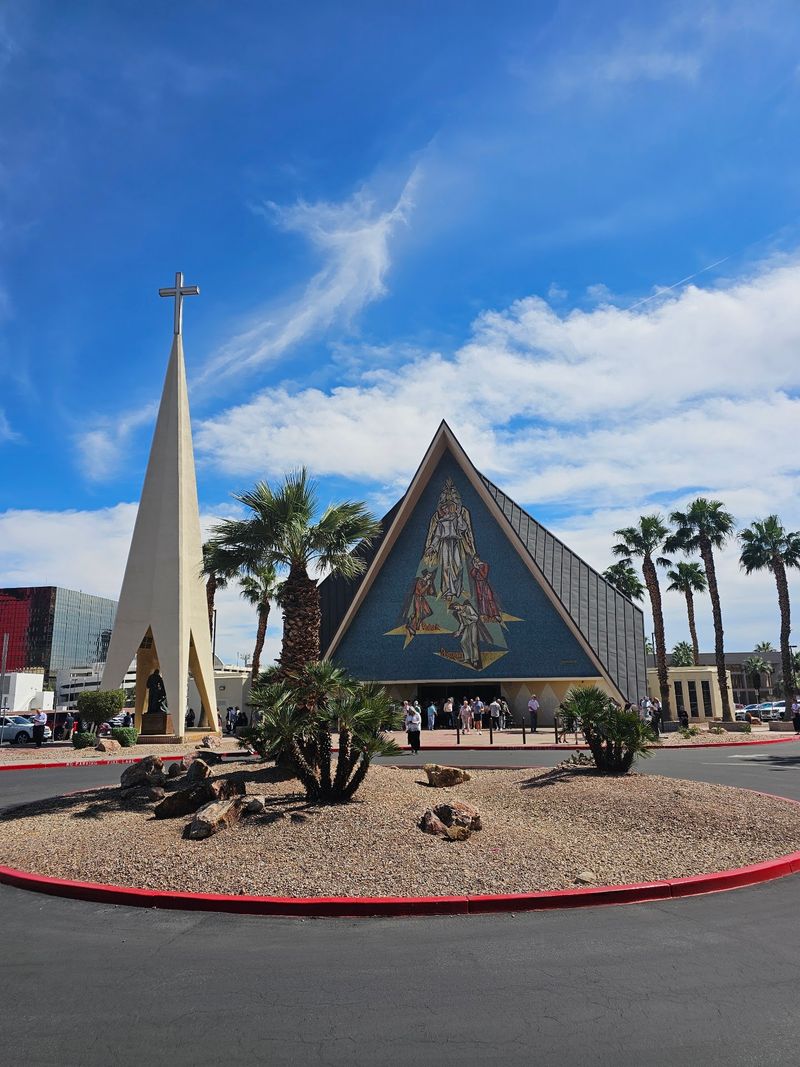
The shape is what stops people first. A row of white triangular peaks rises from a concrete base, topped by a slim spire, looking less like a European church and more like something engineered for the high desert.
It is the cathedral church of the Diocese of Las Vegas, which surprises visitors who assume the building is some leftover novelty from the old Strip. In fact it is one of the few original Strip-era structures still standing in its neighborhood.
Visitors regularly describe the exterior as odd, modest, even a little stark. That gap between the plain outside and the color waiting inside is the entire appeal, and it is why so many people who wander in for two minutes end up staying half an hour.
For Nevada families hunting an outing that costs nothing, this is about as accessible as landmarks get.
Paul R. Williams And The 1963 Blueprint
Behind those angular walls is a name that architecture fans recognize immediately. Paul R.
Williams, one of the most celebrated American architects of the twentieth century, designed the cathedral in 1963.
Williams built a long career designing homes and civic buildings across the West, and his work here leans fully into mid-century modernism. No flying buttresses, no gothic arches, just clean geometry and a structure that seems to lift straight out of the ground.
Twelve triangular niches bisect the A-frame form, and each one was planned to hold glass rather than stone ornament. The engineering and the artwork were conceived as partners, not as decoration added later.
Guests who know the story tend to look at the building differently on the way out. What first reads as plain suddenly reads as deliberate restraint, the kind of choice an architect makes when he wants the interior to do all the talking.
Sixty-plus years on, the design still holds its own against neighbors that are far taller and far flashier, which says something about how well the original drawings worked.
Built For The Overnight Shift Crowd
Origin stories do not usually involve hotel showrooms, but this one does. In the late 1950s, priests in Las Vegas began holding very early morning services, some reportedly as early as 4:30 a.m., inside casinos and showrooms.
Why so early? Because the people who needed them were just finishing overnight shifts.
Dealers, musicians, housekeepers, cooks, and hospitality staff worked hours that no standard Sunday schedule could accommodate.
Those makeshift gatherings eventually justified a permanent building, and in 1963 the cathedral opened on the Strip itself rather than somewhere quieter and cheaper. Serving working people where they actually were was the whole point.
That history explains a lot about the place, including why the art inside nods so openly to the local economy. It was never meant to feel separate from the city around it.
Longtime Nevadans often find this the most moving part of a visit. The building honors shift workers and service employees, the same folks who built the valley, and that generational connection tends to land harder than any architectural detail.
Isabel Piczek’s Glowing Stations Of The Cross
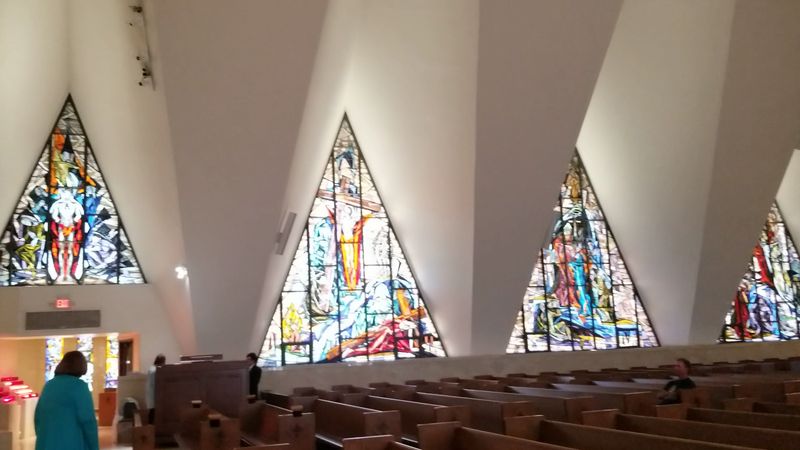
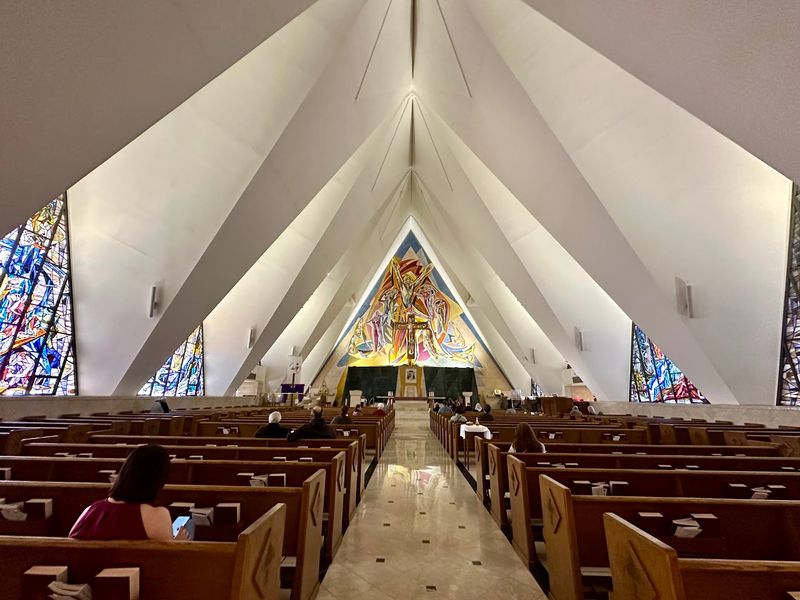
Step inside on a bright afternoon and the concrete practically disappears. Twelve triangular niches hold stained glass by artist Isabel Piczek, and when Nevada sun hits them the whole nave fills with moving color.
The panels depict the Stations of the Cross, arranged in a geometric rhythm that matches the building’s angles instead of fighting them. Visitors often describe the effect as modern and deeply reverent at the same time.
Here is the detail that makes the article title honest: none of this glow is visible from the street. The glass faces inward, hidden by those plain exterior walls, so the payoff only exists for people who actually walk through the doors.
Piczek worked with her sister Edith, and the two described their shared approach as Mystical Realism. Figures are recognizable, but the treatment is abstract enough to feel timeless rather than dated.
Photographers should know that light shifts dramatically through the day. Mid-morning and late afternoon tend to produce the strongest color, though every hour gives you something different across the floor and pews.
Dice, Old Casinos, And Glass That Tells On Its City
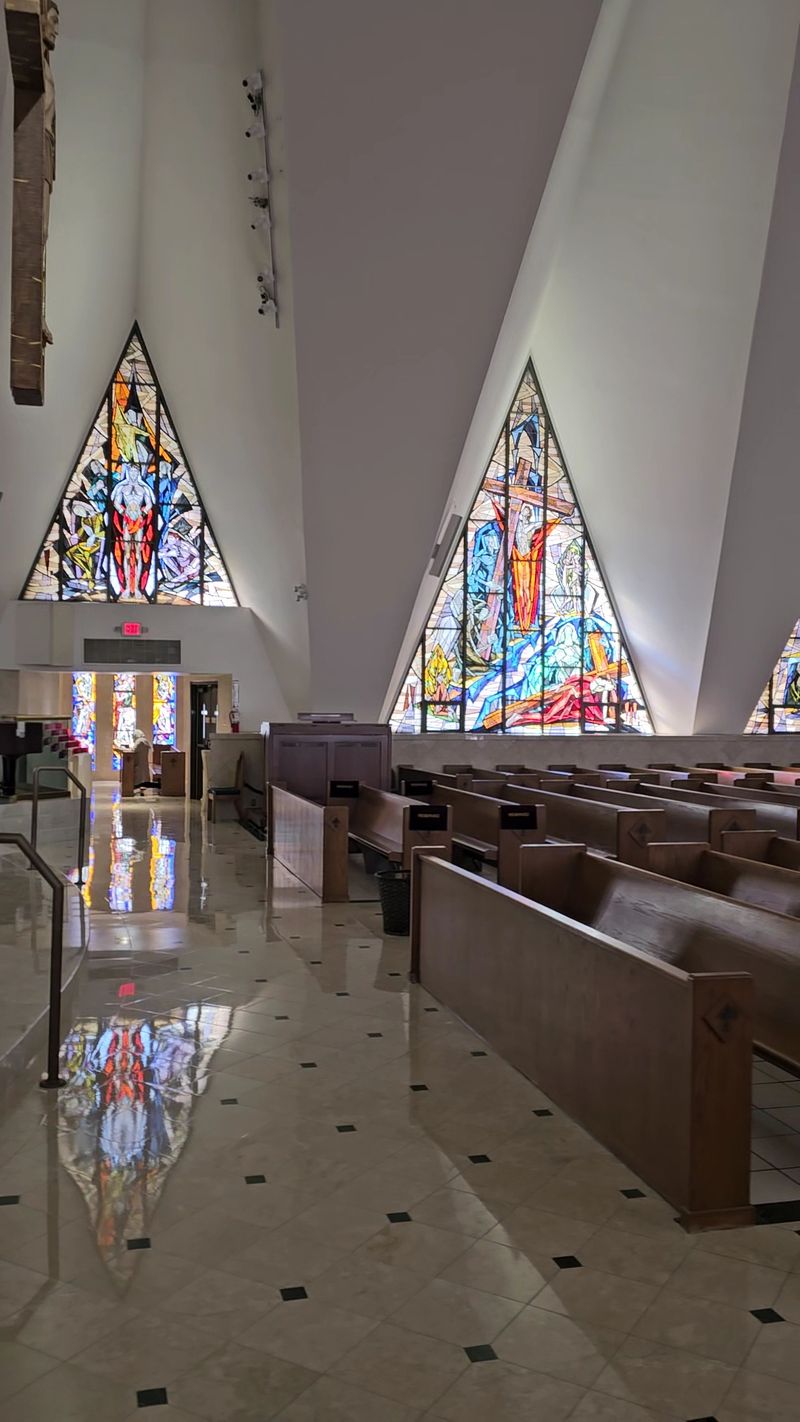
Look closely at certain panels and the imagery gets unexpectedly local. Some of the stained glass incorporates gaming themes, including dice and depictions of former Las Vegas hotels that no longer stand.
Odd choice for a cathedral? Not when you remember who the building was for.
The artwork reflects a congregation of casino employees and travelers, and it refuses to pretend the surrounding city was somewhere else.
Those vanished hotel images now work as accidental history. Properties that were demolished decades ago survive here in colored glass, which makes the windows a kind of memory bank for the old Strip.
Visitors sometimes take a moment to spot them, since the style is geometric rather than literal. Once your eye adjusts, the shapes emerge and the whole composition reads a little differently.
One regular observation worth passing along: the collection basket here has apparently received casino chips over the years, a small quirk that guests mention with obvious affection. Few religious buildings anywhere carry their hometown so plainly in their decoration, and that honesty is exactly what people remember.
The Guardian Angel Mosaic Above The Entrance
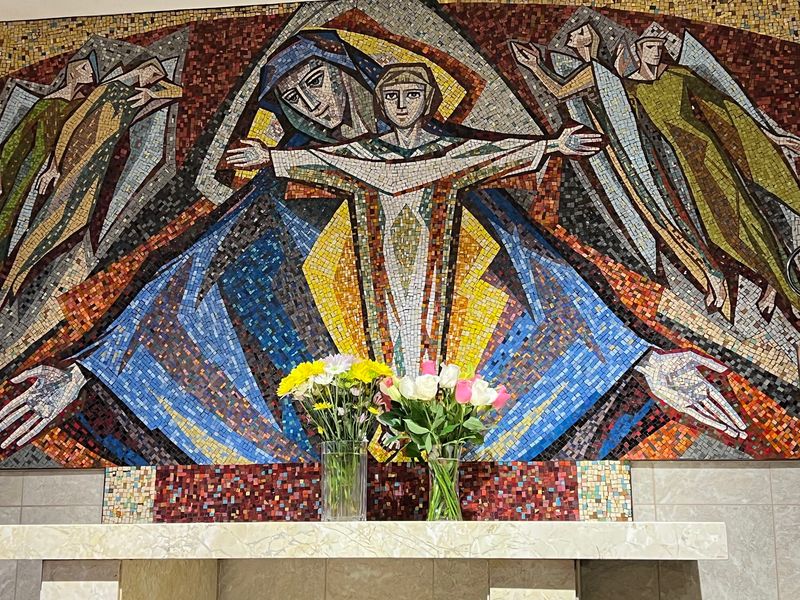
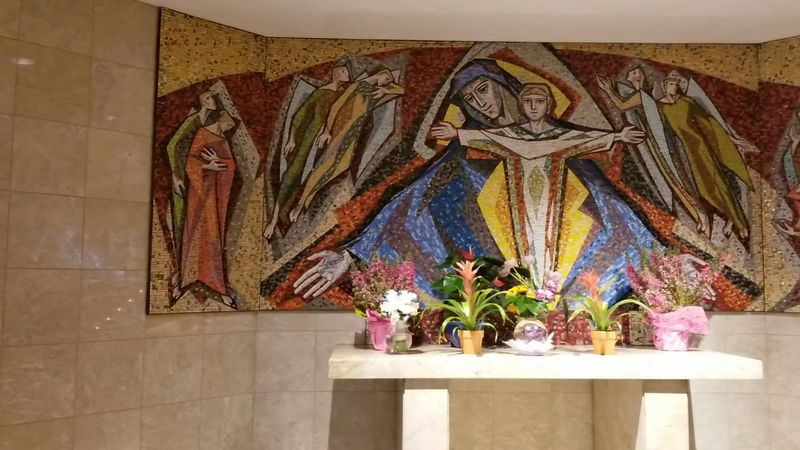
Before you reach the doors, look up. A large mosaic spans the entrance, showing a guardian angel guiding figures that represent prayer, peace, and penance.
Edith Piczek created the mosaics and murals while her sister handled the glass, making the cathedral a rare place where two artists divided an entire building between them. Their Mystical Realism approach ties the exterior and interior work together even though the mediums differ completely.
Tile catches desert light in a way paint never could, so the mosaic looks different in morning shade than it does at midday. Guests who linger for a minute or two usually notice colors they missed on approach.
Functionally, the piece works as a preview. You get one burst of color and symbolism outside, then the plain concrete resumes, then the interior delivers everything at once.
Families with curious kids can turn it into a small game, asking which figure stands for which idea. It takes thirty seconds, costs nothing, and gets everyone paying attention before they walk in.
The Final Beginning Mural Behind The Altar
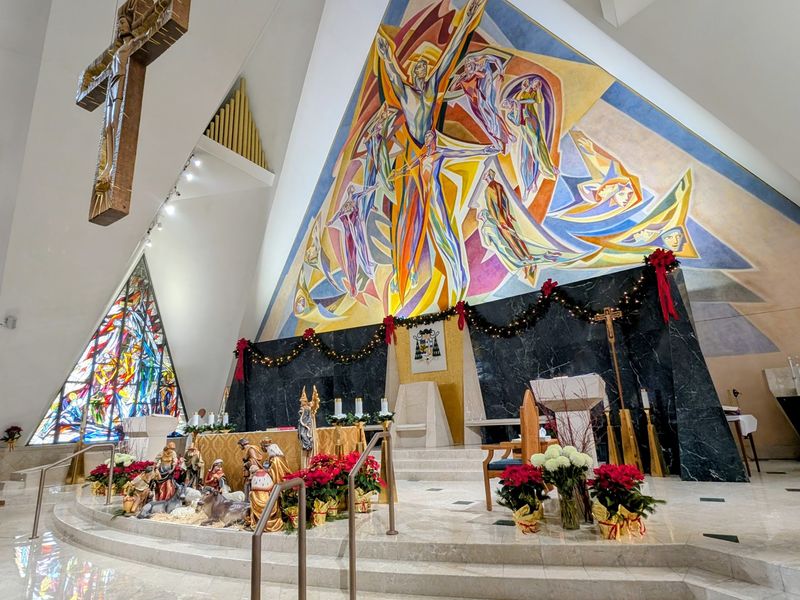
The altar wall holds the single biggest piece of art in the building. Titled The Final Beginning, the mural anchors the sanctuary and draws every eye forward the moment you sit down.
Guests frequently single it out, describing the painting as dramatic and almost otherworldly, a focal point that makes the whole A-frame feel intentional rather than merely unusual.
Scale helps. The angled ceiling narrows toward the front, so the mural sits at the point where the geometry tightens, and the effect is a room that funnels attention exactly where the artists wanted it.
Color choices play against the stained glass too. As sunlight moves through the side panels, tinted light washes across the mural, meaning the painting never looks quite the same twice.
If you have only ten minutes, sit in a middle pew and give this wall your attention. It is the piece most people photograph, and it is also the piece most people mention later when they describe the interior to someone who has not been.
Quiet You Would Not Expect This Close To The Boulevard
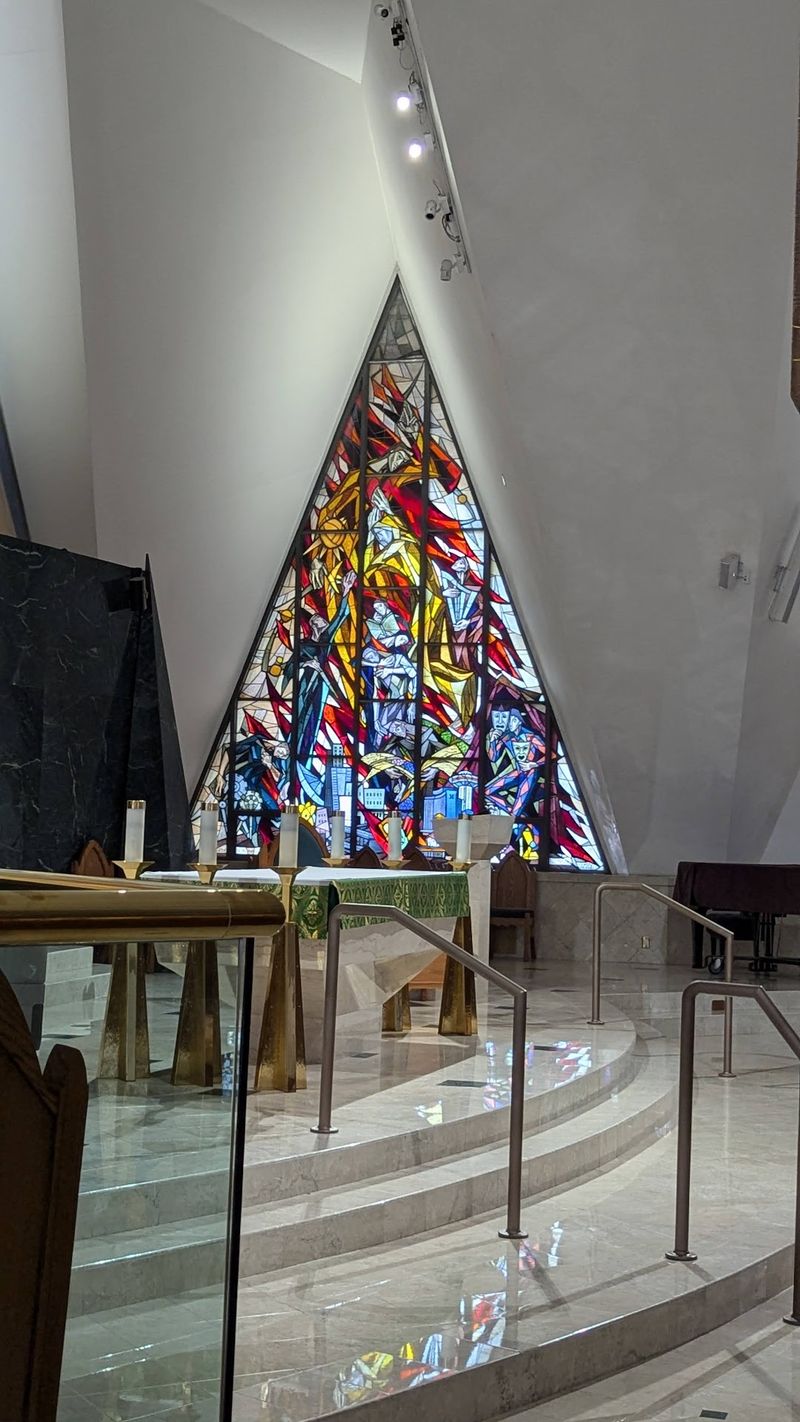
Noise is the default on the Strip. Then a set of doors closes behind you and the volume drops to almost nothing, which is the part visitors talk about most.
Several guests describe the feeling as grounding, a pocket of calm set right against constant motion and neon. The building is air conditioned, which in a Las Vegas summer is its own form of mercy.
Temperature matters more than it sounds. When the valley runs well past 100 degrees, a cool interior with padded pews and colored light on the floor becomes a genuinely practical stop in the middle of a walking day.
Acoustics do carry, though. One visitor noted that sound bounces considerably in the hall, so speech and music can echo depending on where you sit.
Choose a seat closer to the front if you want to hear clearly. If you are there simply to look and breathe, the back rows give you the widest view of the glass and the fullest sense of how big the space actually feels.
Service Times Built Around Visitors
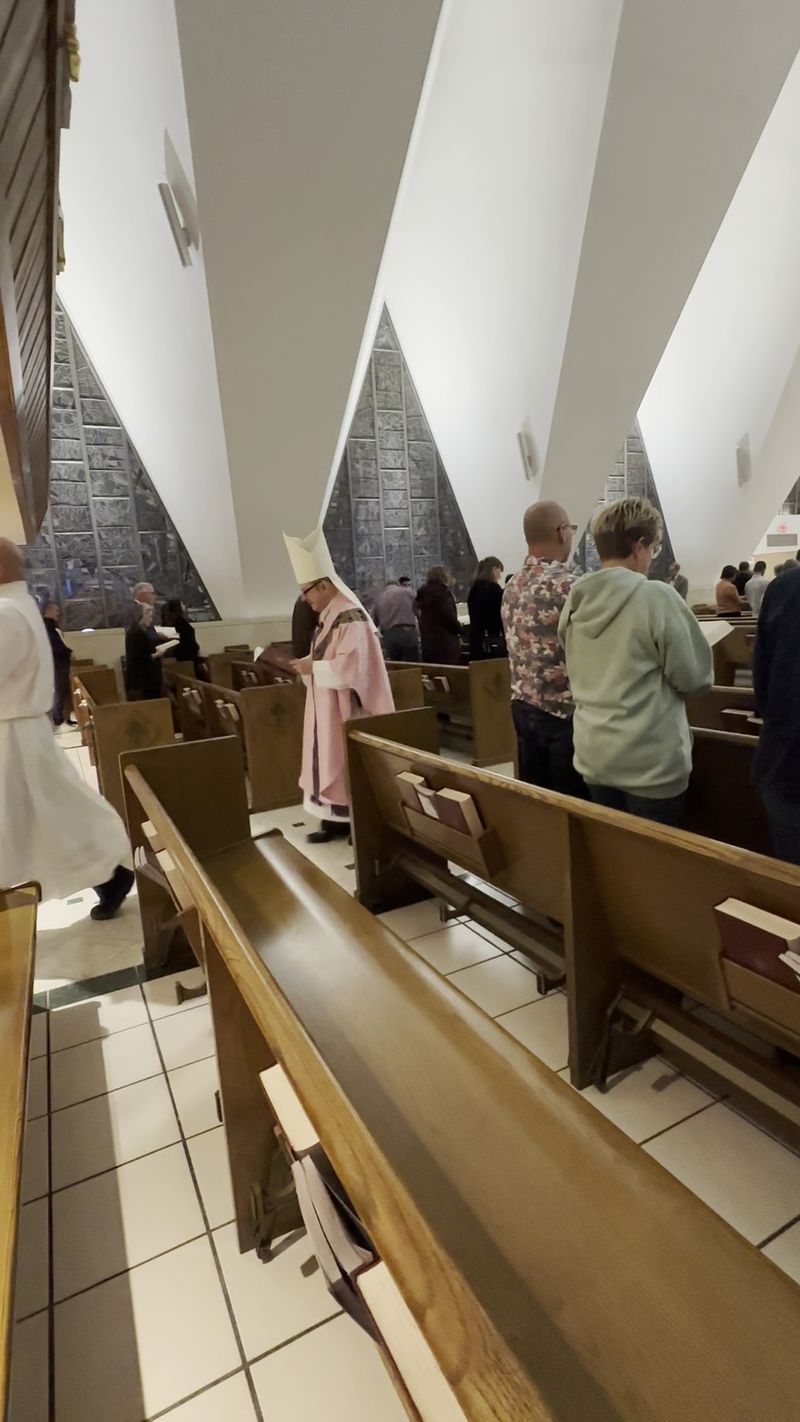
Scheduling here still reflects the original mission of accommodating people on unusual hours. Guests report Sunday Mass offered four times, beginning in the early morning and running through early afternoon, plus two vigil services on Saturday.
Travelers appreciate how early some of those Saturday options run. One visitor mentioned attending an afternoon vigil and still having the entire evening free, which is unusual compared with the later start times common elsewhere.
Length tends to be reasonable. A Christmas service was described as running about fifty minutes, and greeters helped seat a crowded room without leaving people standing at the back.
Music is traditional, with hymns and organ. A few guests have noted that volume levels and limited song books can make following along tricky, so arriving a few minutes early to grab a book helps.
Reconciliation is reportedly available nearly every day of the week. Worth remembering: doors have closed on latecomers before, and the space clears out promptly afterward, so plan to arrive on time rather than drifting in mid-service.
Who Gets The Most Out Of A Stop Here
Architecture buffs will get the most obvious reward, especially anyone tracking mid-century modern work or the career of Paul R. Williams.
The A-frame is a textbook example sitting in an unlikely spot.
Retirees traveling on a fixed budget do well here too. There is no admission, parking does not cost anything, and the whole stop can fill twenty minutes or an hour depending on how long you want to sit.
Families with school-age kids can treat it as a short, low-pressure break between bigger attractions. The colored light is genuinely interesting to children, and the visit is brief enough that nobody gets restless.
Visitors who are not religious have still found the experience worthwhile. One guest described attending purely out of curiosity and finding the service beautiful from an outside perspective.
Photographers should temper expectations slightly. The exterior is stark, and the real material is inside, which means your best shots depend entirely on whether the doors happen to be open when you arrive.
Hours, Admission, And The Closed-Door Catch
Costs first, because that is the easy part. There is no admission charge to visit, and parking on site is free, so a family of four can stop here without spending a dollar.
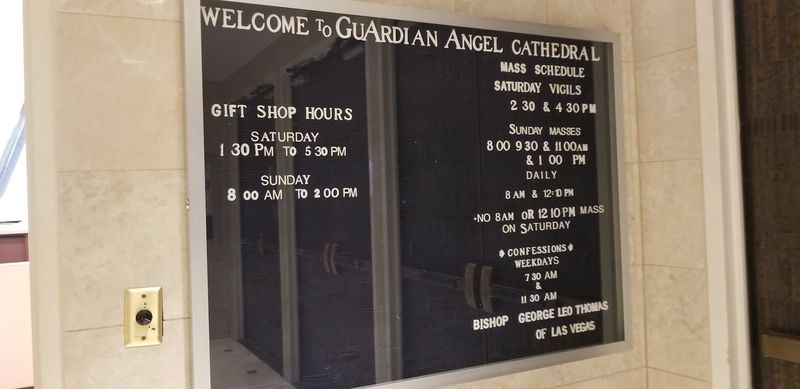
Posted hours run 8:15 a.m. to 1 p.m. Monday through Friday, 1:15 to 5:30 p.m. on Saturday, and 7 a.m. to 2 p.m. on Sunday.
Outside those windows the doors are typically locked.
That closure trips up some travelers. One visitor noted that many western churches stay shut between services, unlike what they were used to back east, and left a little disappointed at only seeing the outside.
The workaround is simple enough: time your arrival inside the posted hours, and understand that security concerns mean the chapel is not open around the clock.
Schedules at religious sites shift with holidays and seasons, so confirm before you build a drive around it. If you arrive after closing, the entrance mosaic and the exterior geometry are still visible from the sidewalk at no cost.
Finding Cathedral Way Without Circling The Block
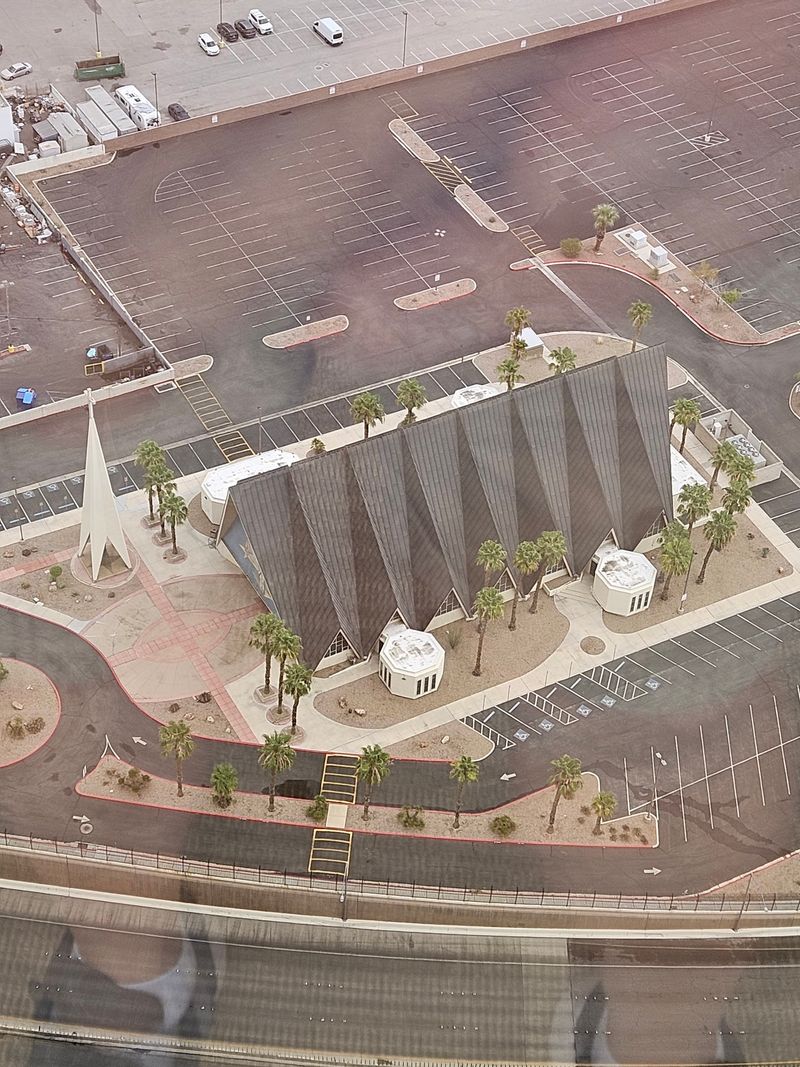
Navigation is the one genuine headache. Several guests mention that getting to Cathedral Way is confusing the first time, since the short access road sits behind the resort frontage rather than directly on the boulevard.
Landmarks help more than turn-by-turn instructions. The cathedral sits across from the Encore, near Resorts World and Circus Circus, and within walking distance of the Wynn and Fashion Show area.
Once you find the lot, parking is described as plentiful and free, even on busy service days. Drop-off and pickup are straightforward, which is why some visitors skip driving entirely and use a ride share or the bus.
For Nevadans arriving from farther out, the address is 302 Cathedral Way, and the building is easy to spot from above thanks to that row of white peaks among glass towers.
Walking over from a nearby hotel is often simpler than driving. If you are already exploring the north end of the Strip on foot, the detour adds only a few minutes to your route.
Worth The Detour For A Different Kind Of Nevada Landmark
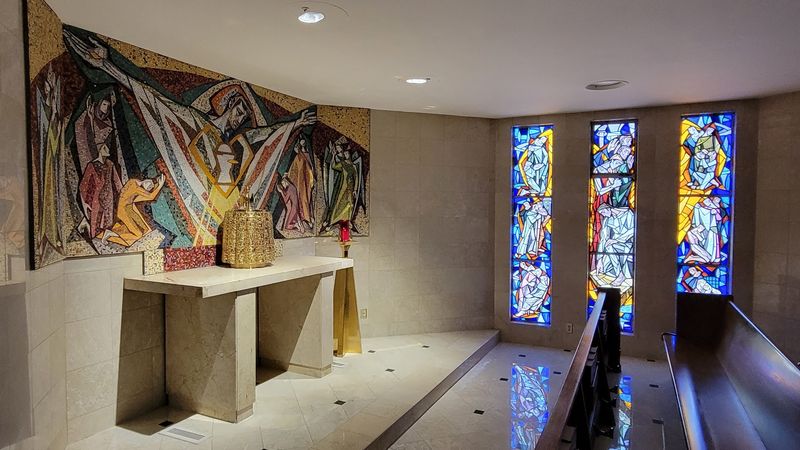
Sixty-plus years after it opened, the payoff here remains the contrast. Plain concrete outside, twelve panels of glowing color inside, and none of it advertised to passing traffic.
What makes the place stick is not just the art but the reason it exists. A building designed by a major American architect, decorated by two sisters working in their own invented style, created so shift workers had somewhere to go before dawn.
Practically speaking, it is one of the least expensive stops in the area. Free entry, free parking, and a visit you can stretch or shorten to fit whatever else the day holds.
Go during posted hours, sit for a few minutes rather than snapping one photo and leaving, and let your eyes adjust to what the sun is doing through the glass.
Plenty of Nevada landmarks trade on spectacle. This one does the opposite, keeping everything good behind an unremarkable wall and quietly rewarding the people who bother to walk in.