
This 1896 Mississippi Carousel Is The Only One Of Its Kind Left In The World
A century of digital entertainment cannot match the simple mechanical magic of whirring gears and hand-carved wood. Modern theme parks rely on screens, but this historic attraction captures attention through pure, tactile nostalgia.
Mississippi guards a rare survivor that outlasted the rise and fall of industrial manufacturing. The wooden horses retain their fierce, expressive stares under coats of carefully maintained paint.
Steam-powered history breathes through the center housing with every slow, deliberate rotation. The calliope organ does not use digital files to play its jaunty, echoing tunes.
It uses punched paper rolls that create a physical soundtrack for the flying manes. Children climb aboard the same saddles their great-grandparents sat on decades ago.
Time slows down to a crawl the moment the platform begins to turn.
Origins And Evolution Of Early Design
In 1896, a man named Gustav Dentzel built something truly remarkable in Philadelphia, Pennsylvania. He came from a carousel-making family rooted in Germany.
His father, Michael Dentzel, had already been crafting carousels across Europe before the craft crossed the Atlantic.
Gustav started his own carousel business in Philadelphia around 1867. His workshop was careful and slow.
The Dentzel factory only produced two or three carousels per year, which made each one rare and precious.
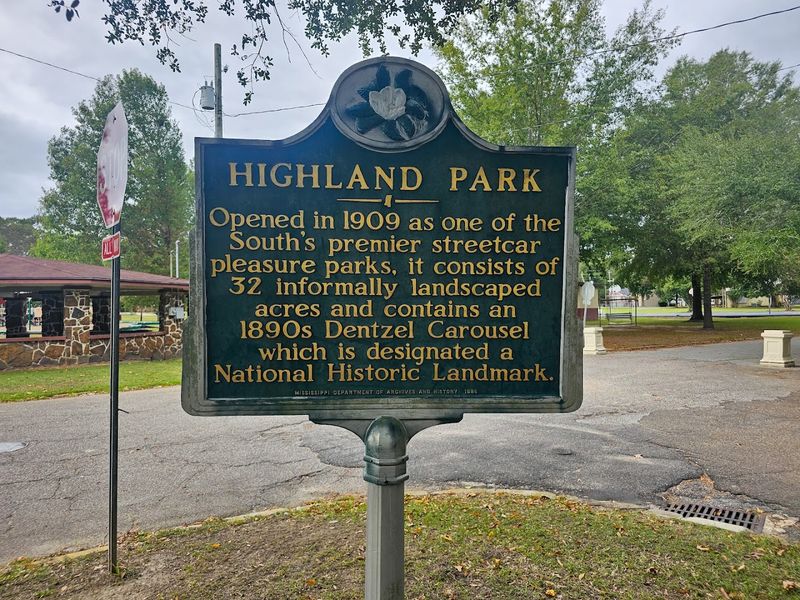
This specific carousel was originally built for the 1904 St. Louis Exposition. It eventually found its permanent home at Highland Park in Meridian, Mississippi, where it has been running since 1909.
You can visit it at 1720 Jimmie Rogers Memorial Dr, Meridian, MS 39307.
Early carousels did not always look like what we picture today. They started with human or pony power and gradually moved to steam and then electricity.
That evolution made carousels more reliable and more exciting for the public.
What makes this one so special is its classification. It is the only remaining two-row stationary Dentzel menagerie carousel left in the entire world.
That is not just a local bragging point. That is a global distinction that puts Meridian on the map for history lovers everywhere.
Craftsmanship Techniques Behind Wooden Figures
Every single animal on this carousel was carved by hand. All 28 figures were shaped with real skill and patience.
Gustav Dentzel specifically hired German and Italian immigrant woodworkers who had classical training in carving.
These were not hobbyists. They were serious craftsmen who treated each figure like a sculpture.
The animals were made from poplar wood or basswood, both known for their smooth grain and ability to hold fine detail.
Brass poles anchor each animal to the platform. The combination of brass hardware and hand-carved wood gives the carousel a warmth that modern machines simply cannot replicate.
You can actually see the tool marks and painted details up close when you visit.
The top crown of the carousel is decorated with original oil paintings. Those paintings have survived over a century of use, which is a tribute to how well the whole piece was assembled.
Restorers later discovered original paint layers hidden beneath many coats added over the decades.
Gustav Dentzel was known for pushing his craftsmen toward realism. He wanted the animals to look alive, not cartoonish.
That philosophy is visible in every curve and texture on each figure. The result is a carousel that feels more like a museum installation than a fairground ride, and that is exactly what makes it unforgettable for everyone who sees it.
Historical Importance Of Fairground Entertainment
Carousels have a history that goes back thousands of years, with roots in the Middle East. They were first used in Europe as a training tool for cavalry riders.
Soldiers would practice balance and coordination on spinning platforms before heading into battle.
Over time, the ride shifted from military training to public entertainment. The Industrial Revolution changed everything.
Steam power made carousels faster and more accessible, and suddenly they appeared at parks and fairs across the world.
This Meridian carousel has been in operation since 1909. That means it has been spinning for over 115 years.
Generations of Mississippi families have ridden these same carved animals, making it a living piece of community history rather than just a museum artifact.
In 1986, the carousel was officially designated a National Historic Landmark. That recognition placed it alongside some of the most important cultural sites in the entire country.
Not many amusement rides earn that kind of honor.
What makes this moment in carousel history so compelling is that this ride survived when so many others did not. Most Dentzel carousels have been lost to time, fire, or neglect.
This one kept going. It kept welcoming riders year after year in Meridian, Mississippi, quietly becoming the last of its kind.
That kind of staying power says a lot about how much this community has valued it over the generations.
Mechanics And Movement Of Vintage Models
Here is something that surprises most first-time visitors. The animals on this carousel do not move up and down.
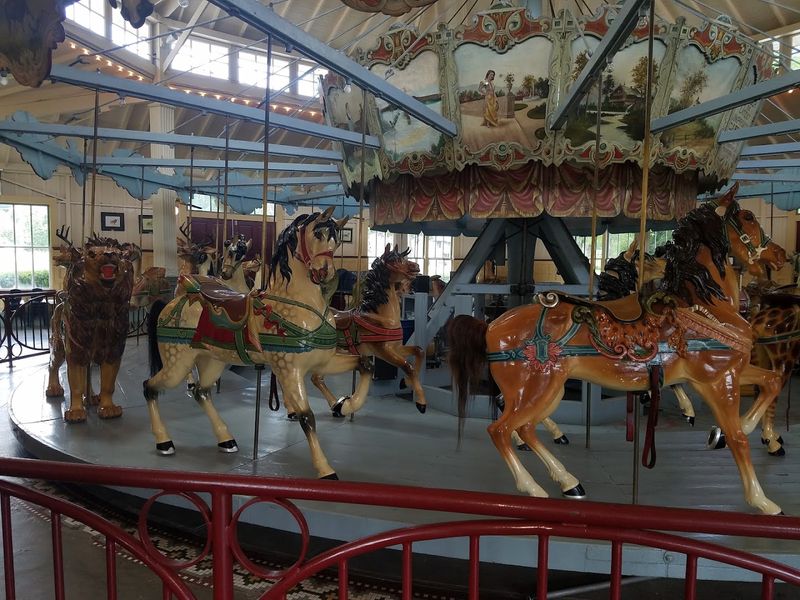
It is classified as a stationary carousel, which means the figures stay fixed while the whole platform rotates. That design is actually a big part of what makes it historically unique.
Each animal is attached to the wooden platform using brass poles. The poles are solid and secure, built to last decades of constant use.
There is something satisfying about knowing the hardware holding these animals in place is the same hardware installed over a century ago.
Early carousels relied on human or animal power to spin. Workers or ponies would walk in circles to keep the ride moving.
Later, steam engines took over that job, making the experience smoother and more consistent for riders.
Eventually, electric motors became the standard. This carousel followed that progression and now uses an electric system to keep it turning.
The ride also features a Wurlitzer organ as part of its structure, though today the music played is recorded rather than live mechanical organ music.
The stationary design actually gives riders a different experience compared to modern carousels. Without the up-and-down motion, you feel the full rotation more clearly.
You notice the painted scenery, the carved details, and the other animals sharing the platform. It is a slower, more intentional kind of joy that feels completely different from anything built today.
Conservation Strategies For Antique Amusement Rides
Keeping a 130-year-old carousel running is not a simple task. The carousel building at Highland Park was closed for major restoration from 1983 to 1984.
That shutdown was necessary to address structural issues that had built up over decades of use and weather exposure.
From 1984 to 1995, the animals, chariots, and canvas oil paintings all went through their own careful restoration process. That is eleven years of detailed, patient work.
Restorers had to strip back layers of paint to find the original colors hidden underneath, which helped them restore each figure accurately.
A national restoration specialist named Rosa Patton oversaw much of this work. Her involvement brought professional expertise to a project that required both art knowledge and conservation science.
The goal was never just to make things look pretty. It was to preserve historical accuracy while also making the ride structurally safe for modern visitors.
Conservation of antique amusement rides also means meeting current safety standards. That balance between old and new is tricky.
You want to keep the original materials and appearance, but you also need the ride to be safe for children and adults today.
The effort paid off. The carousel continues to operate and welcome visitors at Highland Park.
Every restored figure is a small victory for preservation. Without that long restoration period, this one-of-a-kind piece of American history might have quietly disappeared, and nobody would have known what the world had lost.
Cultural Impact Of Attractions In Mississippi
A carousel purchased for two thousand dollars in 1909 is now valued at over a million dollars. That jump in value tells you a lot about what this ride has become for Meridian and for Mississippi as a whole.
It went from a fairground attraction to a genuine cultural landmark.
The community clearly feels that connection. Meridian launched a public art project called Around Town Carousels Abound.
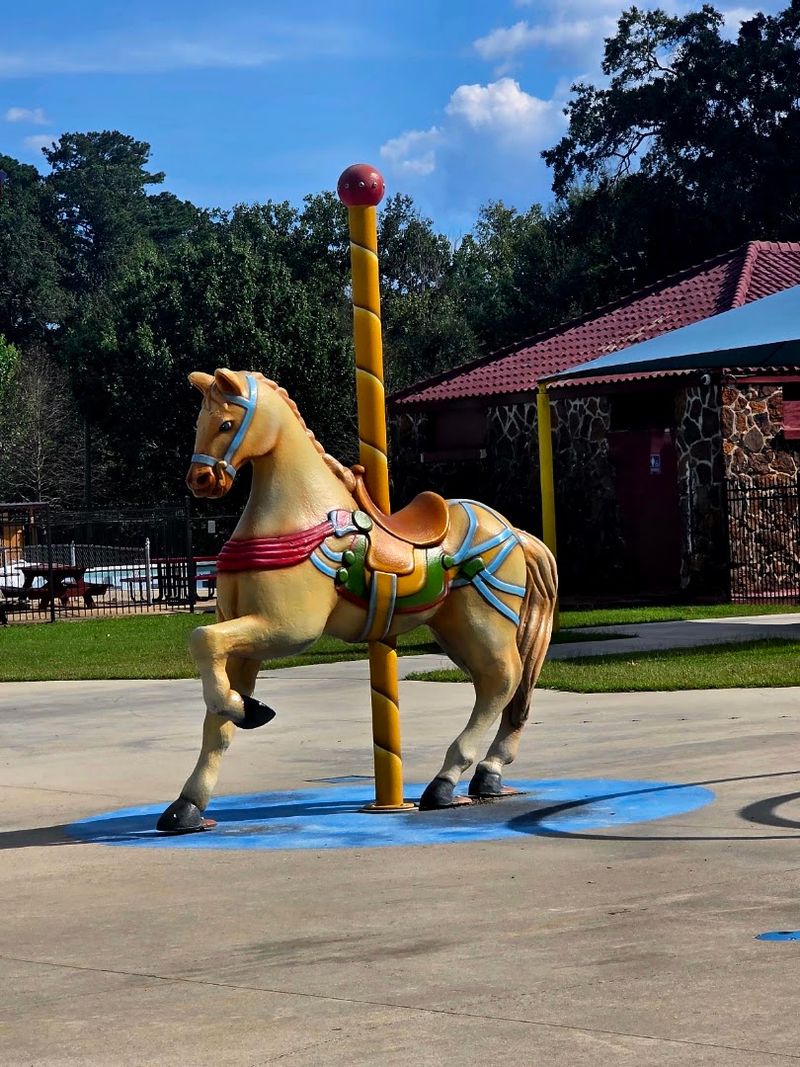
This project placed over 60 life-size carousel horse sculptures around the city. Each one is painted and decorated differently, representing the spirit of the original Dentzel Carousel.
Those sculptures function like a city-wide gallery. You can walk or drive around Meridian and spot them outside businesses, parks, and public spaces.
It turns the whole city into an extension of Highland Park’s most famous attraction.
The carousel has also shaped how Meridian presents itself to visitors. It is not just a park feature.
It is a reason people plan trips to this part of Mississippi specifically. That kind of cultural magnetism is rare for a single object in a mid-size city.
For local families, the carousel carries personal meaning across generations. Grandparents rode it.
Their children rode it. Now, grandchildren are riding the same carved animals on the same spinning platform.
That chain of shared experience is exactly what makes a cultural landmark feel real. It is not just history on a sign.
It is history you can actually touch and ride.
Artistic Styles Found On Hand-Carved Animals
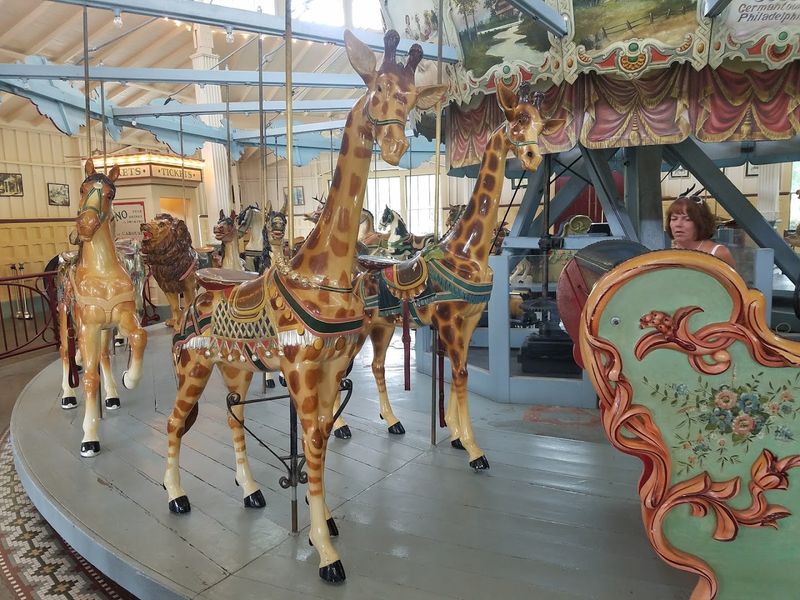
The word menagerie is key to understanding what makes this carousel visually different. Most carousels feature only horses.
This one has 28 animals representing a full range of species. You will find 20 horses alongside a lion, a tiger, two deer, two antelope, and two giraffes, all sharing the same spinning platform.
Gustav Dentzel pushed for realism in his figures. He wanted each animal to look like it belonged in the wild, not in a toy store.
That meant studying animal anatomy and translating it into carved wood with fur textures, muscle definition, and expressive faces.
The Dentzel factory maintained a consistent artistic identity across its carousels for decades. There was a house style, but it never felt rigid.
Each animal had a personality. Each figure was a standalone piece of art that also worked as part of a larger visual composition when seen together on the carousel.
Original oil paintings on the carousel crown add another layer of artistry. These painted panels sit at the top of the ride and frame the whole experience visually.
They were created with the same care as the carved animals below them.
Looking at the full collection of figures together is genuinely impressive. The variety of animals, the quality of the carving, and the painted details all work together.
It is the kind of artwork that rewards slow looking. The more time you spend studying each figure, the more details you notice hiding in plain sight.
Community Events Featuring Classic Merry-Go-Rounds
Highland Park is not just a place to see a historic carousel. It is a full community space where Meridian residents come together regularly.
Meridian Parks and Recreation organizes events like Picnic at the Park, which brings food vendors, live music, and family-friendly activities right to the park grounds.
The carousel itself can be rented for private events. Birthday parties have been held inside the carousel house, giving kids a one-of-a-kind celebration space.
There is something genuinely special about celebrating inside a building that houses a National Historic Landmark.
Beyond the carousel, Highland Park offers basketball courts, baseball and softball fields, a duck pond, disc golf, and a splash pad. The Frank Cochran Center inside the park serves as a venue hall for larger gatherings.
The park truly functions as a community hub rather than just a sightseeing stop.
The carousel is open to the public with seasonal hours. On weekdays, it opens at 10 AM and closes at 6 PM.
On Sundays, the hours run from 10:30 AM to 5:30 PM. A small fee applies to ride the carousel, so it is worth checking current details before you go.
You can call ahead at 601-485-1802.
Visiting during a community event adds a whole other layer to the experience. The park fills with people, the energy picks up, and the carousel becomes the centerpiece of something much bigger than a single ride.
That combination of history and community life is what keeps Highland Park relevant year after year.