
This Nevada Desert Hides Neon-Colored Sculptures Taller Than a Three-Story Building
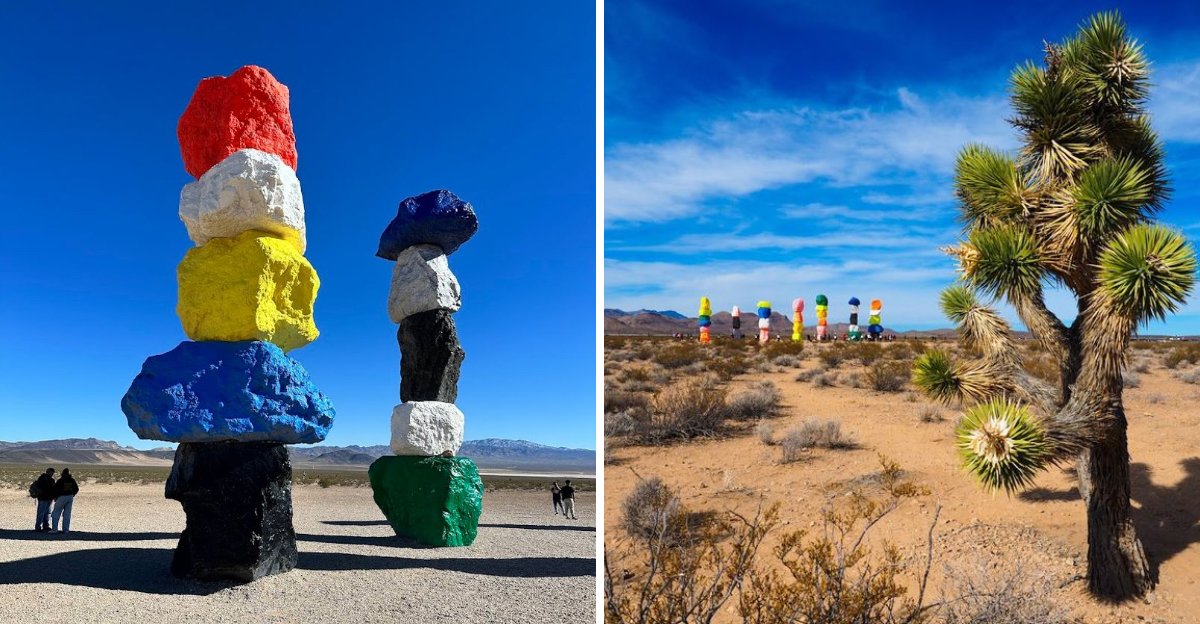
Bright fluorescent rock towers rise straight out of flat desert ground. It looks unreal until you actually see it in person.
Someone stacked massive boulders taller than a house, then coated every one in Day-Glo colors this desert never makes on its own. Nevada hides plenty of strange sights, but this collection of glowing totems might be the boldest yet.
Get close and the scale hits different fast. What looked small from the highway now towers overhead, throwing shade in hot pink and electric blue.
Artists picked this exact patch of Nevada ground for a real reason. Drivers slow down for it daily, and photographers plan whole trips around it.
Once those colors hit against the mountains, the rest starts making sense fast.
What Exactly Is Seven Magic Mountains
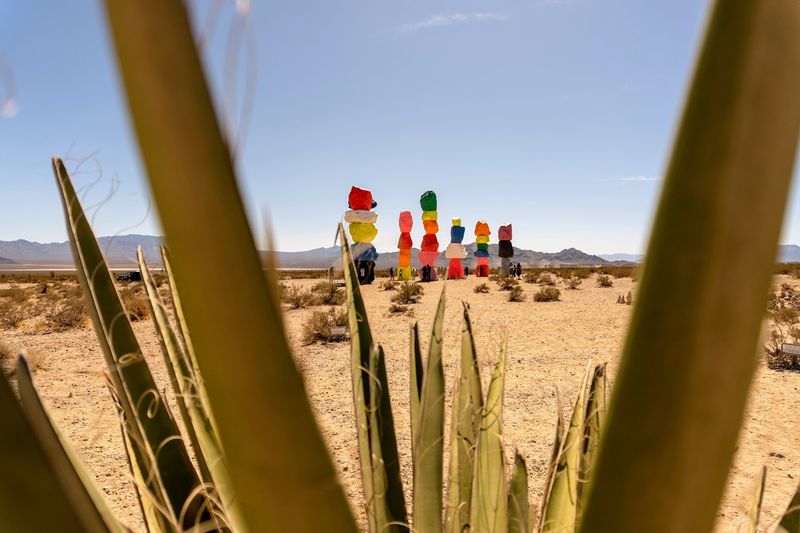
Before anything else, let’s set the scene. Seven Magic Mountains is a large-scale public art installation located in the Ivanpah Valley, along South Las Vegas Boulevard in Las Vegas, Nevada, at the address S Las Vegas Blvd, Las Vegas, NV 89054.
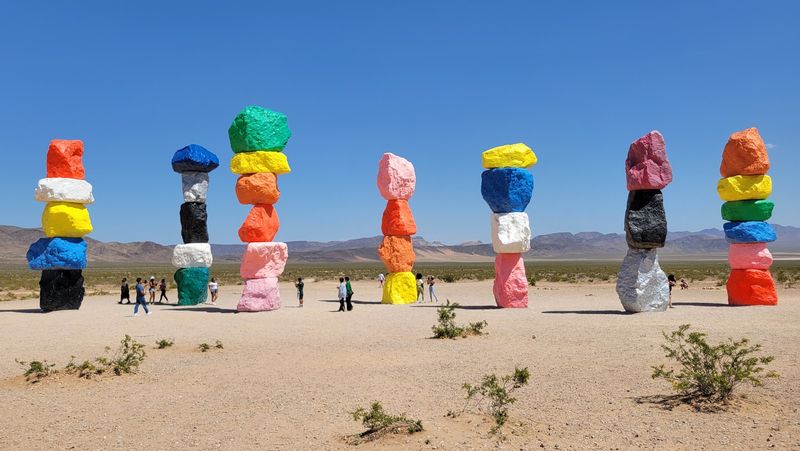
The installation features seven towering totems made from locally sourced limestone boulders. Each totem stands between 30 and 35 feet tall, roughly the height of a three-story building.
The boulders are stacked in groups of three to six, creating a precarious, playful silhouette against the open desert sky.
What makes the whole thing pop is the paint. Each boulder is coated in vivid Day-Glo pigments, turning ordinary rock into something electric.
The colors include hot pink, neon orange, acid green, and electric blue. Visible from Interstate 15, the installation sits about 10 miles south of the Las Vegas Strip.
It is free to visit, open daily, and requires zero planning to enjoy. Pure desert magic, no ticket required.
The Artist Who Dreamed It All Up
Behind every jaw-dropping art project, there is a mind bold enough to imagine it. Swiss artist Ugo Rondinone created Seven Magic Mountains with a specific philosophical goal in mind.
He wanted to explore the tension between the natural world and the artificial structures humans build within it.
Rondinone is known for his poetic, visually arresting work. His approach often blends romanticism with a deep curiosity about human existence.
This project, however, pushed things further. Rather than placing artificial art in a gallery, he placed it directly into a raw, untamed landscape, forcing a conversation between geology and creativity.
The concept draws on the tradition of stone cairns, ancient markers used by travelers to indicate paths. By painting the boulders in fluorescent tones, Rondinone flipped the script.
These are not subtle trail markers. They are bold declarations.
The project was produced jointly by the Nevada Museum of Art and the Art Production Fund, and took nearly five years of planning before the first boulder was stacked.
The Colors That Stop Traffic
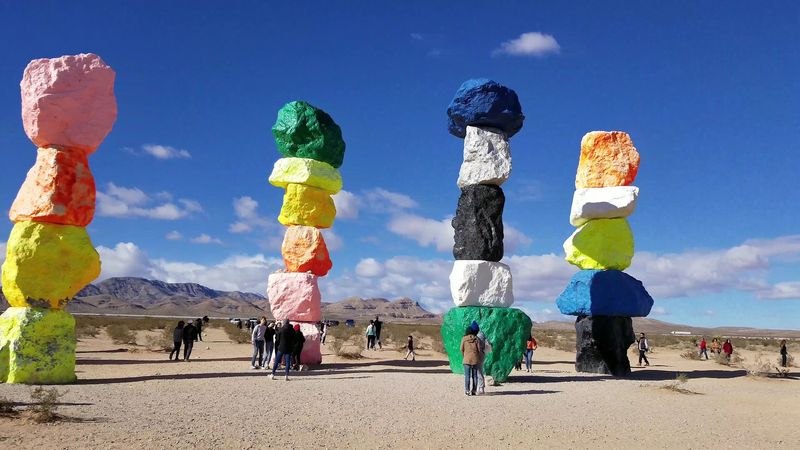
The colors are the first thing that hits you, and they hit hard. Each of the seven towers carries its own distinct palette of fluorescent hues.
Think radiant hot pink, blazing orange, electric lime green, and deep neon blue. Against the muted tans and browns of the Mojave, the effect is almost disorienting in the best possible way.
The paint itself is no ordinary finish. A specialized Day-Glo coating covers the limestone in two layers, engineered to activate brilliantly under the intense Nevada sun.
As the light shifts throughout the day, the colors seem to change mood entirely. Morning light gives them a soft glow.
Midday sun cranks up the intensity. Late afternoon turns them almost otherworldly.
Photographers obsess over this place for good reason. The contrast between the neon sculptures and the pale desert backdrop creates images that look almost digitally enhanced, even when they are completely unedited.
No filter needed when the desert itself becomes your backdrop.
The Scale Will Genuinely Surprise You
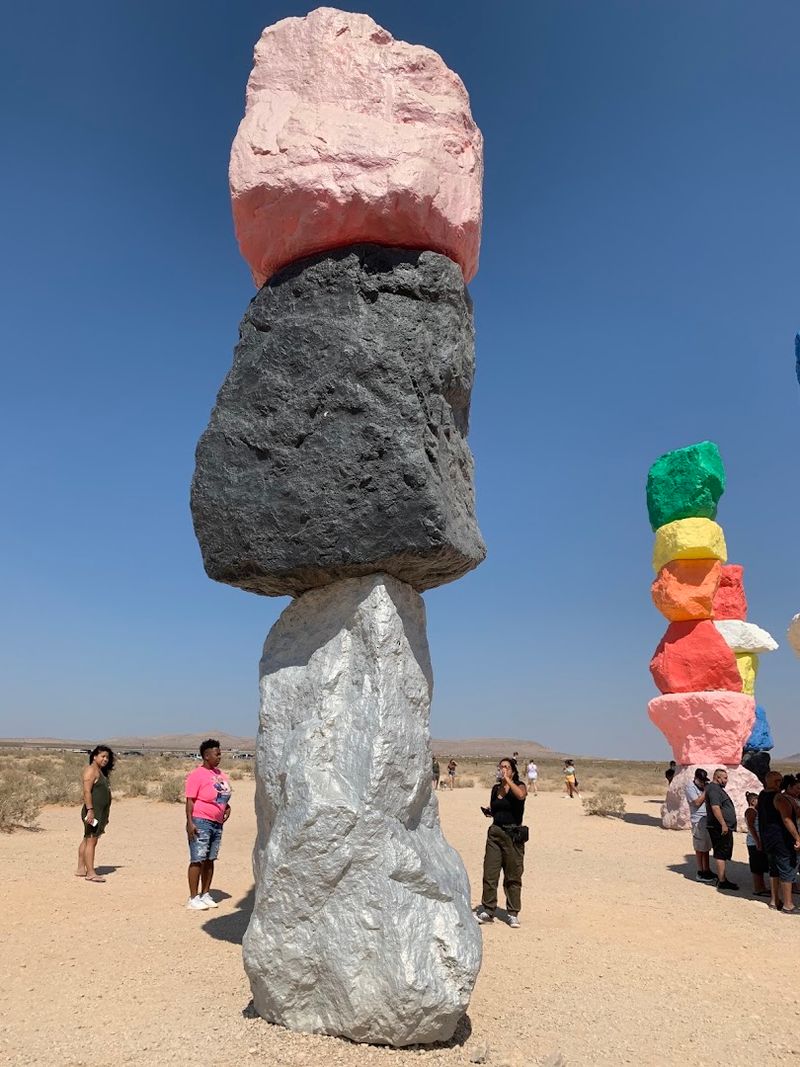
Photos are deceptive. Even the best images struggle to capture just how massive these sculptures really are.
Standing at the base of one of the seven towers, the sheer scale becomes immediately clear. Each boulder in the stack is enormous, with individual rocks weighing anywhere from 10 to 25 short tons.
That is not a typo.
The stacks reach up to 35 feet into the sky, which puts them on par with a three-story building. When visitors walk up close, many describe a sudden shift in perspective, as if the desert floor dropped away and the towers grew taller.
The boulders look almost weightless from a distance, yet their mass is staggering up close.
This sense of impossible balance is part of what makes the installation so captivating. The engineering required to achieve this look was substantial.
Careful structural planning and expert installation crews worked together to make the stacks both safe and visually striking. The result feels effortless, which is exactly the point.
Symbolism Baked Into Every Boulder
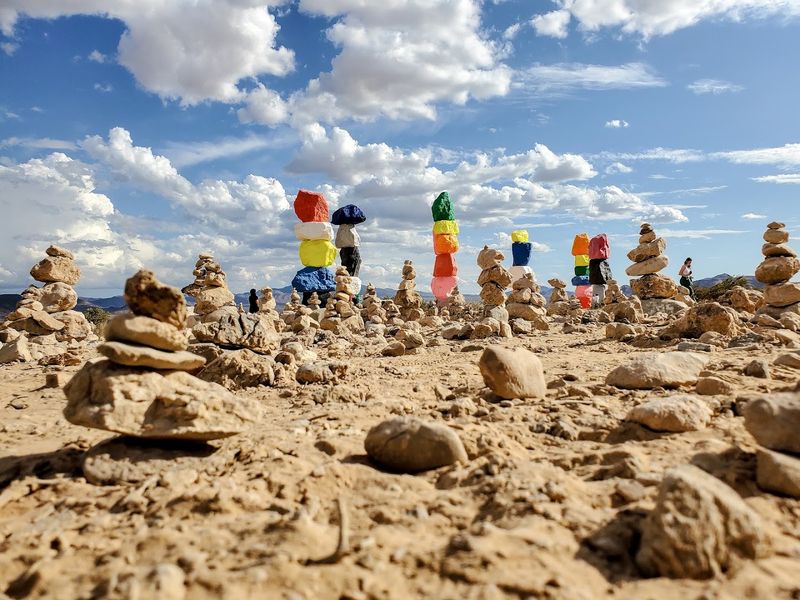
Art that just looks pretty is fine. Art that makes you think is something else entirely.
Seven Magic Mountains was built with layers of meaning woven into its design. The most central idea is the dialogue between the natural and the artificial.
The raw limestone boulders come from the earth itself, yet they are painted in colors that nature never produces.
The Ivanpah Valley location was chosen deliberately. It sits at a symbolic midpoint between the wild Mojave Desert and the hyper-constructed world of Las Vegas, Nevada.
The artwork essentially asks: where does nature end and human invention begin? That question feels especially sharp when you are standing between ancient mountain ranges and a neon art tower.
The cairn reference adds another layer. Historically, cairns were stacked by travelers to mark routes and signal safe passage.
These fluorescent versions do the same, in a sense. They mark a contemporary passage through the American Southwest, inviting modern travelers to pause and consider their place in the landscape.
Heavy thoughts, colorful delivery.
How It Went From Temporary To Timeless
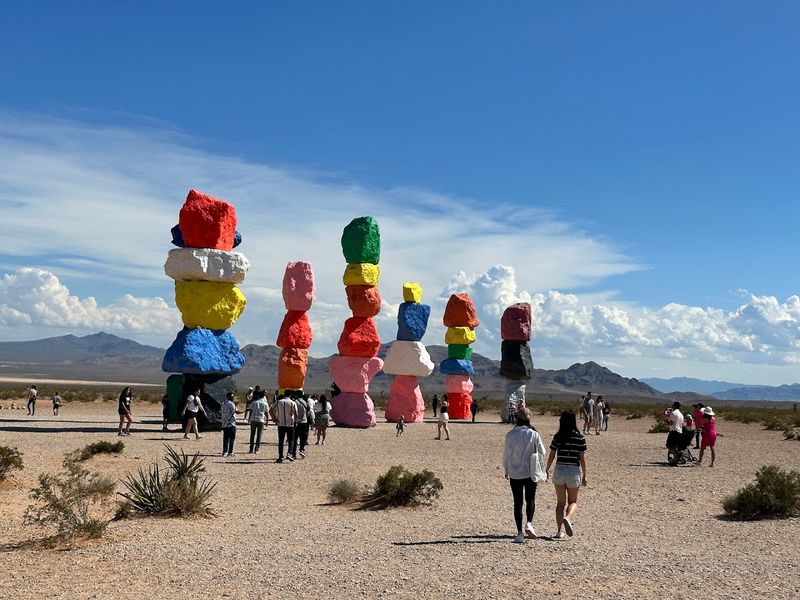
Here is a fun fact about this installation: it was never supposed to last this long. When Seven Magic Mountains opened on May 11, 2016, the plan was for it to stay up for just two years.
Two years turned into an extended run, and then another extension, and then another.
The overwhelming public response made it impossible to take down. Visitors from around the world began making special trips just to see it.
The installation became a cultural landmark almost overnight. As of now, it is scheduled to remain accessible through at least May 2027, though nothing is guaranteed.
This extended lifespan has given the artwork something temporary pieces rarely achieve: a sense of permanence in the public imagination. People plan road trips around it.
Families return for second and third visits. The Nevada desert has a way of making things feel ancient, even when they are modern.
Seven Magic Mountains has earned its place in that tradition, one fluorescent boulder at a time.
Best Times To Visit For Maximum Impact
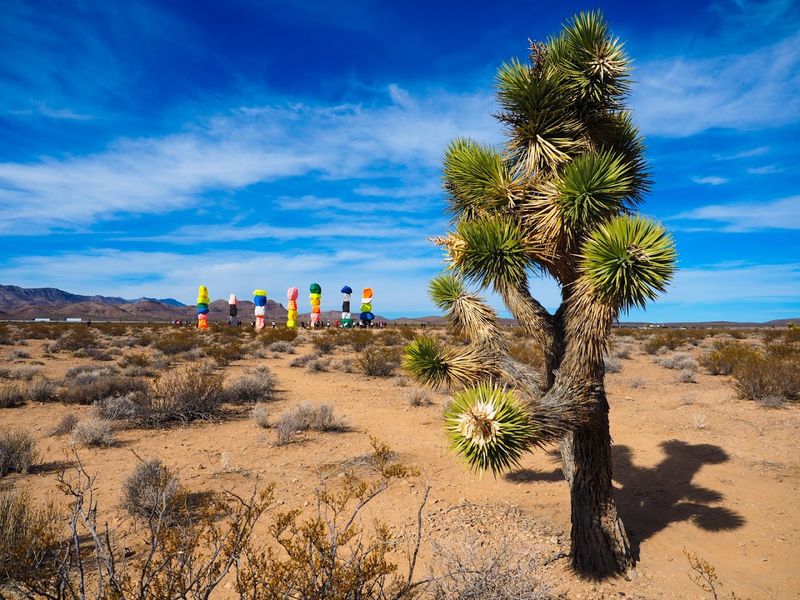
Timing a visit to Seven Magic Mountains can completely change the experience. Early morning is widely considered the sweet spot.
The soft, angled light of sunrise wraps around the boulders and pulls out every shade of neon in a way that midday sun simply cannot match. Crowds are also thinner, which means more space and better photos.
Late afternoon runs a close second. As the sun drops toward the Spring Mountains, the light turns golden and the Day-Glo colors seem to intensify.
Shadows stretch dramatically across the desert floor, adding depth and texture to the scene. Many photographers camp out during these windows specifically.
Midday visits are still worthwhile, but the heat can be brutal, especially during summer months in Nevada. Temperatures regularly climb well above 100 degrees Fahrenheit in peak summer.
Spring and fall offer more forgiving conditions. Winter visits can be surprisingly pleasant, though wind is common.
Whatever season you choose, bring water, sunscreen, and a wide-brimmed hat. The desert does not negotiate.
Getting There and Finding Your Footing
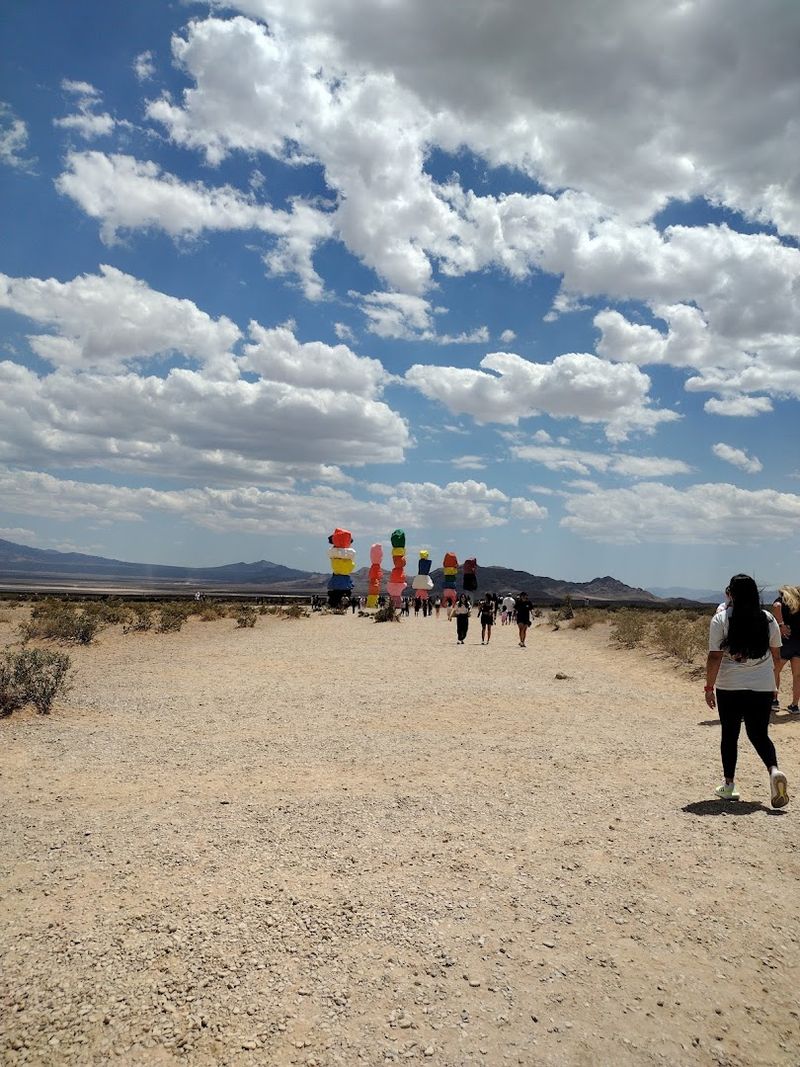
Getting to Seven Magic Mountains is straightforward, even if the location feels remote. The installation sits along South Las Vegas Boulevard, roughly 25 minutes south of the Las Vegas Strip via Interstate 15.
Most visitors coming from Las Vegas take Exit 25 toward Sloan Road, then head south on South Las Vegas Boulevard for about seven miles to reach the gravel parking lot. Those arriving from California take Exit 12 near Jean instead and head north for about five miles.
The parking area is large and unpaved, accommodating plenty of vehicles at no cost. From the lot, a short walk across flat desert terrain brings you directly to the base of the sculptures.
The path is unpaved, so comfortable closed-toe shoes are strongly recommended. Sandals and flip-flops are a poor match for gravel and desert rock.
One important heads-up: there are no restroom facilities at the site. The nearest public restrooms are approximately five miles south in the town of Jean, or about ten miles north near the intersection of St. Rose Parkway and Las Vegas Boulevard.
Plan accordingly, especially if traveling with kids or on a long road trip.
Photography Tips That Actually Help
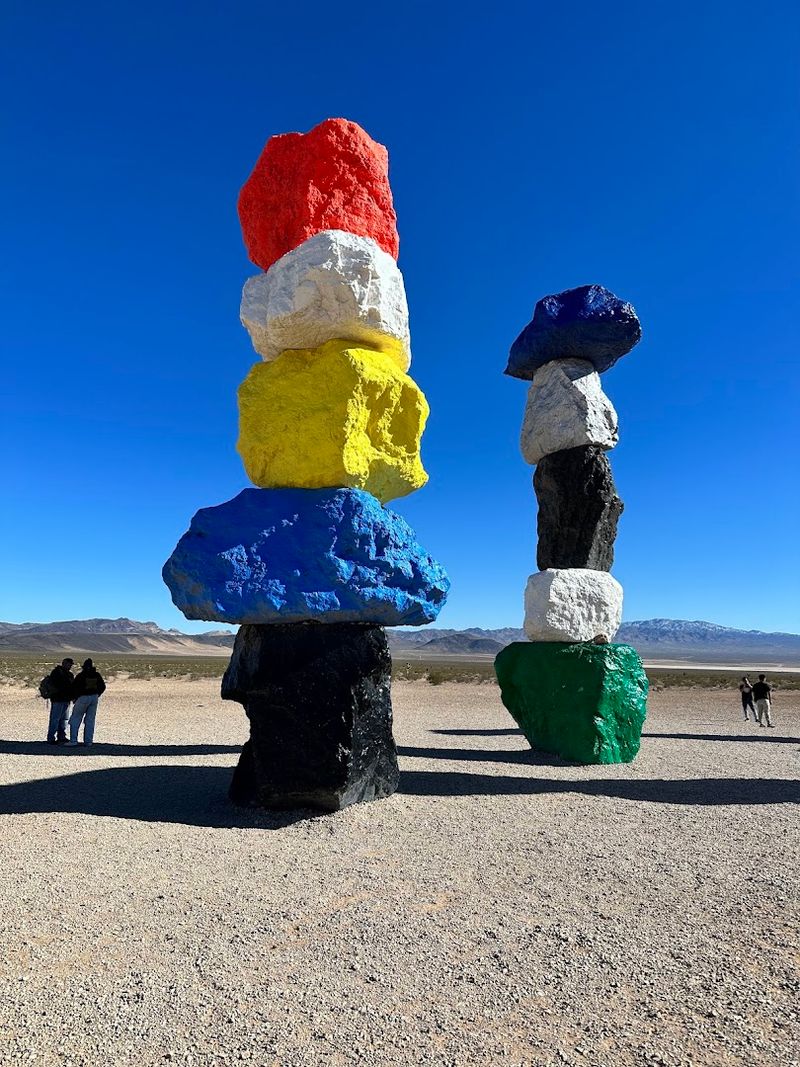
Seven Magic Mountains is one of the most photogenic outdoor art installations in the entire American Southwest. Getting great shots, though, takes a little strategy.
Walking the full perimeter of the installation before shooting is a smart first move. Each tower looks completely different depending on your angle and distance.
Wide shots work brilliantly for capturing all seven towers together with the desert and mountain backdrop. Tighter shots of individual stacks reveal texture, color variation, and the sheer mass of each boulder.
Including a person in the frame for scale is a classic move that never fails to communicate just how massive the towers really are.
The flat desert terrain can make judging distance tricky in photos. Moving closer than feels comfortable often produces the most dramatic results.
For those with drone equipment, the aerial perspective over the Mojave is reportedly stunning, though always check current local regulations before flying. Morning and late afternoon light remain the gold standard for color accuracy and shadow depth.
Every visit produces something different.
Visiting Responsibly and Leaving It Better Than You Found It
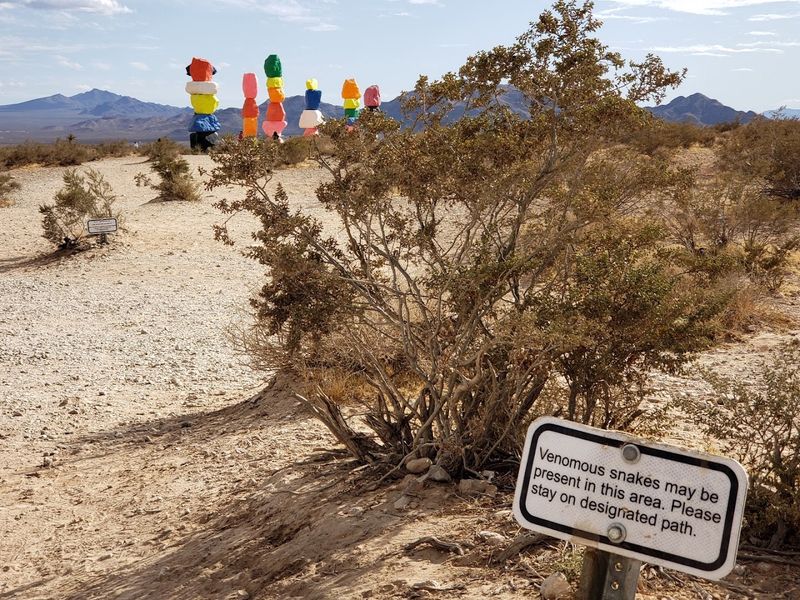
This is public land managed in partnership with the Bureau of Land Management, which means every visitor shares responsibility for keeping it intact. The rules are simple but important.
Stay on designated paths to protect fragile desert vegetation and the various animals that call this landscape home.
The Mojave Desert is home to protected species, including the endangered desert tortoise. Disturbing or approaching wildlife is strictly prohibited and carries legal consequences.
Climbing on the sculptures is not allowed, both for visitor safety and to protect the artwork itself. The boulders may look sturdy, but the installation is not a jungle gym.
Practicing Leave No Trace principles is non-negotiable here. Pack out everything you bring in, including food wrappers, bottles, and any other waste.
The desert has no maintenance crew waiting to clean up after visitors. What you leave behind stays behind, affecting the experience for everyone who comes after you.
The installation has remained free and publicly accessible because visitors largely respect it. Keep that streak going.